HIGH PERFORMANCE CONCRETE USING RICE HUSK ASH

Page 1

International Research Journal of Engineering and Technology (IRJET)

e-ISSN: 2395-0056

Volume: 09 Issue: 07 | July 2022

p-ISSN: 2395-0072

www.irjet.net

HIGH PERFORMANCE CONCRETE USING RICE HUSK ASH Vishal M. Rathod1, Dr.D.H.Tupe2 1PG

student, Dept. of civil engineering, deogiri Institute of Engineering & Management studies ,Aurangabad Maharastra , India 2Professor, Dept. of civil engineering, deogiri Institute of Engineering & Management studies ,Aurangabad Maharastra , India ---------------------------------------------------------------------***--------------------------------------------------------------------It broadens the scope of cement's utility. Abstract - When it comes to determining the structural strength of a structure, strong material is critical. The fact that India is a growing country with a Mega structure and ranks among the world's strongest nations. For a study form, the material strength must be sufficient.

RHA concrete becomes more hard and plastic as a result of its expansion. The mass thickness of RHA content decreases as RHA content increases.

What if the concrete used has a high level of power and we can shop the material and make environmentally friendly? That is a better way to think about making the structure eco-friendly and reducing the amount of material used. The major purpose of the project is to use High Performance Concrete to accelerate infrastructure improvement. One of the main benefits of the project is that we may use waste material created at some point during the farming process to improve material power and use it in the construction section of giant constructions.

The use of RHA as a method of solidification reduces consumption and increases considerable strength.

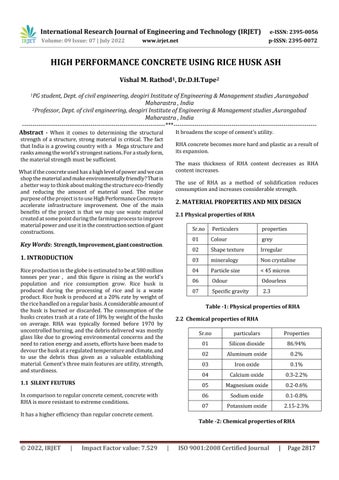
2. MATERIAL PROPERTIES AND MIX DESIGN 2.1 Physical properties of RHA

Key Words: Strength, Improvement, giant construction. 1. INTRODUCTION Rice production in the globe is estimated to be at 580 million tonnes per year , and this figure is rising as the world's population and rice consumption grow. Rice husk is produced during the processing of rice and is a waste product. Rice husk is produced at a 20% rate by weight of the rice handled on a regular basis. A considerable amount of the husk is burned or discarded. The consumption of the husks creates trash at a rate of 18% by weight of the husks on average. RHA was typically formed before 1970 by uncontrolled burning, and the debris delivered was mostly glass like due to growing environmental concerns and the need to ration energy and assets, efforts have been made to devour the husk at a regulated temperature and climate, and to use the debris thus given as a valuable establishing material. Cement's three main features are utility, strength, and sturdiness.

Sr.no

Perticulers

properties

01

Colour

grey

02

Shape texture

Irregular

03

mineralogy

Non crystaline

04

Particle size

< 45 micron

06

Odour

Odourless

07

Specific gravity

2.3

Table -1: Physical properties of RHA 2.2 Chemical properties of RHA Sr.no

particulars

Properties

01

Silicon dioxide

86.94%

02

Aluminum oxide

0.2%

03

Iron oxide

0.1%

04

Calcium oxide

0.3-2.2%

1.1 SILENT FEUTURS

05

Magnesium oxide

0.2-0.6%

In comparison to regular concrete cement, concrete with RHA is more resistant to extreme conditions.

06

Sodium oxide

0.1-0.8%

07

Potassium oxide

2.15-2.3%

It has a higher efficiency than regular concrete cement. Table -2: Chemical properties of RHA

© 2022, IRJET

|

Impact Factor value: 7.529

|

ISO 9001:2008 Certified Journal

|

Page 2817


Turn static files into dynamic content formats.
Create a flipbook