International Research Journal of Engineering and Technology (IRJET)
e-ISSN: 2395-0056
Volume: 09 Issue: 07 | July 2022
p-ISSN: 2395-0072
www.irjet.net
EXPERIMENTAL STUDY ON CONCRETE BY PARTIAL REPLACMENT OF CEMENT AND FINE AGGREGATE WITH BAGASSE ASH AND MARBLE POWDER SIDDARTH B H 1, SRINIDHI P 2,PADMASHREE M J 3, BHOOMIKA B P 4, RANJAN H R 5 1Assistant
Professor, Department of Civil Engineering, C I T, Gubbi, Karnataka, India P, Student, Department of Civil Engineering, C I T, Gubbi, Karnataka, India 3Padmashree M J, Student, Department of Civil Engineering, C I T, Gubbi, Karnataka, India 4Bhoomika B P, Student, Department of Civil Engineering, C I , Gubbi, Karnataka, India 5Ranjan H R, Student, Department of Civil Engineering, C I T, Gubbi, Karnataka, India ---------------------------------------------------------------------***--------------------------------------------------------------------and 1100 marble processing plants. Six million metric tons Abstract - The rapid growth of the construction sectors 2 Srinidhi
leads to high demand for construction material. Due to which there is increase in concrete demand which may leads to shortage of natural resource, which leads to the world to look for material that can be effectively used in construction without affecting the environment. The use of agro industrial waste as construction material will support in either way of waste handling and environmental conservation. Sugarcane Bagasse Ash (SCBA) is a byproduct of sugar and alcohol factories mainly composed of silica. Similarly, the Marble Powder waste produced by marble factories during cutting of the marble stone whose disposal may effect the environment as per Abdul Ghani et al. The study focuses on the performance of bagasse ash and marble powder in concrete.
of marble slurry is disposed per annum (Singh et al. 2017). Due to the demand for marble building products, the quarrying and production of marble stone are increased. Therefore, the disposal of marble waste has also increased to a greater extent and become problematic due to the restriction from environmental authorities. Better mechanical properties have been reported for selfcompacting concrete with marble waste compared concrete with rivers sand. Marble waste was used as a partial replacement of fine aggregate
Key Words: Concrete, Bagasse Ash(BA), Marble Powde
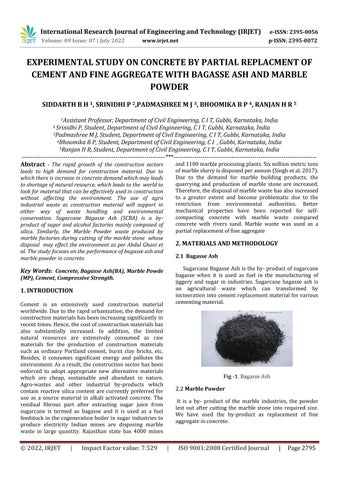
Sugarcane Bagasse Ash is the by- product of sugarcane bagasse when it is used as fuel in the manufacturing of jiggery and sugar in industries. Sugarcane bagasse ash is an agricultural waste which can transformed by incineration into cement replacement material for various cementing material.
2. MATERIALS AND METHODOLOGY 2.1 Bagasse Ash
(MP), Cement, Compressive Strength.
1. INTRODUCTION Cement is an extensively used construction material worldwide. Due to the rapid urbanization, the demand for construction materials has been increasing significantly in recent times. Hence, the cost of construction materials has also substantially increased. In addition, the limited natural resources are extensively consumed as raw materials for the production of construction materials such as ordinary Portland cement, burnt clay bricks, etc. Besides, it consumes significant energy and pollutes the environment. As a result, the construction sector has been enforced to adopt appropriate new alternative materials which are cheap, sustainable and abundant in nature. Agro-wastes and other industrial by-products which contain reactive silica content are currently preferred for use as a source material in alkali activated concrete. The residual fibrous part after extracting sugar juice from sugarcane is termed as bagasse and it is used as a fuel feedstock in the cogeneration boiler in sugar industries to produce electricity Indian mines are disposing marble waste in large quantity. Rajasthan state has 4000 mines
© 2022, IRJET
|
Impact Factor value: 7.529
Fig -1. Bagasse Ash 2.2 Marble Powder It is a by- product of the marble industries, the powder lest out after cutting the marble stone into required size. We have used the by-product as replacement of fine aggregate in concrete.
|
ISO 9001:2008 Certified Journal
|
Page 2795