International Research Journal of Engineering and Technology (IRJET)
e-ISSN: 2395-0056
Volume: 09 Issue: 07 | July 2022
p-ISSN: 2395-0072
www.irjet.net
Analysis of performance of various skew angles of deck slab bridges in MIDAS Software Gayatri Deshmukh, Prof. Pandurang S. Patil PG Student (MTech in Structural Engineering), Rajarambapu Institute of Technology, Uran Islampur, Maharashtra, India Associate Professor, Dept. of Civil Engineering, Rajarambapu Institute of Technology, Maharashtra, India ---------------------------------------------------------------------***--------------------------------------------------------------------1.1 Skew Bridge Abstract - In this modern age, many highway bridges are curved and need to facilitate their behavior and corresponding analysis in order to fully achieve their design goals. This project deals with the behavior of skew deck slab bridges with different tilt angles of 0°,20°,40°,60° and 65°. In this project, MIDAS structural analysis software was used to conduct a detailed analysis in wood armer moment with different skew angles, and the analysis complies with the provisions of Indian Codes IRC 6: 2014.
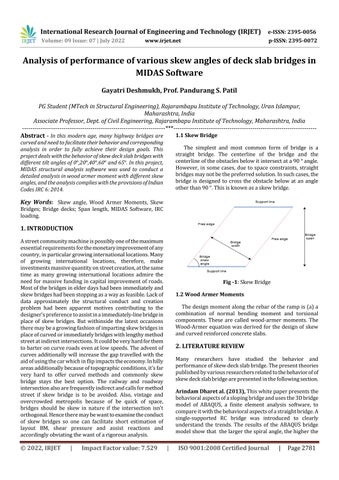
The simplest and most common form of bridge is a straight bridge. The centerline of the bridge and the centerline of the obstacles below it intersect at a 90 ° angle. However, in some cases, due to space constraints, straight bridges may not be the preferred solution. In such cases, the bridge is designed to cross the obstacle below at an angle other than 90 °. This is known as a skew bridge.
Key Words: Skew angle, Wood Armer Moments, Skew Bridges; Bridge decks; Span length, MIDAS Software, IRC loading.
1. INTRODUCTION A street community machine is possibly one of the maximum essential requirements for the monetary improvement of any country, in particular growing international locations. Many of growing international locations, therefore, make investments massive quantity on street creation, at the same time as many growing international locations admire the need for massive funding in capital improvement of roads. Most of the bridges in elder days had been immediately and skew bridges had been stopping as a way as feasible. Lack of data approximately the structural conduct and creation problem had been apparent motives contributing to the designer’s preference to assist in a immediately-line bridge in place of skew bridges. But withinside the latest occasions there may be a growing fashion of imparting skew bridges in place of curved or immediately bridges with lengthy method street at indirect intersections. It could be very hard for them to barter on curve roads even at low speeds. The advent of curves additionally will increase the gap travelled with the aid of using the car which in flip impacts the economy. In hilly areas additionally because of topographic conditions, it's far very hard to offer curved methods and commonly skew bridge stays the best option. The railway and roadway intersection also are frequently indirect and calls for method street if skew bridge is to be avoided. Also, vintage and overcrowded metropolis because of be quick of space, bridges should be skew in nature if the intersection isn't orthogonal. Hence there may be want to examine the conduct of skew bridges so one can facilitate short estimation of layout BM, shear pressure and assist reactions and accordingly obviating the want of a rigorous analysis.
© 2022, IRJET
|
Impact Factor value: 7.529
Fig -1: Skew Bridge 1.2 Wood Armer Moments The design moment along the rebar of the ramp is (a) a combination of normal bending moment and torsional components. These are called wood-armer moments. The Wood-Armer equation was derived for the design of skew and curved reinforced concrete slabs.
2. LITERATURE REVIEW Many researchers have studied the behavior and performance of skew deck slab bridge. The present theories published by various researchers related to the behavior of of skew deck slab bridge are presented in the following section. Arindam Dharet al. (2013), This white paper presents the behavioral aspects of a sloping bridge and uses the 3D bridge model of ABAQUS, a finite element analysis software, to compare it with the behavioral aspects of a straight bridge. A single-supported RC bridge was introduced to clearly understand the trends. The results of the ABAQUS bridge model show that the larger the spiral angle, the higher the
|
ISO 9001:2008 Certified Journal
|
Page 2781