International Research Journal of Engineering and Technology (IRJET) e ISSN: 2395 0056

Volume: 09 Issue: 07 | July 2022 www.irjet.net p ISSN: 2395 0072
International Research Journal of Engineering and Technology (IRJET) e ISSN: 2395 0056
Volume: 09 Issue: 07 | July 2022 www.irjet.net p ISSN: 2395 0072
Adesh Patil1 , Ashwini P2 , Athira Pillai3
1BE Student, Department of Civil Engineering, Pillai HOC College of Engineering and Technology, Maharashtra
2Assistant Professor, Department of Civil Engineering, Pillai HOC College of Engineering and Technology, Maharashtra
3Lecturer, Department of Mechanical Engineering, Pillai HOC College of Engineering and Technology (Diploma Section), Maharashtra ***
Abstract Concrete is one of the most important elements used by the construction industry throughout the world. Inflation has been seen in the case of natural sand due to its rapidly increasing demand. In such a scenario waste marble sand would be economical as compared to river sand. And thus, we can tackle one of the environmental problems worldwide today which is the disposal of the waste marble sandor powder material from the marble industry.Thispaper puts forward the study conducted to understand and explore the suitability of using industrial and quarrying waste marble sand (dust) in concrete as a replacement for fine aggregates. In this paper, we have replaced fine aggregates in concrete with waste marble sand of size 1 2mm (marble fine aggregates) in an M20 mix design as per IS CODE 10262. As waste marble is a low cost product and it resembles cementitious properties, the strength of concrete is also increased than conventional concrete. It is cheap economical andeco friendly material for the replacement of natural sand and fine aggregate
Key Words: Waste Marble sand, Compressive Strength, Concrete, Ecofriendly.
The term "conventional concrete" refers to the ordinary concrete that weutilize on a daily basis in India. Concrete constitutes are cement, coarse aggregate, fine aggregates, water,andsometimesanadditiveintheproperquantities. Hydraulic(Portland)cement,sand,stone,andwatermakeup traditionalconcrete.Itwasinventednearly150yearsagoas asubstitutematerialtonaturalstonewhileallowingforless labor exhaustiveshapingtechniques.Astonemadeofcalcite, dolomite, or serpentine that can be polished is known as construction marble. Marble is a term used in the constructionindustrytorefertoanycrystallinecalcificrock thatcanbeutilizedasabuildingstone.Sinceancienttimes marblehasbeenwidelyusedasabuildingmaterial[8].Asa result,marblesandhasbeentheby productthatisacritical substance,henceitrequirescarefulenvironmentaldisposal. In addition to this, improper waste recycling can lead to environmentalconcernsthatareworsethanthewasteitself. Themarblemanufacturingprocessleadstotheprocurement ofmarblesandordustwhichisitsbyproduct.Anenormous amountofmarblewasteisgeneratedasaresultofthecutting
process.Asaresult,approximatelyone fourthoftheoriginal marble mass is retained in the form of sand dust. Adverse effects of discharging these waste materials into the environmentwouldleadtoenvironmentalproblemssuchas increasedhumanhealtheffects,soilalkalinity,andsoon.Asa result,Marblesandcanbeconsideredasareplacementfor sand(fineaggregates)inconcreteresultingtoanincreasein strength of the concrete. Some of the environmental and ecologicalissuescanbereducedifweutilizesuchdebristo makecheaperandmorelastingconcrete.
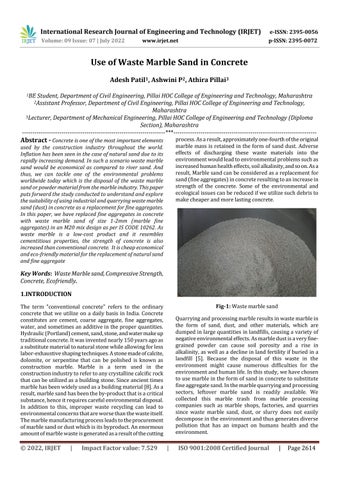
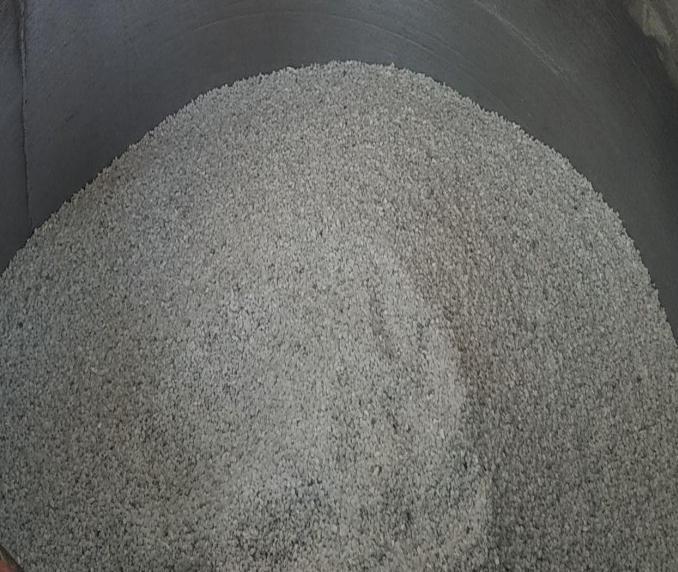
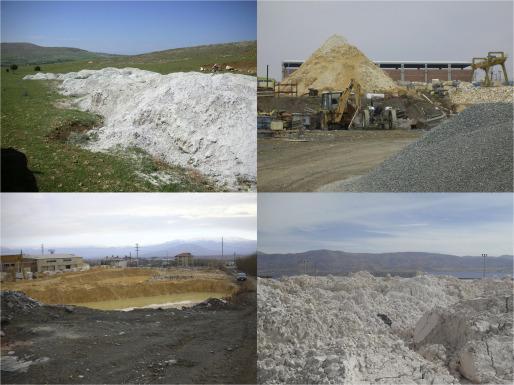
Quarryingandprocessingmarbleresultsinwastemarblein the form of sand, dust, and other materials, which are dumpedinlargequantitiesinlandfills,causingavarietyof negativeenvironmentaleffects.Asmarbledustisaveryfine grained powder can cause soil porosity and a rise in alkalinity,aswellasadeclineinlandfertilityifburied ina landfill [5]. Because the disposal of this waste in the environment might cause numerous difficulties for the environmentandhumanlife.Inthisstudy,wehavechosen tousemarbleintheformofsandinconcretetosubstitute fineaggregatesand.Inthemarblequarryingandprocessing sectors, leftover marble sand is readily available. We collected this marble trash from marble processing companies such as marble shops, factories, and quarries since waste marble sand, dust, or slurry does not easily decomposeintheenvironmentandthusgeneratesdiverse pollution that has an impact on humans health and the environment.
.
International Research Journal of Engineering and Technology (IRJET) e ISSN: 2395 0056
Volume: 09 Issue: 07 | July 2022 www.irjet.net p ISSN: 2395 0072
To find an alternative for natural sand with full replacementofWasteMarbleSandinconcrete.
Concretewithawater cementratio(W/CRatio)of0.45is used. The cement used in this study is Ordinary Portland Cement (OPC) of 53 grade [4]. The substitution of Waste Marble Sand (WMS) will be 100% of the weight of fine aggregate.Toattainenoughworkability,therelativeratioof coarse aggregate and sand turned was determined with respecttostandardweightconcrete.
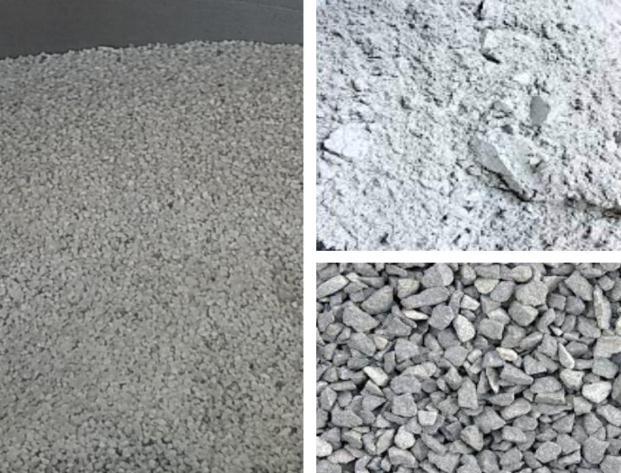
Fig 2:Effectofmarblewasteontheenvironment
AbdulGhaniet.al(2020)experimentedbysubstitutingsand (0 80% of sand replaced with Waste Marble Powder at incrementsof20%)inconcretewithwastemarblepowderin concreteproduction.Throughthisexperiment,itwasfound thatthemechanicalpropertiesofconcreteincreaseuptoa certain percentage of replacement, and on further replacementitdecreases.Theworkabilityandunitweightof concrete decrease proportionally to the replacement percentage. With the increase in Waste Marble Powder percentage,thereisadecreaseinpermeability.
Begashaw Worku Yifru et.al (2020) experimented normal strength concrete by partially replacing sand with marble wasteandscoria.Marble:scoriaratiosusedwere2:1,1:1, and1:2.Furtherthecombinedfractionofbothmarblewaste and scoria in concrete was increased from 33 to 67 and 100%.Itwasfoundthatconcretecontainingmarblewaste andscoriaasasandreplacementshowsbettercompressive strength than conventional concrete whereas the workability and compressive strength decrease with an increaseinthecontentofmarblewasteandscoria.
Nadhir Toubal Seghir et.al (2019) experimented the utilization of marble dust powder in concrete wherein a water cement ratio of 0.50 kept constant was used in all mixes.Marbledustatvariouspercentage(0%,15%,25%& 35%)withsubstitutionbysandwasmadeinM15grade.The effectsofthelaboratorytestsexhibitedthatbothresistance tocompressiveloadandtensileenergyofconcreteincreased uptotwenty fivepercentbythesubstituteofcementwith marbledustpowder.
To find out the compressive strength of concrete usingWasteMarbleSand.
Fig-3:Materialsusedforconcrete
OrdinaryPortlandcementusedfulfillstherequirementsof Bureau ofIndianStandards, BIS8112 1989.Initial setting time,finalsettingtime,standardconsistency,compressive strengthandSpecificgravityaregivenintable1.
Table 1:PhysicalPropertiesofCementOPCgrade53
Initialsettingtime 30min
Finalsettingtime 600min
Compressivestrength 53MPa
Standardconsistency 33% Specificgravity 3.13
Thecoarseaggregateusedinthisinvestigationwassourced through a local quarry. Table 2 shows the specific gravity and water absorption of coarse aggregate. The aggregate usedwas20mminsize,andthechemicalcompositionofthe coarseaggregateisshownintable3.
International Research Journal of Engineering and Technology (IRJET) e ISSN: 2395 0056
Table 2:Physicalpropertiesofaggregate
TypeofAggregate Specific gravity Waterabsorption %byweight
Coarseaggregate 2.60 0.55
Wastemarble sand 2.70 0.05
Table 3: Chemicalcompositionofwastemarbleand coarseaggregate[06].
Chemical Component Percentageof marblewaste Percentageof coarseaggregate
LOI 45.07 5.08 SiO2 3.75 53.70
CAO 33.12 4.83 MGO 17.91 2.01 Fe2O3 0.13 10.66
Al2O3 Traces Nil
Themarbleutilisedinthisinvestigationwassourcedfroma nearby manufacturing facility. Table 2 shows the specific gravity and water absorption of marble waste. Table 2 depicts the chemical composition of marble trash. The investigationemployedfineaggregatewithamaximumsize of425microns.
TheM20concretemixdesign,asdefinedbyIS10262 2009, istakenintoaccount.Marbleaggregatewasusedinplaceof fineaggregateinconcrete.Table4showstheproportionsof concreteinacombination.Ina160lmixer,allconcretemixes had been mixed for five minutes prior to adding water to achievearadicalhomogenousmix.
Table-4: MixDesignasperIS(10262 2009)M20Grade
Material
Qty /mᶟ (in kg/m3)
Cement 413 MarbleSand 722
CoarseAggregate 1135 Water 119 W/Cratio 0.45
To evaluate the compressive strength, a 150mm concrete cube was cast in a typical 150mm square mould. The materialwasweighed,batchedinaccordancewiththemix design as specified by the IS code. A specimen of 150mm cubeswascast.Themouldswerefilledinthreelayers,with eachlayercompactedbyavibratingtable,asperBIS516 1959 technique [7]. After casting, all specimens were demoulded and cured in water for 24 hours. The compressivestrengthtestwascarriedoutafter7days,14 days,and28days.
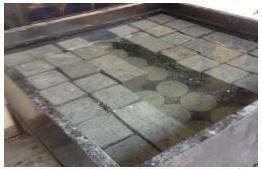
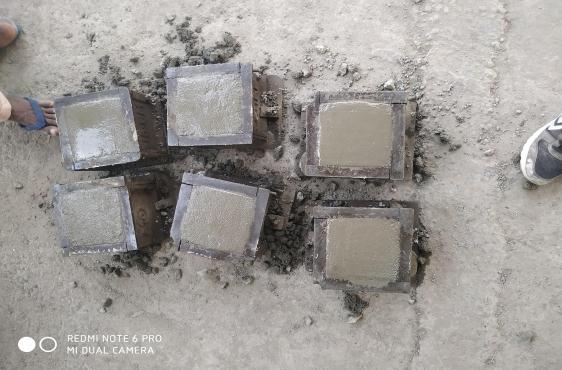
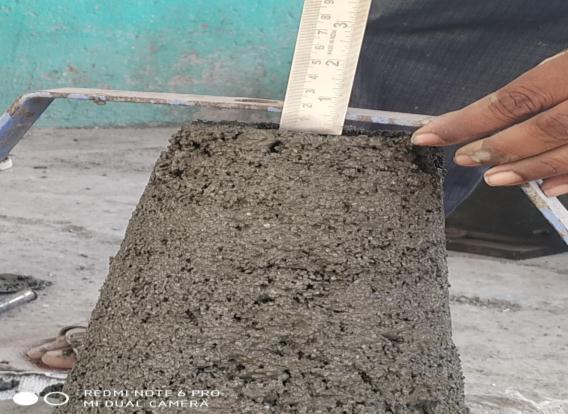
TheslumpconetestwasdoneasperISCODE1199:(1959) to study the consistency of concrete with standard apparatus.
AsperBIS516 59,Compressivestrengthfor7days,14days and 28 days was determined for concrete specimens. The capacityofdigitalcompressiontestingmachineusedwasof 1000kN
Volume: 09 Issue: 07 | July 2022 www.irjet.net p ISSN: 2395 0072 © 2022, IRJET | Impact Factor value: 7.529 | ISO 9001:2008 Certified Journal
International Research Journal of Engineering and Technology (IRJET) e ISSN: 2395 0056 Volume: 09 Issue: 07 | July 2022 www.irjet.net p ISSN: 2395 0072
5.1
Test Fromtheslumpconetest,trueslumpmeasuredwas10mm.
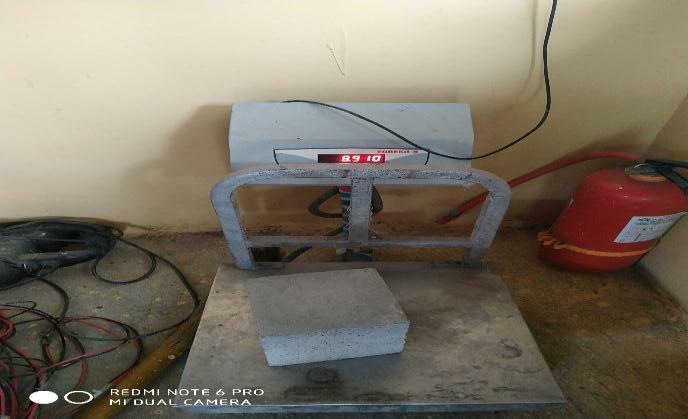
Theweightofobtainedconcreteblockwasweighedandwas about 8.91 kg after 28 days curing. The weight of conventional concreteblock isabout8.5kgwithsamemix after28dayscuring Fig 8:Weightofwastemarblesandconcreteblock
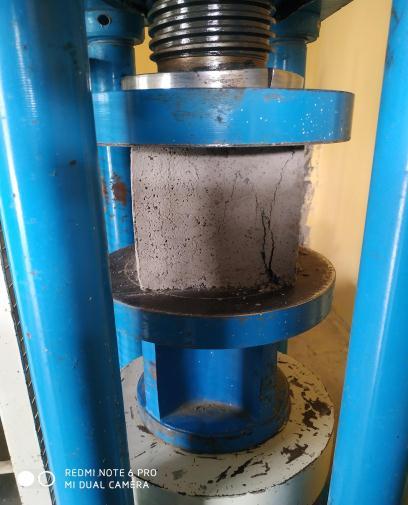
Experimentationledtothefollowingconclusions
Theworkabilityofconcretemixincreasesaccording totheamountoffineaggregatebeingreplacedby marble waste sand and the compressive strength also increases until 100 percent of waste marble sandisaddedasfineaggregate.
High strengthconcretecomponentssuchaspaver blocks,railwaysleepers,stiffpavement,andsoon can be produced as the weight of concrete is 5% morethanconventionalconcrete.
In Rajasthan and other parts of India, large volumes of marble refuse are available. This trash can be used in the productionofconcretemixtures,whichisbothcost effective andenvironmentallyfriendly.
[1]AbdulGhani,ZeeshanAli,FasihAhmedKhan,SaidRehan Shah, Sajjad Wali Khan, Muhammad Rashi.“Experimental study on the behavior of waste marble powder as partial replacementofsandinconcrete” SNAppliedSciences.2020
[2]Yifru,B.W.,Mitikie,B.B“Partialreplacementofsandwith marble waste and scoria for normal strength concrete production”SNAppl.Sci.2,1938(2020).
[3] Nadhir Toubal Seghir, Mekki Mellas, Lukasz Sadowski, AleksandraKrolicka,AndrzejZak,KrzysztofOstrowski“The UtilizationofWasteMarbleDustasaCementReplacementin Air CuredMortar”Sustainability2019.
[4] G V Vigneshpandianet al2017IOP Conf. Ser.: Earth Environ.Sci.80012007.
[5] Deepankar Kumar Ashish “Feasibility of waste marble powder in concrete as partial substitution of cement and sandamalgamforsustainablegrowth” Journal ofBuilding Engineering.2018;15(236 242).
[6]Kore,SudarshanD.Vyas,A.K“ImpactofMarbleWasteas Coarse Aggregate on properties of lean cement concrete” CaseStudiesinConstructionMaterials2016.
International Research Journal of Engineering and Technology (IRJET) e ISSN: 2395 0056 Volume: 09 Issue: 07 | July 2022 www.irjet.net p ISSN: 2395 0072 © 2022, IRJET | Impact Factor value: 7.529 | ISO 9001:2008 Certified Journal