International Research Journal of Engineering and Technology (IRJET) Volume: 09 Issue: 07 | July 2022 www.irjet.net
e-ISSN: 2395-0056 p-ISSN: 2395-0072
Sensor Fault Detection in IoT System Using Machine Learning Mahadev Lot1, Sachin Belekar2, Pranay Redekar3, Prof. Sejal Shah4 1,2,3 Students,
Department of Electronics Engineering, KJSIEIT, Mumbai, India Department of Electronics Engineering, KJSIEIT, Mumbai, India -------------------------------------------------------------------------***-----------------------------------------------------------------------i.e., physical-based or mathematical. These approaches were Abstract—From good industries to good cities, sensors 4 Professor,
restricted to specific environments and conditions. it’s tough to see variant model parameters thanks to system
within the present plays a vital role by covering an oversized range of applications. However, sensors get faulty typically resulting in serious outcomes in terms of safety, economic price and dependability. This paper presents associate analysis and comparison of the performances achieved by machine learning techniques for real- time drift fault detection in sensors employing a low-computational installation, i.e., ESP8266. The machine learning algorithms underneath observation embrace artificial neural network, support vector machine, na¨ıve mathematician classifier, knearest neighbors and call tree classifier. the info was noninheritable for this analysis from digital relative temperature/humidity detector (DHT22). Drift fault was injected within the traditional information exploitation Arduino Uno microcontroller. The applied math timedomain options were extracted from traditional and faulty signals and pooled along in coaching information. Trained models were tested in a web manner, wherever the models were wont to sight drift fault within the detector output in period. The performance of algorithms was compared exploitation exactness, recall, f1-score, and total accuracy parameters. The results show that support vector machine (SVM) and artificial neural network (ANN) outmatch among the given classifiers.
complexities. to beat these limitations, data-driven approaches victimization machine learning techniques are projected, that analyses information to develop the simplest models. The models essentially use historical information to seek out hidden patterns and determine expected outcomes. As fashionable systems have become complicated, previous approaches have become tough to implement. On the opposite hand, the information-driven models are often developed to adequately approximate real systems supported the collected data. The fault happens in actuators, sensors or the other mechanical systems. within the past, algorithms for fault detection in rolling components of machines are explored in an exceedingly large range of studies news economical results. However, sensors conjointly fault oftentimes resulting in serious consequences in terms of safety and operation. Therefore, sensing element fault detection is extremely vital to make sure the security and responsibleness of systems. many studies with time have mentioned variety of faults, which might presumably occur in sensors. However, in the present study the most occurred sensor fault is focused, i.e., drift fault, which can be defined as follows:
I. INTRODUCTION
A. Drift Fault
Modern technologies like Industrial systems or wireless sensing element networks (WSNs) typically comprises many sensors which will be deployed in comparatively harsh and complicated environments. Natural factors, magnetism interference, and lots of different factors will have an effect on the performance of the sensors. once the sensing element becomes faulty, it’s going to utterly stop generating signals or turn out incorrect signals. It are often jumping between traditional and faulty state unstably. to enhance safety, information quality, shorten reaction time, strengthen network security and prolong network time period, several studies have targeted on sensing element fault detection. A fault are often expressed as associate uncommon property or behavior of a system or machine. Studies are disbursed chiefly since the Eighties for the detection and identification of defects in industrial facilities,
© 2022, IRJET
|
Impact Factor value: 7.529
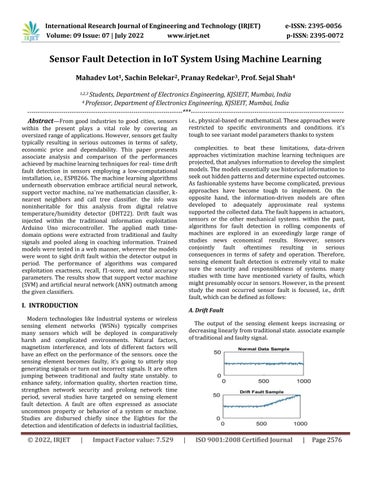
The output of the sensing element keeps increasing or decreasing linearly from traditional state. associate example of traditional and faulty signal.
|
ISO 9001:2008 Certified Journal
|
Page 2576