International Research Journal of Engineering and Technology (IRJET)
e-ISSN: 2395-0056
Volume: 09 Issue: 07 | July 2022
p-ISSN: 2395-0072
www.irjet.net
GIS BASED LANDSLIDE MAPPING: A CASE STUDY OF MAHABALESHWAR REGION OF SATARA DISTRICT Abhishek A. Wadate 1, Amarsinh B. Landage2 M. Tech Scholar, Construction Management, Government College of Engineering Karad, Maharashtra – 415124, India 2 Assistant Professor, Department of Civil Engineering, Government College of Engineering Karad, Maharashtra – 415124, India ---------------------------------------------------------------------***--------------------------------------------------------------------the Mahabaleshwar study area, few of these studies were Abstract - Landslides are a massive natural and man-made 1
fully integrated to determine the integrated strategy. The primary objective of this work is to use GIS, to analyse aerial photos and satellite photos, which is beneficial for locating landslide hazard zones on a wide scale. The usefulness of the satellites for landslide hazard zonation and studies of changes in land use and land cover is another major focus of the project.
calamity that destroys natural capital and human assets all over the world. Landslides brought on by steep slopes and mountainous terrain commonly occur in Maharashtra's Western Ghats. For this study, the area surrounding the previously occurring landslide at Mahabaleshwar in Maharashtra was considered. The most significant contributing element to landslide risk was discovered to be the geology. Technologies like Geographical Information Systems (GIS) have generated a lot of excitement as prospective tools for dealing with natural disasters like landslides. The mapping of landslide prone zones was done using the multi-criteria model and weighted overlay methods in ArcGIS 10.3 software. The final results of the study can be used by the engineers, planners, and administrators in this area of the region to help them implement the necessary mitigation and adaption measures.
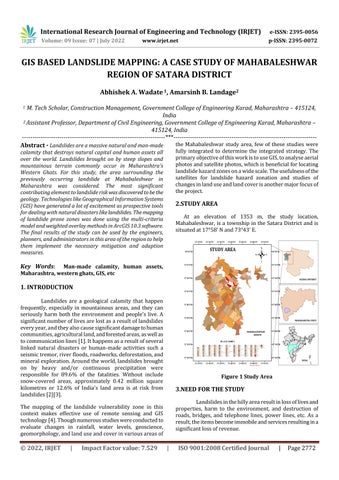
2.STUDY AREA At an elevation of 1353 m, the study location, Mahabaleshwar, is a township in the Satara District and is situated at 17°58' N and 73°43' E.
Key Words:
Man-made calamity, human assets, Maharashtra, western ghats, GIS, etc
1. INTRODUCTION Landslides are a geological calamity that happen frequently, especially in mountainous areas, and they can seriously harm both the environment and people's live. A significant number of lives are lost as a result of landslides every year, and they also cause significant damage to human communities, agricultural land, and forested areas, as well as to communication lines [1]. It happens as a result of several linked natural disasters or human-made activities such a seismic tremor, river floods, roadworks, deforestation, and mineral exploration. Around the world, landslides brought on by heavy and/or continuous precipitation were responsible for 89.6% of the fatalities. Without include snow-covered areas, approximately 0.42 million square kilometres or 12.6% of India's land area is at risk from landslides [2][3].
Figure 1 Study Area
3.NEED FOR THE STUDY Landslides in the hilly area result in loss of lives and properties, harm to the environment, and destruction of roads, bridges, and telephone lines, power lines, etc. As a result, the items become immobile and services resulting in a significant loss of revenue.
The mapping of the landslide vulnerability zone in this context makes effective use of remote sensing and GIS technology [4]. Though numerous studies were conducted to evaluate changes in rainfall, water levels, geoscience, geomorphology, and land use and cover in various areas of
© 2022, IRJET
|
Impact Factor value: 7.529
|
ISO 9001:2008 Certified Journal
|
Page 2772