Effect of Pollutants on Permeability Characteristics of Soil

Page 1

International Research Journal of Engineering and Technology (IRJET)

e-ISSN: 2395-0056

Volume: 09 Issue: 07 | July 2022

p-ISSN: 2395-0072

www.irjet.net

Effect of Pollutants on Permeability Characteristics of Soil T Sai Krishna1, Dr. M Chittaranjan2, S Akhil Tej3 1Assistant

Professor, Dept. of Civil Engineering, Annamacharya Institute of Technology & Sciences- Tirupati, Andhra Pradesh, India 2Associate Professor & Head, Dept. of Civil Engineering, Sri Venkatehswara College of Engineering- Tirupati, Andhra Pradesh, India 3Assistant Professor & Dept. of Civil Engineering, G. Pullaiah College of Engineering and Technology, Andhra Pradesh, India ---------------------------------------------------------------------***---------------------------------------------------------------------

Abstract - In the present investigation two types of soils were collected near renigunta region to study the effect of pollutants on permeability characteristics of the soils a limited effort is made to evaluate the influence of inorganic chemical pollutants predominantly present in the effluents from tannery, textile and pharmaceutical industries on the permeability of soils. The inorganic chemicals considered are sodium chloride, sodium carbonate, and calcium carbonate. The percentage concentrations of inorganic salts, which are added range from 0% - 6%

The data thus obtained from the study is thought to be useful towards development of a better understanding of permeability studies and establishment of quantitate guidelines for soil behaviour in a given environment. An account has been made to understand the effect of inorganic chemicals such as NaCl, NaCO3, CaCO3 on Permeability characteristics of soils. Further, soil in combination with Fly ash is also considered indenting inorganic chemicals to understand the Permeability properties when Fly ash is used in combination with Soils.

Key Words: NaCl, CaCO3, NaCO3, Permeability

2. EXPERIMENTAL INVESTIGATION.

1. INTRODUCTION

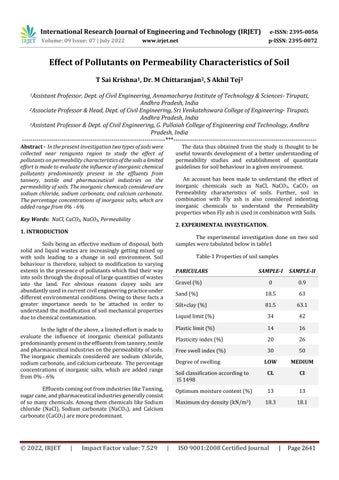
The experimental investigation done on two soil samples were tabulated below in table1

Soils being an effective medium of disposal, both solid and liquid wastes are increasingly getting mixed up with soils leading to a change in soil environment. Soil behaviour is therefore, subject to modification to varying extents in the presence of pollutants which find their way into soils through the disposal of large quantities of wastes into the land. For obvious reasons clayey soils are abundantly used in current civil engineering practice under different environmental conditions. Owing to these facts a greater importance needs to be attached in order to understand the modification of soil mechanical properties due to chemical contamination.

Table-1 Properties of soil samples SAMPLE-I

SAMPLE-II

0

0.9

Sand (%)

18.5

63

Silt+clay (%)

81.5

63.1

Liquid limit (%)

34

42

In the light of the above, a limited effort is made to evaluate the influence of inorganic chemical pollutants predominantly present in the effluents from tannery, textile and pharmaceutical industries on the permeability of soils. The inorganic chemicals considered are sodium chloride, sodium carbonate, and calcium carbonate. The percentage concentrations of inorganic salts, which are added range from 0% - 6%

Plastic limit (%)

14

16

Plasticity index (%)

20

26

Free swell index (%)

30

50

LOW

MEDIUM

Soil classification according to IS 1498

CL

CI

Effluents coming out from industries like Tanning, sugar cane, and pharmaceutical industries generally consist of so many chemicals. Among them chemicals like Sodium chloride (NaCl), Sodium carbonate (NaCO3), and Calcium carbonate (CaCO3) are more predominant.

Optimum moisture content (%)

13

13

Maximum dry density (kN/m3)

18.3

18.1

© 2022, IRJET

|

Impact Factor value: 7.529

PARICULARS Gravel (%)

Degree of swelling

|

ISO 9001:2008 Certified Journal

|

Page 2641


Turn static files into dynamic content formats.
Create a flipbook
Effect of Pollutants on Permeability Characteristics of Soil by IRJET Journal - Issuu