International Research Journal of Engineering and Technology (IRJET) e-ISSN: 2395-0056

Volume: 09 Issue: 07 | July 2022 www.irjet.net p-ISSN: 2395-0072
International Research Journal of Engineering and Technology (IRJET) e-ISSN: 2395-0056
Volume: 09 Issue: 07 | July 2022 www.irjet.net p-ISSN: 2395-0072
1 Assistant Professor, Dept. of Computer Science and Engineering, Maharaja Institute of Technology,Thandavapura 2,3,4,5 Students, Dept, of Computer Science and Engineering, Maharaja Institute of Technology, Thandavapura ***
Abstract - Due to its numerous applications in variousfacialanalysischallenges,automaticpredictionof age and gender from face images has received a lot of interest recently.Theavailablemodels,however,arestill belowtheneededaccuracylevel,whichisrequiredforthe usage of these models in real world applications due to thesignificantintra classvarianceoffaceimages(suchas differenceinlighting,position,scale,andopacity).Inthis study, we offer a classification model that can accurately identify the gender and age range of facial images using convolutionalneuralnetworks
Age, gender, mood, and other characteristics can allbe inferred from a person's face. Numerous dynamic aspects that alter over time, such as age, hairstyles, expressions,etc.,haveanimpactonit.Ageandgenderare regarded as crucial biometric characteristics for identifying humans. For the purpose of human identification and verification, biometric recognition gathers data on a person's physiological and behavioral traits (security models). Age, gender, ethnicity, height, and face measurements are examples of soft biometrics. Hardbiometrics aremeasurements of the body(physical, behavioral,and biological). Tospeedupdata traversalor tocategorize unlabeled subjects for different gender and agegroups,soft biometricfeaturescanberetrieved,such as skincolor,haircolor,thedistancebetweentheeyeand nose,facialshape,etc.
Additionally, with the ubiquitous use of computers,biometricidentificationisbecomingmoreand more necessary in sectors like healthcare and home automation. Through pattern recognition, computer vision, and picture analysis, it has recently become possible to automatically determine one's physical presence and verify their identification.Ageis one of the biometric characteristics taken into account. Numerous factors, including DNAalteration, metabolic changes, sun exposure,variationsin face tissues,reorganizationofthe facial bones, and others, contribute to aging. The aging of the face has a negative
impact on facial recognition systems. This concept is crucialtothe new fieldsof computer vision research that willbeinvestigated.
With the expansion of real world applications has expanded day to day living, researchers have shown more interest in the soft biometrics sector to close the communication gaps between humans and machines. Age, gender, ethnicity,height,facedimensions,andother softbiometricsareincluded.
Machines cannot classify patterns as effectively and powerfullyasthehumanbraincan.Therefore,ourgoalis tousetechnologytoimitatetheabilityofthehumanbrain todetermineaperson'sageandgender.Thisproblemcan be solved by developing an application for age and gender detection that can accurately determine a person'sageandgender.Theageandgenderoftheperson are determined byusing their human face as the input. Theperson'sageandgenderaretheoutput.
Ageestimationandfacial genderclassificationprovide numerousdifficulties.Twoclassesthatcanbeeithermale or female are subject to gender prediction. While a machine cannot easily classify gender, a human can. Numerous methods and models have been criticized for genderclassificationbasedonextra data fromhairstyles, body shape, attire, and facial traits. As of now, it is not possible todetermine actual age while estimating age. In order to determine age from facial photos, age grouping isstillused.Additionally,therearen'tenoughhigh quality datasets for estimating age and classifying gender to supportextensiveresearch.
Partialocclusionsandpoor qualityphotosarethemost frequent issues when it comes to face detection or age/genderclassification.Duetothemodel'slimiteddata set and difficulty in making predictions, these directly affecttheoutcomefindings. Whenahumanismaking the forecast,thesamerulesstillapply.Itismoredifficultfora human tocomprehend what is being viewed in a low qualityimageand,asaresult,topredictthefuture.
International Research Journal of Engineering and Technology (IRJET) e ISSN: 2395 0056
Volume: 09 Issue: 07 | July 2022 www.irjet.net p ISSN: 2395 0072
Age recognition is important in police investigations and intelligence departments because it aids in locating the actual suspect based on his age. They may receive a filtered result of that person who has committed a criminal act or any other activity. When it comes to software, the actual andpredicted ages are roughly the same, indicatingits dependability, and this dependability serves as a trust factorfor many other useful operations indailylife.
We propose a scheme in this paper to bridge the gap betweenautomaticface recognitionandageandgender prediction. When there is a large scale improvement in face recognition, a link between face recognition and Convolution Neural Network (CNN) is proposed, and by studying it further, we created a system in which a limitednumber of face data sets are used to accurately predictageandgender.
The various machine learning approaches utilized for categorization and implementation in this system are covered in this section. The optimal model for the system has been determined bycomparing the resultsofallofthesemodels.
In recent times, deep learning techniques proved to be a big success in the Computer Vision discipline. Deep learning enables multi layered computing models todetermineandinterpretdata with multiple abstraction levels and imitates how the information is perceived and translatedbythebrain.So, it implicitly captures large scaledata structures. Deep learning has outperformed many of the previously existing techniques. Deep learning has enabled various techniques in computer vision to increaseaccuracy and efficiency, which includes object detection, action recognition, human emotion recognition, and others. Further, types of deep learning techniques will be discussedwiththeircomprehensivedetails.
Convolutional Network Network (CNN) was first proposed in 1962, and it consists of the following layers.
• Convolutional Layer: As it is known that CNN utilizes various kernels, so the convolutional operation ofthelayerincreasedthelearningtimeofthedeveloped
model.
• PoolingLayers:Itreducesthespatialdimensions of the input volume for the next convolutional layer. It only
affectsthelengthandheight,andnotthedepth.
Fully connected Layers: Several connected neuralnetwork layers have been used to perform any high-levelreasoning.
•
There are some difficulties that might also arise with CNN, such as overfitting, which is due to the CNN training of a large number of parameters. The solution toitisthepretrainingofparameters,whichaccelerates the learning process of the model as well as improves the generalising capability of the model. In short, CNN has outperformed the usual and traditional machine learningalgorithms.
Python programming language, as well as numerous computer vision and machine learning packages and libraries, will be used throughout the research implementation. The primary goal of the project will be to create a Python-based, Tensorflowcompatible high-levelconvolutional neural network API. Python, in and of itself, is a high-level programming language. Python is open-source, object-oriented, and hassimplereadabilityandcoding.Becauseitcontainsso many packages, it is widely used in Big Data, Machine Learning, and Computer Vision. Furthermore, Python was chosenforthis experiment becauseitis freetouse, compatible with the Windows operating system, and containsallofthenecessarylibrariesforfacerecognition, emotiondetection,andgenderclassification.
Face identification consists of three steps. Detect
which part of an image is the face, then train our classifier for that dataset of images, and finally, predict the face. OpenCV, a Python open-source library for computer vision,will be used for this. A Haar cascade frontal face default classifier will be used for face detection, which is a pretrained model that is freely availableonline.AdefaultHaarclassifierwillbeusedfor genderandageprediction.Thefirststepwillbetodetect the face in the image using some test images. All of the images used in the training are freely available online and open-source.The entire experiment will be implemented in Keras with Tensorflow as the backend. TheentireConvolutionalNeuralNetwork willbebuilton these,aswellastheOpenCVcomputervisionlibrary.Keras can determine whether the model's current epoch outperformed the previously saved epoch. In this case, the best model weights will be saved in a file that will allow the weights to be loaded directly without retraining if the model needs to be used in another
situation. Keras has modularity, extensibility, and Python nativeness when compared to other similar libraries.
Gender identification is the process of determiningwhether a person is male or female. It is a binary model because there are only two options: male or female. The primary libraries for Gender ClassificationareOpenCVandKeras.
Byanalyzinghumanfacialfeaturesinreal-time,this model can predict ages rangingfrom 0to80andclassify genders as Male or Female. Because the model predicts ageinreal-time,itissubjecttochangewitheachwebcam frame.
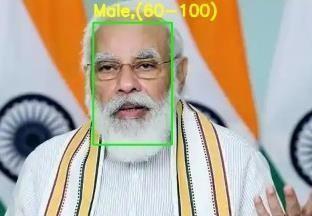
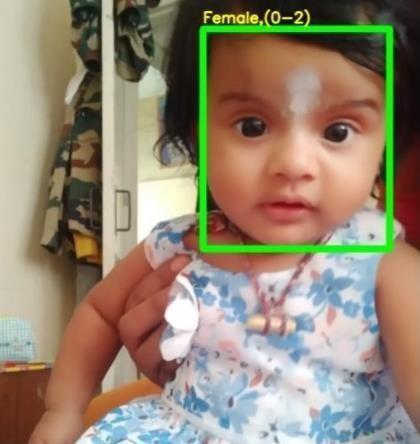
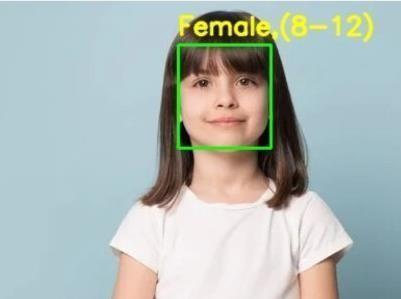
Figure 1,2 and 3 shows the prediction results of the developedmodel.
AthoroughliteraturereviewofvariousMachine Learning and Deep Learning techniques is used to discuss all of the techniques and methods that have already been implemented in this field. Facial images have become increasingly important in recent decades, owing primarily to their promising real-world applications in a variety of emerging fields. The proposed system is capable of classifying gender as eithermaleorfemaleandpredictingagefrom0to80.
Themodel'saccuracyiscalculatedseparatelyto provide a more accurate comparison and interpretation of the study. The proposed architecture was built methodically to improve accuracy and reduce the number of parameters. Gender classification and age prediction have been manually tested, and the results have been astounding. Because gender classification is considered a binary probleminthisstudy,ithasproven tobeveryefficientwiththeuseofKerasandachievesan overallaccuracyofabout90%.Agepredictionisaffected byavarietyofexternalfactors,includinglightingeffects, facial expressions, and skin tones, but it also produces impressiveresults.
We would like to express our sincere gratitude to Prof. Suhasini, who served as our project advisor. Prof. Suhasini directed us through this project, offered usimportantadvice,andhelpedusdevelopitbeyondour expectations. Second, we would like to express our gratitudetoDr.RanjithKN, ourprojectcoordinator, for her ongoing support and assistance in helping us for
International Research Journal of Engineering and Technology (IRJET) e ISSN: 2395 0056
Volume: 09 Issue: 07 | July 2022 www.irjet.net p ISSN: 2395 0072
completing this project within the allotted time. Additionally, we would like to extend our sincere gratitude to our department's head, Dr. Ranjith K N, for giving us access to a platform where we can attempt to work on project development and illustrate the realworld applications of our academic curriculum. We wouldliketothankDr.YTKrishneGowda,
ourprincipal,
for giving us the chance to complete this wonderful project on the topic of "Age and Gender Classification Using Convolutional Neural Network." This project has also assisted us in conducting extensive research and learninghowtoimplementit.
Jadavpur University, Kolkata. 700032, India, Department of Information Technology, Jadavpur University, Kolkata 700106, India , Institute of Industry Revolution 4.0, The National University of Malaysia (UKM), Selangor 43600,Malaysia, Institute for Mathematical Research, University Putra Malaysia,Serdang43400,Malaysia
[7] Insha Rafique, Awais Hamid, Sheraz Naseer, MuhammadAsad,MuhammadAwais,TalhaYasir,Age and Gender Prediction using Deep Convolutional Neural Networks, Department of Software Engineering University of Management and TechnologyLahore,Pakistan.
Technology Letterkenny, Ireland, ORCiD:
[1]Asad Mustafa, Kevin Meehan, Gender Classification and Age Prediction using CNN and ResNet in Real Time, Department of Computing Letterkenny Institute of
0000 0001-5447 5878.
[2] Thakshila R, Kalansuriya, Anuja T, Facial Image ClassificationBasedonAgeandGender,Dharmaratne University of Colombo School of Computing, UniversityofColomboNo35,ReidAvenue,Colombo7.
[3] Vijay Prakash Dwivedi, Deepak Kumar Singh, Saurav Jha,Ranvijay, Gender Classification of Blog Authors: With Feature Engineering and Deep Learning using LSTM Networks, Computer Science and Engineering DepartmentMNNITAllahabadUP,India.
[4] Mohammed Kamel Benkaddour, Sara Lahlali, Maroua Trabelsi, Human Age and Gender Classification using Convolutional Neural Network, University Kasdi Marbah, Department of Computer Science and Information Technology, FNTIC Faculty, Ouargla, Algeria.
[5] Hiromi Kondo, Fumiyo N. Kondo, Convolutional Neural Networks on Multichannel Time Series of Smartphone Applications for Gender or Age Range Classification, Toyota Motor Corporation Customer First Promotion Group C&A Operations Div. Aichi, Japan, University of Tsukuba Division of Policy and Planning SciencesFaculty of Engineering, Information andSystemsIbaraki,Japan.
[6] Avishek Garain , (Member, Ieee), Biswarup Ray , Pawan Kumar Singh , (Member, Ieee), Ali Ahmadian , (Member, Ieee), Norazak Senu , And Ram Sarkar , (Senior Member,IEEE), A Deep Learning Model for Classification of Age and Gender From Facial Images, Department of Computer Science and Engineering,
[8] Md.NahidulIslamOpu,TanhaKabirKoly,AnneshaDas and Ashim Dey, A Lightweight Deep Convolutional Neural Network Model for Real-Time Age and Gender Prediction, Department of Computer Science & Engineering Chittagong University of Engineering and TechnologyChittagong-4349,Bangladesh
[9] Azliza Mohd Ali, Plamen Angelov, Gender and Age Classification of Human Faces for Automatic Detection of Anomalous Human Behaviour, 2017 3rd IEEE International Conference on Cybernetics (CYBCONF), DOI:10.1109/CYBConf.2017.7985780
[10]Seok Hee Lee, Hyuk Jin Kwon, Hyung Il Koo, Nam Ik Cho, Age and gender classification using wide convolutional neural network and Gabor filter, 2018 International Workshop on Advanced Image Technology (IWAIT), DOI: 10.1109/IWAIT.2018.8369721.
[11]XuanLiu,JunbaoLi,CongHu,Jeng-ShyangPan,Deep convolutionalneuralnetworks-basedageandgender classification with facial images, 2017 First International Conference on ElectronicsInstrumentation & Information Systems (EIIS),DOI:10.1109/EIIS.2017.8298719.
[12]MohammedKamelBenkaddour,SaraLahlali,Maroua Trabelsi,HumanAgeandGenderClassificationusing Convolutional Neural Network, 2020 2nd International Workshop on Human-Centric Smart EnvironmentsforHealthandWell-being(IHSH).
[13]Gil Levi, Tal Hassncer, Age and gender classification using convolutional neural networks, 2015 IEEE Conference on Computer Vision and Pattern Recognition Workshops DIO:10.1109/CVPRW.2015.7301352.
International Research Journal of Engineering and Technology (IRJET) e ISSN: 2395 0056
Volume: 09 Issue: 07 | July 2022 www.irjet.net p ISSN: 2395 0072
[14]Avishek Garain, Biswarup Ray, Pawan Kumar Singh, Ali Ahmadian, Norazak Senu, Ram Sarkar, A Deep LearningModel for Classification of Age and Gender From Facial Images, DOI: 10.1109/ACCESS.2021.3085971.
[15]Syed Taskeen Rahman, Asiful Arefeen, Shashoto Sharif Mridul, Asir Intisar Khan, Samia Subrina, Human Age and Gender Estimation using Facial Image Processing, 2020 IEEE Region 10 Symposium (TENSYMP), DOI: 10.1109/TENSYMP50017.2020.9230933.
[16]SandeepKumar,SukhwinderSingh,JagdishKumar,A study on face recognition techniques with age and gender classification, Published in: 2017 International Conference on Computing, Communication and Automation DOI: 10.1109/CCAA.2017.8229960.
[17]SandeepKumar,SukhwinderSingh,JagdishKumar,A study on face recognition techniques with age and gender classification, 2017 International Conference onComputing, Communicationand Automation. DOI: 10.1109/CCAA.2017.8229960.
[18]JunBeomKo,WonjuneLee,SungEunChoi,JahieKim, Agenderclassificationmethodusingageinformation, 2014 International Conference on Electronics, Information and Communication, DOI:
10.1109/ELINFOCOM.2014.6914362.
[19]Min Hu, Yaona Zheng, Fuji Ren, He Jiang, Age
estimationand gender classification of facial images based on LocalDirectional Pattern, 2014 IEEE 3rd International Conference on Cloud Computing and Intelligence Systems, DOI: 10.1109/CCIS.2014.7175711.
[20]Chi Xu, Yasushi Makihara; Ruochen Liao, Hirotaka Niitsuma; Xiang Li, Yasushi Yagi, Jianfeng Lu, Real Time Gait Based Age Estimation and Gender Classification
from a Single Image, 2021 IEEE Winter Conference on Applications of Computer Vision (WACV).


Suhasini, Professor at Maharaja Institute Of Technology Thandavapura, Mysore, Department of Computer Science andEngineering.
Sunil M S, Student of Maharaja Institute Of Technology Thandavapura, Mysore. Pursuing Bachelor'sofEngineering Degree in Computer Science and Engineering.



Vinay M, Student of Maharaja Institute Of Technology Thandavapura, Mysore. Pursuing Bachelor's of Engineering Degree in Computer Science and Engineering.
TCApoorva, Student ofMaharaja Institute Of Technology Thandavapura, Mysore. Pursuing Bachelor's of Engineering Degree in Computer Science and Engineering.
Harshitha M N, Student of Maharaja Institute Of Technology Thandavapura, Mysore. Pursuing Bachelor's of Engineering Degree ComputerScience
andEngineering.