International Research Journal of Engineering and Technology (IRJET) Volume: 09 Issue: 07 | July 2022
www.irjet.net
e-ISSN: 2395-0056 p-ISSN: 2395-0072
Review on Comparative Study on Behaviour of Various Dome Structures for Different Parameters Mr. Aniket G. Sawant 1, Prof. Pandurang S. Patil 2 1PG
Student, Dept. of Civil Engineering, Rajarambapu Institute of Technology, Maharashtra, India Dept. of Civil Engineering, Rajarambapu Institute of Technology, Maharashtra, India ---------------------------------------------------------------------***--------------------------------------------------------------------2Professor,
Abstract - A dome is a distinctive structural arrangement that gains strength and stiffness based on its shape and form. Traditionally, stone masonry domes were constructed and are now mostly made of RCC Steel because of its re-usability. Traditionally, a dome is a hollow upper half of a sphere, made of various materials, with a history dating from prehistory. It encompasses the maximum volume with the smallest sized volumes without interruption by columns. The main goal of architects and engineers has always been to solve the problem of space enclosure. Architects and engineers look for new structural forms to accommodate large unobstructed areas. As a result, space structures, in which the three-dimensional function is realized, are of considerable importance. These structures are increasingly used in construction. They entail essentially analysis and design in three dimensions, as opposed to two dimensions.
new production processes enabled forecast iron and wrought iron to be produced in greater quantities and at lower prices [2]. In recent the majority of domes in the past were made of stone masonry, but currently RCC Steel domes are being built all across India because of the material's reusability. These structures enclose the most amount of space with the least amount of surface and steel truss. Because of its skilled structural shape, the lattice system has gained popularity among engineers. [5]. The space structure in which the aforementioned threedimensional function is achieved is thus extremely important. These structures are increasingly being employed in the building industry. They generally entail three-dimensional analysis and design rather than two-dimensional analysis and design. [7].
Key Words: Ribbed Dome, Schwedler Dome, Kiewitt
1.1 Braced type domes:
Dome, lattice system, Reticulated domes
(a) Ribbed Dome
1.INTRODUCTION
(b) Schewedler Dome
The dome is a majestic structure that dates back thousands of years. Each element is arranged in layers that are arched in all directions. Dome structures are used for covering large areas such as exhibition halls, stadiums, and concert halls. In terms of materials, they are economical and provide a completely unobstructed interior space. Comparatively to more conventional forms of structures, they are lighter [1, 2]. Engineers are particularly interested in them because they contain a great deal of space with a minimum amount of surface area and are extremely efficient regarding construction materials. An affixed dome has a mainly membrane and compressive stress distribution, except for circumferential tensile stresses near the edges and small bending moments at the junction of the shell and the ring beam. [1]. Over the years, domes have been built out of a diverse range of materials, including mud, stone, wood, brick, concrete, metal, glass, and plastic. During the last three decades, braced steel dome structures have been widely used all over the world. During the Industrial Revolution,
© 2022, IRJET
|
Impact Factor value: 7.529
|
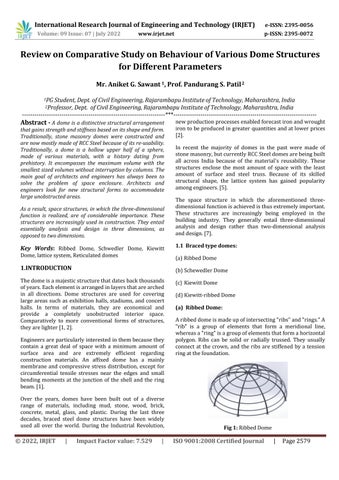
(c) Kiewitt Dome (d) Kiewitt-ribbed Dome (a) Ribbed Dome: A ribbed dome is made up of intersecting "ribs" and "rings." A "rib" is a group of elements that form a meridional line, whereas a "ring" is a group of elements that form a horizontal polygon. Ribs can be solid or radially trussed. They usually connect at the crown, and the ribs are stiffened by a tension ring at the foundation.
Fig 1: Ribbed Dome
ISO 9001:2008 Certified Journal
|
Page 2579