International Research Journal of Engineering and Technology (IRJET) e ISSN: 2395 0056

Volume: 09 Issue: 07 | July 2022 www.irjet.net p ISSN: 2395 0072
International Research Journal of Engineering and Technology (IRJET) e ISSN: 2395 0056
Volume: 09 Issue: 07 | July 2022 www.irjet.net p ISSN: 2395 0072
1 ,2VIII semester, BE, Department of Computer Science and Engineering, BNMIT 3 Assistant Professor, Department of Computer Science and Engineering, BNMIT, Bangalore, Karnataka, India ***
Abstract - Agriculture, is a well known fact that it is the major source of food, income, and employment for rural populations. Various seasonal conditions, however, the crops get infected by many kinds of diseases. These diseases threaten farmers’ income and food security. Identification of plant diseases by using the recent technologies can help farmers with further diagnosis and treatment. This paper introduces the modeling of plant disease detection along with severity classification using Support Vector Machine (SVM) and Convolutional Neural Networks (CNN). The dataset contains images of four different plant species of various diseases. The accuracy obtained by this model varies with each disease of the plant which is around 80 to 90%.
Key Words: PlantDisease,SeverityClassification,Support VectorMachine,ConvolutionalNeuralNetworks
Being the major portion of the population is from rural segments, Agriculture plays a major role as of important sectoroftheIndianEconomy.Themaintenanceofitshealth, quality&quantityisofutmostconcernforthecountry.The diseaseisamajorconcernineverycountry,asthedemand for food is rapidly increasing due to an increase in the population
As per the latest estimates by the Food and Agriculture OrganizationoftheUnitedNations(FAO),around40%ofthe cropsarelostworldwideeveryyearduetoplantdiseases. Thecropsgetinfectedbyvariouskindsofdiseases,dueto variousseasonalconditions,animate(pestsandweeds),and inanimate (weather, rainfall, wind, moisture) matters. Identificationofplantdiseasescanhelpfarmerswithfurther diagnosis and treatment which in turn increases their incomeandfoodsecurity.Theinfluenceofdiseaseplaysone of the factors in the quality and quantity of agricultural production.
The recent developments in technology, efficient data storage,andpowerfulhardwareprovideanopportunityfor image classification in agriculture. Studying visually observablepatternsofplantleavescanhelpidentificationof folic diseases and monitor the health of plants. Thus, it provides a way to reduce loss in yield substantially and increaseplantproduction.
Inordertoidentifythedifferentdiseasesofplants,various machine learning algorithms are significantly been used. Hence,thispaperfocusesondetectingplantdiseasesusing Support Vector Machine and classifying their severity by deep learning models such as DenseNet and EfficientNet whichhelpstoimprovetheaccuracy.Knowingtheseverity ofthediseasemakesthefarmerstakenecessarymitigations attheearliest.
The rest of the paper is organized as follows: Section 2 provides the related works on the identification of plant diseases. Section 3 discusses the proposed methodology. Section 4 presents the experimental results and analysis. Finally,section5summarizesthemodel.
Thissectiondescribesvariousapproachesfordetectingthe diseaseinplantleavesusingdifferenttechniques.
The plant diseases are detected based on the images provided as input. It is known that there is noise in the images,thatareusedfortrainingwillcauseincorrectresults. Inordertoobtainabetterefficacy,methodslikebackground subtraction and segmentation algorithms were used that helpincleaningthenoisybackgroundimages.Thisapproach is proposed in paper [1] which outlines the various deep modelswhichweretestedandappliedonimagesetswith differentbackgrounds.
Fortheclassificationofplantdiseases,techniqueslikeDeep Learning (DL) algorithms are significantly used by most researchers. The following papers provide a comparative studyonusingDL methods. Paper[2] explainsDL models thatwereinfrom2012to2018tovisualizeplantdiseases.It presentsthecurrenttrendsandchallengesforthedetection ofplantleafdiseaseusingadvancedimagingtechniquesand deep learning along with the problems that need to be resolved. Similarly, the authors in the paper [3] give an insight into the evaluation of various deep learning architectures.Thebest performingmodelwasfurtherfine tunedbyvariousoptimizationalgorithms.Thisresultedthat theXceptionmodelwithAdamoptimizerhasachievedthe highestF1scoreof0.9978.Paper[4]thatwasreferredhere presented a survey on the exemplary comparison, frameworks,ConvolutionalNeuralNetwork(CNN)models andoptimizationtechniquestodetectplantdiseasesusing
International Research Journal of Engineering and Technology (IRJET) e ISSN: 2395 0056
Volume: 09 Issue: 07 | July 2022 www.irjet.net p ISSN: 2395 0072
leaf images as a data set. It highlighted merits & demerits easingthetaskofdeveloperswhileapplyingDLtechniques.
ManyresearchersalsousedConvolutionNeuralNetworksin theirmodel whichgaveahigheraccuracy.Paper[5]deals with the usage of minimal computing resources over traditionalmodelsforbetterresultssuchasNeutralnetwork models by using feature extraction achieved an average accuracy of 94.8% indicating its efficacy even under unfavorablesituations.Inpaper[6],theauthorsproposeda model which is based on the inception layer and residual connection. The technique was tested on 3 plant disease datasetsresultinginaccuracypercentageasappended,plant villageis99.39%,Riceis99.66%andCasavais76.59%.
Other techniques include SVM, Artificial Neural Networks and GAN network. Paper [7] highlights the usage of Wassersteingenerativeadversarialnetworkwithgradient penalty (WGAN GP) combined with Label Smoothing Regularization(LSR)whichaddressedtheoverfittingissues due to limiting training data. The model fine tunes the classification accuracy by 24.4% when compared to 22% using synthetic samples without LSR and 20.2% of classic dataaugmentation.Paper[8]dealtwithanimageprocessing frameworkforplantdiseaseidentificationandclassification which consists of 3 stages, image segmentation, feature extractionandclassification.Thetestswereconductedon4 different classes of Tomato leaf diseases by using GLCM, multithreshold, etc. This method achieved 98.3% overall accuracywith10 foldcross validation.
Theidentifieddiseaseofaleafimageshouldbeshowntothe userssothattheycantakenecessarymitigationsattheright time. There are various ways like a web interface, mobile application,ormessagingtool developedforthispurpose. Paper[9]focusesonprovidingusersthenameofthedisease detectedanddirectsthemtoane commercewebsitewhere they can purchase the medicine for the diseases and use them appropriately according to the directions given. In paper [10], two crops i.e., Corn and Tomato are taken for diseaseidentificationusingSVMandANN,andthedetected diseaseissenttousersthroughGCM.Theaccuracyobtained bySVMis60 70%andbyANN80 85%.IncaseofCorn,by using SVM is 70 75% and by ANN is 55 65%. Table 1 providesasummaryoftherelatedworksintheliterature.
Source Dataset/Crops Methods and Results
[1] PlantLeaf Fine tuned Densenet121(Removed Background);93%
[2] PlantVillage DLmodels
[3] PlantVillage XceptionwithAdam; 99.7%
[4] PlantVillage DCNN
[5] PlantVillage VGG16;94.8%
[6] PlantVillage, Rice,Cassava 99%forplantvillage andrice,76%for cassava
[7] PlantVillage GAN
[8] Tomato SVM;98.3%
[9] Apple CNN;around70 80% fordifferentdiseases
[10] Corn,Tomato SVM,ANN;60 80%
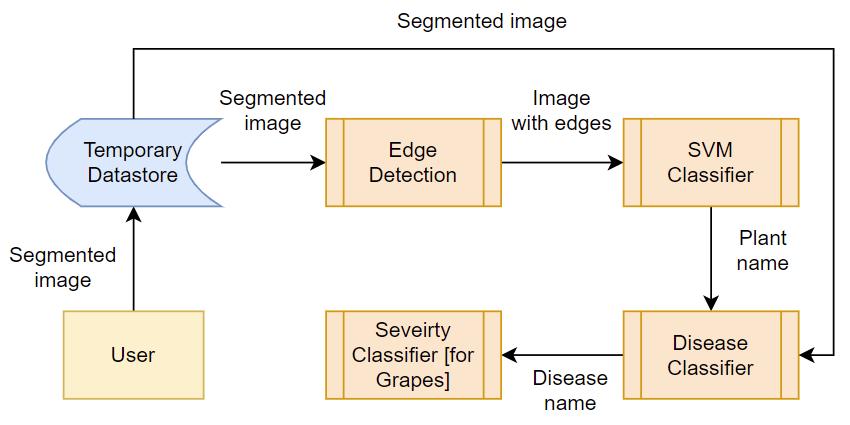
Inthissection,theapproachisdefinedforthedetectionof plantdiseases.First,wedescribethedataset,highlightthe segmentationsteps,anddiscussthemethodsfortrainingthe learningmodels.Figure1showsthedataflowdiagramofthe proposedmodel.
TheproposedexperimentutilizedthePlantVillageDataset available on Kaggle which contains 20,639 images of high resolution of 38 different healthy and diseased leaves pertainingto14plantspecies.Fortheimplementationofthis model,segmentedimagesof4cropswiththeirdiseasesare considered. All the diseases of a crop are grouped into a singlefolderandstoredinGoogleDriveplant wiseasshown intable2.
Fig 1: DataFlowDiagram
Image segmentation is an important part of image processing.Forthesegmentationofimages,variousmethods like region and edge based methods, boundary and spot detectionalgorithm,K meansclustering,Otsu’smethod,etc. are available. Canny edge detection is one of the optimal
International Research Journal of Engineering and Technology (IRJET)
e ISSN: 2395 0056
Volume: 09 Issue: 07 | July 2022 www.irjet.net p ISSN: 2395 0072
edge detectors as it provides a good, reliable, and lowest errorrateinrealedgepointdetection.Itisatechniquethat detectsawiderangeofedgesinimagesusingamulti stage algorithm.Thestepsfollowedforedgedetectionusingthe cannyedgedetectorare:
1. Smoothing:Gaussianfilterisappliedtosmooththe imageinordertoreducenoise.
2. Findingintensitygradients:Theedgesaremarked wherethegradientsoftheimagearehavinglarge magnitudes. The gradients of the images of large magnitudesarehighlightedasedges.
3. Non maximumsuppression:Thisisappliedtoget rid of spurious responses to edge detection. The edgesmarkedarelocalmaxima.
4. Double Threshold: Thresholding is taken as a criterionfordeterminingpotentialandactualedges.
5. Edge tracking by hysteresis: Weak edges that are connectedtostrongedgesareactualorrealedges and those that are not connected to strong edges willbesuppressed.
Plant Disease Name Count
Apple Healthy 1645
AppleScab 630
BlackRot 621
Corn Healthy 1162 CommonRust 1192
Grayleafspot 513
Grapes Healthy 423
Blackrot 1180
Esca 1383
Isariopsis 1076
Tomato Healthy 1591
Leafmold 952
Septoria 1771
Earlyblight 1000

Fortheidentificationofplantdiseases,theSVMalgorithmis used. An SVM is a supervised learning and vector space basedmachinelearningmethodwherethegoalistofinda maximum marginal hyperplane (MMH) that divides the training data into classes. This algorithm helps to analyse data used for clustering, classification and regression analysis. The following steps are used to search for the maximummarginalhyperplane:
1. Hyperplanesarerecursivelygeneratedtosegregate theclassesinthebestway.
2. Thenextstepistoselectthehyperplanewiththe maximum segregation from both nearest data pointsforaccurateresults.
ConvolutionalNeuralNetworks(CNN)isaclassofArtificial NeuralNetworks(ANN)thatworksontheconceptofhidden layers and is most widely used in image processing and recognition. The different methods used in this model are DenseNetandEfficientNet.Theyaredonebyusingactivation functionsandanoptimizer.
DenseNet: A DenseNet isone of the CNN that uses dense connectionsbetweenlayerswheretheyareconnectedwith eachother,throughDenseBlocks.Thisapproachissuitable iftherearesimilarkindsofplantimages.Forexample,the leavesofTomatoandApple.
EfficientNet: EfficientNetisaCNNarchitecturethatusesa compoundcoefficienttechniquethatuniformlyscaleseach dimensionwithacertainfixedsetofscalingcoefficients.It achievesbetterefficiencyandhigheraccuracy.
Activation functions: In neural networks, the activation functionisresponsiblefortransformingtheweightedsumof the input into an output from nodes in a layer of the network.ThismodelusesReLU(RectifiedLinearUnit)asthe activationfunctioninthehiddenlayer,thatoutputstheinput directlyifitispositive,otherwise,itwilloutputzero: f(x)=max(0,x) (1)
Inthelastlayer,theSoftMaxfunctionisused,whichreturns valuesbetween0and1anddeterminestheprobabilitiesof datarelatedtotheclassusedforthemulticlassproblems: (2)
International Research Journal of Engineering and Technology (IRJET) e ISSN: 2395 0056
Volume: 09 Issue: 07 | July 2022 www.irjet.net p ISSN: 2395 0072
Optimizers: Optimizers are methods used to adjust the parameterssuchasweights,andlearningrateforamodelto reduce losses. One of the optimizers used in this model is Adam Optimizer. This algorithm accelerates the gradient descentalgorithmbyconsideringtheexponentiallyweighted averageofthegradients.
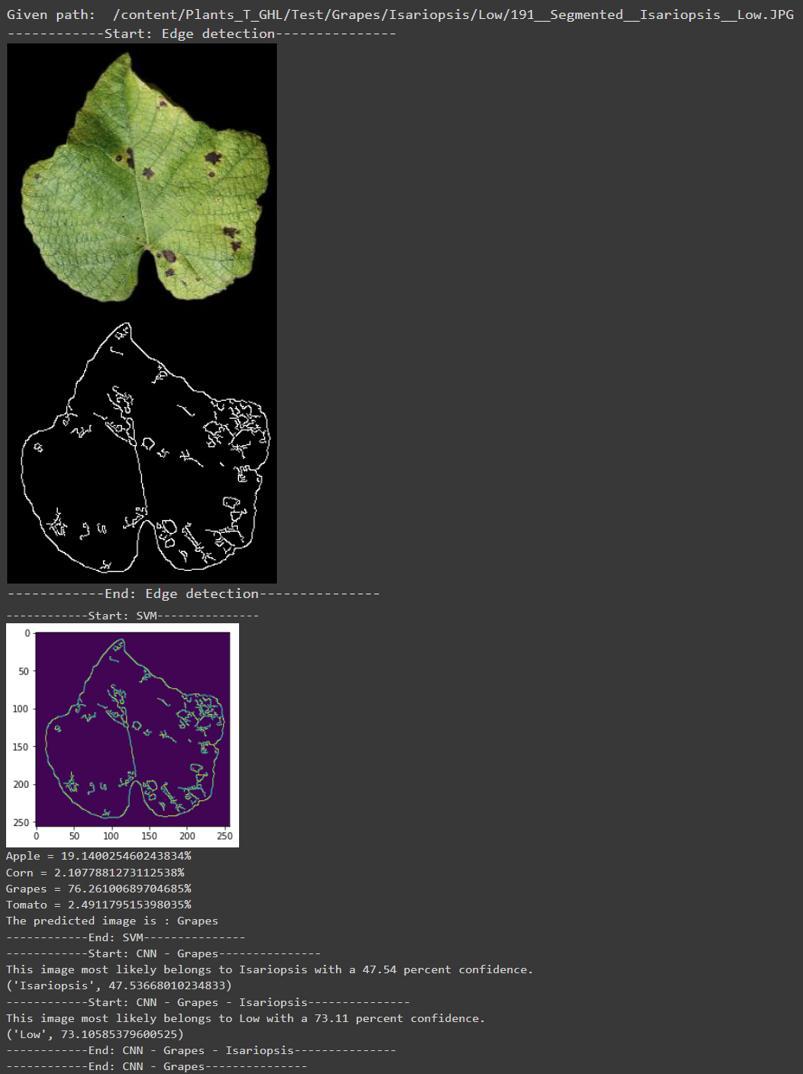
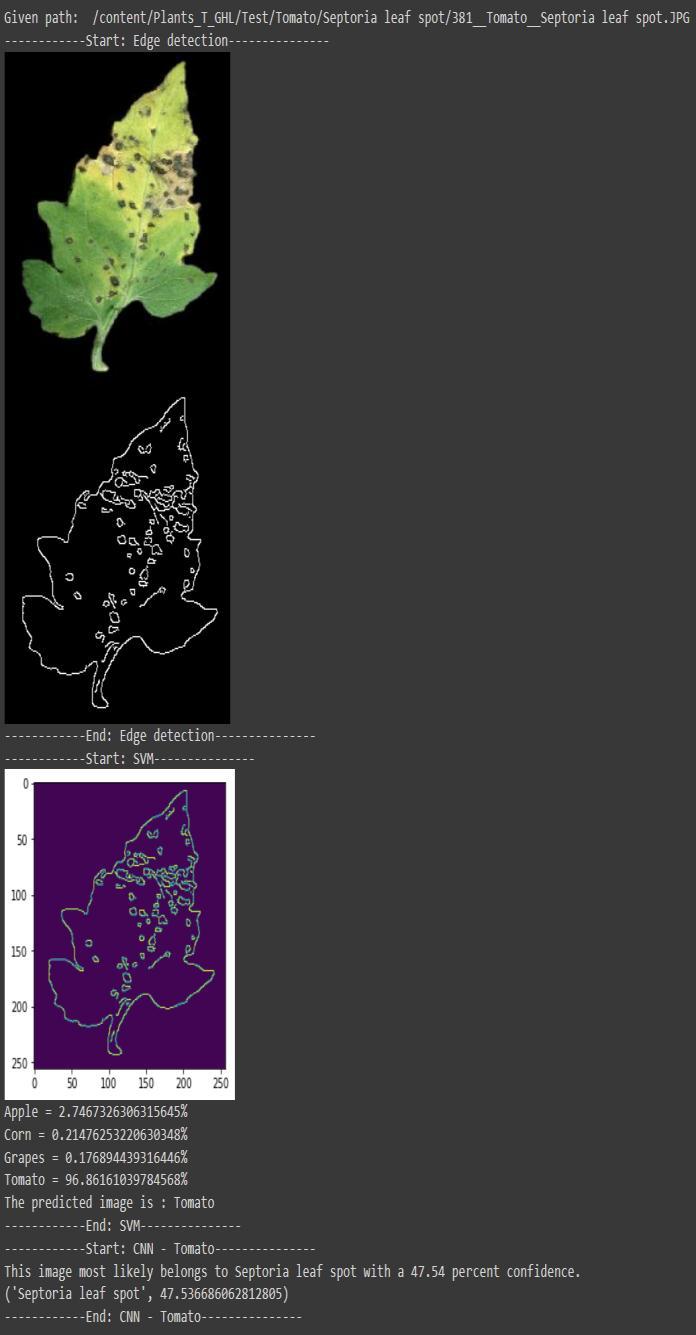
Theproposedmodelisdividedintothreemodulesnamely, identification of the plant, classification of disease, and classification of severity. In the plant classifier module, a segmentedimageisgivenastheinputwhichfirstdetectsthe edgesintheleafimageusingCannyEdgeDetectionmethod. Then the image is processed through SVM classifier for identification of plant. Deep learning methods are used in diseaseclassifiermoduleandseverityclassifiermoduleto providebetterperformanceandaccurateresults.Figures2, 3,4and5displaytheoutputofthemodel.
scoresobtainedforthediseaseanditsseverityclassifierare shownintable3.
Plant Disease Name Accuracy (%)
Apple Healthy 92.5 AppleScab 100 BlackRot 100
Corn Healthy 100 CommonRust 100 Grayleafspot 57.5
Grapes
Healthy 90 Blackrot High 100 Low 85 Esca High 90 Low 100 Isariopsis High 95 Low 100
Tomato Healthy 100 Leafmold 100 Septoria 100 Earlyblight 95
Taking the various images of plant disease datasets from Kaggle namely, apple, corn, tomato and grapes, the test
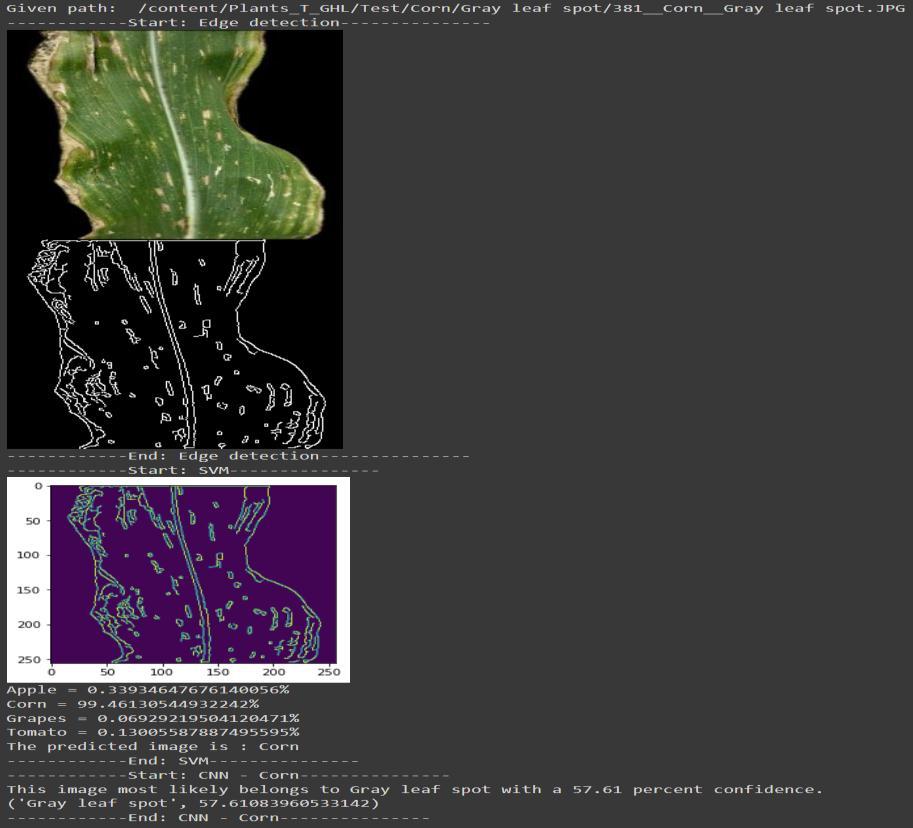
3: OutputofCorndiseasedetection
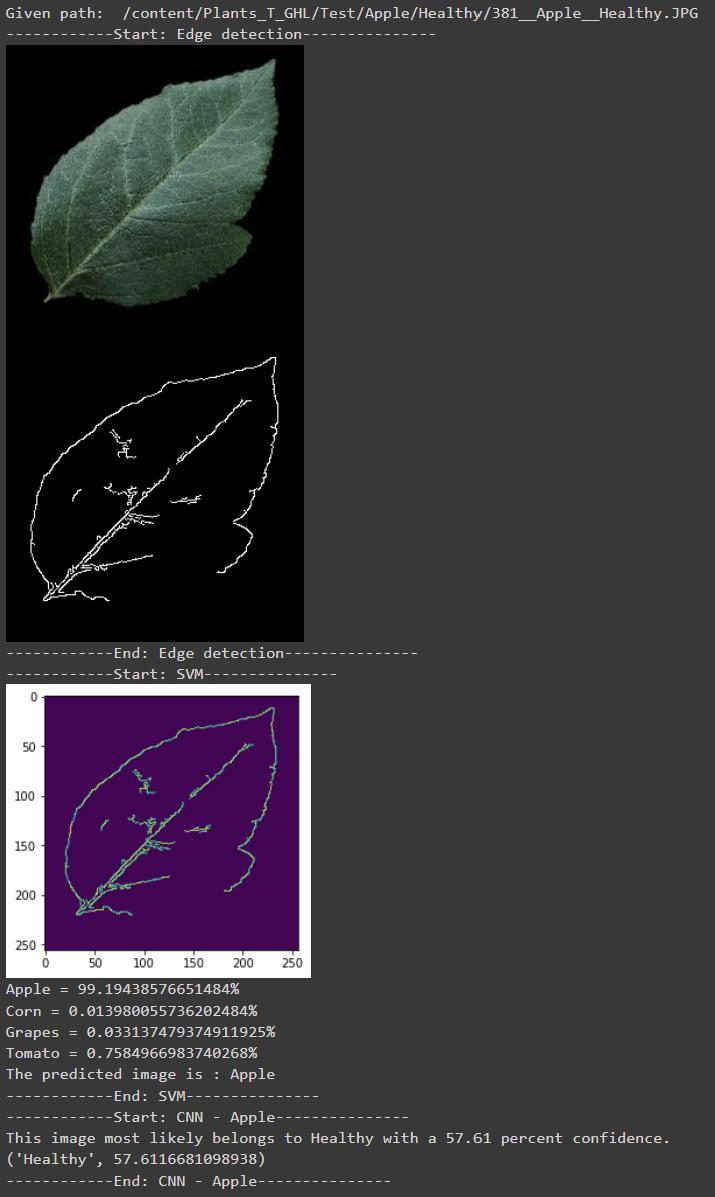
Fig 4: OutputofTomatodiseasedetection
Theprimaryobjectiveofthemodel“PlantDiseaseDetection andSeverityClassification”istodetectplantdiseaseswith severityusingimagesofdiseasedplantspecies.Thismodel highlights the identification of severity of disease through image processingandextractsinformationwhichhelps in the classification task and supports disease detection in plants. The model is tested on four plants namely, Apple, Corn,Grapes,andTomatohavingtwotothreediseaseseach. The technologies used here are SVM, CNN methods like DenseNetandEfficientNetthatpredictthediseasesandtheir severityearlyandinasimplemannertomakethegrowers take disease measures at right time. The experimental resultsindicatethatbothapproachessignificantlyimprove theaccuracyofleafdiseases.
Thefutureresearchworkincludesthefollowing: The use of other algorithms can be explored to enablethemtodetectandclassifydiseasesduring
theircompletecycleofoccurrenceandenhancethe efficiencyofthesystem.
Developmentofauser friendlyinterfaceormobile applicationwhichishandyforthegrowerstocarry intheirpocketswhichmayprovetobeagreatasset totheagriculturalsector.
Fig 5: OutputofGrapesdiseasedetectionwiththe severitylevel
[1] KC, K.; Yin, Z.; Li, D.; Wu, Z., “Impacts of Background
Removal on Convolutional Neural Networks for Plant Disease Classification In Situ”, MDPI Plants, Agriculture 2021,11,827 © 2022, IRJET | Impact Factor value: 7.529 | ISO 9001:2008 Certified
International Research Journal of Engineering and Technology (IRJET) e ISSN: 2395 0056
Volume: 09 Issue: 07 | July 2022 www.irjet.net p ISSN: 2395 0072
[2]L.Li,S.ZhangandB.Wang,"PlantDiseaseDetectionand ClassificationbyDeepLearning AReview,"inIEEEAccess, vol.9,pp.56683 56698,2021
[3] Saleem, M.H.; Potgieter, J.; Arif, K.M. Plant Disease Classification: A Comparative Evaluation of Convolutional Neural Networks and Deep Learning Optimizers. Plants2020, 9,1319
[ ]Dhaka,V.S.;Meena,S.V.; ani, .;Sinwar,D.;K.;Ija ,M. .; Wo niak, M. “A Survey of Deep Convolutional Neural Networks Applied for Prediction of Plant Leaf Diseases”, MDPISensors2021,21,4749
[5] Rinu , Manjula S H, “Plant Disease Detection and ClassificationusingCNN”,IJRTE,Volume 10Issue 3,2021
[6]S.M.HassanandA.K.Maji,"PlantDiseaseIdentification Using a Novel Convolutional Neural Network," in IEEE Access,vol.10,pp.5390 5401,2022
[7] Bi L and uiping Hu, “Improving Image Based Plant DiseaseClassificationWithGenerativeAdversarialNetwork Under Limited Training Set”, ront. Plant Sci. 11:583 38, 2020
[8]M.Z. Din, S.M. Adnan, W.Ahmad, S. Aziz,J. Rashid,W. Ismail,M.J.Iqbal,“ClassificationofDiseaseinTomatoPlants' LeafUsingImageSegmentationandSVM”,TechnicalJournal, University of Engineering and Technology (UET) Taxila, PakistanVol.23No.2 2018
[9] Plant Disease Detection using Image Processing, Mr. V Suresh,DGopinath,MHemavarthini,KJayanthan,Mohana Krishnan, IJERT, ISSN: 2278 0181, Vol. 9 Issue 03, March 2020
[10] Plant Disease Identification Using SVM and ANN Algorithms, N. Kanaka Durga, G. Anuradha, IJRTE, ISSN: 2277 3878,Volume 7,Issue 5S4,February2019