International Research Journal of Engineering and Technology (IRJET) e ISSN: 2395 0056

Volume: 09 Issue: 07 | July 2022 www.irjet.net p ISSN: 2395 0072
International Research Journal of Engineering and Technology (IRJET) e ISSN: 2395 0056
Volume: 09 Issue: 07 | July 2022 www.irjet.net p ISSN: 2395 0072
Ayesha Fathima1 , Greeshma P K2 , Vijay Kumar3
1VIII Semester, Dept. of ISE, BNMIT
2 VIII Semester, Dept. of ISE, BNMIT
3Asst. Professor, Dept. of ISE, BNMIT, Karnataka, India ***
Abstract The severe acute respiratory syndrome coronavirus, which is the source of the present deadly coronavirus epidemic, was discovered in Wuhan, China. Threats to human life have been created by this pandemic's effects. Covid 19 is a fatal virus that is fast spreading and has an impact on people's daily lives, health, and economies of nations. This sickness not only harmed a single nation; it also hadanimpact onthe entire world. Millions ofindividualshave been impacted by the outbreak, and the death toll has been rising alarmingly. Forecasting and careful analysis of the pattern of disease spread in such a setting might motivate the creation of better strategies and more effective decision making.
Key Words: COVID 19, CNN, VGG, Deep Learning, Lung CT Scan Images.
Artificialneuralnetworks,aclassofalgorithmsinspiredby thestructureandoperationofthebrain,arethefocusofthe machine learning discipline known as deep learning. Although they can also include propositional formulas or latent variables organised layer wise in deep generative models like the nodes in deep belief networks and deep Boltzmann machines, the majority of contemporary deep learning models are based on artificial neural networks, specifically convolutional neural networks (CNN). Deep learningmodelsaresometimesreferredtoasdeepneural networksbecausethemajorityofdeeplearningtechniques useneuralnetworktopologies.Thenumberofhiddenlayers in the neural network is typically indicated by the term "deep." While deep networks can have up to 150 layers, traditionalneuralnetworksonlyhavetwoorthreehidden layers.Largecollectionsoflabelleddataandneuralnetwork topologiesthatautomaticallylearncharacteristicsfromthe dataareusedtotraindeeplearningmodels.Convolutional neuralnetworksareamongthemostoftenusedvarietiesof deepneural networks.Convolutional neural networksuse 2Dconvolutionallayersandcombinelearntcharacteristics withinputdata,makingthisarchitectureidealforprocessing 2Ddata,suchasphotos.Additionally,itdoesawaywiththe necessity for manual feature extraction, so you are not requiredtoknowwhichfeaturesareutilisedtocategorise photographs.TheCNNworksbyextractingfeaturesdirectly fromimages.Therelevantfeaturesarenotpretrainedbut
theyarelearnedwhilethenetworktrainsonacollectionof images.
Usingdozensorevenhundredsofhiddenlayers,CNNlearns to recognise various elements in an image. Every hidden layermakesthelearntpicturefeaturesmorecomplex.For example, the first hidden layer could learn how to detect edges, and the last learns how to detect more complex shapesspecificallycateredtotheshapeoftheobjectweare tryingtorecognize.Aparticulartypeofmachinelearningis deep learning. A machine learning workflow starts with relevantfeaturesbeingmanuallyextractedfromimages.The featuresarethenusedtocreateamodelthatcategorizesthe objects in the image. Relevant features are automatically retrieved from photos using a deep learning approach. In additiontothisdeeplearningperformsend to endlearning where a network isgivenrawdata anda task toperform, such as classification, and it learns how to do this automatically.
Oneofthemostserioushealthissuesatthemomentisthe COVID 19virus,alsoknownastheSARS CoV 2coronavirus or just corona virus. Coronavirus sickness is a highly contagiousillnessbroughtonbythecoronavirusthatcauses severe acute respiratory syndrome. The disease first originated in 31 December 2019 from Wuhan, Hubei Province,Chinaandsincethenithasspreadgloballyacross the world. Coronavirus disease is highly contagious with limited treatment options. The rapid spread of the novel coronavirus has caught much of the world off guard. This includesmedicalprofessionalsattemptingtohealthesickat risktotheirownhealth,publichealthofficialstrackingthe virus and vigilantly researchers are now engaged in the developmentofdiagnostics,treatmentsandvaccines.
Governments can interrupt the transition chain and flattentheepidemiccurvebydetectingthehazardoussevere acute respiratory syndrome coronavirus early and using clinical competence. Therefore, preventing the spread of Covid 19andtheassociatedmortalityrequiresanearlyand correctdiagnosis.AlthoughRT PCRisaquickprocedure,it only has a 70 75% accuracy in detection. For doctors, governments,organisations,andnationstostopthedeadly virus'srapidspreadinanylocation,earlydiagnosisofCOVID patientsisacrucialtask.Inthiscase,theresearcherswere motivatedtoplayabigpartinthedetectionofCovid 19by
International Research Journal of Engineering and Technology (IRJET) e ISSN: 2395 0056
thepriorepidemicevidenceonmachinelearninganddeep learningapproaches.
•Thepurposeofselectingthisproblemstatementistoaidin thequickandprecisediagnosisofCovid 19.
• To provide innovative computer assisted diagnosis methods for quick and affordable screening in locations whereextensivetraditionaltestingisimpractical.
•Toassessandcomparetheeffectivenessofdeeplearning methodsfordetectingCovid 19infectionsfrompatientCT scanpictures.
• The problem statement's major focus is on developing solutions for high risk groups facing COVID 19. The basic goalistoachievethefinestoutcomes.
•Itwillbeverybeneficialtomedicalprofessionalsforearly detectionthatcouldresultinanaccuratediagnosisofCovid 19patients.
Arecognisedandacceptedelementofcontemporarysociety is the survey. It is one of the ways society keeps itself updated whilestayingoutofsituationsthatare becoming larger and more complex in order to attain common perceptionsandstandards.Asurveyisamapratherthana precise plan that provides an overview of a field, differentiating it from a type of study that entails a microscopic investigation of a turf. Before the survey is conducted,itmustbeplanned.Theprojectheavilydepends on the literature review. It serves as a starting point for project ideas that are then developed into concepts and, ultimately,theories.
The study by Yujin Oh, Sangjoon Park, and Jong Chul Ye, "Deep Learning COVID 19 Features on CXR Using Limited Training Data Sets,"[1] illustrates how deep learning approach on chest X ray for Covid 19 classification have been actively researched. It is challenging to compile a systematicsetofchestX raydatafordeepneuralnetwork training.Theysuggestedapatch basedconvolutionalneural networktechniquewithamanageablenumberoftrainable parametersforCovid 19diagnosticstosolvethisissue.The proposedmethodwasinspiredbystatisticalanalysisofthe potential imaging biomarkers of the chest radiographs. Experimental results showed that the method achieved state of the art performance and provided clinically interpretablesaliencymaps,whichareusefulforCovid 19 diagnosisandpatienttriage.Inthisapproachimagesarefirst pre processedfordatanormalization,afterwhichthepre processeddataarefedinto asegmentationnetwork,from whichlungareascanbeextractedthenfromthesegmented lung area, classification network is used to classify the
correspondingdiseasesusingapatch by patchtrainingand inference,afterwhichthefinaldecisionismadebasedonthe majorityvotingbutthedrawbackofthisstudystatedthatCT scanhasshownbetterperformances.Itoffersbettercontrast andcreatesdetailedqualityimages.
ApresentationofANN basedtechniquesthatcanbe used for big data analysis is made in the publication "Artificial Intelligence and COVID 19 Deep Learning ApproachesforDiagnosisandTreatment"[2]byMohammad JamshidiandAliLalbakhsh.IthasbeensuggestedthatANN based strategies could be employed in addition to conventionalonestokeeppatientsinvolved.TheCovid 19 registry emphasises clinical factors and cardiovascular complications because it helps to identify the pattern of cardiovascularcomplications,advancethedevelopmentofa risk model for cardiac complications, and help identify or predict the response to various treatment modalities. However,thestudy'smainlimitationwastheuseofasmall numberofdata,whichledtounderfitoroverfitissues. .A deeplearning basedmethodwaspresentedbyGhoshaland Tucker to quantify the degree of uncertainty and interpretability in coronavirus detection. The authors discoveredthatthecorrelationbetweenpredictionaccuracy andpredictionuncertaintyisquitestrongusingaBayesian convolutional neural network using publically available Covid 19CXRpictures.UsingthepretrainedVGG 16model, the performance results show an increase in detection accuracy from 85.2 percent to 92.9 percent. In order to betterunderstandtheoutcomesproducedbytheproposed approach, they have also demonstrated the model's interpretabilitybycreatingsaliencymaps.
AnotherstudybyHamedTabrizchiandAmirMosavi titled"RapidCOVID 19DiagnosisUsingDeepLearningofthe ComputerizedTomographyScans"[3]showedhowSVMis used to solve non linear classification problems by transformingtheproblemusingthekernelmethod,which causesSVMcalculationinthehigherdimension.Oneofthe often employed algorithms in both research and industry, SupportVectorMachinederivesitsstrengthfrommachine learningmethods.Thisalgorithm'scapacitytohandlenon linearissuesisitskeybenefit.
By changing the issue using the kernel approach, which performs SVM calculation in the higher dimension, nonlinearclassificationissuescanbesolvedusingSVM.SVM wasfirstpresentedbyVapnikin1995.Heintroducedthis idea using the Structural Risk Minimization (SRM) and StatisticLearningTheory(SLT),respectively.
In their article "Covid 19 Detection Using Deep Learning Model," Ghada A. Shadeed and Abdullah A. Jabber[4] compared and scored the accuracy of the GoogLeNet,ResNet 101,Inceptionv3network,andDAG3Net models.Inceptionnetwaspickedbecauseithas316layers, comparedtotheGoogLeNetmodel's22layers,ResNet 101's 101 layers, the DAG3Net's three layers, and ResNet 101's
Volume: 09 Issue: 07 | July 2022 www.irjet.net p ISSN: 2395 0072 © 2022, IRJET | Impact Factor value: 7.529 | ISO 9001:2008 Certified Journal |
International Research Journal of Engineering and Technology (IRJET) e ISSN: 2395 0056
Volume: 09 Issue: 07 | July 2022 www.irjet.net p ISSN: 2395 0072
101layers.Toensurethattheclassificationlevelsbetween the two groups (Covid 19 and Non Covid 19) were equivalentandthattheclassificationmodel'srequirements weremet,allofthemodelsinthisstudyweretrainedusing standardisedX raypicturesofaspecificsizeanddimension. Thefinallayerwithcompleteconnectivitywasthenremoved andanewoneadded.
AnewCOVID 19patientsdetectionstrategy(CPDS) based on hybrid feature selection and improved KNN classifier is described in the research. According to [5] by Warda M.Shabana, Asmaa H.Rabieb, and Ahmed Covid 19 Patients Identification Strategy is a brand new Covid 19 diagnostic strategy that has been introduced. A revolutionarymeta heuristicoptimizationmethodologyis the first (HFSM). The second addition is an improved K NearestNeighbor(EKNN)classifier,whichhasbeenshown to be very effective and capable of handling challenging pattern classification issues. KNN is a handy and quick approachingeneral.HFSMselectstheimportantfeaturesfor thesubsequentdetectionphaseasahybridmethodology.By includingreliableheuristicswhileselectingtheneighbours ofthetesteditem,EKNNeliminatesthetrappingissueofthe conventionalKNN.
On "Deep Learning Based Decision Tree Classifier for COVID 19DiagnosisFromChestX rayImaging"[6],another effort by Seung Hoon Yoo1, Hui Geng1, and Tin Lok Chiu proposedaclassifierthatconsistsofthreebinarydecision trees, each trained by a deep learning model with convolution neural network based on the PyTorch frame. TheCXRimagesarecategorisedasnormalorabnormalin the first decision tree. The third tree performs the same functionforCOVID 19whereasthesecondtreeidentifiesthe aberrantimagesthatcontainsymptomsoftuberculosis.For each step in this study, training data were taken from an acceptabledatagroup;nevertheless,trainingdatashouldbe verifiedwithpathologicaldata.Theconclusionsofthemodel areunreliablewithouttheuseofpathologicallyverifieddata. New pathology information was thus necessary for the prediction of new instances. Third, a deep learning model was expanded with more training data using simple techniques like horizontal flipping, rotations, and shifts. There are various data augmentation methodologies for picturedata.Theperformanceoftheobtainedmodel may havebeenenhancedbytakingintoaccountimageprocessing techniques like stochastic region sharpening, elastic transforms,randomlyerasingpatches,andmanyothersto augmentdata.
Inordertoimprovemodelsanddevelopasystemthatdoes not require collecting a large amount of training data in ordertoobtainacrediblestatisticalmodel,furtherresearch is therefore required on sophisticated augmentation approaches.Additionally,inthiscase,aslightchangeinthe datacouldresultinasignificantchangeinthedecisiontree's structure.
Stefano Cabras'"AStudyBayesian Deep Learning Model for Estimating COVID 19 Evolution in Spain" [9] offeredasemi parametricmethodologytoestimateCOVID 19 (SARS CoV 2) evolution in Spain. It blends traditional Bayesian Poisson Gamma models for counts with cutting edge Deep Learning methods for sequence analysis. The observedtimeseriesofcountscanbeadequatelydescribed bytheDLmodel.Thewell knownPoisson Gammamodelis usedinabasicBayesiananalysistogeneratetheposterior predicted distribution of counts. The model enables estimation of the effects of potential scenarios or future sequence evolution across all regions. LSTM models' consistency, despite the fact that they have otherusefulapplications.Thesuggestedhybridmodelsalso lackanytheoreticalcoherence.
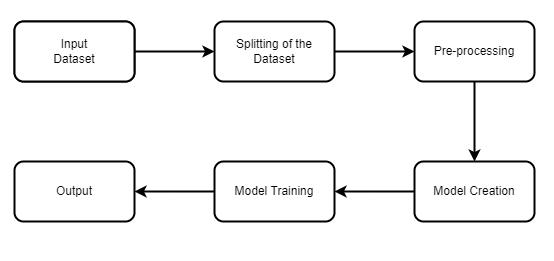
Software requirements should be converted into an architecturaldiagramthatoutlinesthesoftware'stop level structure and lists its constituent parts. This is achieved througharchitecturaldesign,whichalsogoesbythenameof systemdesign.Itservesasaninitialblueprintfromwhich softwarecanbecreated.Theprocessofidentifyingagroup of hardware and software components, as well as their interaction, in order to provide the framework for the creation of a computer system, is known as IEEE architecturaldesign.Bylookingatthesoftwarerequirement document and creating a model for delivering implementation details, this framework is created. The system'scomponents,theirinputs,outputs,functionalities, andinterrelationshipsarealldescribedusingthesespecifics. A design for an architectural structure serves many purposes.
Tobuildthebestmodelorasystemwithhighfidelity,deep learningmodelsaredata hungryandneedalotofdata.Even ifyouhaveabrilliantalgorithminplace,thequalityofthe dataisjustascrucialasthequantity.Findingahigh quality datasetisacrucialcomponentofdevelopinganyapplication. The datasets in the actual world are more complicated, disorganised, and unstructured. The size, quality, and
2022, IRJET | Impact Factor value: 7.529 | ISO 9001:2008 Certified Journal |
International Research Journal of Engineering and Technology (IRJET) e ISSN: 2395 0056
Volume: 09 Issue: 07 | July 2022 www.irjet.net p ISSN: 2395 0072
relevanceofthedatasetallaffecthowwelladeeplearning modelperforms.Findingtheidealbalanceisadifficulttask.
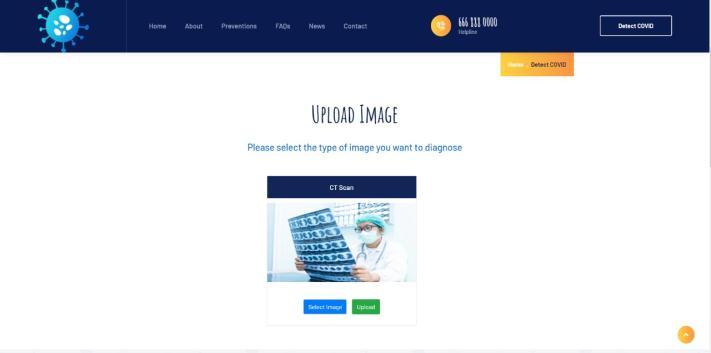
The planned study focuses on the detection of COVID 19 utilisinglungCTimages.BygatheringCTscansfromactual patients, the dataset comprises of a lung CT scan image dataset with two groups, COVID and non COVID. Visit https://github.com/UCSD AI4H/COVID CT/tree/master/Data splittoaccessitintheopen.
The training file complies to a programming abstraction paradigm. All the functions necessary for the project'seffectivecompletionandmodelcreationarecalled in this file in a methodical manner. This file, which has a modulardesign,includesmultiplestepsorfunctioncalls,as seenbelow:
Importing data, data visualisation, data preparation for processing,datasplitting,increasingthevarietyandvariance ofthedata,pre processing,modelcreation,modeltraining, andmodelanalytics.
Numerousproject relatedtasksarerequestedandcarried outwithinthetrainingmodule.Thisisalsotheprimaryfile neededtocreatethe model.Itgathersthenecessarydata, processesit,dividesit,buildsaneuralnetworkmodel,and thensavesitofflinein.md5formattothedisc.
A vital function to the overall project is the vgg pred()function.Themodelcannotaccuratelygraspthedata sinceitisnotlinear.Additionally,thisfunctionusestheidea ofbinningtobalancethedata.Toproducebins,datamustbe binned, or divided into intervals. By using binning to transformvisualdataintonumericaldata,themodelismade more adaptable. The model has already been built and storedbythisPythonapplication.Aserversocketismade andconfiguredtolistenonthecorrectport.Thecodeinthis file is in charge of importing the images from the dataset, preprocessing them, putting them through the neural network model, and accurately producing the desired outcome ConvolutionalNeuralNetworks(CNN)learntodo tasks like object detection, image segmentation, and classificationbytakinginaninputimageandapplyingfilters toit.First,sincenotalloftheimagesinourdatasethavethe samedimensions,weresizeeachimagebeforefeedingitinto themodel.Wecroporscaletheotherimagesto256×256 becausemorethanhalfofthetrainingimageshavethissize. Adifferentfunctionisusedtogeneratesubsequentbatches withauser definedsize.Inthenetworktrainingphase,the modelreceivesthesebatches.Alisttransformationiswhat makesupbatches.
OneormoreconvolutionallayersmakeupCNN.One or more neural network connected layers come before it. These were motivated by the visual cortex of animals. Convolutionallayers,alsoknownaslandpooling,areusedin the CNN Architecture that is being displayed. Pooling is a techniqueforarbitraryexperimentationthatisfrequently
usedwhenaddingpoolinglayerstoreducetheparameters and get rid of extra features during training in order to prevent the network from being overfit. The numerous proportional arrays are flattened into a two dimensional arrayinafullylinkednetworkfollowingtheconvolutional layers. The CNN model's performance was then assessed using a variety of performance indicators. These measurementsincludesensitivity,accuracies,andprecision.
TheremaybeoneormoreconvolutionallayersinCNN.One or more layers related to neural networks come before it. Animal visual cortex served as inspiration for these. Convolutional layers, also referred to as land pooling, are used in the CNN Architecture. Pooling, a technique for arbitraryexperimentation,isfrequentlyusedinconjunction withtheadditionofpoolinglayerstoreducetheparameters and get rid of extra features during training in order to preventoverfittinginthenetwork.Inafullylinkednetwork, the several proportional arrays are flattened into a two dimensionalarrayfollowingtheconvolutionallayers.After that, the CNN model's performance was assessed using several performance measures. Accuracy, precision, and sensitivityaresomeofthesemeasurements.
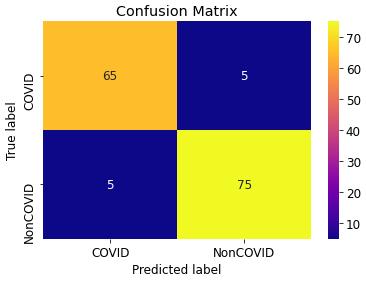
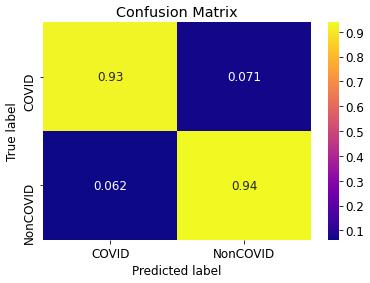
The confusion matrix is a two dimensional array that contrasts the true label with the inferred category labels. These categories for binary classification include True Positive,TrueNegative,FalsePositive,andFalseNegative.
Fig – 2: Confusion Matrix without Normalization
International Research Journal of Engineering and Technology (IRJET) e ISSN: 2395 0056 Volume: 09 Issue: 07 | July 2022 www.irjet.net p ISSN: 2395 0072
these strategies can be used to make speedy diagnostic decisions for COVID 19. This study lends credence to the notionthatDLalgorithmsofferaviablemeansofenhancing healthcare and the efficacy of diagnostic and therapeutic operations.
Since COVID 19 DL diagnostic models must be trained on sizable, heterogeneous datasets to fully exploit theavailabledataspace,developersmustbecarefultoavoid overfitting and to maximise the generalizability and usefulnessofCOVID 19DLdiagnosticmodels.DLisoneof the most powerful computing tools for diagnosing pneumonia.
Bytrainingthemodelsonmorephotographsinthefuture and perhaps integrating additional variables like age, nationality, gender, etc., we hope to increase the performanceofthealgorithms.Wearecurrentlyconsidering combining the three models that were suggested in this workandtrainingeachlayerseparatelyasanovelstrategy toprovidebetterresultsinthefuture.Finally,itcanbesaid that the COVID 19 pandemic was predicted, classified, screenedfor,andkeptfrom spreadingsignificantlybythe useofMLandDLapproaches.
[1]Oh, Yujin; Park, Sangjoon; Ye, Jong Chul (2020).“DeepLearningCOVID 19FeaturesonCXR using Limited Training Data Sets”. IEEE Transactions on Medical Imaging, (), 1 1.doi:10.1109/TMI.2020.2993291
[2]MohammadBehdadJamshidi,correspondingauthor Ali Lalbakhsh, Jakub Talla, Zdeněk Peroutka,” ArtificialIntelligenceandCOVID 19:DeepLearning Approaches for Diagnosis and Treatment” IEEE Access.2020;8:109581 109595,publishedonline 2020Jun12.doi:10.1109/ACCESS.2020.3001973
[3]Hamed Tabrizchi, Amir Mosavi, Óbudai Egyetem, Nádai László, “Rapid COVID 19 Diagnosis Using DeepLearningoftheComputerizedTomography Scans”, October 2020DOI:10.20944/preprints202010.0290.v1
The fundamental steps in stopping the sickness and the spreadofthepandemicareearlydetectionanddiagnosisof COVID 19 using DL techniques, with the least amount of expenseandproblems.Theequipmentofradiologycentres will soon include DL algorithms, making it possible to diagnosethisconditionmorequickly,affordably,andsafely. In order to limit human error and help radiologists make decisions under pressure and at the height of the disease,
[4]Ghada A. Shadeed;Abdullah A. Jabber;Nahedh H. Alwash; (2021). “Covid 19 Detection using Deep LearningModels“.20211stBabylonInternational ConferenceonInformationTechnologyandScience (BICITS), (), doi:10.1109/bicits51482.2021.9509874