An Analysis of Building Information Modeling (BIM) Usage in Nigerian Construction Industry
Akadiri Peter OluwoleCollege of Engineering, Architectural Engineering Department, University of Buraimi, P.C. 512, Al Buraimi, Sultanate of Oman *** Abstract
The global construction industry is in rising demand for Building Information Modeling (BIM) components in new constructionprojects.Althoughtherehasbeensignificantincreaseinindustry wideacceptanceofBIM,andinspiteofits benefits,itisstillnotastandardpracticeinNigerianConstructionIndustry(NCI).Thisresearchaimedatexploringtheuse of BIM among architects in Nigeria. A survey that investigated BIM awareness and usage, BIM software used in projects, activities executed using BIM and barriers to BIM usage was distributed to architects practicing in NCI. Responses were collected using questionnaires and data analyzed through descriptive and statistical tests. The survey results indicated a lowusageofBIMinconstructionprojectsdespitearchitectsshowingfairawarenessofBIM. TheresultalsorevealedBIM was mostly used for architectural detailed design, 3D visualization, architectural modelling, scheduling and construction documentscoordination.Lackofclientsdemand,poorleadershipandorganizationtowardsdigitalinnovationandcostof trainingwerethethreetopobstaclestoBIMimplementation.Theresearchcontributestotheexistingbodyof knowledge byprovidinginsightintoBIMusageinNigeria.Itisexpectedthat thisknowledgecouldbeusefulforBIMimplementation andtacklebarrierstoBIMadoptionintheNigerianconstructionindustry.

Keywords
:BIMusage,architects;constructionindustry;Nigeria
1. Introduction
Inrecenttime,therehadbeenagrowinginterestinBuildingInformationModeling(BIM)asanevolvingcollaboration and digital transformation tools in the architecture, engineering and construction (AEC) industry to reduce costs, increase quality and manage resources efficiently. Theoretically, there is consensus in the literature that BIM has the potential to revolutionize project delivery process by enhancing design and engineering creativity and ensure inter dependency of the design, construction and operation of the built environment. Kubba (2012) described BIM as a lifesaver due to its ability to identify and rectify errors at early design stage and accurately break down schedule of constructionprojectintodetailedtasks.
AstheconstructionindustrystartedtoembracetheconceptofBIM,AntonandDiaz(2014)suggestedthattheconcepts shouldbeimplementedintheearlystageofthebuildingdesignprocess,asitcanimpactaprojecteffectively.Zhaoetal. (2021)reinforcedthisandnotedthatforabuildingtobeenergyefficient,BIMasanenablingsoftwarecanbeusedto simulate and predict the energy performance. Ku and Taiebat (2011) found that the BIM technology has been welcomed by professionals in several countries and used to reduce cost, time, and enhance quality as well as environmentalsustainability.Popovetal.(2010)suggestthatBIMprovidesaplatformthatfacilitatesthecreationand sharingofinformationrelevantfordesign,constructionandmaintenanceofbuildingsovertheirentirelifecycle.BIMis capable of supporting project integration into a collaborative process, to promote increase efficiency and reduce conflict in project delivery system (Grilo and Jardim Goncalves, 2010). The completeness of the information enables better lifecycle management and sustainable building design (Azhar et al., 2011). With the integrated information model, visualization of construction process and design details is easier which facilitates analysis of alternative solutions(Popovetal.2010)andidentificationofpotentialconflicts(GriloandJardim Goncalves,2010).
Furthermore, BIM reduces the duration and cost of a project, improves maintenance management and increases the valueofthebuilding(BarlishandSullivan,2012).TomekandMatejka (2014)pointedoutthatBIMhasimpactonboth external and internal risks in construction industry. This is important according to what Rezakhani (2012) says that due to unique properties of construction operations, many risk factors are involved in construction project. BIM also improvescommunication between the differentproject parties(Hatem etal.,2012).On the otherhand,BIM as a new phenomenon seeks to renew the practices of the construction industry, so it is subject to several barriers facing its applicationdespiteitsoutstandingcapabilities(Kekanaetal.,2014).
International Research Journal of Engineering and Technology (IRJET) e ISSN: 2395 0056
DespitetheincreasedglobalinterestinBIMdevelopment,thelevelofadoptioninNigeriaconstructionindustryisstill verylow(AkadiriandOmisakin,2020;Sakaetal.2020) Ugochukwu etal.(2015)described theNigerianconstruction industry as “notoriously conservative and slow to change”, despite been faced with so many challenges. The authors went further supporting this statement nothing that the traditional procurement and building delivery methods have largelyremainedthesamefordecades. Acomprehensivereviewofliteraturepublishedfrom2000to2022showedan insufficient attention from researchers, leading to a very few BIM publications in the context of the Nigerian construction industry.Babatunde etal.(2020) examined BIM uptake amongcontractingfirms inNigeria. Onungwaet al.(2017)exploreBIMasatoolforconstructionmanagementinNigeria.Whereas, thebarrierstobuildinginformation modeling(BIM)implementationwithintheNigerianconstructionindustrywereidentifiedbyOlanrewajuetal.(2020). Thisisinadditiontootherstudies(Muhammadetal(2018);Anifowoseetal.(2018);Amudaetal(2018);Olapadeand Ekemode(2018);Ezeokolietal.(2016)whichinvestigated theawareness,adoptionandimpactofBIMintheNigerian construction industry. However, these studies failed to recognize the uniqueness of the different professions and the needfordevelopingspecificBIMusesindifferentprojectphasesbydifferentdisciplines.
Inotherwords,theliteraturereviewindicatedascarcityofliteratureonBIMuseforbuildingprojectsinNigeriawitha focusonarchitectswhoareresponsiblefortheimplementationofBIMattheearlystageoftheconstructionprocess.It alsoshowedthatthereislimitedknowledgeregardingtheexistinguseofBIMwithintheconstructionindustry,which motivatedtheconductofthisresearch. Againstthisbackground,thegoalofthisresearchistoexploretheperspectives ofarchitectsintheNigeriaconstructionindustrytowardsBIMadoption.Moreimportantly,thisresearchaddressedthe followingresearchquestions.
a) WhatisthelevelofawarenessofBIMuseamongbuildingstakeholders?
b) WhataretheBIMsoftwarepackagesuseforbuildingprojects
c) WhatarethebuildingactivitiesexecutedusingBIM?
d) Whataretheobstaclesof/toBIMimplementationinprojects?
2. Research Methods
The purpose of this research is to understand the use of BIM by architects in building projects. The study reviews extant literature on BIM technology and its use in Nigeria. A quantitative research method through structured questionnaire was employed for data collection and analysis. The sample frame consists of practicing architects in registered Architectural, Engineering and Construction (AEC) firms in Nigeria. An invitation to participate in a web basedQuestionProsurveywase mailedtoarchitectsdrawnfromadatabaseofaround1,500AECpracticesregistered inNigeria.A total of 540 questionnaires were mailed outto participantsforcompletion,outof which 48 respondents indicated the use of one form of BIM software or another and are therefore processed for this research. The survey responses were analyzed using the SAS 9.0 statistical software package The generated data were analyzed through descriptivestatistics(inpercentages)andpresentedinchartsandgraphs. Theparticipantswereaskedtoindicatethe frequency of use of 22 different BIM software packages using 3 Point Likert type scale of “1” for Never, “2” for occasionally,and“3”for Frequently. Rating forusageofBIMsoftwarewasbasedona5 PointLikerttypescaleranging from “1” for Strongly Disagree to“5” for Strongly Agree. Inorderto identifytherelativeimportance of theobstaclesto BIM adoption, ranking analysis was performed using relative index analysis . The following formula is used to determinetherelativeindex(Akadiri,2015):
(1)
wherewistheweightingasassignedbyeachrespondentonascaleofonetofivewithoneimplyingtheleastandfivethe highest.Aisthehighestweight(i.e.5inthiscase)andNisthetotalnumberofthesample.FollowingtheworkofChenet al.(2010)andAkadiri(2015),fiveimportantlevelsaretransformedfromRIvalues:high(H)(0.8≤RI≤1),high medium(H M)(0.6≤RI<0.8),medium(M)(0.4≤RI<0.6),medium low(M L)(0.2≤RI<0.4)andlow(L)(0≤RI<0.2).
3. Results and discussion
Thecharacteristicsoftherespondentswerecategorizedusingtheareaofspecialization,type,ageandsizeoforganization and work experience in Table 1. Experience of respondents was highly impressive as 43.7 per cent have over 20 years’ experienceworkinginthebuildingandconstructionindustry,18.8percenthasindustryexperiencerangingbetween11 and20years,while37.5percenthaveatleasttenyearsorless.Asforthesizeoforganization,66.6percentworkinsmall to medium size organizations, with a small proportion 14.6 per cent working in large organizations with over 250 staff. The result also shows that 54.2 per cent work in an architectural/design office while most of the respondent’s area of
Volume: 09 Issue: 07 | July 2022 www.irjet.net p ISSN: 2395 0072 © 2022, IRJET | Impact Factor value: 7.529 | ISO 9001:2008 Certified Journal |
International Research Journal of Engineering and Technology (IRJET) e ISSN: 2395 0056
Volume: 09 Issue: 07 | July 2022 www.irjet.net p ISSN: 2395 0072
projectspecializationisresidentialandinstitutionalbuildingsat43.7and39.6percentrespectively.Fromtheaboveitcan be concluded that respondents played important role in their organizations and are very experienced. These characteristicsmaketheirviewontherelevanceofsurveyimportantandcanbesufficientlyrelieduponwithconfidence.
3.1 Level of awareness and BIM usage
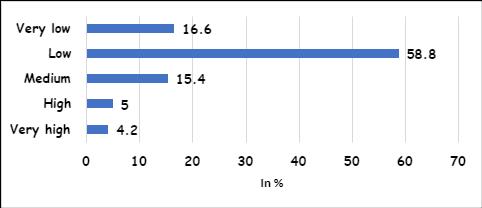
ThesurveyparticipantswereaskedtoidentifythelevelofawarenessofBIM.Fromthe resultinFigure1,43.8percentof respondentsstatedthattheyareawareofBIMandhaveeitherusedorstillusingthetechnology.Afurtherprobetoknow thelevelofusageamongtheusersshowsthatonly9.2percentareactivelyusingBIMasseeninfigure2.
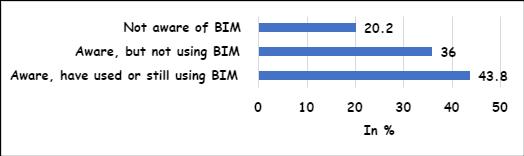
Table1. Demographyofexperts
Variable
Work experience
Number Percentage(%)
<5years 4 8.3 6 10years 14 29.2 11 20years 9 18.8 >20years 21 43.7
Size of organization (by staff) <10staff 20 41.6 11 50staff 12 25.0 51 249staff 9 18.8 250 500staff 4 8.3 >500staff 3 6.3
Age of organisation (in years) <5years 4 8.3 6 10years 6 12.5 11 20years 16 33.3 21 30years 13 27.1 >30years 9 18.8
Type of organization
Architecture/design 26 54.2 Civil/structuralengineers 14 29.2 BuildingContractors 8 16.6
Area of project specialism Commercial 7 14.6 Residential 21 43.7 Institutional 19 39.6 Industrial 1 2.1
Thishoweverindicatethatawarenessdoesnotnecessarilyreflectactiveusage.Thisfindingscollaboratepreviousstudies by Dare Abel et al. (2014) and Hamma Adama et al. (2018) which report that the usage of BIM is low among architects whoareawareofitinNigeriaconstructionIndustry.Anexplanationforthelow usagecouldbethattheyhaven’thandled project in which BIM was part of the project criteria and are rather ignorant about the importance and benefits of its usage.
Figure1:BIMlevelofawareness
International Research Journal of Engineering and Technology (IRJET) e ISSN: 2395 0056
Volume: 09 Issue: 07 | July 2022 www.irjet.net p ISSN: 2395 0072
Whilst BIM has been receiving attention globally as its realization has been identified as the basis for the generation of users satisfaction, respondents were asked to evaluate BIM software user friendliness based on 5 criteria of comfort, operability,taskaccomplishment,flexibilityandproductivitylistedinTable2.Thecriteriaandthevariableswereadapted fromtheworkofParketal.(2022).
Criteria Variables
Comfort
Operability
Task accomplishmen
t
Flexibility
Productivity
Figure2:BIMlevelofUsage
Table2. BIM userssatisfaction
Strongly Disagree Disagree Neutral Agree Strongly Agree Mean score n(%) n(%) n(%) n(%) n(%) n(%)
Pleasant,easy to navigateuser interface(toolbar,screencomposition, etc.)
3(6.3) 2(4.2) 5(10.4) 15(31.2) 23(47.9) 4.10
Itiseasytouseintermsof parametricfunctionsandcomponents 1(2.1) 5(10.4) 5(10.4) 17(35.4) 20(41.7) 4.04
Easytoinstall 2(4.2) 3(6.3) 0(0.0) 18(37.5) 25(52.0) 4.27 Thesoftwareworkflowisgood 4(8.3 5(10.4) 2(4.2 16(33.3 21(43.8) 3.94
Fastoperation timeand synchronization arepossible 5(10.4) 7(14.6) 3(6.3) 17(35.4) 16(33.3) 3.67
Iamsatisfiedwithfunctionssuchas measuringenvironmentalimpacts 9(18.8) 10(20.8) 4(8.3) 14(29.1) 11(23.0) 3.17 Ithassufficientfunctionstorespond tothestandardsoftheordering systemandgovernmentpermission
7(14.6) 14(29.1) 2(4.2) 13(27.1) 12(25.0) 3.19
Thesoftwarehasenoughtoolsto use intheearlystagesofdesign 8(16.7) 12(25.0) 1(2.1) 12(25.0) 15(31.2) 3.29
The software hasenough features to supportmodeling tasks 8(16.7) 8(16.7) 3(6.3) 15(31.2) 14(29.1) 3.40
Thesoftwaresupportcommunity, includingtutorials,issufficient 11(22.9) 9(18.8) 7(14.6) 11(22.9) 10(20.8) 3.00
Interoperability withother software and systemsisgood 4(8.3) 6(12.5) 2(4.2) 17(35.4) 19(39.6) 3.85
The softwarehasaworking environment thatenablesefficient collaboration
2(4.2) 3(6.3) 4(8.3) 15(31.2) 24(50.0) 4.17
IamsatisfiedwithAutodeskCloud services 5(10.4) 6(12.5) 4(8.3) 16(33.4 17(35.4) 3.71
Easytoupdateandtroubleshoot 1(2.1) 5(10.4) 5(10.4) 17(35.4) 20(41.7) 4.04
Itreducessimpleandrepetitivetasks duetolibraries,etc. 6(12.5) 7(14.6) 3(6.3) 18(37.5) 14(29.1) 3.56
The paperwork time isreduced by easilyderiving theinformation requiredfor theproject
1(2.1) 4(8.3) 2(4.2) 17(35.4) 24(50.0) 4.23
Thesoftwareimprovesthe productivityofwork 3(6.3) 3(6.3) 5(10.4) 14(29.1 23(47.9) 4.06
Factor value: 7.529 | ISO 9001:2008 Certified Journal
International Research Journal of Engineering and Technology (IRJET) e ISSN: 2395 0056
Volume: 09 Issue: 07 | July 2022 www.irjet.net p ISSN: 2395 0072
With a mean score ranging from 4.04 to 4.27, ease of installation of BIM software, the ability of the technology to reduce paperwork time by easily deriving the information requiredfor the projecta working environment thatenables efficient collaboration, pleasant, easy to navigate user interface, improved work productivity, ease of use of parametric functions and components and ability to update and troubleshoot were the top satisfaction of BIM software. These findingsareimportantasit emphasizesuser’semotionalandcognitiveevaluationoftheentireBIMexperience andcould provideanexcellentframework forthemanagementofBIMfromtheuser'sperspective, therebyhelptostimulateuser's acceptanceofBIMintheNigeriaconstructionindustryinfuture.
3.2 BIM Software usage by the Respondents
IntermsoftheBIM softwareusage,the large majority ofthearchitects at75.2% respondedthat theyalways useRevit™ Architectureoutofthe22BIMsoftwareinvestigated(Table3).ThisisnotasurprisebecauseAutodeskRevitArchitecture was specifically designed and developed to meet the needs of architects. As anticipated, this was closely followed by AUTOCADandGoogleSketchupat62.4%and43.1%respectively.Thesethreesoftwareareparticularlyusedastheyallow architectstodesign,document,visualize,anddeliverarchitecture,engineering,andconstructionprojectsmoreefficiently
Table3FrequencyofuseofBIMsoftware
BIM software Never Sometimes Always n(%) n(%) n(%)
Blender 41(85.4) 4(8.3) 3(6.3) Cattia 45(93.7) 1(2.1) 2(4.2) SolidWorks 46(95.8) 2(4.2) 0(0.0) Bricscad 46(95.8) 1(2.1) 1(2.1) AutodeskRevit 3(6.3) 10(20.8) 35(72.9) Ecotect 41(85.4) 5(10.4) 2(4.2) DigitalProject 40(83.3) 7(14.6) 1(2.1) AllplanArchitecture 44(91.6) 3(6.3) 1(2.1) Edificius 35(72.9) 9(18.8) 4(8.3) GoogleSketchup 6(12.5) 13(27.1) 29(60.4) 3DsMax 12(25.0) 11(22.9) 25(52.1) Lightworks 44(91.6) 2(4.2) 2(4.2) Revizto 24(50.0) 15(31.2) 9(18.8) Rhinoceros3D 28(58.3 11(22.9) 9(18.8) Caddie 18(37.5) 28(58.3 2(4.2) AutoCAD 2(4.2) 13(27.1) 33(68.7) VectorworksArchitect 18(37.5) 22(45.83) 8(16.7) Lumion 11(22.9) 9(18.8) 28(58.3) Infurnia 43(89.6) 5(10.4) 0(0.0) DataCAD 35(72.9) 8(16.7) 5(10.4) ArchiCAD 8(16.7) 12(25.0) 28(58.3) Houdini 47(97.9) 1(2.1) 0(0.0)
In a typical construction projects, different activities are carried out by architects aided with use of BIM software. These activities are listed in Table 4 based on the perceived duties of architects from the design to constructionstage.Thesurveyparticipantswereaskedtorank relevanttaskdonebyBIM.ThemostcommonlyusedBIM functions include schematic design and presentation of drawings, 3D visualization, architectural modelling, architectural detailsandScheduling.Energyanalysis,solaranalysis,structuralanalysisandlightinganalysismakeuptheleastactivities BIMisusedforinNigeria.Asexpectedthesearedutiesdirectlyattherealmofthearchitecturalprofessionandassuchthe focusisinusingBIMtoimprovethequalityandacceleratethedesignprocess.
Table4:RankingofRelevantTasksdonebyBIM
Tasks Response Yes No n(%) n(%)
Schematicdesignandpresentationofdrawings 47(97.9) 1(2.1)
Architecturalmodelling 45(93.7) 3(6.3)
3Dvisualization 46(95.8) 2(4.2)
Constructiondocumentscoordination 41(85.4) 7(14.6)
Specificationwriting 32(66.7) 16(33.3)
Scheduling 43(89.6) 5(10.4)
Clashdetection 40(83.3) 8(16.7)
Architecturaldetails 46(95.8) 2(4.2)
Virtualreality 26(54.2) 22(45.8)
QuantityTake off 36(75.0) 12(25.0)
Facilitiesmanagement/buildingrenovation 39(81.2) 9(18.8)
Constructionlogisticsandprocurement 36(75.0) 12(25.0)
Lightinganalysis 11(22.9) 37(77.1)
Energyanalysis 9(18.8) 39(75.0)
Solaranalysis 8(16.7) 40(83.3)
Structuralanalysis 10(20.8) 38(79.2)
Indoorhumancomfortanalysis 26(54.2) 22(45.8)
3.3 Barriers of BIM adoption
Relative index analysis was used to rank the criteria according to their relative importance. Table 5 show the ranking results for each criteria category (e.g. technological) by using the relative index analysis in Equation (1). Based on these ranking results, 12 criteria were highlighted to have “high” importance levels in evaluating building material with an RI valuebetween 0.808 and 0.898.These twelve criteria are “Lack ofawareness(O4)”,Lack oftrained professionals(O6)”, CostofBIMsoftware(O9)”, Lackofclientsdemand(O1)”,Lackofempowermentandsupporttodigitalinnovation(O7)”, Poorleadershipandorganizationtowardsdigitalinnovation(O8)”,Unavailabilityofnewdigitaltools(T4)”,Slowspeedof computers in processing and drawing extraction (T3)”, Poor power supply (T8)”, Limited availability of digital tools to deliverdigitalinnovations(T9)”,Inflexiblebuildingcode(LR1)”,Submissionofdrawingsisstillhardtocopy(LR4)”. “Lack ofawareness”wasrankedasthefirstpriorityintheorganizationalcategorywithanRIvalueof0.898,anditwasalsothe highestamongallcriteriaandwashighlightedat“High”importancelevel.
International Research Journal of Engineering and Technology (IRJET) e ISSN: 2395 0056
Volume: 09 Issue: 07 | July 2022 www.irjet.net p ISSN: 2395 0072
Table5.ObstaclesaffectingadoptionofBIM
Source LawsandRegulations
Literature review, existingand focusof construction stakeholders
LR1:Inflexiblebuildingcodes
LR4:Submissionofdrawingsis stillhardcopy
LR2:Submissionofdrawings doesn’tusedigitalcopyfrom digitalinnovations
LR3:Highstandardofdigital modellingandprocedure establishedbygovernmentfor drawingsubmission.
Organizationalcriteria
O8:Poorleadershipandorganizational attitudetowardsdigitalinnovation
O7:Lackofempowermentandsupport todigitalinnovation
O6:Lackoftrainedprofessionalsto manageBIMinnovation
O4:Lackofawareness
O1:Lackofclient’sdemand
O9:CostofBIMsoftware
O11:Costoftraining
O2:Lackofassuredreturnon investment
O3:Highequipment(computer) maintenancecost
O5:Fearofworkchanges
O10:Lackofpsychologicalassurance
Table3.RankofcriteriaaffectingBIMadoption
Criteria Validpercentageofscoreof(%) Relativ e index
Organizational criteria
O4:Lackofawareness
O6:LackoftrainedprofessionalstomanageBIM innovation
O9:CostofBIMsoftware
O1:Lackofclientsdemand
O7:Lackofempowermentandsupporttodigital innovation
Technologicalcriteria
T7:Lackoftrainingfortechnology
T1:Lackofinterestforthe knowledgeofdigitaltechnology, T6:LackofadequateICT infrastructure
T5:Insufficientskillsonthe technology
T4:Unavailabilityofnewdigital tools
T3:Slowspeedofcomputersin processinganddrawing extraction
T8:Poorpowersupply
T9:Limitedavailabilityofdigital toolstodeliverdigitalinnovation
T2:Slowdataprocessingof3d models
Overall ranking Importanc e level 1 2 3 4 5
0.0 0.0 0.0 0.0 4.4
0.0 0.0 0.0 0.0 1.1
10.1 3.3 3.2 4.4 13.2
30.3 47.3 50.4 50.5 29.7
56.9 49.5 46.2 45.1 51.6
0.898 0.892 0.886 0.881 0.846
Ranking by category
1 2 3 4 5
1 2 3 4 7
H H H H H
O8:Poorleadershipandorganizationtowards digitalinnovation 1.1 1.1 18.0 46.1 33.7 0.820 6 10 H
O11:Costoftraining 1.1 9.9 28.6 47.3 13.2 0.723 7 19 M H
O2:Lackofassuredreturnoninvestment 1.1 10.1 36.0 34.8 18.0 0.717 8 20 M H
O3:Highequipment(computer)maintenancecost 4.4 8.8 35.2 39.6 12.1 0.692 9 21 M H
O5:Fearofworkchanges 4.4 15.4 31.9 37.4 11.0 0.670 10 22 M H
O10:Lackofpsychologicalassurance 5.5 19.8 45.1 20.9 8.8 0.615 11 24 M H
Technological criteria
T7:Lackoftrainingfortechnology 3.3 8.8 19.8 39.6 28.6 0.763 7 15 M H
T1:Lackofinterestfortheknowledgeofdigital technology 3.3 2.2 22.2 38.9 33.3 0.793 5 13 M H
T6:LackofadequateICTinfrastructure 3.3 7.7 29.7 39.6 19.8 0.729 9 18 M H
T5:InsufficientskillsonBIMtechnology 1.1 7.7 29.7 38.5 23.1 0.749 8 17 M H
T4:Unavailabilityofnewdigitaltools 0.0 0.0 13.2 44.0 42.9 0.859 1 5 H
T3:Slowspeedofcomputersinprocessingand drawingextraction 0.0 0.0 9.9 53.8 36.3 0.853 2 6 H
T8:Poorpowersupply
T9:Limitedavailabilityofdigitaltoolstodeliver digitalinnovations
0.0 1.1 0.0 3.4 12.1 15.9 56.0 40.9 31.9 38.6 0.839 0.825 3 4 8 9 H H
T2:Slowdataprocessingof3Dmodels 1.1 1.1 28.6 48.4 20.9 0.774 6 14 M H
Laws and Regulations criteria
LR1:Inflexiblebuildingcode 0.0 5.5 14.3 49.5 30.8 0.810 1 11 H
LR4:Submissionofdrawingsisstillhardcopy 1.1 0.0 22.0 47.3 29.7 0.808 2 12 H
LR2:Submissionofdrawingsdoesn’tusedigital copyfromdigitalinnovations 3.3 5.5 23.1 48.4 19.8 0.752 3 16 M H
LR3:Highstandardofdigitalmodellingand procedureestablishedbygovernmentfor drawingsubmission.
5.5 16.5 39.6 29.7 8.8 0.639 4 23 M H
International Research Journal of Engineering and Technology (IRJET) e ISSN: 2395 0056
Volume: 09 Issue: 07 | July 2022 www.irjet.net p ISSN: 2395 0072
A total of 12 criteria, consisting of 5 organizational criteria, 5 technological criteria, and 2 laws and regulations criteria, were recordedtohave “High Medium” importance levels.Although these 12criteria were in thesameimportancelevel category,thelawsandregulationscriteria(averageRI=0.695)werelessimportantcomparedtotheorganizationalcriteria (average RI=0.774) and technological criteria (average RI=0.716). An interesting observation is that none of the criteria fall under the medium and other lower importance level. This clearly shows how important the criteria are to building professionals as factors affecting the adoption of BIM. All criteria were rated with “High” or “High Medium” importance levels.
4. Conclusions
This study investigated the use of BIM by architects in Nigeria Construction Industry. The objectives were to determine perceptionsofthedesignprofessionalsaboutBIMadoptionandimplementationonconstructionprojects. Theresultofan onlinequestionnairesurveysentto540architectsindicatedahighawarenesslevelbutlowBIMusageonprojectsasonly 48respondentshaveusedoneformofBIM softwareoranother. ThemajorityofthoserespondentswhodidnotuseBIM wouldbeinterestedinimplementingBIMinthefuturewithonly5%thatindicatedhavingnointerestinusingBIM.
The result also revealed that the major BIM applications are architectural detailed design, 3D visualization, architectural modelling,schedulingandconstructiondocuments coordination.Theseweredone mainlyusingCAADBIMsoftwaresuch as Autodesk Revit Architecture, AutoCAD and Google sketch up. As expected, the major BIM applications and software usage were based on the discipline’s scope of work, which is firstly to prepare architectural drawings. This also implies thatthereisalimiteduseofBIMsoftwareforanalyseswhen comparedtotheiruseforarchitecturaldesignand drafting, hence,capacitybuildingisneededintheareaofoptimizationofthevariousBIMtoolsinarchitecturalpracticetoincrease productivity, efficiency, and quality Regarding the Specific obstacles that prevent the frequent usage of BIM use on construction projects, the majority of respondents indicated lack of clients demand, poor leadership and organization towardsdigitalinnovationandcostoftrainingasthethreetopobstaclestoBIMusage.
Since these are derived from the survey through expert opinion, they symbolize the obstacles that affect the adoption of BIM technology by architects in Nigeria Construction Industry. Consideration of these obstacles will go a long way in enhancing BIM’s uptake through vigorous campaigns, sensitization, and training of architects on the use of BIM and its adoption in all construction projects. Further research is however recommended on improving clients’ awareness and adoptionofBIM.Moreso,simplifiedBIMtrainingtechniquesandadoptionframeworkareotherareasforfutureresearch work.
References
[1] Dare Abel,O.A.,Igwe,J.M., Ayo,C.K.(2014).Proficiency,andCapacityBuildingofHuman CapitalinArchitectural FirmsinNigeria.InternationalJournalofArchitectureandDesign,25,1133 1139.
[2] Muhammad,W.N.S.,Abdullah,M.R.,Ismail,S.,Takim,R.(2018).OverviewofBuildingInformationModelling(BIM) AdoptionfactorsforConstruction Organizations. IOPConf.Series:EarthandEnvironmentalScience,140,1 9.
[3] Anton,L.A.,Diaz,J.(2014).IntegrationofLCAinaBIMEnvironment,ProcediaEngineering,85,26 32.
[4] Amma Adama, M., Kouider, T., Salman, H. (2018). State of building information modelling (BIM) adoption in Nigeria. 34th Association of Researchers in Construction Management (ARCOM) annual conference, Belfast, UnitedKingdom.
[5] Zhao,T.,Qu,Z.,Liu,C.,Li,K.(2021).BIM basedanalysisofenergyefficiencydesignofbuildingthermalsystemand HVAC system based on GB50189 2015 in China.International Journal of Low Carbon Technologies,16, 1277 1289.
[6] Park,D.Y.,Choi,J.,Ryu,S.,Kim,M.J.(2022).AUser CenteredApproachtotheApplicationofBIMinSmartWorking Environments.Sensors,22,2871.
[7] Jiang,H.J.,Cui,Z.P.,Yin,H.,Yang,Z.B.(2021).BIMPerformance,ProjectComplexity,andUserSatisfaction:AQCA Studyof39Cases.AdvancesinCivilEngineering,2021.
[8] Popov, V., Juocevicius, V., Migilinskas, D., Ustinovichius, L., Mikalauskas, S. (2010). The use of a virtual building design and construction model for developing an effective project concept in 5D environment. Automation in Construction,19,357 367.
International Research Journal of Engineering and Technology (IRJET) e ISSN: 2395 0056
Volume: 09 Issue: 07 | July 2022 www.irjet.net p ISSN: 2395 0072
[9] Ku,K.,Taiebat,M.(2011).BIMExperiencesandExpectations:TheConstructor’sPerspective.InternationalJournal ofConstructionEducationandResearch,7,175 197.
[10] Olanrewaju, O. I., Chileshe, N., Babarinde, S. A., Sandanayake, M. (2020). Investigating the barriers to building informationmodeling(BIM)implementationwithintheNigerianconstructionindustry.Engineering,Construction andArchitecturalManagement,27,2931 2958.
[11] Kubba, S. (2012).Handbook of green building design and construction: LEED, BREEAM, and Green Globes. Butterworth Heinemann.
[12] Grilo, A., Jardim Goncalves, R. (2010). Value proposition on interoperability of BIM and collaborative working environments.AutomationinConstruction,19,522 530.
[13] Azhar, S., Carlton, W. A., Olsen, D., Ahmad, I. (2011). Building information modeling for sustainable design and LEED®ratinganalysis.AutomationinConstruction,20,217 224.
[14] Barlish, K., Sullivan, K. (2012). How to measure the benefits of BIM A case study approach. Automation in construction,24,149 159.
[15] Rezakhani, P. (2012). Fuzzy MCDM model for risk factor selection in construction projects. Engineering Journal, 16,79 93.
[16] Onungwa,I.O.,Uduma Olugu,N.,Igwe,J.M.(2017).Buildinginformationmodelingasaconstructionmanagement toolinNigeria.WITTransactionsontheBuiltEnvironment,169,25 33.
[17] Tomek,A.,Matejka,P.(2014).TheimpactofBIMonriskmanagementasanargumentforitsimplementationina constructioncompany.ProcediaEngineering,85,501 509.
[18] Hatem, W.A., Kwan, A., Miles, J. (2012). Comparing the effectiveness of face to face and computer mediated collaboration.AdvancedEngineeringInformatics,26,383 395.
[19] Kekana, T.G., Aigbavboa, C.O., Thwala, W.D. (2014). Building information modelling (BIM): Barriers in adoption and implementation strategies in the South Africa construction industry”, in International Conference on EmergingTrendsinComputerandImageProcessing,Thailand.
[20] Akadiri, P. O., Omisakin, A. J. (2020). Trends in BIM Research: Application in Nigeria AEC Industry. International ResearchJournalofEngineeringandTechnology,7,1345 1351
[21] Saka,A.B.,Chan,D.W.,Siu,F.M.(2020).Driversofsustainableadoptionofbuildinginformationmodelling(BIM) intheNigerianconstructionsmallandmedium sizedenterprises(SMEs).Sustainability,12,3710.
[22] Babatunde, S.O.,Perera, S.,Ekundayo, D.andAdeleke, D.S.(2021). An investigation into BIM uptake among contracting firms: an empirical study in Nigeria.Journal of Financial Management of Property and Construction, 26,23 48.
[23] Ugochukwu,S.,Akabogu,S.C.,Okolie,K.(2015).Statusandperceptionsoftheapplicationofbuildinginformation modelingforimprovedbuildingprojectsdeliveryinNigeria.AmericanJournalofEngineeringResearch(AJER),4, 176 182.
[24] Anifowose, O. M.,Babarinde,S.A.,Olanrewaju, O.I. (2018).Adoption Level of BuildingInformationModelling by SelectedProfessionalsinKwaraState.EnvironmentalTechnologyandScienceJournal,9,35 44.
[25] Akadiri, P.O. (2015). Understanding barriers affecting the selection of sustainable materials in building projects. JournalofBuildingEngineering,4,86 93.
[26] Amuda, Y. G., Adebiyi R.T., Isa B. M. (2018). BIM Awareness and Adoption by Construction Organizations in Nigerian.JournalofResearchInformationinCivilEngineering,15,2205 2224.
[27] Olapade,D.T.,Ekemode,B.G.(2018).Awarenessandutilisationofbuildinginformationmodelling(BIM)forfacility management(FM)inadevelopingeconomy:ExperiencefromLagos,Nigeria.JournalofFacilitiesManagement,16, 387 395.
© 2022, IRJET | Impact Factor value: 7.529 | ISO 9001:2008 Certified Journal | Page2418
International Research Journal of Engineering and Technology (IRJET) e ISSN: 2395 0056
Volume: 09 Issue: 07 | July 2022 www.irjet.net p ISSN: 2395 0072
[28] Ezeokoli, F. O., Okoye, P. U., Nkeleme, E. (2016). Factors affecting the adaptability of building information modelling(BIM)forconstructionprojectsinAnambraStateNigeria.JournalofScientificResearchandReports,11, 1 10.
[29] Chen, Y., Okudan, G.E., Riley, D.R. (2010). Sustainable performance criteria for construction method selection in concretebuildings.AutomationinConstruction,19,235 244.
© 2022, IRJET | Impact Factor value: 7.529 | ISO 9001:2008 Certified Journal | Page2419