Hate Speech Recognition System through NLP and Deep Learning
Sagar Mujumale1 , Prof. Nagaraju Bogiri21,2 Computer Department, KJCOEMR,

Abstract Hate speech is connected to racial prejudice, and there is evidence that hate crimes are on the rise. It has grown in popularity as a result of the rise of online social media where most hate speech is concentrated. Several government sponsored remedies are being undertaken as the problem of racist speech acquires traction. In recent years, there has been a fast expansion of information or knowledge, which has been driven by the internet paradigm. The quick expansion has resulted in the realization of a wide range of distinct and one of a kind implementations. These services have rapidly expanded and are providing increasing convenience in all aspects of life, including sociability. Socialization has been moved online through the usage of online social networks, which have grown in popularity in recent years. Every day, new people join these online platforms, significantly boosting their user base while also increasing the incidents of hate speech. Therefore, this research article elaborates on an effective approach for the purpose of achieving effective hate speech recognition through the use of Natural Language Processing approaches such as TF IDF, Entropy Estimation along with Fuzzy Artificial Neural Networks and Decision Making. The experimentations have been conducted to attain the performance of the approach which has resulted in highly positive results.
Keywords Hate Speech Recognition, Fuzzy ANN, Entropy Estimation, Natural Language Processing, Term Frequency and Inverse Document Frequency.
I. INTRODUCTION
Internet has grown in popularity as an excellent means to convey one's feelings and emotions. However, under the pretext of free expression, the increasing use of social media has resulted in the spread of hate propaganda.Despitethefactthatsocialmediaisextremely quick, open, free, and simple to use, it is also quite vulnerableduetoitsrapidgrowth.Itisusedbymiscreants to promote various types of bigotry or prejudice statements directed towards another community. Hate speech is described as discourse that may be damaging to a person's or group's feelings and may inspire violence or
Pune, Indiaa lack of compassion, as well as irrational and inhuman behavior.
These socializing services allow users to communicate and socialize with their friends and followers by exchanging text messages and material such as photographs, videos, and so on. The social network concept allows users to communicate with their followers and contribute their opinions, which are relayed to them. More than any other sort of material, social networking sites and tweeting services attract Internet users. Facebook,Instagram,andTwitteraregrowingincreasingly popular among people of different ages, races, and interests. Their material is continually expanding, making them an intriguing example of so called big data. Big data has aroused the interest of academics who, among other things, want to automate the study of people's thoughts andtheorganizationordispersionofusersincompanies.
Socialmediaisfrequentlyusedtodisseminateawide range of content. People commonly use social media to express their opinions and ideas. While these platforms allow users to explore and share their ideas, the sheer amount of postings, comments, and conversations makes maintaining quality control challenging [1]. Furthermore, due to the diversity of origins, cultures, and beliefs, many people use aggressive and harsh language while interactingwithpersonsofdifferentnationalities.
Interaction is one of the most important aspects of a person's daily life. Humans and other primates have a universal need for sociability, which has been seen and extensively documented. Individual communication is nearly totally responsible for socialization. The primary goal of socializing is to promote healthy dialogue, which allows for successful mood enhancement and the formation of social bonds. A lack of communication or sociability may be immensely damaging to an individual's general welfare, leading to a variety of mental health issues.
There are several approaches for socializing or communicating with one another, but one of the most frequent is through the use of speech or language. This is one of the most powerful and popular types of socializing found all across the world. This may be seen in the wide
International Research Journal of Engineering and Technology (IRJET) e ISSN: 2395 0056
Volume: 09 Issue: 07 | July 2022 www.irjet.net p ISSN: 2395 0072
variety of languages that have emerged and are now used all across the world. Over the history of human evolution, there have been clever storytelling and other modes of communication that have culminated in the creation of language that we see and use today including the hate speechwhichishighlydifficulttodetectautomatically[2]
The second section of this research article is a literature review. The proposed approach is described in section 3,and the acquired findingsarecarefullyassessed in part 4. This study article is finalized in the section 5 includingtheextentofthefutureimprovements.
II. LITERATURE SURVEY
Pradeep Kumar Roy [3] addresses the issue of hate speech detection on Twitter using a deep convolutional neural network. The authors have utilized approaches such as KNN, GB, DT, SVM, NB, RF, and LR which are machine learning classifiers. These classifiers have been utilized for the purpose of achieving the identification of the hate speech content through the TF IDF values retrieved from the tweets. The classifiers were then compared with the one another on the basis of their classification accuracy. The classification accuracy with these classifiers has been on par with the conventional CNNmethodology.TheproposedDCNNapproachachieves the optimal solution and an improved accuracy over the classifiersthathavebeentested.
Flor Miriam Plaza Del Arco [4] states that the problem of hate speech is one of the most problematic occurrences that have been a significant challenge for the social media networks and other web based platforms. Investigations on two benchmark crops show that their proposed technique outperforms an STLBETO model and yields state of the art results. The proposed model's outcomes, as well as a complete knowledge acquisition research from SA, show that polarization and emotional classification methods help the MTL model recognize HS by leveraging emotional information. The relationship between emotional knowledge and HS opens the door to new methods to constructing NLP systems in other disciplineswherepolarityandemotionmaybeimportant.
Ashwin Geet d'Sa [5] investigated the multiclass categorization of hate speech using embedding vector representationsofwordsandDNNs.Theclassificationwas performed on Twitter data that used a three class classification scheme: hate, offensive, and neither. They proposedfeature basedandfine tuningstrategiesforhate speech classification.The feature basedmethodgenerates a series of word embeddings as source for the classifiers.
As word embeddings, they investigated fastText embedding and BERT embedding. Within the framework of a feature based approach, the capabilities of these two typesofembeddingsarealmostcomparable.
C. Baydogan [6] proposes two unique optimization based strategies for tackling the HSD challenge in social networking websites. For the first time in the study, the most recent optimization techniques, ALO and MFO, were used to address the HSD problem. Researchers used 8 different supervised data mining algorithms, SSO, and cutting edge TSA to monitor the effectiveness of the recommended metaheuristic based approaches. The pre processing stage was completed using NLP techniques for the given real world HSD situations. The BoW+TF+Word2Vec approaches were used to extract features. Then, in order to address HSD concerns, twelve different algorithms competed. With the exception of one dataset, the modified ALO algorithm produced the highest accuracy, specificity, responsiveness, and f score numbers inthestudy.
Y.Zhou[7]presentedtheprinciplesofthreedifferent typesoftextclassificationmethods,ELMo,BERT,andCNN, andusedthemtodetecthatespeech.Hethenenhancedthe efficiency by blending from multiple viewpoints: blending of ELMo, BERT, and CNN classification techniques, and mergingof3CNNclassifierswithvaryingparameters.The findings indicated that unification synthesis can help identifyhatespeech.
M. Mozafari [8] investigated the feasibility of a meta learning approach as a viable strategy of few shot acquisition in cross lingual hateful speech and inappropriate language detection tasks for the first time. Tothatend,theauthorscreatedtwoevaluationmetricsfor cross lingual hateful speech and inappropriate language classificationtechniquesbycombiningavarietyofpublicly accessible datasets including hate and controversial material from a variety of languages. The authors employed a meta learning strategy based on multi threading and metric based techniques to train the model that can generalization quickly to a new language with a small amount of classification model (k examples per class) (MAML and Proto MAML). The results reveal that meta learning dependent models outperform transferable learning based algorithms in the majority of circumstances,withProto MAMLbeingjustthebestmodel for recognizing hostile or offensive language with a little quantityoflabeleddata.
M. Z. Ali [9] created a comprehensive data collection by gathering Urdu language tweeting and getting trained linguistsanalyzethemonaspectandmoodlevels.Thereis
Volume: 09 Issue: 07 | July 2022 www.irjet.net p ISSN: 2395 0072
currently no data collection of annotated Urdu inciting hatred with element and emotion degrees. The authors appliedcutting edgemethodologiestoovercomethethree most prominent problems in deep learning sentiment classification, including sparsity, complexity, and class skew, and saw an improvement in performance well over model generated. Two machine learning techniques were used to train the classifier: SVM as well as Multilayer perceptron Nave Bayes. To minimize sparsity, the authors used dynamic stop words filtering, a variable global feature selection strategy, and artificial minority frame interpolationtodecreaseclassimbalance.
O. Oriola [10] built an English collection of South African tweets in applied to measure objectionable and hateful speech. The collection was transcribed by multilingual transcribers because the tweets featured a variety of indications from Southern African languages. Four distinct extracted features and their permutations were extracted from the tweets after tokenization and preprocessing. Researchers used three types of improved machinelearningmodelstoclassifytweetsashatespeech, offensive speech, or free speech: hyper parameter optimization, ensemble, and multi tier meta learning on different machine learning algorithms such as Regression Model, Support Vector Machine, Multilayer Perceptron, andRandomForest.
H. S. Alatawi [11] investigated network and agnostic wordencodingusingdeeplearning.Accordingtothedata, this strategy is helpful in suppressing white nationalist hateful speech. The BERT approach has also shown to be the most up to date answer for this problem. The trial results show that BERT outperforms domain specific method by 4 points; nevertheless, the domain specific techniquecandistinguishpurposelymisspelled termsand common slang from the hate movement, but the BERT modeling cannot even though it is learned on Wikipedia and culture. Some dataset in the investigations are imbalanced in order to mimic actual information, while othersarebalancinginordertoassesstheperformanceof themodelunderperfectcircumstances.
L. H. Son [12] developed sAtt BLSTM convNet, a mix of soft attention dependent bidirectional long short term memory (sAtt BLSTM) as well as convolution neural network (convNet), to identify sarcasm in short texts (tweets).Semanticword embeddingsaswell aspragmatic auxiliarycharacteristicswereusedtotrainthenetwork.In comparison to the baseline approaches, the suggested model has the highest classification accuracy across both datasets. The use of mash up languages and novel vocabulary with complicated structures increases the
challenge of automatic sarcasm detection and highlights severalunresolvedissues.
V. I. Ilie [13] talks about his work on ContextAware Misinformation Identification Employing Deep Learning Implementations. They employ two text preprocessing pipelines (Lemma and Aggressive Text Preprocessing) for multi class classification, 3 context aware phrase embeddings, and ten Machine Learning. Context aware extracted features are either pre trained or custom generatedonthedatabase.Theyproposeaprocessingand categorization pipeline based on their findings. The experimental validation dataset consists of several news articlesclassifiedastrueorfalse.
H. Watanabe [14] presented a pattern based approach for detecting hate speech on Twitter. The authors provide a set of settings to maximize pattern collection by pragmatically dynamic and ever changing fromthetrainingset.Theyalsoofferasystemfordetecting hate speech in which words and phrases pragmatically signifying hatred and offense are accumulated and mixed with themes and other sentiment based qualities. The recommended unigram and trend collections will be utilized as pre built dictionaries for subsequent hate speech recognition investigations. They divide comments into three main categories to distinguish between aggressiveandjustoffensivetweets.
III PROPOSED METHODOLOGY
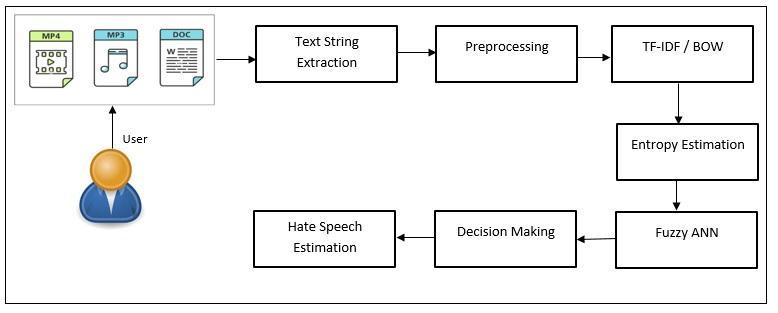
Figure1:SystemOverviewDiagram
The proposed approach for the purpose of achieving the hate speech recognition through the use of Fuzzy Artificial Neural Network has been described in the steps givebelow.
Volume: 09 Issue: 07 | July 2022 www.irjet.net p ISSN: 2395 0072
Step 1: Data Collection and Preprocessing Thisisthe initial step of the methodology where an excel sheet is provided as an input to the proposed approach which contains tweets suspected of propagating hate speech. This tweet Dataset is downloaded from the URL: https://www.kaggle.com/datasets/vkrahul/twitter hate speech?select=train_E6oV3lV.csv The audio files with the hate speech if any, are provided to a python code that effectively extracts the speech text from the audio and addsittotheexcelsheet.
Theexcelsheetisprovidedtothesystemthatisajava code. The JXL library is being utilized to interface the workbook format file to the java code effectively. The contents of the excel file are being converted into a string format and then stored in the form of a list which is then provided to the next step of the approach for the purpose ofpreprocessing.
Step 2: Preprocessing This is one of the most essential steps in the approach due to the fact that this stepcan considerablyimprovethe executionperformance effectively. The extracted text string from the previous stepwithsuspectedhatespeechistakenasaninputinthis stepoftheapproach.Thisstepidentifiesandremovesany redundancies or contradictions in the string to clean or condition it. This process considerably reduces the errors and any kind of flaw in the string that can cause a bottleneckinthelatersectionsofthisapproach.
The preprocessing is achieved by a number of stepselaboratedbelow.
Special Symbol removal Thestringusedasinput in the structure of a workbook would contain a variety of special characters that users would use to write the content using correct syntax. Among these special characters are #, !, @,?, and Such special symbols can dramatically increase processing time, hence raising the approach's temporal complexity. As a result, these special symbolscanindeedberemovedwithoutconsequence.
Stemming Thisstepisoneofthemostsuccessful because it uses the input string to seek for words with postfixes in their end such as ion, ing. These postfixes are just extensions of the core word. These prefixes are unnecessary and superfluous in the input text since they provide no further information. As a result, these words must be reduced to the base word, such as going, which will be changed into go without affecting the string's underlyingmeaning.
Stop Word Removal Stopwordsarewordsinthe English language that serve as a conjunction or link
between two elements of a phrase. These words are extremely important in spoken English because they construct a model to the phrase that a listener can efficiently follow. These words are mainly cosmetic in design and provide no further semantic value to the phrases.Asaresult,termslikefrom,and,is,the,andsoon may be simply deleted and discarded from the input text without affecting the semantic information of the string, substantially lowering the time required for system executionsignificantly.
Step 3: Term Frequency & Inverse Document Frequency
In this stage of the suggested technique, which is one of themostsignificant,theinputstringisexaminedusingthe TF IDF model. This TF IDF approach identifies the importance of the words in the string by assessing the termfrequencyandinversedocumentfrequency.Thisstep can be quantitatively expressed using the accompanying equation1.
(1)
Term frequency is obtained by calculating the frequencyofeachterminagivencommentorhatespeech The Term Achieved the prevalence of a term is calculated bymultiplyingthelogarithmicratioofthetotalnumberof documents by the number of documents containing a specificwordW.
The words with the highest TF IDF scores are considered to have a substantial impact on the sarcastic pattern's creation. As a consequence, these words have been categorized in the created framework for future use. The TF IDF technique may be defined using the algorithm 1shownbelow.
Volume: 09 Issue: 07 | July 2022 www.irjet.net p ISSN: 2395 0072
Step 4: Bag of Words: Alongside TF IDF, this is yet another essential component of Natural Language Processing that's also implemented in the proposed approach.Thebagofmodellikestoexaminetheexistence of hate speech in the supplied input text in the preprocessed string. The Bag of Terms is a set of words thathavebeenexpresslydesignatedashatefulandusedby theindividualsengaginginhatespeech.
The list previously obtained in the earlier step is being used as an input in this step of the approach. This input list contains the words in the first column and the TF IDF scores in another. This list of words is correlated with the bag of Words stored in the database. If the word in the list is correlated with the Bag of Words, then the score1isappendedattheendofthelist,ifthewordisnot found in the BoW then a score of 0 is appended. This is doneforallofthewordsinthelistandanupdatedlistwith the BoW score column is provided to the next step for entropyevaluation.
Step 3: Entropy Estimation The information gain values of the obtained word characteristics for the input stringwillhavetobeanalyzed.Thisstageofthetechnique usesthe list obtained fromthepreviousstageasan input. TheentropyoftheBOWwordsiscalculatedusingShannon informationgain,whichisprovidedinequation2below.
_____(2)
the purpose of hidden layer values estimation. The equation5providestheformulafortheactivationfunction calledReLUbeingusedintheFuzzyANN.
T= ∑ ____(3) HLV= ) 1_______(4) Where, n Numberofattributes AT AttributeValues W RandomWeight B BiasWeight HLV HiddenLayerValue
___(5)
The difference between the highest and least probabilityscoresiseffectivelydividedinto5equalpieces to create effective fuzzy categorization labels. These designations pertain to the fuzzy crisp values, which have been classified as extremely high, medium low, or very low.
Where, a=matchedwordcount c=totalnumberoftweets b=c a E=EntropyGainfactor
ThewordsareretrievedforalloftheBoWitems,andthe number of comparable words is tallied using entropy, which would be referenced to as the Information gain score. This score is calculated using the Shannon information gain formula mentioned before. The entropy estimates obtained are then added to the list and sent on tothenextphaseforthefurtherevaluation.
Step 5: Fuzzy Artificial Neural Network This is amongthemostfundamentalcomponentsintheproposed approach, in which a double dimensional list of features obtained previously is used to efficiently used to generate theneuronsfortheArtificialNeuralNetworks Thehidden layer and the output layer values are evaluated using relevant bias weights and target values as shown in the equation 3 given below. The equation 4 is being used for
The neurons of the Artificial Neural Network are therefore classified using the following criteria based on the TF IDF, BoW and Entropy scores, with labels such as Veryhigh,high,medium,low,andverylow.Theextremely high rating correlates to a high chance of hate speech, which is subsequently efficiently categorized in the following and final stage utilizing decision making. The algorithm2shownbelowmayexplainthecompleteFuzzy ANNprocedure.
14: end for 15: returnHLV 16:Stop Step 6: Decision Making The characteristics retrieved fromthecollectedstringareusedtodetecthatespeechin the previous stage using the fuzzy Artificial Neural Network. The extremely high score values obtained from the Fuzzy Artificial Neural Networks are being used to provide excellent hate speech identification. However, these numbers are inconclusive and may produce false positives and other inconsistencies. As a result, these occurrences must be effectively categorized before being showntotheuser.Asa consequence,theDecisionMaking technique successfully categorizes the data using the If then rules and shows the appropriate hate speech recognition output to the user via the Interactive User Interface.
IV RESULTS AND DISCUSSIONS
The proposed approach for hate speech estimation based on NLP and deep learning was implemented by developing the methodology in Java using the NetBeans IDE. The laptop utilized for the deployment had a typical setup with an Intel Core i5 CPU, 8GB of RAM, and a 1TB hard drive. To meet the storage requirements, the MySQL databasewasemployed.
This technique has undergone rigorous testing in order to appropriately assess the suggested approach's performance.Theprecisionandrecallconceptwasusedto evaluatetheperformancecharacteristics.
Performance Evaluation through Precision and Recall
Precision and recall are two really useful approaches for understanding how correctly a certain component in our methodology is used. A module's accuracy defines its relativecorrectnessandoffersawiderangeofreliability.
The precision metric was calculated using our techniqueastheratioofcorrecthatespeechpredictionsto total messages received. The recall criteria, on the other hand, supplement the accuracy metric and assist in determining the exact effectiveness of the Fuzzy Artificial NeuralNetworkcomponent.
This procedure calculates recall as the proportion of correct hate speech estimations to total number of inaccurate hate speech estimations. The following equationsquantitativelydescribethisprocess.
Precisioncanbedepictedasbelow
TP(TruePositive) =Thenumberofaccuratehate speechestimationsforthegiveninputtexts
FP (False Positive) = The number of inaccurate hatespeechestimationsforthegiveninputtexts
FN (False Negative) = The number of accurate hate speech estimations that are not done for the giveninputtexts
So,precisioncanbedefinedas
Precision=(TP/(TP+FP))*100 Recall=(TP/(TP+FN))*100
FMeasure=2*(Precision*Recall)/(Precision+Recall)
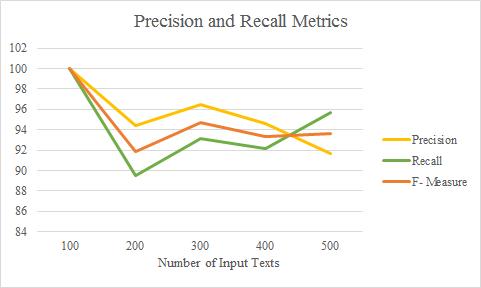
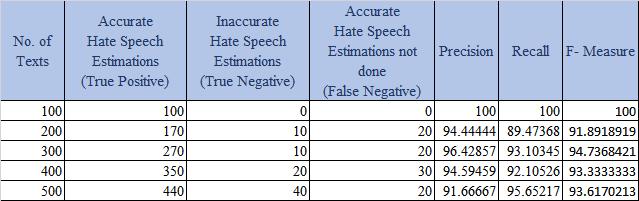
Table 1 below summarizes the empirical findings acquired using the aforementioned formula. Figure 2 shows how these tabular information are combined to produceavisualrepresentation.
Table 1: Precision and Recall Measurement Table
Figure 2: Comparison of Precision, Recall &F-Measure
The graph demonstrates the Fuzzy Artificial Neural Network's efficacy in predicting hate speech associated withtheinputtexts.Theapproach'soutstandingefficiency is demonstrated by precision and recall ratings of 95.42 percent and 94.06 percent, respectively. These figures are
International Research Journal of Engineering and Technology (IRJET) e ISSN: 2395 0056
Volume: 09 Issue: 07 | July 2022 www.irjet.net p ISSN: 2395 0072
pretty useful and satisfying for a first time application of suchamethodology.
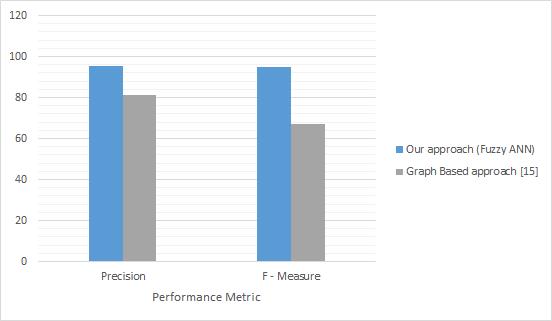
The precision, recall, and accuracy scores examined for hate speech detection revealed the suggested system's usefulness in great detail. The proposed method was successfully compared to the methods described in [15]. Our approach has a precision of 95.42 percent and an accuracy of 94.71 percent. The correlation of the graph based hate speech detection strategy with the proposed methodologyisshownintable2belowinatabularstyle.
Frequency and Inverse Document Frequency. The TF IDF andpreprocessedstringarethenusedtoestimateentropy. Entropy is estimated utilizing Shannon Information Gain, which yields entropy values that are fed into Fuzzy ArtificialNeuralNetworksforneuronsynthesis.TheFuzzy ANN technique is charged with identifying hate speech, which yields likelihood ratings. To estimate hate speech, these likelihood scores are successfully categorized using the Decision Making technique. The approach's execution effectiveness has been properly assessed through a number of tests, yielding good results of precision and Recall. The proposed method yields a precision of 95.42 percent and an accuracy of 94.71 percent over the precision and accuracy of 81% and 61% of graph based approachasmentionedin[15].
Table2:Precision,andAccuracycomparison

Inthefuturethismodelcanbeenhancedtodetectthe live hate speech in audio, video, tweets and comments by deploying the generative adversarial neural network in cloudparadigm.
REFERENCES
[1] K. A. Qureshi and M. Sabih, "Un Compromised Credibility: Social Media Based Multi Class Hate Speech ClassificationforText,"inIEEEAccess,vol.9,pp.109465 109477,2021,DOI:10.1109/ACCESS.2021.3101977.
[2] A. Rodriguez, Y. L. Chen and C. Argueta, "FADOHS: Framework for Detection and Integration of Unstructured Data of Hate Speech on Facebook Using Sentiment and Emotion Analysis," in IEEE Access, vol. 10, pp. 22400 22419,2022,DOI:10.1109/ACCESS.2022.3151098.
Figure 3: Comparison with Graph based technique depictedin[15]
As seen in Figure 3, the deep learning methodology proposed in this research paper outperforms the graph based hate speech identification approach proposed in [15]. This is owing to the Fuzzy Artificial Neural Network that has been implemented to significantly improve the accuracy of hate speech identification. These findings are extremely satisfactory because the given system achieves theaccuracyindicatedbytheperformancescores.
V CONCLUSION AND FUTURE SCOPE
This research study presents an effective technique fordetectinghatespeechonvariousmediaplatforms.This method efficiently takes the string from either the audio andaddsitintoaworkbookwhichisprovidedasaninput to the system which initially preprocesses it. Following preprocessing, the preprocessed text is delivered for Natural Language Processing utilizing the string's Term
[3] P. K. Roy, A. K. Tripathy, T. K. Das and X. Z. Gao, "A Framework for Hate Speech Detection Using Deep Convolutional Neural Network," in IEEE Access, vol. 8, pp. 204951 204962, 2020, DOI: 10.1109/ACCESS.2020.3037073.
[4] F. M. Plaza Del Arco, M. D. Molina González, L. A. Ureña López and M. T. Martín Valdivia, "A Multi Task Learning Approach to Hate Speech Detection Leveraging Sentiment Analysis," in IEEE Access, vol. 9, pp. 112478 112489,2021,DOI:10.1109/ACCESS.2021.3103697.
[5] Ashwin Geet d’Sa, Irina Illina, and Dominique Fohr, " ClassificationofHateSpeechUsingDeepNeuralNetworks" in HAL Open Access, HAL Id: hal 03101938 https://hal.archives ouvertes.fr/hal 03101938.
[6]C.BaydoganandB.Alatas,"MetaheuristicAntLionand Moth Flame Optimization Based Novel Approach for Automatic Detection of Hate Speech in Online Social
Networks," in IEEE Access, vol. 9, pp. 110047 110062, 2021,DOI:10.1109/ACCESS.2021.3102277.
[7] Y. Zhou, Y. Yang, H. Liu, X. Liu, and N. Savage, "Deep Learning Based Fusion Approach for Hate Speech Detection," in IEEE Access, vol. 8, pp. 128923 128929, 2020,DOI:10.1109/ACCESS.2020.3009244.
[8] M. Mozafari, R. Farahbakhsh, and N. Crespi, "Cross Lingual Few Shot Hate Speech and Offensive Language Detection Using Meta Learning," in IEEE Access, vol. 10, pp. 14880 14896, 2022, DOI: 10.1109/ACCESS.2022.3147588.
[9]M.Z.Ali,Ehsan Ul Haq,S.Rauf,K.Javed,andS.Hussain, "Improving Hate Speech Detection of Urdu Tweets Using Sentiment Analysis," in IEEE Access, vol. 9, pp. 84296 84305,2021,DOI:10.1109/ACCESS.2021.3087827.
[10] O. Oriola and E. Kotzé, "Evaluating Machine Learning Techniques for Detecting Offensive and Hate Speech in South African Tweets," in IEEE Access, vol. 8, pp. 21496 21509,2020,DOI:10.1109/ACCESS.2020.2968173.
[11] H. S. Alatawi, A. M. Alhothali, and K. M. Moria, "Detecting WhiteSupremacistHateSpeechUsingDomain SpecificWordEmbeddingWithDeepLearningandBERT," in IEEE Access, vol. 9, pp. 106363 106374, 2021, DOI: 10.1109/ACCESS.2021.3100435.
[12]L.H.Son,A.Kumar,S.R.Sangwan,A.Arora,A.Nayyar, and M. Abdel Basset, "Sarcasm Detection Using Soft Attention Based Bidirectional Long Short Term Memory Model With Convolution Network," in IEEE Access, vol. 7, pp. 23319 23328, 2019, DOI: 10.1109/ACCESS.2019.2899260.
[13] V. I. Ilie, C. O. Truică, E. S. Apostol and A. Paschke, "Context Aware Misinformation Detection: A Benchmark of Deep Learning Architectures Using Word Embeddings," in IEEE Access, vol. 9, pp. 162122 162146, 2021, DOI: 10.1109/ACCESS.2021.3132502.
[14] H. Watanabe, M. Bouazizi, and T. Ohtsuki, "Hate Speech on Twitter: A Pragmatic Approach to Collect Hateful and Offensive Expressions and Perform Hate SpeechDetection,"inIEEEAccess,vol.6,pp.13825 13835, 2018,DOI:10.1109/ACCESS.2018.2806394.
[15] M. Beatty, "Graph Based Methods to Detect Hate Speech Diffusion on Twitter," 2020 IEEE/ACM International Conference on Advances in Social Networks Analysis and Mining (ASONAM), 2020, pp. 502 506, doi: 10.1109/ASONAM49781.2020.9381473.
International Research Journal of Engineering and Technology (IRJET) e ISSN: 2395 0056 Volume: 09 Issue: 07 | July 2022 www.irjet.net p ISSN: 2395 0072 © 2022, IRJET | Impact Factor value: 7.529 | ISO 9001:2008 Certified Journal | Page2372