International Research Journal of Engineering and Technology (IRJET) e-ISSN: 2395-0056

Volume: 09 Issue: 07 | July 2022 www.irjet.net p-ISSN: 2395-0072
Personalized Route Recommendation for self-drive tourists based on V2V communication Suganya T1& Mrs. K.S.Janu.,M.E2 1
Abstract In this work, concentrate on a significant errand in area based administrations, specifically Personalized Route Recommendation (PRR). Given a street organization, the PRR task expects to create client explicit course ideas for answering to clients' course inquiries. An exemplary methodology is to adjust search calculations to develop pathfinding like arrangements. These techniques commonly center around lessening search space with reasonable heuristic systems. For these pursuit calculations, heuristic methodologies are frequently hand tailored, which are not adaptable to work in confounded task settings. What's more, using helpful setting data in the hunt procedure is troublesome. To foster a more principled answer for the PRR task, we propose to further develop scan calculations with brain networks for tackling the PRR task in view of the generally utilized A* calculation. The principal thought of our answer is to consequently get familiar with the expense capabilities in A* calculations, which is the key of heuristic pursuit calculations. This model comprises of twoprimaryparts. Inthefirstplace, weutilizeconsideration based Recurrent Neural Networks (RNN) to display the expense from the source to the applicant area by consolidating valuable setting data. Rather than learning a solitary expense esteem, the RNN part can gain proficiency with a period shifting vectorized portrayal for the moving condition of a client. Second, we propose to utilize an assessment network for anticipating the expense from an up and comer area to the objective. For catching primary attributes, the assessment network is based on top of position mindful diagram consideration organizations. The two parts are coordinated in a principled manner for determining a more precise expense of an up and comer area for the A* calculation. Broad analysis results on three genuine world datasets have shown the adequacy and heartinessoftheproposedmodel.
Key Words: Route Recommendation, A? Search, Graph Neural Networks, Attention, Deep Learning.
I INTRODUCTION
Data and Communication Technology gigantically affects monetaryandsocialadvancementinthetravelindustry.A programmedtravelsuggestionframeworkhasturnedinto a significant area of examination due to the headway of virtual entertainment. It has helped individuals in beating different issues. Location Based Social Networks (LBSNs) isonewheretheclientcanshareonesareaandareabased dataoverinformalcommunicationdestinations.ThisLBSN assists with understanding the users‟ propensities and overcomes any barrier between the genuine and virtual world. Giving a huge help with investigating suggestion frameworks, the geospatial datasets have upgraded the clientstravelencounters.Significantly,throughthecurrent frameworksforheadoutsuggestionneglectstogiveatotal customized travel succession for the clients. Taking visits, during the recreation time, is one of the most engaging exercises for a person. To publicize and advance the movement organizations, different associations are giving various the travel industry offices in light of a legitimate concern for the vacationers. Proposal frameworks have been effectively furnishing the clients with customized travel bundles.Facebook, Twitter, and Flickrare probably the most famous web applications, and the data in these persontopersoncommunicationlocalescanbeutilizedto foster assorted suggestion frameworks. The actual area can be divided between online networks by utilizing the area based administrations. The current data on the web based entertainment is over burden and can be diminished step by step with the assistance of the Recommendation Systems, subsequently offering types of assistance, suitable to the singular client, which is the really point of convergence of this examination. Virtual entertainment mining is the method involved with distinguishing,addressing,breakingdown,andextricating noteworthy examples, in light of the propensities for clients. It addresses measures, and models, mining significant examples from largescale web based entertainment locales Recommender frameworks make proposals, in light of the client inclinations, which is a
International Research Journal of Engineering and Technology (IRJET) e-ISSN: 2395-0056
Volume: 09 Issue: 07 | July 2022 www.irjet.net p-ISSN: 2395-0072
confounded errand. In this work the area suggestion and virtualentertainmentproposalframeworksarecompleted in view of the Travel Recommender and POI Recommender. A few compelling perspectives, similar to the clients inclinations and interests, influence the proposalsmadefortheitemsortheadministrations.Facts , contributed by networks, similar to web journals, posts made on different interpersonal organizations, logs got from Geographic Positioning Systems (GPS), geotagged photographs, structure the reason for recommender frameworks to make customized suggestions. These suggestions give individual clients, the data expected to help them in deciding. Recommender frameworks are viewedasvery pertinentwithregardstotravel arranging. Over the most recent couple of many years, these frameworks have assisted guests with distinguishing favored POIs. The primary target of the movement recommender frameworks is to associate, distinguish, coordinate the requirements and interests with the trademark the travel industry and recreation assets or spots that usually draw in voyagers. The customary recommender frameworks give clients pertinent suggestionsasfarasthemostliked,andmorelikeasimple to allude to positioned list that has uniquely diagrammed things, similar to films, spots to travel, books, etc. The customary framework generally keeps a convention and follows the positioning of comparable sorts of things. Nonetheless,whilearranginganyouting,acommonclients fundamental interest is to search for ideas from others or prescribedspotstovisitorassuchPOIs.Thesesuggestions are typically described by being heterogeneous, similar to historicalcenters,lodgings,gardens,etc.Itwouldbeuseful in this situation, if the travel industry recommender frameworkupgradesitscapacitytosuggestthingsthatare morecoordinatedandmoresensible.Packagesorbundles might be utilized instead of positioned records, as they give a more daring and exploratory experience for the clientsorvoyagers.Thesignificanceandjobofcustomized POI suggestion frameworks can't be overlooked, as they workwiththeusers‟outsideexercises.
II RELATED WORK
With the availability of user generated trajectory information, route recommendation has received much attentionfromthe research community [3],whichaimsto generate reachable paths between the source and destination locaions. The task can be defined as either personalized [5] or no personalized [8], and constructed based on different types of trajectory data, e.g., GPS data [6]or POI check in data. In the literature, various algorithms have been developed for route
recommendation. Wei et al. [7] utilized graph search algorithmsforidentifyingthepathovertheroadnetwork; Chen et al. [8] proposed probabilistic POI transition/ranking models are employed to recommend probable routes; Yuan et al. [9] proposed to mine diver direction from the historical GPS trajectories of a large number of taxis. Overall, these studies focus on search algorithms or probabilistic models by considering additional constraints, e.g., road networks or time. Our work is built on top of search based solutions, and the noveltylies intheautomatic learningofthecostfunctions usingneuralnetworks.Ourmodelisflexibletoincorporate rich context or constraint information. VanDam et al. [10] focused on studying compromised accounts in Twitter to understand who were hackers, what type of content did hackers tweet, and what features Recent years have seen the progress of profound learning in demonstrating complex information relations or attributes. As early investigations, area/direction implanting strategy are applied to address direction related assignments [11]. All themoreasoflate,Recurrent BrainNetwork(RNN)along with its variation Long Momentary Memory (LSTM) and GatedRecurrentUnit(GRU)havebeenbroadlyutilizedfor displaying successive direction information. Zhou et al. [12]proposedsubjectupgradedmemorynetworksforPOI suggestionissue;Zhen etal.[13]usedprogressiveRNN to catch significant level data in directions; Gao et al. [14] proposed variational RNN to demonstrate the inert variable of directions information; Wu et al. [15] thought about street network imperatives while planning intermittentbrainorganization;Fengetal.[16]proposeda multi modular installing RNN with consideration system to foresee human versatility; Liu et al. [17] proposed spatial transient RNN to demonstrate spatial fleeting settingdata;Aietal.[18]proposeda Spacetime highlight based RNN to display spatial fleeting data. These investigations mostly center around transient direction ways of behaving, e.g., one step area suggestion [19], whichare notappropriate forsettlingtheongoingerrand. These examinations in this course expect to consequently improve or advance the search calculations with AI strategies. Early works incorporate the utilization of AI in makingviable,reasonableacceptableorfurtherdeveloped heuristics Lelis et al. [20] proposed to predicts the ideal arrangement cost of an issue occasion without tracking down the real arrangement; Ernandes et al. presented the connected idea of likely admissible heuristics where suitabilityprerequisiteis loosenedupfroma probabilistic perspective; Samadi et al.[22] proposed a fake brain organization to consolidate a few elements into a solitary heuristic worth. All the more as of late, profound learning hasfundamentallypushedforwardtheexaminationofthis
International Research Journal of Engineering and Technology (IRJET) e-ISSN: 2395-0056
Volume: 09 Issue: 07 | July 2022 www.irjet.net p-ISSN: 2395-0072
line. The fundamental thought is to use the strong displaying limit of brain networks for further developing the errands that require convoluted addressing procedures, including the Go game [25]. Our work is exceptionally roused by these spearheading works, howeverhaveaveryuniquespotlighton theconcentrated ontask,i.e.,customizedcoursesuggestion.
III OVERVIEW OF OUR SOLUTION
For the PRR task, the previously mentioned two sorts of approaches have their own benefits. On one hand, heuristic inquiry calculations are uncommonly reasonable for the PRR task since it basically takes care of a pathfindingissueonchartsgiventhesourceandobjective. With intricate heuristics, it can create great surmised arrangements in an effective manner. Then again, profound learning techniques are strong to catch the complicated information qualities involving learnable brain networks Automatically gain proficiency with the expensecapabilitiesinA∗calculations,whichisthekey of heuristicpursuitcalculations.Forthisreason,webasically consider resolving three significant issues. In the first place, we really want to characterize a reasonable structure for the expense in the PRR task. Not quite the same as conventional chart search issues, a straightforward heuristic expense can't straightforwardly improve the objective of our errand . For instance, the recognizedcoursefoundedonthemostbriefdistancemay not meet the customized needs of a particular client. Second, we really want to plan powerful models for carrying out the expense capability which trains the hunt cycle, which is a key stage in our work. Third, we really want to use rich setting or limitation data for further developing the undertaking execution, including spatial worldly impact and client inclination. To characterize a reasonable structure for the hunt cost, we initially figure out the PRR task as a restrictive likelihood positioning issue by registering the total for the negative log of contingent probabilities for each point in a competitor direction. We utilize this type of cost to train the learning of the two expense capabilities in A∗ calculation, in particular G(·) and H(·), which measure the current and futureexpenseseparately.
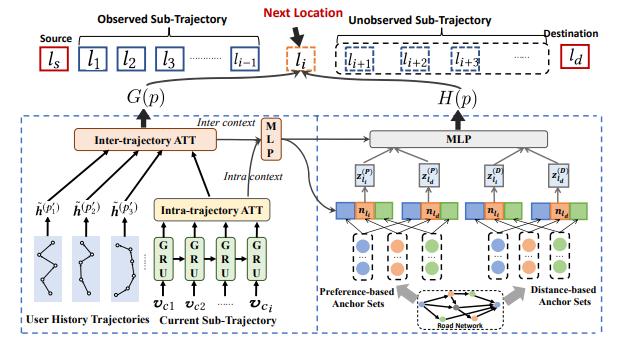
Fig-1 SystemArchitecture
Our model is created in light of the overall A calculation system. For hub assessment, we disintegrate the whole expense capability F into two sections, specifically recognizablecostandunseenexpense,whichrelate tothe cost capabilities G and H. Customarily, both G and H are heuristically registered or set. While, our thought is to consequently become familiar with the two capabilities with brain organizations rather than utilizing heuristics. Uncommonly,utilizeRecurrentNeuralNetworks(RNN)to carryoutGandanother
assessment organization to execute H. In neural network for capability G, we not just figure a solitary cost esteem, yet in addition become familiar with a period fluctuating movingstateforaexplicitclient.Themovingstateencodes essentialdirectiondataofaclienttilltheassessmenttime, whichwillbetakencareofintothecalculationofH.
III PROPOSED ALGORITHMS
A.Embedding Rich Context Information Network
embedding (NE), which maps nodes into a low dimensional latent Euclidean space to represent effective features of each node in the network, has obtained considerable attention in recent years. Many popular NE methods, such as DeepWalk, Node2vec, and LINE, are capable of handling homogeneous networks. However, nodes are always fully accompanied by heterogeneous information (e.g., text descriptions, node properties, and hashtags) in the real world network, which remains a
International Research Journal of Engineering and Technology (IRJET) e-ISSN: 2395-0056
Volume: 09 Issue: 07 | July 2022 www.irjet.net p-ISSN: 2395-0072
great challenge to jointly project the topological structure and different types of information into the fixed dimensionalembeddingspaceduetoheterogeneity.Asthe prerequisite module, embed rich context information into dense vectors, which will be subsequently used by other components. First, set up an embedding vector �� ��∈ℝ^(�� �� )user u, encoding necessary personalized userinformation.Then,foreachlocationl∈L,wesetupa corresponding embedding vector �� ��∈ℝ^(�� �� )For trajectory behaviors, temporal information is also important to consider. At i th time step, we concatenate theaboveembeddingvectorsofuseru’slocation �� ��intoa single embedding vector to form an enhanced representationofcontextualinformationas
vector produced by the GRU network and ��_(�� �� ) is the contextvectordefined,where ��_(�� ��) istakenasinputto incorporatecontextinformationateachstep.
The vector ℎ ��^((��)) encodes the moving state of auseratthei thtimestep.
C. Enhanced Moving States with Attention Mechanism
(
(
) where “||” is the concatenation operation. Here, the representationvxicontainscontextualinformationofuser ID (user preference), location ID (location characteristics) and temporal information (periodical patterns). It will be flexibletoincorporatemorekindsofcontextfeatures.
B. Encoding the Observed Sub Trajectory with RNN
Theanalysisofspatialtrafficpatternsisofinterest for several applications in many domains, from transportation and surveillance, to wireless mobile networks, where mobility modeling is needed to properly address the complexity of the agents’ motion within the system. In the maritime domain, historical ship mobility data, e.g., from the AIS, reveals, for instance, commercial maritime routes and how shipping lanes articulate in national and international waters. An intuitive tool to visualize the spatial distribution of AIS data, and hence shiptraffic,aredensitymaps.Thesimplestwaytocreatea density map is building a grid over an area of interest (AOI) and compute, for each grid cell, the number of AIS messages that ships broadcast from it in a given time frame. For the PRR task, it is important to model the trajectory characteristics of users’ moving behaviors, whichcanbeconsideredasasequentialprocess.
Utilize RNNs to model such sequential behaviors. Given an observed subtrajectory p : ls → l1 · · · → li generated by u, we employ the widely used GRU network toencodeitintoavector
ℎ ��^((��))=������(��_(�� ��),ℎ_(��−1)^((��))) where ℎ ��^((��))∈ℝ^(�� �� ) is the hidden
An observed sub trajectory can be short and noisy. Propose to use two types of attention to improve the learning of moving state by leveraging data dependence. Intra Trajectory Attention. First apply the method to compute the attention between locations in the same trajectoryas
ℎ ��^((��))=∑2_(��=1)^��〖������(ℎ ��^((��)),ℎ ��^((��)) ).ℎ ��^((��))〗
Inter Trajectory Attention. The information from a single trajectory is usually limited. In order to capture overall moving patterns for a specific user, we further consider incorporatinghistoricaltrajectoriesgeneratedbytheuser. Given the current trajectory p, we attend it to each of the otherhistoricaltrajectories,denotedas��^′,as
ℎ ��^((��))=∑2_(��^′∈��^��)〖������(ℎ ��^((��)),ℎ^((��^′)) ).ℎ ��^((��^′))〗
wherePudenotesthesetofhistoricaltrajectories generated by u. The vector ℎ ��^((��^′)) is an representationvectorofthehistoricaltrajectory��^′.
D. Modeling the Unobserved Cost with Estimation Networks
Besides the observable cost, we need to estimate the cost from a candidate location to the destination. Specially, introduce an estimation network to implement H(·). This part is more difficult to model since no explicit trajectory informationisobserved. Inordertobetterutilizetheroad network information and user preference for estimation, we build the estimation network on top of a position awaregraphneural network.Inthisframework,havetwo major parts to set, namely the anchor sets and the Dist() function. This method present two variants for instantiatingtheaboveframework,namelydistance based PA GNN and preference based PA GNN. The distance based PA GNN sets the two parts with distance information, and the preference based PAGNN utilizes userreferenceinformationtoenhancetheperformance.
International Research Journal of Engineering and Technology (IRJET) e-ISSN: 2395-0056
Volume: 09 Issue: 07 | July 2022 www.irjet.net p-ISSN: 2395-0072
IV.RESULTS
In the first place, heuristic hunt strategies, i.e., RICK and MPR, perform well, particularly the RICK strategy. RICK completely portrays the street network data and takes on the informed A calculation. This outcome confirmed the viability of the A calculation in the PRR task. As an examination, MPR for the most part considers the displaying of move organization and utilizations a moderately straightforward BFS search system. Second, the framework factorization based technique CTRR performsworsethan RICK andMPR.A potential reasonis that CTRR could not great at any point use the street organization data. Moreover, it has restricted limits in learningconfoundeddirectionqualities.Inourtrials,CTRR will in general create short course proposals, giving exceptionally awful review results for medium and long questions. Third, the profound learning technique DeepMove performs very well among every one of the baselines, while STRNN gives a more terrible execution. ContrastedandSTRNN,DeepMoveconsidersmoresortsof setting data and plans more high level consecutive brain organizations. At long last, the model NASR and its better variant NASR+ are reliably better compared to every one of the baselines in all cases, yielding excellent execution even on lengthy inquiries. Looking at the two adaptations ofourmodel,
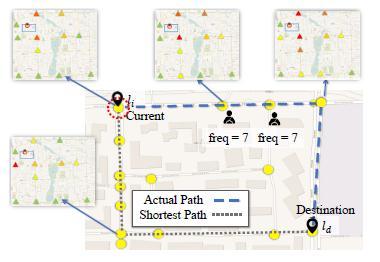
NASR+ further delivers significant improvement over the base model NASR. The significant distinction between the tworenditionsofourmodelliesinthewaythatNASR+can learn distance and inclination data utilizing the position mindful hubembedding’s.ForthePRR task, thepositional and customized data of areas are especially critical to consider. The proposed PA GNN can learn such attributes by setting up anchor sets and estimating the relations betweenanchorareasandtargetareasfromthepositional and customized point of view. By summing up these outcomes, we can see heuristic search strategies are cutthroat to settle the PRR task, particularly when appropriateheuristicsareutilizedandsettingdataisused. Inaddition,profoundlearningislikewisereadytoworkon the presentation by utilizing the strong displaying limit. Our proposed models can join both the advantages of heuristic hunt and brain organizations, furthermore, subsequently it performs best among the examination techniques.
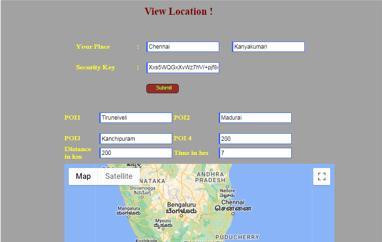
FIG-2 PERSOMALISEDROUTERECOMENDER
A possible extension of our work is the incorporation of prior information. Currently, we mainly learn the model and data representations through the historical trajectories, which can be either sparse or noisy. In order to improve our model, it will be also useful to inject prior information about traffic conditions, e.g., the congestion time of a crossroad. Besides, our approach relies on the cost function for the decision of each candidate location. However, the cost function is difficult to understand, e.g., why a candidate location has a large estimated cost. As future work, we will consider designing more interpretable estimation network for deriving the cost. Besides, our elaborate model structure also introduce some additional computational complexity. Therefore, improving the computational efficiency is also an extensiondirectionofourmodel.
FIG 3 Visualization of the learned representation using improved position-aware graph neural networks
International Research Journal of Engineering and Technology (IRJET) e-ISSN: 2395-0056
Volume: 09 Issue: 07 | July 2022 www.irjet.net p-ISSN: 2395-0072
V CONCLUSION
In this paper, westepped up to the plate and utilize brain organizations to naturally get familiar with the expense capabilitiesinAforthe PRRtask.Weoriginallyintroduced a basic A answer for settling the PRR task, and officially characterizedthereasonablestructureforthe searchcost. Then,wesetuptwopartstogainproficiencywiththetwo expenses separately, i.e., the RNN part for G and the assessment network for H. The two parts were coordinated in a principled manner for determining a more precise cost of a competitor area for search. A significant curiosity of this model lies in the assessment organization, which is created in light of position mindful chart consideration organizations. By choosing appropriate anchor sets, the assessment network is more equipped for learning distance and inclination structure attributes of street organizations. We built broad tests for confirmingtheviabilityandpoweroftheproposedmodel. Curiously, other than the framework execution, we have observed that the proposed model is likewise ready to actuallylessenthehuntspace.
REFERENCES
[1] J. Wang, C. Chen, J. Wu, and Z. Xiong, “No longer sleeping with a bomb: a duet system for protecting urban safety from dangerous goods,” in KDD’17. ACM, 2017, pp. 1673 1681.
[2] J. Wang, X. He, Z. Wang, J. Wu, N. J. Yuan, X. Xie, and Z. Xiong,“CD CNN:a partially supervisedcross domain deep learningmodelforurbanresidentrecognition,”inAAAI’18, 2018.
[3] J. Wang, J. Wu, Z. Wang, F. Gao, and Z. Xiong, “Understanding urban dynamics via context aware tensor factorizationwithneighboringregularization,”IEEETKDE, 2019.
[4] L. Tang, Z. Duan, Y. Zhu, J. Ma, and Z. Liu, “Recommendation for ridesharing groups through destination prediction on trajectory data,” IEEE TITS’19, pp.1 14,2019.
[5] G. Cui, J. Luo, and X. Wang, “Personalized travel route recommendationusingcollaborativefilteringbasedongps trajectories,”IJED,vol.11,no.3,pp.284 307,2018.
[6] J. Dai, B. Yang, C. Guo, and Z. Ding, “Personalized route recommendation using big trajectory data,” in ICDE, April 2015,pp.543 554.
[7] L. Y. Wei, Y. Zheng, and W. C. Peng, “Constructing popular routes from uncertain trajectories,” in KDD’12, 2012,pp.195 203.
[8] W. Luo, H. Tan, L. Chen, and L. M. Ni, “Finding time periodbasedmostfrequentpathinbigtrajectorydata,”in SIGMOD’13,2013,pp.713 724.
[9]H. Wu, J. Mao, W. Sun, B. Zheng,H. Zhang,Z.Chen,and W.Wang,“Probabilisticrobustrouterecoverywithspatio temporaldynamics,”inKDD’16,2016,pp.1915 1924.
[10]Z.Chen,H.T.Shen,andX.Zhou,“Discoveringpopular routesfromtrajectories,”inICDE’11,2011,pp.900 911.
[11] A. Al Molegi, M. Jabreel, and B. Ghaleb, “STF RNN: space time features based recurrent neural network for predictingpeoplenextlocation,”inSSCI’16,2016,pp.1 7.
[12]C.Yang,M.Sun,W.X.Zhao,Z.Liu,andE.Y.Chang,“A neural network approach to jointly modeling social networksandmobiletrajectories,”ACMT IS,vol.35,no.4, pp.36:1 36:28,2017.
[13]H.Wei,N.Xu,H.Zhang, G.Zheng,X.Zang,C.Chen,W. Zhang,Y.Zhu,K.Xu,andZ.Li,“Colight:Learningnetwork level cooperation for traffic signal control,” in CIKM’19, 2019,pp.1913 1922.
[14] Y. Li, R. Yu, C. Shahabi, and Y. Liu, “Diffusion convolutional recurrent neural network: Data driven trafficforecasting,”ICLR’18,2018.[15]J.Wang,X.Wang,C. Li,J.Wuetal.,“Deepfuzzycognitivemapsforinterpretable multivariatetimeseriesprediction,”IEEETFS’20,2020.
[16] S. Guo, C. Chen, J. Wang, Y. Liu, X. Ke, Z. Yu, D. Zhang, and D. M. Chiu, “Rod revenue: Seeking strategies analysis and revenue prediction in ride on demand service using multi sourceurbandata,”IEEETMC’19,2019.
[17]D. Silver,A.Huang,C. J. Maddison,A. Guez,L. Sifre, G. Van Den Driessche, J. Schrittwieser, I. Antonoglou, V. Panneershelvam, M. Lanctot et al., “Mastering the game of go with deep neural networks and tree search,” Nature, vol.529,no.7587,p.484,2016.
[18]P.E.Hart,N.J.Nilsson,andB.Raphael,“Aformalbasis for the heuristic determination of minimum cost paths,” IEEETSSC’68,vol.4,no.2,pp.100 107,1968.
[19]J.You,R.Ying,andJ.Leskovec,“Position awaregraph neuralnetworks,”inICML’19,2019,pp.7134 7143.
International Research Journal of Engineering and Technology (IRJET) e-ISSN: 2395-0056
Volume: 09 Issue: 07 | July 2022 www.irjet.net p-ISSN: 2395-0072
[20] P. Velickovic, G. Cucurull, A. Casanova, A. Romero, P. Lio,andY.Bengio,“Graphattentionnetworks,”inICLR’18, 2018.
[21] T. N. Kipf and M. Welling, “Semi supervised classificationwithgraphconvolutionalnetworks,”ICLR’16, 2016.
[22]J.Zhou,G.Cui,Z.Zhang,C.Yang,Z.Liu,L.Wang,C. Li, andM.Sun,“Graphneural networks:Areviewofmethods andapplications,”arXivpreprintarXiv:1812.08434,2018.
[23] N. Wu, J. Wang, W. X. Zhao, and Y. Jin, “Learning to effectively estimate the travel time for fastest route recommendation,”inCIKM’19.ACM,2019,pp.1923 1932.
[24] J. Wang, N. Wu, X. Lu, X. Zhao, and K. Feng, “Deep trajectory recovery with fine grained calibration using kalmanfilter,”IEEETKDE’19,2019.
[25] J. Wang, N. Wu, W. X. Zhao, F. Peng, and X. Lin, “Empowering A* search algorithms with neural networks for personalized route recommendation,” in SIGKDD’19. ACM,2019,pp.539 547.
© 2022, IRJET | Impact Factor value: 7.529 | ISO 9001:2008 Certified Journal | Page2282