International Research Journal of Engineering and Technology (IRJET)

e-ISSN: 2395-0056
Volume: 09 Issue: 07 | July 2022 www.irjet.net p-ISSN: 2395-0072

e-ISSN: 2395-0056
Volume: 09 Issue: 07 | July 2022 www.irjet.net p-ISSN: 2395-0072
Prof. Manohar B1 , Shreevalli TG2 , Chetana Naik3 , Kushal N Gond4
1Assistant Professor, Department of Civil Engineering,Anjuman Institute of Technology & Management, Bhatkal, Karnataka, India.
2Student, Civil Engineering, Anjuman Institute of Technology & Management, Bhatkal, Karnataka, India. ***
Abstract - Buildings have an important influence on energy use and the environment. Commercial and residential buildings use almost 37% of the primary energy and approximately 63% of the electricity in India. The Zero Energy Building achieve by being extremely energy efficient 50% 70% produces more energy than typical building. In the high performance building, the amount of energy used can be completely offset by renewable energy produced on or around the building. When conditions will not suitable for energy generation, the building will draw energy from the electric grid to meet it needs. When conditions improve, the onsite renewable energy systems will cover the buildingsenergy need and send excess energy back to grid to make the balance, Over the course of year, the building gives back as much energy as it takes. These zero Energy Buildings are more comfortable, morereliableandbetterfortheenvironment.
Key Words: Zero Energy Building, Energy efficiency, Green materials, Simulation, Solar Panels.
Zero Energy Building is characterized as the building with zero energy utilization i.e., the aggregate sum of energy utilized by the structure on yearly premise is generally equivalent to the aggregate sum ofenvironmentally friendly power made on the site. Buildings altogether affect energy use and the climate. The building area produces such incrediblemeasureofozoneharmingsubstancethatterrible actisimportanttoglanceenvironmentdisaster.ZeroEnergy Building will accept a major part in checking an unfamiliar weather change in a very long time to come. Using Zero Energystructuresplanobjectives removesusfromplanning low energy buildings with percent energy saving objectives and into the place i.eknown for a maintainable energy end point. The objectives that are set and characterized to achieve Superior execution building. As non renewable energy resources are finite, it should be standard that the main specific of the upcoming buildings is extreme low energy consumptionanduniform energy consumptionclose to zero. While the current old structures spent from 200 to 400kWh/(m2/year)currentenergyforheating,theneedfor heating energyfor buildings of the future generation will be from 20to50kWh/m2.Andmany countries launch related principlesofenergyconsumption.
This study proposes a detail design process that reflects a structure’s location,heattransmissionrateofthebuilding envelope, surface to volume ratio of the building in terms ofheatgainandheatloss,andalsoobservethepossiblefor solar power generation. Design concept of a zero energy building was derived by learning previous studies on the buildingdesignmethod.
Energy simulation is also called as building energy modelling,istheuseofsoftwaretopredict the energy use of the building. It output building energy use such as heating,cooling,lightingandalsoitcanpredicttheenergy cost. A typical energy model will have inputsforclimate, envelope, internal gains from lighting, equipment and occupants,heatingcoolingventilationsystems,scheduleof openings and materials will be taken from material library. Simulation is a process of using computer to build a virtual replica of building, and simulation is performed by taking the building through the weather condition of an entire year. Energy analysis is done to predictthemonthlyenergy consumptionand bills, Predict annualenergycost,annualCO2 emissions.
Design Builder is simple software to analyze environmental performance data and stunning rendered images/movies at any stage of design process. Design Builder is priced competitively and simple to learn and use by which user will be able to offer advanced simulation on even the smallest project without going overbudget.
International Research Journal of Engineering and Technology (IRJET) e ISSN: 2395 0056
Volume: 09 Issue: 07 | July 2022 www.irjet.net p ISSN: 2395 0072
• Isolationforbuildingowners from future energyprice increases.
• Increased comfort due to more uniforminterior temperatures.
• Reducedrequirementforenergy.
• Reducedtotalcostofownershipduetoimproved energyefficiency.
• Reducedtotalnetmonthlycostofliving.
• MinimizeExtraCost.
Rockwool: It is utilized for residential, commercialand industrial protection. Rockwool is exceptionally dynamic for used as security behind and around electrical boxes, wires and pipes. It can fill most wall cavities, leaving almostnoopenings.Itisalsousedasshoweroninsulating material.
Dual glassy frames: Dual glassy frames especially in combinationwithlow efinishingandgascavities.
Hermetically bolted window: Thisallowsawiderrange of glass materials to be sealed related to predictable glass-to-metal shutting processes. Double glazed windows are made by taking two panes of glass separated by a insertion bar and sealing them together intoasingleunit.
Cool rooftop tiles: Cool rooftop tiles generally havehigh solar reflectance and thermal emittance. The Solar Reflective Index (SFI), that is the limitation used to identify the degree of heat reflectance, Cool Roof Tiles usually have95%. This means that cool tiles can lower heat for about 10-15 degree Celsius on any situations.
1. Study of early and present research works in this research intensively. Based down a detail summary is listedout.
2. Selected previous research recommendations are to be utilized as research objectives in order to study them toformasimpleanddetaildesignmethod.
3 Planning of sample building in assumed site with basic ideas asper NBC recommendations in
4.Simulationofenergyefficiencyforthis welldesignedin DESIGN BUILDER /ENERGY PLUS based on ECBC code requirements.
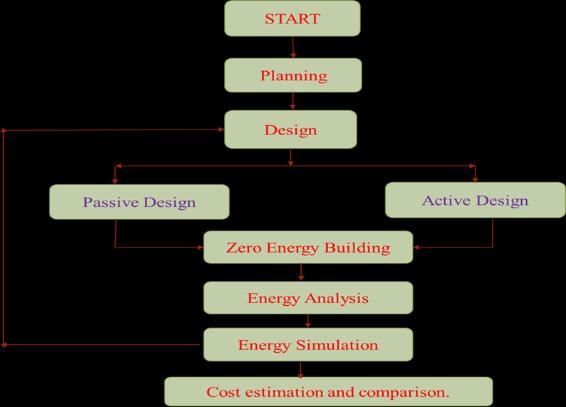
2. Implementationofsimulationdatainthedesign.
3. Quantity Estimation and cost comparison with the additionaldata.
Fig2.1explainthestagesofprojectmethodology.
Fig 2.1 TypicalflowchartofMethodology
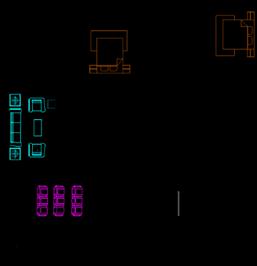
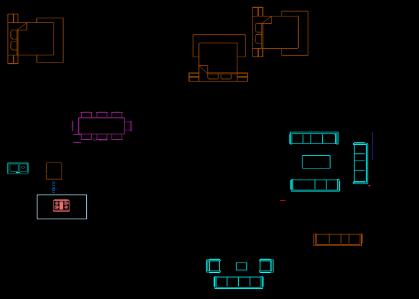
2.2.1 AutoCAD 2D
The typical building plan is prepared and the same has beendrawnusingAutoCADSoftwareshownbelow.
bricks.
Theresearchobjectiveistoprepareadetailmethodology
AAC blocks: AAC blocks are widely used in the construction of rooms and other types of residential properties, industrial and commercial buildings, suchas hotels, offices, hospitals and schools. The weight ofAAC blocks is about 80% less than modern red bricksand leads to a saving in the use of cement and steel,thus, saving costs. Moreover, being environmentallyfriendly, AAC blocks confirm better durability and improved sound and heat protection compared to forsimulationanddesignofzeroenergybuildingandthe processisasbelow,
International Research Journal of Engineering and Technology (IRJET) e ISSN: 2395 0056
Volume: 09 Issue: 07 | July 2022 www.irjet.net p ISSN: 2395 0072
Fig 2.4: Revitworksheet
Individual applicationsand appliancesin everyroomare planned and specified. Based on that data electrical load calculation has been done. Table 2.5 shows the calculationofthe electrical loadinproposedbuilding.

Fig2 .3 : FirstFloorPlan57’x58’
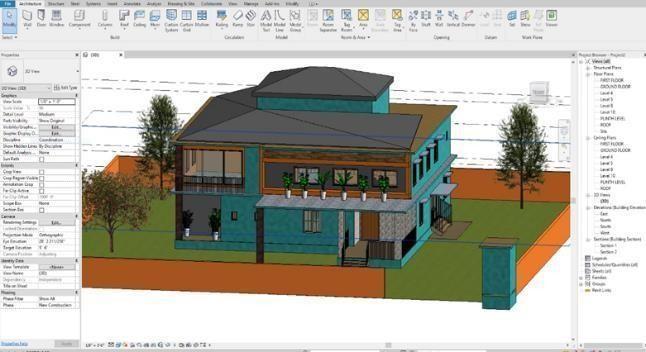
3D Perspective models are prepared using the Autodesk Revit. Materials are individually added with the data required for energy analysis. Location data, assumed orientation detail all are clearly specified. Fig 2.4 shows the3Dperspectiveviewofthebuilding
Fig 2.2: Groundfloorplan57’x58 ’
Table 2.1: CalculationofElectricLoad
International Research Journal of Engineering and Technology (IRJET) e ISSN: 2395 0056
Volume: 09 Issue: 07 | July 2022 www.irjet.net p ISSN: 2395 0072
• TotalPowerforappliances=7583W
• For the inverter optimal ought should be around 7700W
• Divide the total daily power requirement by the number of charge hours for thatenvironmental area = (19254*12)/6 = 3850.8W
• Provide 250Watt individual solar panel Total Watt/250Wattsolarpanel=3850.8/250 =15no’s, Provide 16 No 250 W panels
• NumberofBatteries
• Simulationisdoneforthespecifiedweekandyield dataareobserved.
For6hour,=72.0A*6 =432.0Ah
105Ahbatteries,shouldbesatisfiedtonomorethan50%, thus we divide total Amps by (105 A*50%) = 50Ah (approx.)
No.ofbatteries=432/50
=8.64Provide10Nos 10 batteries of 105Ah are required.
• Transferofplanand3DmodeltoDesignBuilder
• Checktheboundariesandmissingdata
• Siteorientationandregionisselected.
• Materialofbuildingisselectedfromthematerial library.
• Buildingparametersare enteredin accordancewith GRIHAstandards.
• Buildinggraphicsaregenerated tocheckwiththe architecturalfeatures.
• Heating and cooling design are inspected and calculated.
Fig 2.5: DesignBuilderSoftware
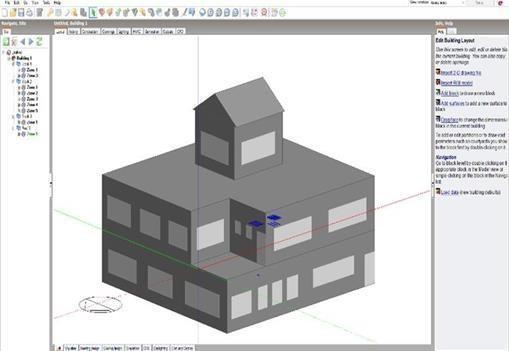
Tocompletetheprojectandobtaintheobjectives,various software is used such as Revit. For planning AutoCAD software is used and Design Builder Software is used for simulating thebuildingandalsoitgivestheoutputdata’s in the form of graphs and charts. From this software the visualresultsatintermediatedateforplannedand actual date been traced. Environmental performance data is displayed without needing to run external modules and importdataandanysimulationsrequiredtogeneratethe dataarestartedautomatically.
• Energy Plus ‘Minimized HVAC’ pictures gives a simple way in to detailed analysis of generally utilized warmingandcoolingframeworks.
• Natural ventilation has been exhibited with the selection for windows to open based on a ventilationset pointtemperature.
• Daylighting-modelslightingcontrolframeworks anddeterminereservefundsinelectriclighting.
• Concealingbylouvers,shadesandsidebladesas wellasinsideandmidsheetbinds.
250Wpanelsproduce4.8Ampsperhour, =15*4.8Amp =72.OO A © 2022, IRJET | Impact Factor value: 7.529 | ISO 9001:2008 Certified Journal | Page2210
• Acompleterangeofsimulationdatahasbeenshown inyearly,monthly,daily,hourlyorsub-hourlyintervals:
• Results on Energy intake brokendown by fuel and end-use.
International Research Journal of Engineering and Technology (IRJET) e ISSN: 2395 0056
Volume: 09 Issue: 07 |
2022
• Yieldsoninternaltemperaturegains.
• ResultsonWeatherdata.
• YieldsonHeattransmissionthroughbuilding fabric includingwalls,roofs,infiltration,ventilationetc.
3.1 Total cost estimation with PV panels.
Table3.1Totalcostestimationwithpvpanels.
Sl no Totalforstructuraland architectural(GF+FF) 1,40,58,724.19
1 ElectricalPlumbingWork 8,17307.19
2 ArchitecturalWorks 12,50,000.00 4KVSolaroffgridPower Plant 3,15,600.00
3 TotalAmount 1,95,91,631
TotalEstimatedcost ofconstruction RS 1,95,91,631
3.2 Total cost estimation without PV panels.
Table3.2 Total cost estimation without PV panels
Sl no
Totalforstructuraland architectural(GF+FF) 1,40,58,724.19
1 ElectricalPlumbingWork 7,63,768.11
2 ArchitecturalWorks 12,50,000.00
3 TotalAmount 1,60,72,649.2
TotalEstimatedcost ofconstruction RS1,60,72,649.2
In conclusion, we concluded that for our Zero Energy Project utilizing sun based energy is the best energy source with respect to saving energy and cost effectiveness. Photovoltaic solar panels are the best answerforgenerationoftheelectricityinourResidential Building. The establishment of the solar panels at first wouldbeexpensive,howeveroverthe longrunownerof thestructurewouldget a gooddeal ontheir energy bill. More extremely, in the shortage of normal assets we wouldgiveanindependent,,energysaving, nonpolluting, Zero
ISSN: 2395 0072
Energy building. The solar panels that would befitted on the back side of the building, facing towards south. This would allow for the originally most direct sunlight to be absorbedbythepanels.Accordingtousitismoreefficient to install the PV Solar system in the Residential Building. We need 250 W PV Solar panels in the Building to match the current situation of Energy Consumed in the Building and7.5yearsare requiredtorecoverthe installationcost ofPVsystem.
1 Soonmyung Lee and Sanghoon Park [2021], ‘Zero Energy Building Integrated Planning Methodology for Office Building Considering Passive and ActiveEnvironmental Control Method’, MDPI,Basel, Switzerland
2 Mr. Pranav Anant Pise, Dr.D.B. Desai, Dr.J.S. Lambe,[2021], ‘Net Zero Energy Building: Design Strategies’,IRJET,Jaysingpur,Maharashtra,India
3 Sandeep Mane, Akshaya parit, Nikhil raybole, Rajiv chavarekar [2021] ‘Planning anddesigning of zero energy residentialbuilding’,IRJET,Ashta,Maharashtra416301
4 MiguelChenAustin,KatherineChungCamargoandDafni mora, [2021] ‘Review of zero energy building concept definition and developments in Latin America: A Framework Definition for Application in panama’, MDPI, Basel,Switzerland
5 Rati Khandelwal, Mukesh Kumar Gupta, [2020] ‘Case study: India’s first netzero energy building – India paryavaranbhavan’,InternationalJournalofscientificand Technology Research Volume 9, Issue11, November 2020 ISSN2277-8616