International Research Journal of Engineering and Technology (IRJET) e-ISSN: 2395-0056 Volume: 09 Issue: 07 | July 2022
www.irjet.net
p-ISSN: 2395-0072
GREEN CHARGE: MANAGING RENEWABLE ENERGY IN SMART BUILDING’S Bhoomika K R, Shameera banu P A, Tara H Vani .R , Arjun joshi Bhoomika K R, Student, Dept. of EEE, RIT, Karnataka, India Shameera banu P A, Student, Dept. of EEE, RIT, Karnataka, IndiaTara H, Student, Dept. of EEE, RIT, Karnataka, India Vani R, Student, Dept. of EEE, RIT, Karnataka, India Arjun joshi, Assistant Professor, Dept. of EEE, RIT, Karnataka, India ---------------------------------------------------------------------***--------------------------------------------------------------------Abstract – The evolution in technology and changes in a METHODOLOGY lifestyle of people have led to risen consumption of electricity over the period time, with the non-renewable sources of energy- depleting, more focus has to be given to generating electricity from renewable energy source like solar energy, wind energy, tidal energy, geothermal energy, ect. Solar energy is one of the energy, Buildings account around 40% of the society’s energy demand and it plays a prominent role in the transition to green energy. By making the energy systems of building smarter we can attain further energy saving. Flexibility and huger efficiency in energy management. The paper elucidates a system that extracts maximum current from the solar cell to charge a battery irrespective of the irradiation and duty cycle.
1. INTRODUCTION The application of solar energy is more universal in daily now. In general, the solar power generation and solar illumination system are more popular for people. With regard to solar illumination system, which can be built while combined the charger and converter structure. It can charge the battery during the day, while lighting the LED module at night. In recent year, many charge methods have been widely used and discussed. For example constant current charging, constant voltage charging and reflex charging, etc. Reflex charging needs large input power, constant current charging is easily overcharge and constant voltage charging is unable to determine the charge current during initial charge stage. So there are still some disadvantages and insufficient while use unique charge method. In other sides, common linear dimming methods include constant voltage dimming scheme and constant current dimming scheme. Among the existing power batteries, lithium batteries possess higher energy density, lighter weight, and compact size. However, the lithium battery is still suitable for lower power applications due to high cost, temperature rise, and lower output current at instant.
© 2022, IRJET
|
Impact Factor value: 7.529
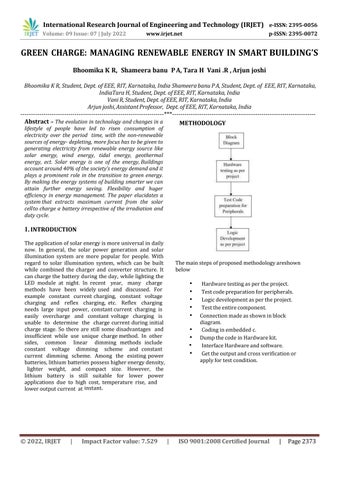
The main steps of proposed methodology areshown below
• • • • • • • • •
|
Hardware testing as per the project. Test code preparation for peripherals. Logic development as per the project. Test the entire component. Connection made as shown in block diagram. Coding in embedded c. Dump the code in Hardware kit. Interface Hardware and software. Get the output and cross verification or apply for test condition.
ISO 9001:2008 Certified Journal
|
Page 2373
International Research Journal of Engineering and Technology (IRJET) e-ISSN: 2395-0056 Volume: 09 Issue: 07 | July 2022
www.irjet.net
p-ISSN: 2395-0072
SOFTWARE USED
BLOCK DIAGRAM
Cube suite+ Renesas Flash Programmer ADVANTAGES
Solar energy is used which is freely available Due voltage regulation by buck boost constant supply voltage is obtained Solar Panel is low cost Many embedded systems have substantially different designs according to their functions and utilities. In this project design, structured modular design concept is adopted and the system is mainly composed of a single microcontroller, solar panel, boost circuit, battery and voltage divider. The microcontroller placed in the system forms the control unit of the project. Embedded within the microcontroller is a program that helps the microcontroller to take action based on the inputs provided by voltage divider
DISADVANTAGE
Current ratings will be lower in Solar Panel Variations in back emf might occur in Motor APPLICATIONS
Solar Energy is used in vehicles Solar energy is used in street lights
Voltage generated from Solar Panel form the renewable energy in this demonstration. The output of the Solar panel is fed to the boost circuit and another to voltage divider circuit. The input voltage fed to the voltage divider is divided by a factor and this voltage forms the output voltage which is given to the ADC unit of the microcontroller. The battery voltage is also given to another voltage divider whose output is fed to the ADC unit of the microcontroller. The output voltage of Solar panel and battery are compared by the microcontroller. If the solar panel is generating less voltage and the voltage stored in battery is less, microcontroller charges the battery through A.C mains.To demonstrate the working of load, a high power LED is connected to the microcontroller via an LED driver. To turn ON the LED, power from the battery is utilized. LCD is used to display the working of every unit.
Solar energy is used in traffic lights Motor is also used as power source for charging batteries in vehicles Motor is used in industries, companies, etc FUTURE SCOPE With change in technology especially in the field of electronic fabrication, most of the units can be mounted on a single chip there by making the entire system more compact.
RESULT
COMPONENTS USED
RL78 Renesas Microcontroller Buck Boost Baterry-12V Voltage divider Relay Solar Panel High Power LED LED Driver
LCD © 2022, IRJET
|
Impact Factor value: 7.529
|
ISO 9001:2008 Certified Journal
|
Page 2374
International Research Journal of Engineering and Technology (IRJET) e-ISSN: 2395-0056 Volume: 09 Issue: 07 | July 2022
www.irjet.net
p-ISSN: 2395-0072
CONCLUSION
BIOGRAPHIES
In this project, we examine how to lower electricity bills using Green Charge by storing low cost energy for use during high cost periods. Finally we analyze the green charge costs, the expected rise in electricity prices and decrease in solar panel prices may make Green Charge return on investment.
Author 1 Bhoomika K R I am currently pursuing B.E Degree in Electrical and Electronics Engineering in the year 2022 from Rajeev Institute of Technology, Hassan – 573201, Karnataka . Author 2
Author 3
Fig; Green Charge; Managing Renewable energy in smart buildings
Author 4
REFERENCES
Young-Sung Son and Kyeong-Deok Moon, “Energy
management system based on power line communication,” in Proc. IEEE International Conference on Consumer Electronics, Las Vegas, USA, pp. 115-116, Jan. 2014.
Author 5
Jinsoo Han, Chang-Sic Choi, Wan-Ki Park, and Ilwoo Lee, “Green home energy management system through comparison of energy usage between the same kinds of home appliances,” in Proc. IEEE International Symposium on Consumer Electronics, Singapore, pp. 1-4, Jun. 2013.
Chia-Hung Lien, Hsien-Chung Chen, Ying-Wen Bai,
and Ming-Bo Lin, “Power monitoring and control for electric appliances based on power line communication,” in Proc. IEEE International Instrumentation and Measurement Technology Conference, British Columbia, Canada, pp. 21792184, May 2014.
© 2022, IRJET
|
Impact Factor value: 7.529
|
Shameera Banu P I am currently pursuing B.E Degree in Electrical and Electronics Engineering in the year 2022 from Rajeev Institute of Technology, Hassan – 573201, Karnataka
Tara H I am currently pursuing B.E Degree in Electrical and Electronics Engineering in the Year 2022 from Rajeev Institute of Technology, Hassan – 573201, Karnataka
Vani R I am currently pursuing B.E Degree in Electrical and Electronics Engineering in the year 2022 from Rajeev Institute of Technology, Hassan – 573201, Karnataka
Mr.Arjun joshi received the B.E. degree in Electrical and Electronics Engineering in the year 2019 from SDM institute of technology ujire and Post-graduation degree in Power System Engineering from The National Institute of Engineering (NIE), Mysore in the year 2021.he is working as Assistant professor in department of Electrical and Electronics engineering at Rajeev instituteof technology Hassan Karnataka. He has 01 years of teaching experience. He published one International Journals. His research interest includes Power System Operational Planning and Control, Distribution System Network Reconfiguration, Service Restoration, Distribution System Automation and Distribution Generation, electric vehicle technologies, power quality.
ISO 9001:2008 Certified Journal
|
Page 2375