Big Data Analytics : Existing Systems and Future Challenges A Review
Poorvi Seth1, Merin Meleet2
Abstract In this data driven era with large amounts of information being generated, it has become quite difficult to handle this data and information through traditional methods using an acceptable number of resources. An efficient technology is required to extract value from these various sources of data, and this is where big data analytics comes into picture. Big data analytics makes use of advance analytical methods to handle data of all types raw and unstructured, semi structured or even structured data. The aim of this paper is to highlight the role of big data analytics in handling data efficiently in various fields, understand its advantages as well as the challenges it brings.
Key Words: Big data, Big data analytics, Data handling, DataLakes,DataMarts.
1.INTRODUCTION
Data is generated from almost every possible source available today, from industries and organizations to data from the digital world, that is, the internet and social media.Theworldnowrevolvesarounddata,ithasbecome the building block for any process. The findings in [1] suggest that the International Data Corporation (IDC) report predicts that the global data volume will grow 33 Zettabytes(ZB)in2018to175ZBby2025.Thisenormous quantityofdatathatisevergrowing,istermedasbigdata. Lately, big data is also being used to refer to the datasets used to carry out research work as these datasets keep increasing constantly and special tools and technologies arerequiredtohandleandfurtheranalyzethem.
Such vast amount of data comes with various characteristics which are broadly classified into five categories, known as the 5 Vs of big data These are namely volume, velocity, variety, veracity and value. Volume refers to the size and quantity of data present If thevolume of the data is large enough, itis considered as big data. As mentioned previously, data present currently is “enormous” which refers to the volume of data. Next comes Velocity which essentially determines the rate at which data gets generated and further grows. This characteristic of big data is very essential for organizations as they need the data flow to be constant and quick to help make the right decisions. While most of thedatageneratedisuseful,butnotallofitiseffectivefor an organization’s decisions and growth. This is where Veracity comes into picture. It deals with the quality and correctnessofthedatabeinggenerated.Varietydealswith the different types of data present. As mentioned previously, big data deals with all types of data which
includes unstructured data that is the raw and unformatted data, which is generated from various sources, semi structured data is a type that as some information attached to it that makes it more usable than unstructured data and lastly is structured data which is the most ideal for of data for effective data analysis. Data lakes constitute of unstructured data while data marts constitutestructureddatawhichisprocessed,filteredand formatteddatafromthedatalakes.Moreaboutdatalakes and data marts will be discussed in the later sections of this paper. Lastly, Value refers to the benefits that can be gained by the usage of data With such enormous volume of data being generated every day, big data can playa big role in adding value to an organization or individual’s performance.
Having discussed the characteristics of big data, it is now clear that such large volumes of data require special methodologies to help analyze it so that it can help add valuetotheorganizations andindustries.Thisiswhatbig data analyticsdealswith tohandleand processbigdata in the right way so that the specific use case gains maximum value from it. For example, Amazon has gained massivevaluebyanalyzingthelargedataofitscustomers and their purchases and then building a recommendation system that allows the customers to easily view more products of their choice, which increases the chances of the customer buying products from their site, which in turnincreasestheprofitsandvalueoftheorganization[2]. However, this is not an easy task larger the volume of data,tougheritgetstoanalyzeit.
Thispaperfirstdiscussesthevariousexistingsystemsthat make use of big data analytics to increase data handling efficiency. The next section highlights the advantages of thebigdataanalyticstoolsandmethods.Lastly,thepaper helps understand the challenges this methodology can bringwithit.
2. EXISTING SYSTEMS
As discussed in the previous section, the right analysis of bigdata canaddtremendousvaluetoanyorganizationor industry.Thisbenefitofbigdataanalysishasalreadybeen put into use in to increase the value and efficiency of various industries. In this section, a few such existing applicationsofbigdataanalysiswillbediscussed.
2.1 Big data analytics in health care
Healthcare is one of the most essential industries in the world. As seen in the pandemic, the health care industry

International Research Journal of Engineering and Technology (IRJET) e ISSN: 2395 0056
wasofprimeimportance,withoutwhichitwasimpossible to survive. Every day, the healthcare sector maintains a large quantity of data and the big data analysis helps this industry by providing tools and technologies to analyze thelargedatasetsofallthepatientswhichinturncanalso help health care researchers understand the diseases and itssymptomswithmoreaccuracy.
The authors of [3] provided a research model that helps corelate how big data analytics can help fight against pandemics like COVID 19 and other epidemics as well because these diseases are highly contagious and infectious so appropriate and efficient tools and technologies are required to study the effects of these diseaseswhichcanhelparriveatasolutionforprevention and even cure. This model was based on researching and reviewing multiple data sources that have proved to help fight against serious diseases. The main intention of this work wastoshowthatwhenthereissucha largevolume of data available, it should be analyzed and used in the right ways as it can contribute towards the health and well beingofthesociety.Asaresultofthisresearch,itwas also found out that majority of health care related data is generated from social media and search engines which makethedata enormous andunstructuredthusmaking it difficult to handle which is where big data analytics helps by providing methods for processing this large unstructured data and adding value to it in a way that benefitsthewell beingofthepeople.
2.2 Big data analytics meets social media
Now is the era of social media. Everything happens on social media because of which enormous volumes of data is being generated every minute. Of course, not all this data would be useful but majority of it can be of great valueifanalyzedintherightways.
In [4] the authors aimed on providing intensive research ontheexistingworkthathasbeencarriedoutinsocialbig data analytics. As shown in Fig 1, two main categories of social
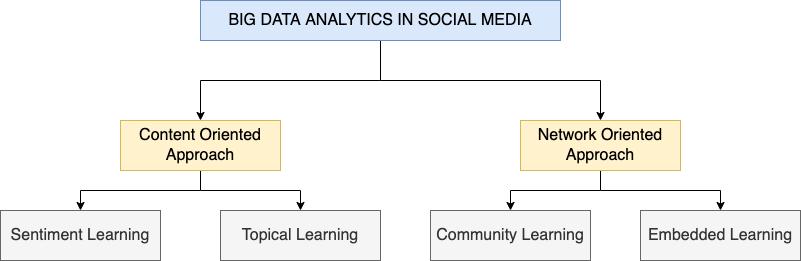
relationships as well as their interactions with users outside their groups are also considered. On the other hand,thecontent orientedapproachdealswiththeposts that are generated as a result of user activity, that is, the content that users create on social media. A large volume of data is generated from such content and big data analysis tools and strategies are used to analyze this content generateddata tohelpgainmaximumvalueout of it. This can be seen in case of the content creators who aremorefamouslyknownasinfluencersthesedays.Social mediasitesmakeuseofbigdataanalyticsbyprovidingits users with insights about the content they post. These insightsarenothingbutwell analyzedandstructureddata that help the content creators understand the number of people engaging with their content which would help them create better content. Also based on these insights, brands collaborate with these creators which adds value both to the brand and the creator. Thus, this shows how just by analysis data in the right way, individuals and businesses can have a great potential to grow. This aligns withtheresultoftheresearchconductedbytheauthorsof [4] who concluded that almost 51% of profits from social bigdataanalysiscomefromcontent basedlearning.
2.3 Big data analytics in intelligent transportation systems
The transportation system is another essential system globally as it is one of the most frequently used systems across the world. But the question here is, how can a transportationsystemgeneratedata?Theanswertothisis the implementation of intelligent transportation systems whichconsist of deviceslikeGPStrackers,videocameras, RFID tags, Vehicle to Infrastructure (V2I) sensors as well as Vehicle to Vehicle (V2V) sensors and many more devices. These devices help in the generation and collectionofdata.Asmentionedpreviously,transportation is one of the most frequently used systems, hence huge volumesofdataaregeneratedeverydayviatheintelligent devicesthatarenowinstalledinmanypartsoftheworld.
Fig 1: Socialbigdataanalytics[4]
bigdataanalysisapproacheswereidentifiedas:network orientedandcontent orientedapproaches. Thenetwork oriented approach took into consideration the relation betweentheuserspresentonsocialmediatocarryoutthe analysis. Groups of social media users and their
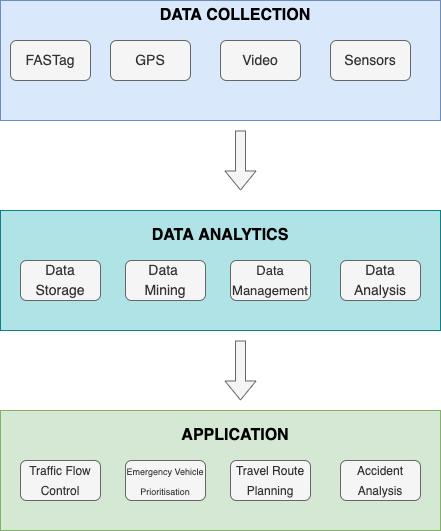
Averyelaborateandeasytoimplementprocessofmaking useofbigdataanalyticstomakeuseofthedatagenerated by intelligent transportation devices is explained by the authors of [5]. It is a three phase process as illustrated in Fig 2.Thefirstandmostimportantphaseisthecollection of data for the analysis. As mentioned previously, data is generated from various devices like video cameras that record and capture details like the vehicle number and speed with which its moving, then there are RFID tags which have recently been introduced in India as FASTags which helps in making wireless toll payments also captures details of the vehicle and its user while registration. Once the data is collected, big data analytics techniques are used to store data using big data analytics technologies like Hadoop, Apache Spark, Kafka, etc., analyze it and further help with the data management. Lastly,bigdataanalyticshelpsinaddingvaluetothelarge volumes of data that is collected. With fast collection and analysis of road data from video cameras, the data can be analyzed to help control and manage the traffic in that
Volume: 09 Issue: 07 | July 2022 www.irjet.net p ISSN: 2395 0072 © 2022, IRJET | Impact Factor value: 7.529 | ISO 9001:2008 Certified Journal | Page 2127
International Research Journal of Engineering and Technology (IRJET) e ISSN: 2395 0056
particular area hence aiming at reducing traffic congestion.Anothervery essential applicationcould be to analyzethereal time
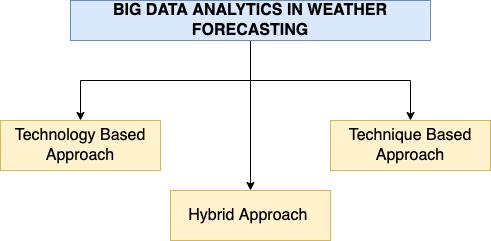
approaches are proposed in [6] as shown in Fig 3. The technique based approach deals with improving the quality of the weather predictions by using analysis techniques like machine learning. As a result, high accuracy is obtained but the time taken to achieve these results is considerably high. On the other hand, the technology based analysis approach tries to overcome thedrawbackofthepreviousapproachbyspeedingupthe data analysis process to further enhance the forecasting process.Asaresultofthisapproach,itisfoundoutthatit provides quick results in term of processing time taken but also has a disadvantage of lesser reliability. As both theabove mentionedapproacheshavesomedrawbacks, a third approach is suggested which is a combination of both the approaches and various big data analysis techniquesandhenceit’scalledthehybridapproach.Soas a result, this approach speeds up the big weather data analysis process as well as provides high quality and accurate results. But in application, currently majority of theindustriesfollowthetechnique basedapproachasit focuses on providing accurate results which is of at most importance.
Fig 2: Processofbigdataanalysisintransportation systems[5]
traffic data via V2I or V2V sensors which would help in prioritization of emergency vehicles like ambulance, fire trucks, etc. This collected data could help provide the vehicle drive the best suitable route so that traffic can be avoided. So, as explained above, the incorporation of big dataanalysiswithintelligenttransportdevicescanaddbig valuetotheglobaltransportationsystem.
2.4 Weather forecasting and big data analytics
Weather forecasting is a concept which is an essential component of people’s daily lives. The daily activities are plannedaccordingtotheweatherforecastoftheday.As it is a daily process, it implies that data also gets generated daily which makes it fall under the category of big data andhencespecial techniquesarerequiredtoanalysisthis big data. It may not seem like an essential system, but various research suggests that weather forecasting as an impact on many industries like tourism, transportation, agriculture, sports, construction, etc. Weather forecasting has an impact on these above mentioned industries as these industries heavily rely on the weather to carry out theirday todayproceedings.Forexample,weatherplaysa crucial role for the right growth of agriculture, tourism industry gets impacted as people plan their travels based ontheweatherandeventhesportsindustryasthesports analystsstudiestheweatherconditionsbeforeeverygame tounderstandhowthepitch/fieldwillplayoutduringthe game.
Asunderstoodfromtheabovediscussion,largeamountof weather related data is generated daily from different industries.Itbecomesimportanttoformulateanapproach toanalyzethisbigdata efficientlysothat theseindustries can gain value from the big data generated. Three such
Fig 3: Approachestoanalyzebigweatherdata[6]
2.5 Big data analytics as a business concept
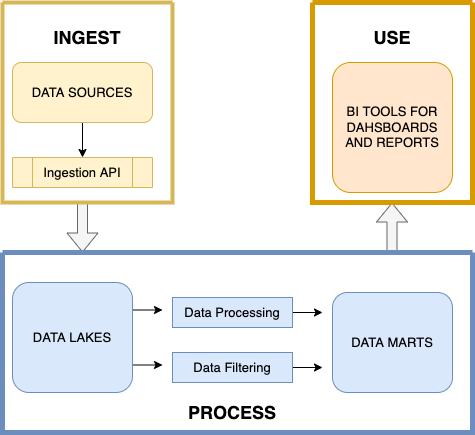
Businesses these days thrive on data. It has become the most essential aspect of a business. Again, data is being generatedbybusinesseseverydayandhenceclassifiedas big data. This data is stored in the form of data lakes withintheorganizations.Thedatalakesactasarepository to store the big data in raw and unstructured format that are generated from various sources available within the organization.
As illustrated in Fig 4, the big data analytics process in handling business data is a three phase process which includes:dataingestion,dataprocessinganddatausage.
The first phase is data ingestion which means collecting data from various sources which could be internal or external but relevant to the organization. As a part of transferringthedatatothenextphase,aningestionAPIis used which stands for Application Program Interface which acts as a link between two applications hence making it easier to ingest data into the data lakes with efficiency.Herethenextphasebeginswherethedatathat is ingested is processed within the data lakes. If required, datamartsarecreatedwhichconsistoftablesthatcontain
Volume: 09 Issue: 07 | July 2022 www.irjet.net p ISSN: 2395 0072 © 2022, IRJET | Impact Factor value: 7.529 | ISO 9001:2008 Certified Journal | Page 2128
International Research Journal of Engineering and Technology (IRJET) e ISSN: 2395 0056
processedandfiltereddatafromdatalakeswhichmakesit easier to analyze the data as the size of data and redundancy get reduced. This is a key concept of big data analyticswheredata marts arecreatedfromdata lakesto make the analysis process faster and efficient. Finally, the ingestedand
itself,it wouldlead to inaccurate resultswhichcould ruin the entire research study or if there is uncertainty in big weather data collected it can cause a negative impact on alltheindustriesthatdependonthisdayfortheirday to day functioning. There are a few theories that exist to deal with this uncertainty in big data, some of which include:Bayesiantheory,Belieffunctiontheory,Fuzziness, Probabilitytheoryandmanymore[2].
3.2 Security and privacy of data
Fig 4: Bigbusinessdataanalyticsprocess
processedbigdataisputintousewiththeaidofBusiness Intelligence (BI) tools which help in creating data jobs which query the data available to create various types of businessreportsanddashboardsintheformofpiecharts, bigvalues,groupedcharts,bargraphs,etc.Thesehelpthe businesses in gaining in depth insights about their products, technologies and customers, hence helping the businessgrowandgainprofits.
3. CHALLENGES
Afterdiscussingtheexisting systems, itisevidentthatbig data analytics prove to be very advantageous in helping industriesandorganizationsgeneratevaleoutofthedata collected.Butdealingwithbigdataisnotaneasytaskand brings along with it certain challenges. This section discussesthechallengesfacedindealingwithbigdata.
3.1 Uncertainty in big data
Uncertainty in big data relates to incomplete or at times incorrectdatacollection.[2]Thiscancauseahugeimpact on the big data analysis process as the analysis would be basedonincompletedatawhichwouldmostprobablylead to wrong results. This would raise a major challenge for the systems and organizations making use of the big data analytics.Forexample,ifabiaseddatasetisgatheredfora medicalresearchandanalysisisperformedonthisdataset
Handlingsuch enormous volume of data is not an easy task. Few of the tools used for performing big data analysis make use of data disparate sources to do so which leads to a high risk of the data being exposed, making it vulnerable. When handling business data in this way it can lead to major security concerns as this datawouldconfidentialandprivatetothecompany.So, if the right bigdata analysis tools and technologies are not used, it can cause a breach of security and privacy leading to high amounts of risk. For example, while performing medical research, if the patient’s dataset gets compromised during the analytics process, it can breach the privacy of the patients and land the researchers into serious trouble. The process of data handling must be done by keeping the risks associated with its mishandling in mind. Company security and confidentiality norms should always be followed while dealingwithorganizationaldata.
3.3 Scattered data storage
When the data is collected from different sources that reside in different databases which do not communicate with each other it hinders the analytics process as the initial access is limited to only certain data and the entire data view is not available. A lot of time gets wasted in raising access permissions. This is not a high priority concernascomparedtotheabove mentionedchallenges, but this definitely slows down the analytics process and hencecausesadelayinachievingthedesiredresults.
3.4 Big data handling costs
Right from the data collection stage till the final analysis stage,thebigdata analysisprocessdemandshighamount ofexpenses.Thisisduethefactthatlargevolumesofdata are being dealt with and it is essential to use the best available tools and techniques for data handling, storage, managementandanalysis.Forexample,ifanorganization decidesonusinganon premisesolutionforcarryingout the process, then additional costs will be incurred for arranging the set up of the hardware devices. Or if the organization opts for a cloud based solution then additional costs are required for hiring trained specialists inthisfieldandforthedevelopmentofcloudservicesand frameworks.Hence,dependingontheorganizationsneeds andgoals,resourcesshouldbeallocatedaccordingly.
Volume: 09 Issue: 07 | July 2022 www.irjet.net p ISSN: 2395 0072 © 2022, IRJET | Impact Factor value: 7.529 | ISO 9001:2008 Certified Journal | Page 2129
International Research Journal of Engineering and Technology (IRJET) e ISSN: 2395 0056
4. CONCLUSION
In this study a rapidly growing technology has been discussed big data. Having understood the five main characteristics of big data Volume, Variety, Velocity, Value and Veracity, various existing systems have been discussed which generate big data and require new tools andtechnologiestohandlethis enormousvolumeofdata. Here is where big data analytics comes into picture. The entire process starting from data collection to data storage, to data management and finally data analytics, is handled by big data analytics. It provides various data storage possibilities some of which are Hadoop, Kafka, Apache Spark and many more. It also provides various methodologies to process this stored data so that some valuecanbegainedfromthegenerationofbigdata.
Withtheapplicationofbigdataanalyticssomeofthemost essential industriesandsystemsoftheworldhavegained huge profits the health care and medicine industry, the transportation systems making use of intelligent devices, the big corporations and businesses, the weather forecasting system, and lastly the biggest industry of this era social media. All of these make use of big data analytics to add value to large volume of data that they generateeveryday.Butwithsomanyadvantagesandsuch large volumes, challenges are bound to appear like the uncertainty of big data, scattered storage, security and privacyaswellasbigdatahandlingcosts.
In conclusion, almost everything in today’s world generates large volume of data daily, and this is just the start. This is a rapidly growing concept which requires specialized techniques to extract value out of it for which analytics plays a key role it helps generate value out of thelargevolumesofdatagenerated.Hence,bigdataisthe future of analytics as their interrelation helps gain maximumprofitstobothindividualsandindustries.
REFERENCES
[1] The Digitization of the World From Edge to Core, #US44413318, David Reinsel, John Gantz , John Rydning,2018.
[2] H.Hariri,Reihaneh&Fredericks,Erik&Bowers,Kate, “Uncertainty in big data analytics: survey, opportunities, and challenges,” Journal of Big Data, 6, Jun2019,doi:44.10.1186/s40537 019 0206 3
[3] Corsi, A., de Souza, F.F., Pagani, R.N.et al,“Big data analyticsasatoolforfightingpandemics:asystematic review of literature,” J Ambient Intell Human Comput12,9163 9180, Oct 2020, doi: 10.1007/s12652 020 02617 4.
[4] Sepideh Bazzaz Abkenar, Mostafa Haghi Kashani, Ebrahim Mahdipour, Seyed Mahdi Jameii, “Big data analytics meets social media: A systematic review of
techniques, open issues, and future directions,” Telematics and Informatics, Volume 57, 101517, ISSN 0736 5853, March 2021, doi: 10.1016/j.tele.2020.101517.
[5] L.Zhu,F.R.Yu,Y.Wang,B.NingandT.Tang,"BigData Analytics in Intelligent Transportation Systems: A Survey," in IEEE Transactions on Intelligent Transportation Systems, vol. 20, no. 1, pp. 383 398, Jan.2019,doi:10.1109/TITS.2018.2815678.
[6] Fathi, Marzieh; Haghi Kashani, Mostafa; Jameii, Seyed Mahdi; Mahdipour, Ebrahim, “Archives of ComputationalMethodsinEngineering,”,Vol.29Issue 2,p1247 1275.29p,Mar2022.
[7] Blagoj Ristevski, Ming Chen, “Big Data Analytics in Medicine and Healthcare,” Journal of integrative bioinformatics,Mar2018.
[8] Galetsi, Panagiota & Katsaliaki, Korina & Kumar, Sameer, "Big data analytics in health sector: Theoretical framework, techniques and prospects,"International Journal of Information Management, Elsevier, vol. 50(C), pages 206 216, 2020.
[9] JunliangWang,ChuqiaoXu,JieZhang,RayZhong,“Big dataanalyticsforintelligentmanufacturingsystems:A review,” Journal of Manufacturing Systems, Volume 62, Pages 738 752, ISSN 0278 6125, Jan 2022, doi: 10.1016/j.jmsy.2021.03.005.
[10] Hassani H, Beneki C, Unger S, Mazinani M.T, Yeganegi M.R, “Text Mining in Big Data Analytics,”Big Data Cogn.Comput,Jan2020,doi:10.3390/bdcc4010001.
[11] Chong, Dazhi & Shi, Hui, “Big data analytics: a literaturereview,”JournalofManagementAnalytics2, 175 201, Jul 2015, doi: 10.1080/23270012.2015.1082449.
[12] Tsai,CW.,Lai,CF.,Chao,HC.etal,“Bigdataanalytics:a survey,”Journal of Big Data2,21, Oct 2015 doi: 10.1186/s40537 015 0030 3
[13] Awotunde J.B., Jimoh R.G., Oladipo I.D., Abdulraheem M.,JimohT.B.,AjamuG.J,”BigDataandDataAnalytics for an Enhanced COVID 19 Epidemic Management,” Artificial Intelligence for COVID 19. Studies in Systems, Decision and Control, vol 358, Springer, Jul 2021,doi:10.1007/978 3 030 69744 0_2
[14] Alam T. Khan, M.A. Gharaibeh, N.K. Gharaibeh M.K., “BigDataforSmartCities:A CaseStudyofNEOMCity, Saudi Arabia,” Smart Cities: A Data Analytics Perspective. Lecture Notes in Intelligent Transportation and Infrastructure, Springer, Dec 2021,doi:10.1007/978 3 030 60922 1_11
Volume: 09 Issue: 07 | July 2022 www.irjet.net p ISSN: 2395 0072 © 2022, IRJET | Impact Factor value: 7.529 | ISO 9001:2008 Certified Journal | Page 2130