International Research Journal of Engineering and Technology (IRJET) e ISSN: 2395 0056

Volume: 09 Issue: 07 | July 2022 www.irjet.net p ISSN: 2395 0072
International Research Journal of Engineering and Technology (IRJET) e ISSN: 2395 0056
Volume: 09 Issue: 07 | July 2022 www.irjet.net p ISSN: 2395 0072
N. Ravikumar1 , CH. Durgarao2
1PG Student, Department of civil Engineering, Velaga Nageswara Rao (VNR) College of Engineering, (Approved by AICTE and affiliated to JNTUK, Kakinada), G.B.C. Road, Ponnur 522124, GUNTUR, A.P (INDIA).
2Assistant Professor, Department of civil Engineering, Velaga Nageswara Rao (VNR)College of Engineering, (Approved by AICTE and affiliated to JNTUK, Kakinada), G.B.C. Road, Ponnur 522124, GUNTUR, A.P (INDIA). ***
Abstract The approximate fundamental natural period of vibration in seconds of a moment resisting frames building without brick infill panels may be estimated by the following empirical expressions of IS 1893:2016
Ta = 0.075h0.75 for R.C. frame building
Ta
= =
0.085h0.75 0.09 h /√d for steel frame building for all other buildings
Computation of seismic base shear requires the fundamental natural period of vibration (T of the building. However, for the building configuration adopted and the construction material chosen, it is not always possible to exactly determine T fromtheoretical considerations, that is, through detailed dynamic analysis. Hence, empirical formulae obtained through experimentally observed behavior of buildings are utilized. A number of experimental studies were performed by various agencies of different countries and proposed period vs. height relationship for the estimation of the fundamental natural period of the building. Efforts arestill being made by various researchers to improve the code based expressions, as current code equations are predicting period values on the lowerside, which ultimatelyproduce higherbase shear. The aim of this study is to produce a period equation in order to predict the fundamental period of vibration of reinforced concrete buildings with moment resisting frames. Such buildings are considered in this study by analytically modeling 3D frames. For bare RC buildings, these 3D frames can be used adequately to estimate the period of vibration of the whole building in the principle direction in which these frames act. However, in a real building with infill panels, some of the frames are bare, some are fully in filled and some have infill panels with openings for windows and doors and it has been observed that infill masonry provides additional stiffness to the structure, but after a few second of earthquake shaking stiffness degradation is observed. Hence, the influence of infill panels is not considered.
building.Thefundamentalperiodistheimportantproperty of the building/structure for determination of the elastic demandand,indirectly,therequiredinelasticperformanceof thestructure.Inthecalculationoflateralforcesanddesign baseshearofabuilding,itisanimportantparametertobe considered. In the evaluation of the expected seismic load affectingthebuilding,theestimatedfundamentalperiodisan essential parameter, that’s why its precise estimation is important for the safety of the design procedure and consequently for the performance of the structure in the future. The Indian seismic code IS 1893(Part 1) 2016 providestheempiricalexpressionsof T ofthebuildingtaking its parameters; vertical dimension (H; height), types of structure,lateralforce resistingsystem,andinfillwalls,into prime consideration. These expressions are based on the recorded period of vibration of real buildings during the earthquake. Initially, the expressions were presented in termsofthenumberofstories(N)orheightofthebuilding (H),butlateron,thesameweredevelopedintermsofother considerationsalsoasmentionedabove.
The use of an empirical expression, the rational method (referring to dynamic analysis) and the experimental techniquesappliedonsimilarbuildings(which isprobably notdoneinusualpractice)aretheprimlyavailablewaysto estimation the value of T. In other words, in current provisionsofseismiccodes,theestimationofseismicforces with the help of design spectra requires either the use of available empirical equations for the fundamental period determination or more specifically detailed dynamic analysis.
But, the study of research works shows that the earlier attempts of the deriving formula of T was made using the recordingsoftheearthquakesandperformingthestudyof vibration on a limited number of buildings of a set of locations.Thederivedempiricalexpressionsof T basedon thesedatawereadoptedbymanydesigncodesofdifferent countries.
Words: ReinforcedConcrete,Steelbuildings,Moment ResistingFramedBuildings
Theearthquakedesignandanalysisofanyreinforced concrete structure requires an essential procedure of the estimation of the fundamental period of vibration of the
ThecharacterizationofthestructuralparametersofRC MRF buildings, affecting the fundamental period of reinforcedconcretemomentresistingframebuilding(RC MRF) comes under the preliminary objective of the study.
International Research Journal of Engineering and Technology (IRJET) e ISSN: 2395 0056
Volume: 09 Issue: 07 | July 2022 www.irjet.net p ISSN: 2395 0072
The detailed analysis of the effect of the different parameters of structure including the characterized parametersistheintermediategoalofthestudy.
The final objective of the work is to develop the expression of the time period(T) of the reinforced concreteframedbuildingsothattheexpressionmaybe capable enough to express the relation of T with the different structural members of the buildings in close vicinityoftheresultsofthedynamicanalysis.
The sensitivity analysis has also been presented in the work to identify the weightage of the intensity of the effectoftheconsideredparametersontimeperiod.
The validation analysis of the result of the developed expressionisalsoperformedbycomparingthemwith theresultsofdynamicanalysis.
In the previous study of literature, it has been already discussed thatthereisthescopeofconsiderationof thestructuralelementsotherthantheheightofthebuilding as the parameters in the analysis of ‘T’ of building. The presentcodeequationof ‘T’ givesitsconservativevalue,due towhich,thebaseshearcalculationsproduceitshighervalue, which tends for uneconomic construction due to higher sections of structural elements. The structural parameters discussed under the objectives of the study have been considered in the analysis of their effect on ‘T’ to fulfil the objective of the development of a period formula incorporating these parameters along with ‘H’. To achieve this aim, the analysis has been done as per the following adoptedmethodology.
The comparative study of the results of the developed equation and the proposed equations of different researchershasalsobeenpresented.
Based on the study of available research literature, the dependency of a fundamental time period (T) of the reinforcedconcrete(RC) momentresistingframed(MRF) building on other structural parameters(other than height ornumberof storey)can easily be observed.
1.2 Factors on the fundamental period of the building
Slabthickness
Dimensionsofthebuilding planorwidthofthe buildinginconsidereddirection
Planareaofthebuilding.
Stiffnessintermsofthetotalcross sectionalarea ofthecolumns
Dimensionsofbeam
Theratioofbeamwidthtodepth
The number of panels in the longitudinal and transversedirection.
Length of panel/bay in longitudinal and transversedirectionetc.
Theratioofbaylengthtothetotalplandimension intheconsidereddirection
Theratioofthetotalcross sectionalareaofthe columns to the base area of thebuilding.
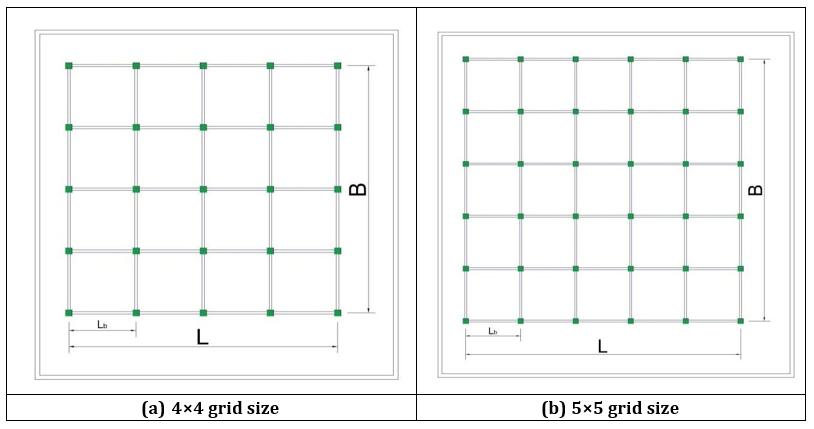
Figure 1representthetypicalplansoftheconsidered buildingmodelswithbaysizes4×4,5×5,6×6,7×7, and8×8. L and B represent the dimension of the plan in respective directions,and, Lb isthelengthofthebay(m)inthecondered directionoftheplan.
Theconsidered RC framebuildingshavingsquare shapedintheplanareanalyzedusingtheanalysisanddesign software of structure STAAD.Pro V8i with the following assumptionmentionedinTables3.1.
International Research Journal of Engineering and Technology (IRJET) e ISSN: 2395 0056
Volume: 09 Issue: 07 | July 2022 www.irjet.net p ISSN: 2395 0072
Table -2: Materialpropertiesanddesignparameters
Specifications Details
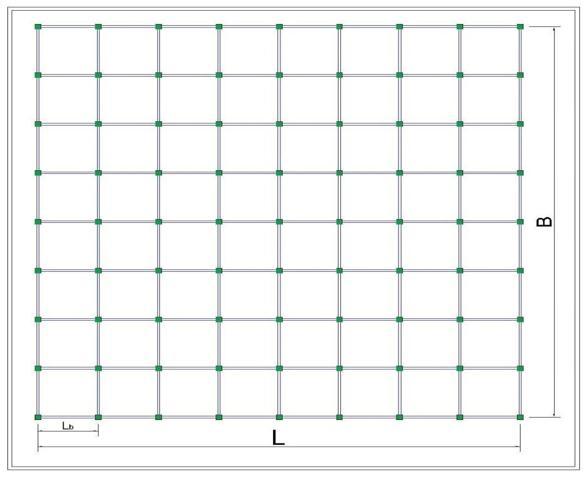
Fig 2:Typicalplanswith8×8gridsize
Table 1: Structuralconfigurations
Specifiions Details
Typeofstructure Multi storeyrigid jointedframes
No. of storey GFtoG+5, G+6toG+10
Floor height 3.6m
No. of grids 8×8,7×7,6×6, 5×5,4×4
Thickness of slab 150mm, 175mm, 200mm, 225mm, 250mm Bay length 4m,5m,6m,8m 0.3m×0.3m,0.4m×0.4m,
Size of columns 0.5m×0.5m,0.6m×0.6m, 0.7m×0.7m,0.8m×0.8m, Walls
(a) External 200mm100mm
(b) Internal Beamwidth 300mm Beam depth 600mm
Equivalent static lateral force method. Static analysis
Dynamic Usingresponsespectrum analysis method.
Seismic code provisions AsperIS1893(Part1):2016
Software used STAAD.Pro V8i
Material used
ConcreteM 25and ReinforcementFe 415. Ec 5000√fckN/mm2 fcr 0.7√fckN/mm2 Specific weight 25kN/m3 (R.C.C.)
Floor finish 1kN/m2
Imposed load 4kN/m2
Type of soil
Type II,(mediumsoil) {as per IS1893 (Part1) : 2016}
Load of waterproofing 2.5kN/m2
Specific weight of infill 20.00kN/m3 Seismic zone III
Zone factor, Z 0.16,Asper IS1893(Part1) :2016. Importance 1 factor, I Response reduction factor, R 5 Damping 5%
432 building models have been analysed to characterizethedifferentconsideredstructuralparameters, which influence the fundamental period of the building. Three building plans with grid size 7×7, 5×5, 4×4 are analyzed with column sizes 0.3m×0.3m, 0.4m×0.4m, 0.5m×0.5m, 0.6m×0.6m, 0.7m×0.7m, 0.8m×0.8m. For above mentioned building plans and column sizes, considered the length of the bay are 4m, 5m, 6m and 8m. Heightofbuildingisalsovariedfrom5.6mto41.6m,andslab thickness variesfrom150mmto250mmattheintervalof 25mm. The variation of the ratio of depth to width of the beamisdonefrom1.5to2.0atinterval0.1.Thus,thetotal casesofbuildingsforcharacterizationstudycomeoutas432. Eachparameterhasbeenanalysed bringingvariationinit,
International Research Journal of Engineering and Technology (IRJET) e ISSN: 2395 0056
Volume: 09 Issue: 07 | July 2022 www.irjet.net p ISSN: 2395 0072
keepingotherparametersconstantatthesametime,tostudy theeffectofthatparameteron ‘T’.
Itisconsideredforanalysisthatearthquakeis not likely to occur simultaneously with high wind, maximumflood.
Table 3: TimePeriod(T): GridSize7×7,SlabThickness= 150mm
ColumnsSize
Thesymmetricalsquare shapedbuildingplans havebeenconsideredtoperformtheanalysis.
RCbuildingshavebeenconsideredwithspecial moment resistingframe.
Thesymmetryisalsomaintainedinthevertical geometryofthebuildingmodelandtheappliedloadings.
Floors/ Height
0.6m×0.6m 0.3m×0.3m Baylength 5m 4m 5m 4m PlanArea
35m×35m 28m×28m 35m×35m 28m×28m T(sec)
Sizesofthestructuralelementslikebeamsand columnswerealsokeptconstantforaparticularmodel.
Thesoil structureinteractionhasnotbeentaken intoconsiderationofanalysis.
Thejointsofthebeamsandthecolumnsarekept asrigidjoints.
G+5/(23.6m) 1.227 0.988 2.617 2.181 G+4/(20m) 1.026 0.826 2.208 1.838 G+3/(16.4m) 0.826 0.665 1.802 1.497 G+2/(12.8m) 0.627 0.505 1.397 1.159 G+1/(9.2m) 0.432 0.348 0.995 0.823 G.F./(5.6m) 0.247 0.198 0.602 0.495
Table 4: TimePeriod(T): GridSize8×8,SlabThickness= 150mm
ColumnsSize 0.5m×0.5m 0.4m×0.4m
The nodes at the footing level are assigned as fixedsupports.
The gross moment of inertia of the sectionsis considered for performing theanalysis.
Theloadingofslabsisappliedusingfloorload commandofthesoftware.
Floors/Height
Baylength
5m 4m 5m 4m PlanArea
35m×35m 28m×28m 35m×35m 28m×28m T(sec)
Theuniformlydistributedloadofbrickmasonry isappliedasamemberloadonthebeams.
Intheframes,noinfillwallsaremodelledinthe softwarefortheanalysis.
In this study report 432 different models of building configurations have been analysed to characterize the differentconsideredstructuralparameterstoidentify them with capacity to affect the fundamental period (T) of the building. The elements of building frame; slab thickness, columnsize,gridsize,beamsize,planareaandbaylengthin considereddirectionofplanhavebeentakenasparameters intoanalysis.Theanalysishas been carried out as per the configurations described in parametric specification and adopted computational methodology as described The followings are the tabulated results of time period values.
G+5/(23.6m) 1.45 1.17 1.817 1.486 G+4/(20m) 1.218 0.982 1.531 1.251 G+3/(16.4m) 0.988 0.796 1.247 1.017 G+2/(12.8m) 0.758 0.61 0.964 0.785 G+1/(9.2m) 0.531 0.427 0.683 0.555 G.F./(5.6m) 0.311 0.249 0.408 0.33
Thevariationoftheratioofdepthtowidthofthebeamis donefrom1.5to2.0atinterval0.1.Thus,thetotalcasesof buildings for characterization. Each parameter has been analysed bringing variation in itself, keeping other parametersconstantat the sametime,tostudytheeffectof that parameter on ‘T’. The above characterization process confirms the significant contribution of considered parameters affecting ‘T’ of building. Hence it supports for further detailed analysis of building models to study the intensity of effect of all considered parameters and its pattern.
International Research Journal of Engineering and Technology (IRJET) e ISSN: 2395 0056
Volume: 09 Issue: 07 | July 2022 www.irjet.net p ISSN: 2395 0072
Variousparametersaffectingthefundamentalperiodof vibration in seismic analysis have been characterized in previouschapter,andithasbeenobservedthroughdynamic analysisonvariousbuildingconfigurations,that,theheightof the building is not only the parameter, but following parametersalsoinfluencetheperiodofvibration: Planareaofthebuilding Totalcrosssectionalareaofthecolumnsofthe structure Baylength Numberofbay Slabthickness Baysize Beamsections
Toobservetheeffectsofthesevariousparameters,1768 variousbuildingconfigurationshavebeenanalyzedkeeping abovementionedparametersasvariables.
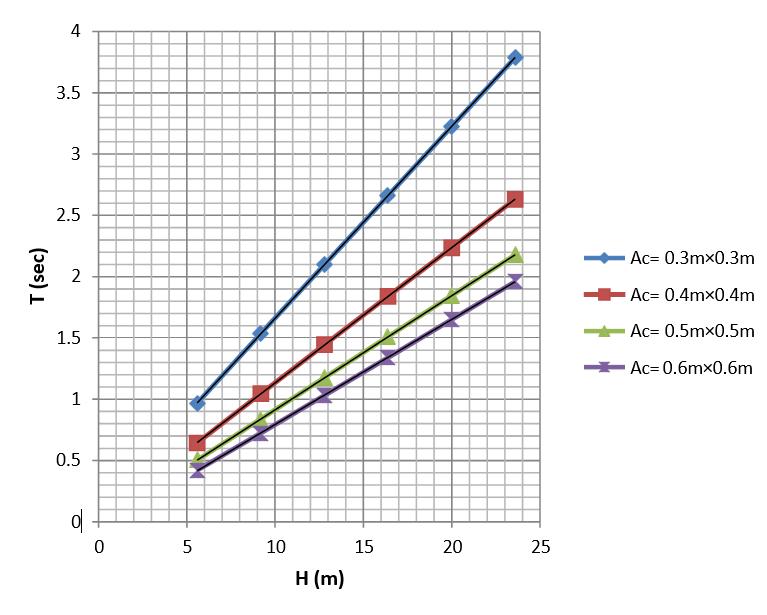
3.2 Effect of column size on time period
Table 5: TimePeriod(T): forgridsize8×8,planarea(m) =48×48,Slabthickness(mm)=150,baylength(m)=6m S. No Floors/ Building height
Tim e Peri od ColumnsSize as per IS18 93
0.5m×0 .5m 0.6m×0 .6m 0.7m×0 .7m 0.8m×0 .8m
T(sec)
1 G+10/(4 1.6m) 1.22 9 2.814 2.531 2.387 2.302 2 G+9 /(38m) 1.18 4 2.566 2.305 2.171 2.089 3 G+8/(34. 4m) 1.06 5 2.32 2.081 1.956 1.876 4 G+7/(30. 8m) 0.98 1 2.075 1.857 1.741 1.665 5 G+6/(27. 2m) 0.89 3 1.829 1.634 1.526 1.459
Chart 1:VariationofTforgridsize8×8
1. It can be concluded that the present work exploresthescopeofimprovisationinexpressionsof timeperiodofvibrationgiveninseismicdesigncode IS1893 2016andpresentsthestudytoshowthatthe height alone, as a primary factor, seems to be inadequate to evaluate the timeperiod of vibration accurately.
2. Further, it can be suggested that the different structural parameters other than the height of the building, also with respect to the parameters characterizedinthisanalysis.
3. Theaffecttheperiodandcanbeincorporatedin the simplified expressions of the time period of vibration illustrated in the design codes, which are commonlyusedinseismicanalysis.
4. In this work, the analysis has been done for buildingsconsideringdifferentbaysizes,columnsizes, slab thickness, bay length, plan area, beam sizes etc. This improvement can provide better assessment of the time period supporting to economy in the structuraldesign.
5. Multiple non linear regression analysis was performedover2200periodvaluesobtainedthrough dynamic analysis with various considered combinationsofdifferentparameters.
6. The different empirical expressions have been developed by non linear regressionand sensitivity analysishasalsobeenpresented.
7. Itissuggestedthatthereisscopetoincorporate theseconsideredstructuralparametersintimeperiod
International Research Journal of Engineering and Technology (IRJET) e ISSN: 2395 0056
Volume: 09 Issue: 07 | July 2022 www.irjet.net p ISSN: 2395 0072
formula given in Indian Standard Code IS1893 to estimatethevalue of ‘T’ closerto results of dynamic analysis.
8. So, for the enhancement of the capacity of availableapproximateformula,theworkpresentswith theresultsofdynamicanalysis,whichcanbeusefulfor the researchers, academicians as well as for the professionals.
[1]ASCE/SEI 7 16, (2016) Minimum Design Loads and associated criteria forBuildingsandOtherStructures, Standard‖, Structural Engineering Institute of the AmericanSocietyofCivilEngineers,ASCE/SEI7 2016, Reston,Virginia.
[2]Athanassiadou, CJ. (2008) Seismic performance of R/Cplaneframesirregularinelevation‖,Engineering Structures,30(5),1250 1261.
[3]Bagchi, A.(2004) A simplified method of evaluating the seismic performance of buildings‖,Earthquake EngineeeringandEngineeringVibration,3(2),223 236.
[4]Balkaya, C and Kalkan, E. (2003) Estimation of fundamentalperiodsofshear walldominantbuilding structures‖, Earthquake Engineering and Structural Dynamics,32,pp.985 998.
[5]Bangladesh National Building Code, BNBC 1993, Earthquake Loads, Part 6, Housing and Building Research Institute and Bangladesh Standard and TestingInstitute,Bangladesh.
[6]Bangladesh National Building Code, BNBC 2006, Earthquake Loads, Part 6, Housing and Building Research Institute and Bangladesh Standard and TestingInstitute,Bangladesh.
[7]Bangladesh National Building Code, BNBC 2010, Earthquake Loads, Part 6, Housing and Building Research Institute and Bangladesh Standard and TestingInstitute,Bangladesh.
[8]Bangladesh National Building Code, BNBC 2017, Earthquake Loads, Part 6, Housing and Building Research Institute and Bangladesh Standard and TestingInstitute,Bangladesh.
[9]Bari, M.S, Das, T A.(2013) Comparative Study on Seismic Analysis of Bangladesh National Building Code (BNBC) with Other Building Codes‖. J. Inst. Eng.IndiaSer.A,94,pp.131 137
[10] Bendimerad, M. F. and Shah, H. C. (1992) Seismic behavior of reinforced concrete frame Structure‖, Earthquake Engineeering, Tenth world
conference, Balkema, Rotterdam, ISBN 9054100605, 4263 4267.
[11] Bertero,V.V.,Bendimerad,F.M.andShah, H. C. (1988) Fundamental period of reinforced concrete moment resisting frame structures‖, Department ofCivil and Environmental Engineering, StanfordUniversity, ReportNo.87.
[12] BHRC PN 374 (1999), Iranian Code of Practice for Seismic Resistant Design of Buildings‖, Standard No. 2800, Iranian building codes and standards,Building and Housing Research Center, Tehran,IRAN.
[13] BHRC PN S 465 (2007), Iranian Code of Practice for Seismic Resistant Design of Buildings‖,StandardNo.2800(3rd Edition), Iranian building codes and standards, Building and Housing Research Center, Tehran,IRAN.
[14] BSSC (2003). NEHRP Recommended provisions for seismic regulations fornewbuildings and other structures, part 2 Commentary (FEMA 450),BuildingSeismicSafetyCouncil,Washington,DC.
[15] Building Standard Law of Japan (BSLJ), (1987). Ministry of Construction,Japan.
[16] Buonopane, S.G., and White, R.N. (1999) Pseudodynamic testing of masonry infilled reinforced concrete frame‖, Journal of Structural Engineering, American Society of Civil Engineers (ASCE),125(6),578 589.
[17] Calvi, G. M, Pinho, R., and Crowley, H (2006) State of the knowledge on the period elongation of RC buildings during strong ground shaking‖,The1stEuropeanConferenceonEarthquake Engineering and Seismology,Geneva,Switzerland,3 8 September2006,Paper1535.
[18] Calvi,G.M.,Pinho,R.,Magenes,G.,Bommer, J.J.,Restrepo Vèlez,L.F.,andCrowley, H. (2006) The development of seismic vulnerability assessment methodologies for variable geographical scales over the past 30 years‖, ISET Journal of Earthquake EngineeringTechnology,43,75 104.
[19] Carrillo, J and Alcocer, S M (2013) Simplified equation for estimating periods of vibration of concrete wall housing‖, Engineering Structures,52,446 454.