A Review on Diagnosis of High-Impedance Faults
1M.Tech, Electrical and Electronics Department SSTC junwani bhilai, c.g. india.
2Assistant Professor, Electrical and Electronics Department SSTC junwani bhilai, c.g. india.

3Assosiciate Professor, Electrical and Electronics Department SSTC junwani bhilai, c.g. india.
4Professor, Electrical and Electronics Department SSTC junwani bhilai, c.g. india. ***
1.Introduction
High impedancefaults(HIFs)arearecurringproblemin power system protection. As a result, many engineers must have a thorough awareness of such flaws in order tocreateviableremedies.Theauthorsof[1,2]presented an HIF detection focused review. The HIF problem was characterisedintheirresearchasapatternclassification jobthatmaybefacedutilisingneuralnetworkclassifiers trainedusingfeaturescollectedfrommeasurements(i.e., current, voltage, and magnetic field intensity). Mishra et al.[3]builtonmathematicalandmechanicalmethodsto HIF detection strategies. The authors of [4] explored industriallyapplicablestrategiesfordetectingHIFs,such as the broken conductor detection method, watt metric protection relaying, and the ground wire grid methodology. Prior to the 2000s, HIFs were covered by [5]. This article seeks to give an up to date complete assessment ofcurrentHIF detection, categorization,and localizationapproaches.
The article will be divided as follows: The rest of this section describes the definition, hazards, and characteristics of HIF. Section 2 gives an overview of current HIF modeling techniques. Section 3 describes new HIF diagnostic methods attempted by researchers. Section 4 compares the performance of the newest approaches in HIF detection, classification, and localization. Section 5 describes conclusions and future recommendations.Ifaconductoraccidentallycomesinto contactwitha highimpedancematerial,whatiscalleda high impedance fault (HIF) occurs. HIFs fall into two types:activeandpassive.Theformerarisesasaresultof subterranean conductor insulation determination over time [6,7], while the latter happens when an overhead conductor breaks and contacts extremely resistive ground, resulting in an abrupt transient arc [7,8]. The current levels of the ensuing events are slightly greater than the typical drawn ampere from the load, making themhardtodetectbytraditionalovercurrentrelays[9 16].Furthermore,ground sensitiverelayswerefoundTo be unstable under imbalanced loading circumstances [17]. According to [5, 6, 17], current values in 20 kV systems can range between 1 and 75 A, as indicated in Table1, and it can be shown that the type of the conductive material and its humidity impact the HIF current.
Table1.High impedancefault(HIF)currentonvarious surfaces.
Surface Current (A)
Reinforcedconcrete 75
Wetgrass 50
Wetsod 40
Drygrass 25
Drysod 20
Wetsand 15 Dryasphalt <1 Drysand <1
Accordingtotheresearch,HIFsaccountfor5%to10%of alltotalsystemdefects[18].Thisstatistic,however,only includes HIFs that progressed to high current short circuit problems. Furthermore, [19] noted that traditional relays are oblivious to 80 percent of HIFs happening in a distribution system, highlighting the current degree of uncertainty in power system safety mechanisms regarding HIFs. An HIF poses a concern to public safety when it is unnoticed, because a dropped conductor can cause hazardous shock, fire, or life threatening injuries through unintended human contact [20 23]. Damage to equipment caused by the presence ofHIFsisalsoseenasahazardtothefacility'sassetsand mayresultinpermanentdamage[24,25].
HIFs differ from regular short circuit failures in their characteristics and are quite complicated. This intricacy is attributable to the following typical characteristics,asgivenintheliteratureanddepictedin Figure1:
A Low current magnitude [26, 27] that might be difficult to differentiate from a typical rise or decreaseinelectricalload.
B Intermittent arcing [28 30] caused by low harmonicsandnoiseinmeasuringsignals.
International Research Journal of Engineering and Technology (IRJET) e ISSN: 2395 0056
Volume: 09 Issue: 07 | July 2022 www.irjet.net p ISSN: 2395 0072
C Asymmetry and randomness [31] owing to the variable fault route, which causes the HIF current magnitudetoalterfromcycletocycle.
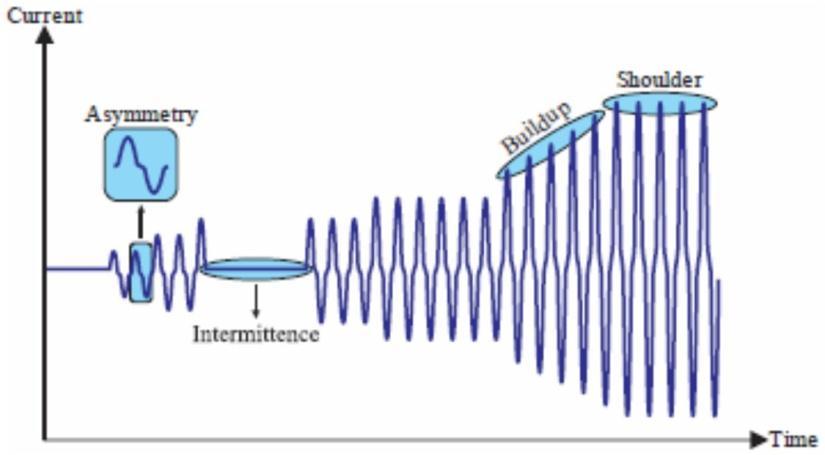
D During theHIF condition,thereis nonlinearity [32 34] in the connection between voltage and current sinusoidalsignals.
E Build up and shoulder [35] where the current magnitude of an HIF gradually increases during several cycles until it reaches a steady state condition.
properties of HIF in an electromagnetic relay module (EMT).
SingleVariableResistor
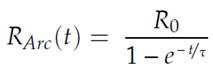
Thismodelwasproposedby[36 38]tosimulatethearc dischargecharacteristicsofaHIFbased onthetheoryof Cassie and Mayr [39,40] using the following equation to calculatethearc resistance whereR0isthe initial error of the resistance system, t is the time, and τ is the user definedtimeconstant.Thisapproachprovidesarandom layer for the simulated HIF. However, the asymmetrical and non linear aspects of the defect are not accurately represented.
Figure1.CharacteristicsofHIFs[26].
2. HIF Modeling
Many research publications rely heavily on HIF modelling since the correctness of the results is greatly dependent on the modelling method's capacity to reproduce the properties of an HIF. Nonlinearity ,asymmetry, unpredictability, intermittence, build up, and shoulder require sophisticated methodologies to be modelled in a simulated system. As a result, this section will go through the current modelling methodologies usedintheliterature.
The goal of HIF diagnosis is to one day address a real world problem. As a result, using real world data modelled in a high current research laboratory is a sensible route to follow. In [18], materials like as tree branches, grass, and concrete surfaces were utilised in dry and wet situations to imitate different HIFs and record important current and voltage magnitudes using digital data recording equipment. The experimental setup has been used by [18]. Despite the fact that this approach is the closest approximation to an HIF and offered excellent study data, it may be impractical for many other researchers due to space constraints. Furthermore, laboratories will require costly high voltageequipmenttosimulatetheperformanceofa real HIF,aswellasstringentsafetyprocedurestoreduceany possiblethreatsfromHIFarcing.
The second layer of modeling is implemented in a simulation environment. This section explains the three main models used in the literature to simulate the
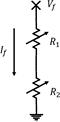
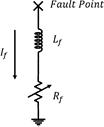
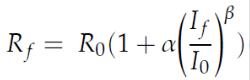
Alternatively, [41] proposed the depiction of HIF shown inFigure2.FaulttoleranceRfcanbecalculatedusingthe followingformula:
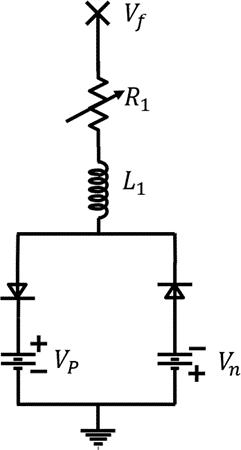
Figure2.Variableresistorwithinductormodel.
In another model presented by [43, 44], R1 has HIF asymmetry and voltage (Vf) and current (If) by calculating their respective ratios according to Ohm's law, as shown in Figure 3. R1 is intended to mimic the non linearity between. Current and voltage readings are sampled Figure 3. Two variable resistors model. over time and each sample is from one complete cycle. The valueusedcanbecalculatedfromcyclesthataresimilar inamplitude to the previouscycle,thus excluding build up characteristics. The current can be calculated as clearlyexplainedin[45].
Figure3.Twovariableresistorsmodel.
International Research Journal of Engineering and Technology (IRJET) e ISSN: 2395 0056
Volume: 09 Issue: 07 | July 2022 www.irjet.net p ISSN: 2395 0072
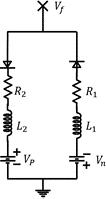
Emanuel et al. [46] presented an additional model to emulate the unique propertiesof an HIF.Asindicatedin Figure 4, R1 and R2 contribute the nonlinearity dimension to the HIF, while Vp and Vn factor in the incident's discharged arcing voltage. This model is built withdirecteddiodessothatthefaultcurrentflowsfrom the source to the ground if Vf>Vp. The opposite will occur at Vf <Vn, as current will flow back to the source, andnocurrentwillflowintothesystemwhenVn<Vf<Vp. Figure 5 shows how other researchers in [47 50] expandedonEmanuel'sconceptbyexperimentingwitha variableresistor.Thismodel,however,lacksthecapacity tosimulate.
TraditionalMethods
In a balanced three phase system, the summation of the currentsinallphasesisequaltozeroasperthefollowing equation:
Ia+Ib+Ic =Izerosequance=0
Controllingzero sequence current using a core balanced circuit using the current transformer is also known as thesensitivegroundfaultrelaying[51].Thistechniqueis extensively utilised. Loads in nature, on the other hand, areimbalanced.Asaresult,residualcurrentisconstantly presentinthesystem,requiring the relaytobetunedto aspecifictolerancerateto minimisenuisancetrips.This tolerance rate may make HIF identification more challenging.Indifferentialprotectiontechniques,suchas pipeline leakage detection, the comparison of outgoing andincomingcurrentflowsisemployed.Theapproachis HIF sensitive. However, implementing differential protectionindistributionnetworksiscomplicateddueto the network's multiple generating sites and loading buses.
In the work proposed in [4], a way for capturing the falling conductor before it makes contact with a high impedance surface is discussed. When the conductor makes contact with the grid, the overcurrent relay may immediately identify the fault and trigger the breaker However, such a solution is economically unfeasible since it necessitates the installation of an extra ground gridattransmissionlinepolesacrosslongdistances.[52] advocated installing a mechanical hook beneath the phaseconductorsandconnectingittothenaturalgrid.In the event of a downed conductor, the procedure will result in a line to neutral short circuit. Paper [53] introduced a Fast Fourier Transform (FFT) based technique for studying single phase feeder currents to address HIF in the presence of non linear loads. This approach evaluates the state of the distributionsystem, taking into account the even and odd harmonic components. The authors found that the critical spacing between the 3rd and 7th harmonics varied significantly in the magnitude to time plane of the harmonics during HIF, enabling an approach to detect HIF. Note that such techniques are noise sensitive and require a noise reductionschemetoachievethedesiredresult.
3. HIF Diagnosis Techniques
An HIF poses a risk to public safety and, eventually, the electricaldistributionsystemwhenitisundiscovered.As a result, numerous researchers sought to discover ways for detecting, classifying, and locating HIFs. This section will go through the most modern approaches for diagnosingHIFs.
The method proposed in [54] proposes a stockwell transformation (ST) based method for constantly monitoring the phase angle of the third harmonic of a sinusoidal current input. Fluctuations in the third harmonicarerelatedtoloadactivityandswitching.As a result, stable values indicate the presence of HIF in the system. However, this approach can take up to 150 milliseconds to detect a defect, allowing the accumulationofincidentenergy.
Volume: 09 Issue: 07 | July 2022 www.irjet.net p ISSN: 2395 0072
The author of [55] proposed a unique method that combines maximum overlap discrete wavelet packet transform (MODWPT) with empirical mode decomposition (EMD). This technique calculates the change in the amount of inter harmonic energy of the faultsignalafteritisnormalizedbythepre failurestate. Theexistenceofsuchanentityrepresentsthepossibility ofan existing HIF. For all types of HIF, it isunlikely that the model will succeed under actual operating conditions.
RoyandDebnath[56]proposedamethodforcalculating the power spectral density (PSD) using the wavelet covariance matrix. The wavelet transform is used to decompose the powersignal to the third level.Then use theexactcoefficients tocalculatethe wavelettransform and PSD in both the frequency domain and the time domain. The proposed strategy uses threshold analysis as the basis for fault detection, but the system has not beenvalidatedforfaultlocationestimation.
The author of [57] studied the orthogonal component decomposition of three phase voltage and current waveforms by signal processing. The projection of the voltage and current components in the plenary function yields eight voltage and eight current components. During normal operation, thecalculatedvaluemaintains an absolute value equal to zero. However, in a flawed situation, the component may fluctuate and HIF may be detected.Althoughthisapproachisrobustwhenitcomes to fault identification, the absolute inaccuracy in estimating fault distance is over 10% in half of the assessedsituations.
MathematicalApproximation
The authors of [58] used differential equations to determinethecapacitanceupstreamanddownstreamof thefaultto estimatethezero sequencegridcapacitance. To discover discrepancies, the estimated values are compared to the anticipated capacitance during normal operation. The approach was found to be rapid, self calibrating, and noise free. However, it was only made available for isolated neutral grids. Another estimating approachbasedonfieldmeasurementswasdevelopedin [59] to determine fault admittance in a medium voltage. The approach was validated for identifying and finding HIFswithresistancesrangingfrom100to200k.
The authors in [60] offered a state estimate model that was adjusted to diagnose HIFs and included features suchasvoltageandpowerdata.Theauthorswereableto demonstrate the effectiveness of such a strategy in HIF identification. However, when the load is altered, incorrect line identification results in severe inaccuracies. The paper [61] discusses an iterative method to the fault finding problem. The method given estimates the location of the fault start and the current
and voltage of the fault. The weighted least squares (WLS) method is used to measure fault resistance and reactance. It then compares the estimates to the convergence tolerance and returns the final fault distance, resistance, and reactance. This approach requires extensive iterative processing and can result in longer error detection times. Ramos et al. [62] An analyticalWLSstateestimatorwasusedtocalculatefault voltageandcurrenttoidentifytheHIFinthedistribution network. This approach also uses values derived from the linear regression of the predicted obstacle distance component.
Using the enhanced Prony approach, we reconstructed thedecayingperiodiccomponentbymonitoringthezero voltage. The technique needs to estimate single phase ground fault information using an attached feed in clamp. The robustness of this approach has only been demonstrated to determine the location of single phase groundfaults.
The authors in [64] devised a strategy based on searching. The approach estimates the fault site by comparing the estimated fault characteristics (voltage and current) at various locations of the feeder to the reference data for faults in a feeder. Such a technique necessitates a large computation overhead for lower tolerance rates and is only applicable to single feeder distribution lines. [65] employed linear prediction to describe time series of signal samples across time. The modeldetectsHIFsbyincreasingtheenergyofthelinear prediction error. However, the authors of this study did not take into account nonlinear loads in the power distributionnetwork.
ArtificialIntelligence BasedMethods
The three primary stages of artificial intelligence based systems for diagnosing HIFs are data collecting, feature extraction using signal processing techniques, and training using machinelearning algorithms. This section willgothroughthemostrecentadvancesineachstep.
DataAcquisition
Thesortofmeasuringsignal employedtodiagnose HIFs servesasthefoundationforintelligent basedtechniques. In the literature, several signals were utilised; nevertheless, current waveforms in HIFs carry over harmoniccomponentsthatcanbeseparatedfromtypical loading scenarios [1]. In [66,67], the subject measurements were used to detect and categorise HIFs in distribution networks. It is worth mentioning that current measurements are influenced by the percentage mistakesofcurrenttransformers.
Ifyoulookatthe defectscaused bymoving objectssuch as trees, you can notice the temporary voltage spikes causedbytheHIFarc.Thismovementcreatesanairgap
International Research Journal of Engineering and Technology (IRJET) e ISSN: 2395 0056
Volume: 09 Issue: 07 | July 2022 www.irjet.net p ISSN: 2395 0072
between the conductor and the surface, changing the faultimpedance.
Theauthorsof [68]have developed theirmethodbased on arc voltage measurements. However, the small drop inHIFmakesitincreasinglydifficulttodetectchangesin the voltage waveform. As a result, many authors, including [69,70], tried to identify the HIF of the distribution system using both current and voltage waveforms in neural network training with excellent results.
The authors of [71] employed resistance measures to diagnose HIFs. When such data are compared to the original impedance values of a transmission line, they offer information about the location of the issue and decrease network downtime. The problem is that resistance alone cannot reflect HIF nonlinearity, asymmetry, or arcing. As a result, utilising this measurement to detect such errors is significantly compromised.
The goal of synchronised phasor measurement units (SPMUs) is to describe a signal over a predetermined time period as an absolute value linked with the phase angle [72]. In power systems, such measurements offer an accurate picture of current and voltage waveforms. The use of SPMUs in HIF diagnosis was described in [73,74], however the use of SPMUs in HIF localization with fault asymmetry and load nonlinearity need more investigation.
FeatureExtraction
Feature extraction using signal processing techniques is a critical tool for machine learning algorithms to work efficiently.TheFouriertransformiscommonlyutilisedin power quality disturbance applications (FT). During disturbances, this signal processing tool determines the presenceofsignalfrequencycomponents[75].
Although FT is continuous over time, discrete Fourier transform (DFT) is widely utilised in computational applications and was employed in [76] for HIF identification. In [77], another variant known as the fast Fouriertransform(FFT)wasused.FT,ontheotherhand, canonlyexpresscharacteristicsinthefrequencydomain forHIFdiagnosticapplications.
In contrast to FT, wavelet transform (WT) is a sophisticated signal processing method that can encode signal properties in the time frequency domain [78]. Whengivenindiscreteformat,asillustratedin[79],this model is beneficial in HIF diagnostic applications. Furthermore,ascomparedtodiscretewavelettransform (DWT), wavelet packet transform (WPT) delivers more informationsincehigherandlowerfrequencybandsmay bedeconstructedateachdecompositionlevel.
This type of application was first established in [80,81], and it produced good results in HIF detection and categorization. Furthermore, the use of multi wavelet transform(MWT)wasdescribedin[82].
It was discovered that MWT is a scalar wavelet extension with several scaling functions and associated multiple wavelets are utilised During a fault, WT can offerinformationaboutthefault.
MachineLearning
A neural network (NN) is a connection of multiple processing nodes that perform a series of mathematical operations obtained throughthe tuning processthat are modifiedbyexternalinputs calledbiasesandareguided by the strength or weight between the nodes of the network[.83 85].
The work proposed in [86 88] employed a multilayer perceptronneuralnetwork(MLP NN)modeltodiagnose HIFs. To train the network in identifying and categorising defects, the approach used the effective backpropagation technique. To get optimal outcomes in less computing time, a strategy for selecting the correct numberofhiddenlayersandneuronsisnecessary.
Furthermore, [80,89] devised a hybrid technique combining MLP NN and Gaussian process regression (GPR).MLP NNwasusedinthestudytoidentifythebest weights and biases for HIF detection and classification, whereas GPR is a linear regressor that seeks to approximatethepositionofafaultinatransmissionline.
The authors of [90] used MLP NN to identify errors in a liveexperimentalsetting.
4. Comparative Analysis
The measurement signals, feature extraction approaches, and machine learning classifiers given here offer specific capabilities for detecting, classifying, and locating HIFs. As a result, a comparison was performed, as indicated in Table 2. The following [2, 31] might influencethegradingcriteriaofsuchpapers:
1. Accuracy is used to compare the performance of proposedprocedurestothepredictedoutcomes.
2. Reliability and security may be used to calculate the precision % and miscalculation ratio of HIF diagnostic procedures,whicharelackinginmostresearch.
The wavelet transform dominates signal processing techniques in the majority of the literature. Other time frequency domain approaches, such as the Stockwell transform,havebeenpresentedinrecentyears.
Refere nce Measurement Data Feature Extraction Technique
Machine Learning Classifiers Experiment Objectives Accuracy %
[69] Voltage and Current WT ANN Detection 91.33
[70] Voltage and Current WT ANN Detection 95.989
[67] Current DFT ANFIS Detection and Classification 99.64
[92] ArcVoltage EMD ANN Detection 99.35
[71] Resistance ANN Location 99
[91] Voltage and Current WT SVM Detection 91.38
[93] Current WT SVM Detection and Classification 96
[94] Current VMD SVM Detection and Classification 99
[82] Voltage and Current WT FLC Classification 88.89
[77] Current FFT FLC Detection
[79] Current WT ANN Classification
[87] Voltage and Current ANN Location 99.67
[86] Voltage and Current WT ANN Detection
[80] Current WT ANN+GPR Location 99.4
[89] Voltage and Current WT ANN Detection 96
[90] Current ST ELM Detection and Classification 99.3
Table2. Comparisonbetweenexistingtechniques
5. Conclusions and Future Recommendations
This publication provided a complete assessment of HIF detection, classification, and localization strategies. This reviewdefinesaphenomenoninHIFwheretheresulting fault current level is slightly higher than the normal amperage drawn from the load, making it difficult for traditionalovercurrentrelaystodetectfaults.
Although such problems have not been diagnosed, public safety is assured that accidental contact with the human body can cause dangerous electric shock, fire, or life threatening injuries if the ladder falls. Concerns arise. Specific properties related to HIF development such as B. Low current, intermittent arc discharge, unpredictability,asymmetry,non linearity,accumulation and shoulder represent most of the obstacles in HIF diagnosis.
In addition, this study examined the modeling methods usedintheHIFliterature.Usingreal worlddatamodeled inhigh currentlaboratories usingmaterialssuchastree branches, grass, and concrete surfaces is an example of how to incorporate real time data into your research. Most authors, on the other hand, used simulation settings with a single variable resistor, a single variable resistor, inductor, two variable resistors, and two antiparalleldiodes.
Finally, this review covers three major processes: data acquisition, feature extraction, and training, including relay based methods, signal processing techniques, parameter estimation, mathematical approaches, and artificialintelligence basedmethodsfordiagnosingHIF.I explainedthefailurediagnosistechnologycenteredonit. Usesmachinelearningalgorithms.
Theapproachesdescribedintheliteratureareprimarily focused on offline systems and requires additional researchtoreachamaturemethodology.Inaddition,the error elimination time (FCT) of the machine learning approach is still under debate. Such a methodology requires additional processing time and increases the potentialfordangerduetothepresenceofHIF.
REFERENCES
[1] Ghaderi, A.; Ginn, H.L.; Mohammadpour, H.A. High impedance fault detection: A review. Electr. Power Syst.Res.2017,143,376 388.
[2] Hao, B. AI in arcing HIF detection: A brief review.IETSmartGrid2020,3,435 444.
[3] Mishra, M.; Panigrahi, R.R. Taxonomy of high impedance fault detection algorithm. Measurement 2019,148,106955.
[4] Theron, J.C.J. ;Pal, A.; Varghese, A. Tutorial on high impedance fault detection. In Proceedings of the 2018 71st Annual Conference for Protective Relay Engineers(CPRE),CollegeStation,TX,USA,26 29March 2018;pp.1 23.
[5] Thakallapelli,A.;Mehra,R.;Mangalvedekar, H.A. Differentiation of faults from power swings and detectionofhighimpedance faultsbydistancerelays.In Proceedings of the 2013 IEEE 1st International Conference on Condition Assessment Techniques in Electrical Systems (CATCON), Kolkata, India, 6 8 December2013;pp.374 377.
[6] Lukowicz,M.;Kang,S. H.;Michalik,M.;Rebizant, W.; Lee, S. J. High Impedance Fault Detection in Distribution Networks with Use of Wavelet Based Algorithm. IEEE Trans. Power Deliv. 2006, 21, 1793 1802.
International Research Journal of Engineering and Technology (IRJET) e ISSN: 2395 0056
Volume: 09 Issue: 07 | July 2022 www.irjet.net p ISSN: 2395 0072
[7] Milioudis, A.; Andreou, G.T.; Labridis, D.P. Detection and Location of High Impedance Faults in Multiconductor Overhead Distribution Lines Using Power Line Communication Devices. IEEE Trans. Smart Grid2014,6,894 902.
[8] Ali, M.S.; Abu Bakar, A.H.; Mokhlis, H.; Aroff, H.; Illias,H.A.;Aman,M.Highimpedancefaultlocalizationin a distribution network using the discrete wavelet transform.InProceedingsofthe2012IEEEInternational
[9] Baqui, I.; Zamora, I.; Mazón, J.; Buigues, G. High impedance fault detection methodology using wavelet transform and artificial neural networks. Electr. Power Syst.Res.2011,81,1325 1333.
10. AbuBakar, A.H.; Ali,M.S.; Tan, C.; Mokhlis,H.; Arof,H.; Illias,H.Highimpedancefaultlocationin 11kV underground distribution systems using wavelet transforms. Int. J. Electr. Power Energy Syst. 2014, 55, 723 730.
11. Mahari, A.; Seyedi, H. High impedance fault protection in transmission lines using a WPT based algorithm. Int. J. Electr. Power Energy Syst. 2015, 67, 537 545.
12. Mokhtari, H.; Aghatehrani, R. A new wavelet based method for detection of high impedance faults. In Proceedings of the 2005 International Conference on FuturePowerSystems,Amsterdam,TheNetherlands,18 November2005.
13. Ghaderi, A.; Mohammadpour, H.A.; Ginn, H.L.; Shin, Y. J. High Impedance Fault Detection in the Distribution Network Using the Time Frequency Based Algorithm. IEEE Trans. Power Deliv. 2015, 30, 1260 1268.
14. Gautam, S.; Brahma, S.M. Detection of High Impedance Fault in Power Distribution Systems Using Mathematical Morphology. IEEE Trans. Power Syst. 2012,28,1226 1234.
15. Kawady, T.A.; Taalab, A.E. M.I.; Elgeziry, M.Z. Experimental investigation of high impedance faults in lowvoltage distribution networks.In Proceedingsof the 2009 IEEE Power & Energy Society General Meeting, Calgary,AB,Canada,26 30July2009.
16. Torres Garcia, V.; Paredes, H.F.R. High Impedance Fault Detection Using Discrete Wavelet Transform. InProceedingsofthe2011IEEEElectronics, Robotics and Automotive Mechanics Conference, Cuernavaca, Mexico, 15 18 November 2011; pp. 325 329.
17. Shahrtash,S.M.;Sarlak,M.HighImpedanceFault Detection Using Harmonics Energy Decision Tree
Algorithm. In Proceedings of the 2006 International Conference on Power System Technology, Chongqing, China,22 26October2006.
18. Sheng, Y.; Rovnyak, S. Decision Tree Based Methodology for High Impedance Fault Detection. IEEE Trans.PowerDeliv.2004,19,533 536.[.]
19. Prasad, C.D.; Srinivasu, N.; Prasad, D.J.V.; Saiveerraju, M. Reliability of different fault detection algorithms under high impedance faults. In Proceedings of the 2013 International Conference on Advanced Computing and Communication Systems, Coimbatore, India,19 21December2013.
20. Siadatan, A.; Karegar, H.K.; Najmi, V. New high impedance fault detection. In Proceedings of the 2010 IEEE International Conference on Power and Energy, Kuala Lumpur, Malaysia, 29 November 1 December 2010;pp.573 576.
21. Bretas,A.S.; Moreto,M.;Salim,R.H.;Pires,L.O.A Novel High Impedance Fault Location for Distribution Systems Considering Distributed Generation. In Proceedings of the 2006 IEEE/PES Transmission & Distribution Conference and Exposition: Latin America, Caracas,Venezuela,15 18August2006.[.]
22. Milioudis, A.; Andreou, G.T.; Labridis, D.P. Enhanced Protection Scheme for Smart Grids Using Power Line Communications Techniques Part II: Location of High Impedance Fault Position. IEEE Trans. SmartGrid2012,3,1631 1640.[.]
23. Sharaf, A.; Wang, G. High impedance fault detection using feature pattern based relaying. In Proceedings of the 2003 IEEE PES Transmission and Distribution Conference and Exposition (IEEE Cat. No.03CH37495), Dallas, TX, USA, 7 12 September 2003; pp.222 226.[.]
24. Samantaray, S.; Dash, P.; Upadhyay, S. Adaptive Kalmanfilterand neural network basedhigh impedance fault detection in power distribution networks. Int. J. Electr.PowerEnergySyst.2009,31,167 172.[.]
25. Abohagar, A.A.; Mustafa, M. Back propagation neural network aided wavelet transform for high impedance fault detection and faulty phase selection. In Proceedings of the 2012 IEEE International Conference on Power and Energy (PECon), Kota Kinabalu, Malaysia, 2 5December2012;pp.790 795.[.]
26. Chen, J.; Phung, B.; Zhang, D.; Blackburn, T.; Ambikairajah, E. Study on high impedance fault arcing current characteristics. In Proceedings of the 2013 AustralasianUniversitiesPowerEngineeringConference (AUPEC), Hobart, TAS, Australia, 29 September 3 October2013.[.]
International Research Journal of Engineering and Technology (IRJET) e ISSN: 2395 0056
Volume: 09 Issue: 07 | July 2022 www.irjet.net p ISSN: 2395 0072
27. Eldin, E.S.T.; Aboul Zahab, D.K.I.E.M.; Saleh, S.M. High impedance fault detection in EHV series compensated lines using the wavelet transform. In Proceedings of the 2009 IEEE/PES Power Systems Conference and Exposition, Seattle, WA, USA, 15 18 March2009.[.]
28. Ibrahim, D.K.; Eldin, E.S.T.; Aboul Zahab, E.M.; Saleh, S.M. Real time evaluation of DWT based high impedance fault detection in EHV transmission. Electr. PowerSyst.Res.2010,80,907 914.[.]
29. Zanjani, M.G.M.; Karegar, H.K.; Niaki, H.A.; Zanjani, M.G.M. High Impedance Fault Detection of Distribution Network by Phasor Measurement Units. SmartGridRenew.Energy2013,4,297 305.[.]
30. Costa, F.B.; Souza, B.A.; Brito, N.S.D.; Silva, J.A.C.B.; Santos, W.C. Real Time Detection of Transients Induced by High Impedance Faults Based on the BoundaryWavelet Transform. IEEETrans. Ind. Appl. 2015, 51,5312 5323.[.]
31. Torres, V.; Guardado, J.; Ruiz, H.; Maximov, S. Modeling and detection of high impedance faults. Int. J. Electr.PowerEnergySyst.2014,61,163 172.[.]
32. Torres Garcia, V.; Guillen, D.; Olveres, J.; Escalante Ramírez, B.; Rodríguez Rodríguez, J.R. Modelling of high impedance faults in distribution systems and validation based on multiresolution techniques.Comput.Electr.Eng.2020,83,106576.[.]
33. Maximov, S.; Torres Garcia, V.; Ruiz, H.F.; Guardado, J. Analytical Model for High Impedance Fault Analysis in Transmission Lines. Math. Probl. Eng. 2014, 2014,1 10.[.]
34. Cassie, A.M. Theorie Nouvelle des Arcs de Rupture et de la Rigidité des Circuits. Cigre Rep. 1939, 102,588 608.
35. Mayr,O.BeiträgezurTheoriedesstatischenund des dynamischen Lichtbogens. Electr. Eng. 1943, 37, 588 608.[.]
36. Wontroba, A.; De Morais, A.P.; Rossini, J.P.; Gallas, M.; Cardoso, G.; Vieira, J.P.A.; Farias, P.E.; Santos, M.C. Modeling and Real Time Simulation of High Impedance Faults for Protection Relay Testing and MethodsValidation.InProceedingsofthe2019IEEEPES Innovative Smart Grid Technologies Conference Latin America (ISGT Latin America), Gramado, Brazil, 15 18 September2019.[.]
37. Sharaf, A.; Abu Azab, S. Smart relaying scheme for high impedance faults in distribution and utilization networks. In Proceedings of the 2000 Canadian
Conference on Electrical and Computer Engineering. Conference Proceedings Navigating to a New Era (Cat. No.00TH8492), Halifax, NS, Canada, 7 10 May 2000; Volume2,pp.740 744.
38. Dos Santos, W.C.; De Souza, B.A.; Brito, N.S.D.; Costa, F.B.; Paes, M.R.C. High Impedance Faults: From Field Tests to Modeling. J. Control. Autom. Electr. Syst. 2013,24,885 896.[.]
39. Wontroba, A.; De Morais, A.P.; Rossini, J.P.; Gallas, M.; Cardoso, G.; Vieira, J.P.A.; Santos, M.C.; Farias, P.E. Comprehensive High Impedance Fault Model for Real Time Environment. In Proceedings of the IECON 2019 45th Annual Conference of the IEEE Industrial Electronics Society, Lisbon, Portugal, 14 17 October 2019;pp.6432 6437.
40. Nam, S.; Park, J.; Kang, Y.; Kim, T. A modeling method of a high impedance fault in a distribution system using two series time varying resistances in EMTP. In Proceedings of the 2001 Power Engineering Society Summer Meeting. Conference Proceedings (Cat. No.01CH37262), Vancouver, BC, Canada, 15 19 July 2001;Volume2,no.SUMMER.pp.1175 1180.[.]
41. Emanuel, A.E.; Cyganski, D.; Orr, J.A.; Shiller, S.; Gulachenski, E.M. High impedance fault arcing on sandy soil in 15 kV distribution feeders: Contributions to the evaluation of the low frequency spectrum. IEEE Trans. PowerDeliv.1990,5,676 686.42. Mishra, M.; Rout, P.K.; Routray, P. High impedance fault detection in radial distribution system using wavelet transform. In Proceedings of the 2015 Annual IEEE India Conference (INDICON),NewDelhi,India,17 20December2015.[.]
43. Nayak,P.K.;Sarwagya,K.;Biswal,T.Anovelhigh impedance fault detection technique in distribution systems with distributed generators. In Proceedings of the 2016 National Power Systems Conference (NPSC), Bhubaneswar,India,19 21December2016.[.]
44. Iurinic, L.U.; Herrera Orozco, A.R.; Ferraz, R.G.; Bretas, A.S. Distribution Systems High Impedance Fault Location:AParameterEstimationApproach.IEEETrans. PowerDeliv.2015,31,1806 1814.[.]
45. Zamanan,N.; Sykulski,J.K.Theevolution ofhigh impedance fault modeling. In Proceedings of the 2014 16th International Conference on Harmonics and Quality ofPower(ICHQP),Bucharest,Romania,25 28May2014; pp.77 81.[.]
46. Novak, T.; Morley, L.; Trutt, F. Sensitive ground fault relaying. IEEE Trans. Ind. Appl. 1988, 24, 853 861. [.]
47. Mitolo, M.; Musca, R.; Zizzo, G. A Cost effective Solution for Clearing High Impedance Ground Faults in
International Research Journal of Engineering and Technology (IRJET) e ISSN: 2395 0056
Volume: 09 Issue: 07 | July 2022 www.irjet.net p ISSN: 2395 0072
Overhead Low Voltage Lines. IEEE Trans. Ind. Appl. 2018,55,1208 1213.[.]
48. Soheili, A.; Sadeh, J.; Bakhshi, R. Modified FFT based high impedance fault detection technique considering distribution non linear loads: Simulation and experimental data analysis. Int. J. Electr. Power EnergySyst.2018,94,124 140.[.]
49. Lima, É.M.; Brito, N.S.; Souza, B.A. High impedance faultdetection basedon Stockwell transform and third harmonic current phase angle. Electr. Power Syst.Res.2019,175,105931.[.]
50. Gadanayak, D.A.; Mallick, R.K. Interharmonics based high impedance fault detection in distribution systems using maximum overlap wavelet packet transform and a modified empirical mode decomposition. Int. J. Electr. Power Energy Syst. 2019, 112,282 293.[.]
51. Roy, S.; Debnath, S. PSD based high impedance fault detection and classification in distribution system. Measurement2020,169,108366.[.]
52. Batista, O.E.; Flauzino, R.A.; De Araujo, M.A.; De Moraes, L.A.; Da Silva, I.N. Methodology for information extractionfromoscillogramsanditsapplicationforhigh impedance faults analysis. Int. J. Electr. Power Energy Syst.2016,76,23 34.[.]
53. Gonzalez, C.; Tant, J.; Germain, J.G.; De Rybel, T.; Driesen, J.; Miguel, C.G. D. Directional, High Impedance Fault Detection in Isolated Neutral Distribution Grids. IEEETrans.PowerDeliv.2018,33,2474 2483.[.]
54. Nikander, A.; Jarventausta, P. Identification of High Impedance Earth Faults in Neutral Isolated or Compensated MV Networks. IEEE Trans. Power Deliv. 2017,32,1187 1195.[.]
55. Langeroudi, A.T.; Abdelaziz, M.M. Preventative highimpedancefaultdetectionusingdistributionsystem state estimation. Electr. Power Syst. Res. 2020, 186, 106394.[.]
56. Nunes, J.; Bretas, A.S.; Bretas, N.G.; Herrera Orozco, A.; Iurinic, L. Distribution systems high impedance fault location: A spectral domain model considering parametric error processing. Int. J. Electr. PowerEnergySyst.2019,109,227 241.[.]
57. Ramos,M.J.;Resener,M.;Bretas,A.S.;Bernardon, D.P.; Leborgne, R.C. Physics based analytical model for high impedance fault location in distribution networks. Electr.PowerSyst.Res.2020,188,106577.[.]
58. Li, J.; Wang, G.; Zeng, D.; Li, H. High impedance ground faulted line section location method for a
resonant grounding system based on the zero sequence current’s declining periodic component. Int. J. Electr. PowerEnergySyst.2020,119,105910.[.]
59. Mortazavi, S.H.; Moravej, Z.; Shahrtash, S.M. A Searching Based Method for Locating High Impedance Arcing Fault in Distribution Networks. IEEE Trans. PowerDeliv.2018,34,438 447.[.]
60. Grimaldi, R.B.; Chagas, T.S.; Montalvão, J.; Brito, N.S.;DosSantos,W.C.;Ferreira,T.V.Highimpedancefault detection based on linear prediction. Electr. Power Syst. Res.2021,190,106846.[.]
61. Mortazavi, S.H.; Moravej, Z.; Shahrtash, S.M. A hybrid method for arcing faults detection in large distribution networks. Int. J. Electr. Power Energy Syst. 2018,94,141 150.[.]
62. Aziz, M.S.A.; Hassan, M.A.; Zahab, E.A. ApplicationsofANFISinhighimpedancefaultsdetection and classification in distribution networks. In Proceedings of the 8th IEEE Symposium on Diagnostics for Electrical Machines, Power Electronics & Drives, Bologna,Italy,5 8September2011;pp.612 619.[.]
63. Lala, H.; Karmakar, S. Detection and Experimental Validation of High Impedance Arc Fault in Distribution System Using Empirical Mode Decomposition.IEEESyst.J.2020,14,3494 3505.[.]
64. Hafidz, I.; Nofi, P.E.; Anggriawan, D.O.; Priyadi, A.;Pumomo,M.H.Neurowaveletalgortihmfordetecting highimpedancefaultsinextrahighvoltagetransmission systems. In Proceedings of the 2017 2nd International Conference Sustainable and Renewable Energy Engineering (ICSREE), Hiroshima, Japan, 10 12 May 2017;pp.97 100.[.]65. Lai, T.M.; Lo, W.; To, W. M.; Lam, K. RMS percent of wavelet transform for the detection of stochastic high impedance faults. In Proceedings of the 2012 IEEE 15th International Conference on Harmonics and Quality of Power, Hong Kong,China,17 20June2012;Volume3,pp.823 828.[.]
66. Mahmoud,M.M.A.S.Detectionofhighimpedance faultsinM.V. meshdistribution network.In Proceedings of the 2015 Modern Electric Power Systems (MEPS), Wroclaw,Poland,6 9July2015;pp.1 8.[.]
67. De La Ree, J.; Centeno, V.; Thorp, J.S.; Phadke, A.G. Synchronized Phasor Measurement Applications in Power Systems. IEEE Trans. Smart Grid 2010, 1, 20 27. [.]
68. Ledesma, J.J.G.; Nascimento, K.B.D.; De Araujo, L.R.; Penido, D.R.R. A two level ANN based method usingsynchronized measurements to locate high impedance fault in distribution systems. Electr. Power Syst.Res.2020,188,106576.[.]
International Research Journal of Engineering and Technology (IRJET) e ISSN: 2395 0056 Volume: 09 Issue: 07 | July 2022 www.irjet.net p ISSN: 2395 0072
69. Cui, Q.; Weng, Y. Enhance High Impedance Fault Detection and Location Accuracy via [Math Processing Error] PMUs.IEEETrans.SmartGrid2020,11,797 809. [.]
70. Khokhar, S.; Zin, A.A.B.M.; Mokhtar, A.S.B.; Pesaran, M. A comprehensive overview on signal processingand
artificial intelligence techniques applications in classification of power quality disturbances. Renew. Sustain.EnergyRev.2015,51,1650 1663.[.]
71. Cui, Q.; El Arroudi, K.; Weng, Y. A Feature Selection Method for High Impedance Fault Detection. IEEETrans.PowerDeliv.2019,34,1203 1215.[.]
72. Suliman, M.Y.; Ghazal, M.T. Detection of High impedance Fault in Distribution Network Using Fuzzy Logic Control. In Proceedings of the 2019 2nd International Conference on Electrical, Communication, Computer, Power and Control Engineering (ICECCPCE), Mosul,Iraq,13 14February2019;pp.103 108.[.]
73. Huang,S. J.;Hsieh,C. T.;Huang,C. L.Application ofwaveletstoclassifypowersystemdisturbances.Electr. PowerSyst.Res.1998,47,87 93.[.]
74. Kannan, A.N.; Rathinam, A. High Impedance Fault Classification Using Wavelet Transform and Artificial Neural Network. In Proceedings of the 2012 Fourth International Conference on Computational Intelligence and Communication Networks, Mathura, India,3 5November2012;pp.831 837.[.]
75. Moloi, K.; Jordaan, J.A.; Hamam, Y. High Impedance Fault Classification and Localization Method for Power Distribution Network. In Proceedings of the 2018 IEEE PES/IAS PowerAfrica, Cape Town, South Africa,28 29June2018;pp.84 89.[.]
76. Sirojan, T.; Lu, S.; Phung, B.T.; Zhang, D.; Ambikairajah, E. High Impedance Fault Detection by Convolutional Deep Neural Network. In Proceedings of the2018IEEEInternational ConferenceonHigh Voltage Engineering and Application (ICHVE), ATHENS, Greece, 10 13September2018.[.]
77. Narasimhulu, N.; Kumar, D.V.A.; Kumar, M.V. Classification of high impedance fault using MWT and enhanced fuzzy logic controller in power system. In Proceedings of the 2017 Innovations in Power and Advanced Computing Technologies (i PACT), Vellore, India, 21 22 April 2017; Volume 2017, pp. 1 13. [.] Gurney, K. An Introductionto Neural Networks; CRC Press: Boca Raton, FL, USA, 1997.
78. Nielsen,M.NeuralNetworksandDeepLearning; Springer:Berlin,Germany,2018.
79. Belfast, G.I.; Reading, K.W.; Berlin, K.H. Neural Network Applications in Control; Institution of ElectricalEngineers:London,UK,1995.
80. Vijayachandran, G.; Mathew, B. High impedance arcing fault detection in MV networks using discrete wavelet transform and Artificial Neural Networks. In Proceedings of the 2012 International Conference on Green Technologies (ICGT), Trivandrum, India, 18 20 December2012;pp.89 98.[.]
81. Uma, U.U.; Ekwue, A.; Ejiogu, E. An Adaptive Distance Protection Scheme for High Varying Fault Resistances: Updated Results. Sci. Afr. 2020, 9, e00528. [.]
82. Aljohani, A.; AlJurbua, A.; Shafiullah, M.; Abido, M.A.SmartFaultDetectionandClassification
for Distribution Grid Hybridizing ST and MLP NN. In Proceedings of the 2018 15th International Multi Conference on Systems, Signals & Devices (SSD), Hammamet,Tunisia,19 22March2018;pp.94 98.[.]
83. Lucas, F.; Costa, P.; Batalha, R.; Leite, D. High Impedance Fault Detection in Time Varying Distributed Generation Systems Using Adaptive Neural Networks.In Proceedings of the 2018 International Joint Conference onNeuralNetworks(IJCNN),RiodeJaneiro,Brazil,8 13 July2018.[.]
84. Aljohani, A.; Sheikhoon, T.; Fataa, A.; Shafiullah, M.; Abido, M. Design and Implementation of an Intelligent Single Line to Ground Fault Locator for Distribution Feeders. In Proceedings of the 2019 International Conference on Control, Automation and Diagnosis (ICCAD), Grenoble, France, 2 4 July 2019; pp. 1 6.[.]85. Mortazavi,S.H.;Moravej, Z.; Shahrtash, S.M. A Hybrid Method for Arcing Faults Detection in LargeDistributionNetworks.
86. Lala, H.; Karmakar, S. Detection and Experimental Validation of High Impedance Arc Fault in Distribution System Using Empirical Mode Decomposition.
87. Moloi, K.; Jordaan, J.A.; Hamam, Y. A hybrid method for high impedance fault classification and detection. In Proceedings of the 2019 Southern African Universities Power Engineering Conference/Robotics and Mechatronic/Pattern Recognition Association of South Africa (SAUPE/RobMec/PRASA), Bloemfontein, SouthAfrica,28 30January2019;pp.548 552.[.]
88. Chaitanya, B.K.; Yadav, A.; Pazoki, M. An Intelligent Detection of High Impedance Faults for Distribution Lines Integrated With Distributed Generators.IEEESyst.J.2020,14,870 879.[.]
International Research Journal of Engineering and Technology (IRJET) e ISSN: 2395 0056
Volume: 09 Issue: 07 | July 2022 www.irjet.net p ISSN: 2395 0072
89. Chaitanya, B.; Yadav, A. An intelligent fault detectionandclassificationschemefordistributionlines integrated with distributed generators. Comput. Electr. Eng.2018,69,28 40.
90. Sekar,K.;Mohanty,N.K.Data mining basedhigh impedance fault detection using mathematical morphology.Comput.Electr.Eng.2018,69,129 141.
91. Routray,P.;Mishra,M.;Rout,P.HighImpedance Fault detection in radial distribution system using S Transform and neural network. In Proceedings of the 2015 IEEE Power, Communication and Information Technology Conference (PCITC), Bhubaneswar, India, 15 17October2015;pp.545 551.
92. Sekar, K.; Mohanty, N.K. A fuzzy rule base approach for High Impedance Fault detection in distribution system using Morphology Gradient filter. J. KingSaudUniv.Eng.Sci.2020,32,177 185.
93. Sarwar, M.; Mehmood, F.; Abid, M.; Khan, A.Q.; Gul, S.T.; Khan, A.S. High impedance fault detection and isolation in power distribution networks using support vectormachines.J.KingSaudUniv.Eng.Sci.2019.
94. Sekar,K.;Mohanty,N.K.CombinedMathematical Morphology and Data Mining Based High Impedance FaultDetection.EnergyProcedia2017,117,417 423.