ROLE OF AI IN SMART CITIES

Page 1

International Research Journal of Engineering and Technology (IRJET)

e-ISSN: 2395-0056

Volume: 09 Issue: 07 | July 2022

p-ISSN: 2395-0072

www.irjet.net

ROLE OF AI IN SMART CITIES M R Aniruddha1, Akshay Maiya G2, Akshay R Hegde3, Dattaguru Hegde4, B. Nethravathi5 Department of Information Science and Engineering, JSS Academy of Technical Education, Bangalore, Karnataka, INDIA ---------------------------------------------------------------------***--------------------------------------------------------------------Abstract - Artificial intelligence is often regarded as the 2. ARTIFICIAL INTELLIGENCE FOR SMART CITIES fourth industrial revolution owing to its unparalleled capability to change each and everything. Recent advances in artificial intelligence, including autonomous vehicles, robots, and city brains, have pushed the smart city toward becoming an autonomous city that collectively, is mostly unknown within this emerging strand of smart urbanism. Artificially intelligent entities are taking over the management of urban services and urban governance from humans and operating the city autonomously. Social scientists and engineers, as well as those who seek to integrate technology into their daily lives, have been fascinated by smart cities in recent years. A recent rise in smart cities urban locations that are leveraging community technologies and policies to advance productivity, innovation, sustainability, accessibility, good governance, and good planning has increased demand for AI-powered innovation. This paper sheds light on how artificial intelligence can contribute to the development of smarter cities.

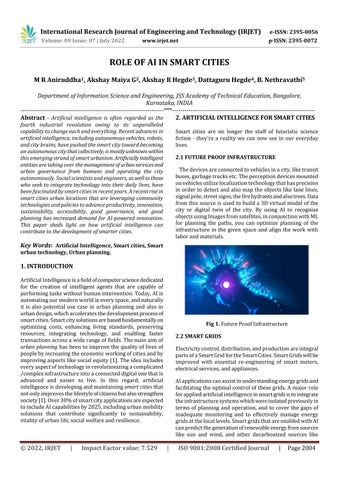
Smart cities are no longer the stuff of futuristic science fiction - they're a reality we can now see in our everyday lives. 2.1 FUTURE PROOF INFRASTRUCTURE The devices are connected to vehicles in a city, like transit buses, garbage trucks etc. The perception devices mounted on vehicles utilize localization technology that has precision in order to detect and also map the objects like lane lines, signal pole, street signs, the fire hydrants and also trees. Data from this source is used to build a 3D virtual model of the city or digital twin of the city. By using AI to recognize objects using Images from satellites, in conjunction with ML for planning the paths, you can optimize planning of the infrastructure in the given space and align the work with labor and materials.

Key Words: Artificial Intelligence, Smart cities, Smart urban technology, Urban planning.

1. INTRODUCTION Artificial Intelligence is a field of computer science dedicated for the creation of intelligent agents that are capable of performing tasks without human intervention. Today, AI is automating our modern world in every space, and naturally it is also potential use case in urban planning and also in urban design, which accelerates the development process of smart cities. Smart city solutions are based fundamentally on optimizing costs, enhancing living standards, preserving resources, integrating technology, and enabling faster transactions across a wide range of fields. The main aim of urban planning has been to improve the quality of lives of people by increasing the economic working of cities and by improving aspects like social equity [1]. The idea includes every aspect of technology in revolutionizing a complicated /complex infrastructure into a connected digital one that is advanced and easier to live. In this regard, artificial intelligence is developing and maintaining smart cities that not only improves the lifestyle of citizens but also strengthen society [1]. Over 30% of smart city applications are expected to include AI capabilities by 2025, including urban mobility solutions that contribute significantly to sustainability, vitality of urban life, social welfare and resilience.

© 2022, IRJET

|

Impact Factor value: 7.529

Fig 1. Future Proof Infrastructure 2.2 SMART GRIDS Electricity control, distribution, and production are integral parts of a Smart Grid for the Smart Cities. Smart Grids will be improved with essential re-engineering of smart meters, electrical services, and appliances. AI applications can assist in understanding energy grids and facilitating the optimal control of these grids. A major role for applied artificial intelligence in smart grids is to integrate the infrastructure systems which were isolated previously in terms of planning and operation, and to cover the gaps of inadequate monitoring and to effectively manage energy grids at the local levels. Smart grids that are enabled with AI can predict the generation of renewable energy from sources like sun and wind, and other decarbonized sources like

|

ISO 9001:2008 Certified Journal

|

Page 2004


Turn static files into dynamic content formats.
Create a flipbook