International Research Journal of Engineering and Technology (IRJET) e ISSN: 2395 0056

Volume: 09 Issue: 07 | July 2022 www.irjet.net p-ISSN: 2395-0072
International Research Journal of Engineering and Technology (IRJET) e ISSN: 2395 0056
Volume: 09 Issue: 07 | July 2022 www.irjet.net p-ISSN: 2395-0072
1,2,3,4,5 Department of Computer Engineering Agnel Institute of Technology and Design, Assagao, Goa 6,7 Assistant Professor, Department of Computer Engineering Agnel Institute of Technology and Design, Assagao, Goa ***
Abstract In our world today, the unusual shift to home learning has had a profound impact on students. AR enabled eLearning applications render augmented objects on screens and play 3D examples of concepts that allow students to learn and engage easily (Silva, 2019, 1)[1]. The application can capture the image of objects from the real environment and provide a detailed description of the object. Students find theoretical information without any visuals or relatable examples difficult to understand. As a result, many concepts remain unclear and out of reach for students. This is where AR applications come to the rescue, visually transforming information and creating order from the chaos. The AR App will enable students to wander around objects like a 3D CPU on the screens of their smartphones/tablets and interact with it, click on it for labeling of parts, rotate it and play around with it. (Silva, 2019,1)[1]
Key Words: Augmented Reality, 3 dimensional, Education, Image Target, Technology.
Augmented reality (AR) is an interactive experience of a real world environment where the objects that reside in the real world are enhanced by computer generated perceptual information, sometimes across multiple sensory modalities, including visual, auditory, haptic, somatosensory and olfactory.(Lintern, 2017)[10] Designers create inputs ranging from graphics to GPS overlays and more in digital content which responds in real time to changes in the user’s environment, typically movement,tosoundtovideo.(Antoniolietal.,2014,1)[6] ARmustalsomeetthreebasiccharacteristics:
1. Real timeinteraction.
2. Accurate3Dregistrationofrealandvirtualobjects. 3. Combination of real and virtual world (Softtek, 2021)[3]
TypesofAugmentedReality Marker BasedAugmentedReality
AR applications based on Marker use target images that are markers, to position objects in a given space. The application places the 3D digital content considering the user’s field of view is determined by using markers. Markerswereusedinearly stageARtechnologies.
Inordertosuperimposethe3Dvirtualobject,theMarker based AR applications are often linked to a specific physical image pattern marker in a real world environment. Thus, the cameras must continuously scan theinputandplaceamarkerforimagepatternrecognition in order to create its geometry. In case the camera is not properlyfocused,thevirtualobjectwillnotbedisplayed.A marker based image recognition system requires several modules consequently, such as camera, image capture, image processing and marker tracking, among others. Generally, this is a simple and inexpensive system to implement in filters through a custom application to recognizespecificpatternsthroughacamera.
Virtual 3D objects positioning in the real image environmentbyexaminingthefeaturespresentinthedata in real time is allowed by Marker less AR. This type of guidancedependsonthehardwareofanysmartphone,be ittheGPSoraccelerometer,camera,amongothers,thejob iscompletedbytheaugmentedrealitysoftware.
With this model, there is no need for an object tracking system due to recent technological advances in cameras, sensors and AI algorithms. Thus, it works with the digital data obtained by these sensors capable of recording a physicalspaceinrealtime.
Students can achieve better results through visualization and full immersion in the subject matter with the help of AR in education. So, instead of reading theories about something, students can see it with their own eyes, in action. The potential of Augmented reality can be used to replace paper textbooks, physical models, posters, and printed manuals. It offers less expensive and portable
International Research Journal of Engineering and Technology (IRJET) e ISSN: 2395 0056
Volume: 09 Issue: 07 | July 2022 www.irjet.net p-ISSN: 2395-0072
learningmaterials.Educationhasbecomemoreaccessible andmobileduetoAR.
Therefore,theobjectivesoftheresearchare:
i. To create an educational application using augmented realitytechnology.
ii. To provide users a new interactive technology to be practicedintheeducationalsector.
iii. To build an augmented reality mobile application, an effective means of educating and entertaining young peopleofallages.
iv. To produce interactive learning application using AR the abstract concepts are materialized to help students understandandvisualizechallengingsubjects.
Software Requirements: There are various different softwareusedinthedevelopmentoftheproject,themain being unity which is a tool used for developing android apps and AR core, an SDK which focuses on AR. The secondarysoftwarewhichwe’reusingisBlenderwhichis asoftwareusedtocreate3dmodelsofourproductswhich thenwillbeusedbyARcorerenderit.
Hardware requirements: An AR Core supported device, RAM Minimum 4GB, Camera Minimum 5MP, Mobile, Tablet,Computer.
Thepapermentioned,proposedbyR.Silva,J.C.Oliveira,G. A. Giraldi presents an overview of basic aspects of Augmented Reality (AR) and the main concepts of this technology. The paper gives information on the fields in whichARisappliednowadaysandmainARdevices(Silva, 2019,1)[1].
This paper shows an instructive mobile application based system model on Augmented Reality which is used to learn history through augmented videos. In this applicationscannedimagesaredemandedfromusersand it will show the history related to that particular image (Raghaw&Paulose,2018,1)[7].
TheMagicBook interfacemakesuseofbooksasthemain interface objects. When the user looks at the pages through an Augmented Reality display, they see three
dimensional virtual models appearing out of the pages. In theVRviewusersarefreetomoveaboutthesceneatwill and interact with the characters in the story. Thus, users can experience the full Reality Virtuality continuum (Billinghurstetal.,2001,3)[5].
This research shows a design of an Augmented Reality (AR) on engineering equipment for education called (AREEE)withanandroidphone.AREEEapplicationswith smartphonesareusedtoscanthetargetanddisplaysome AR 3D models on engineering equipment. On the smartphone’sscreen,the3Dmodelcanbeinteractedwith, and users can rotate the model to look at it from a different angle and tap to display the specifications of the equipment and other information about the equipment (Kassim&Zubir,2019,1)[8].
The paper mentioned proposed by Misty Antonioli, Corinne Blake, and Kelly Sparks focuses on how this technology can be applied, the problems surrounding the useofthistechnology.ARcanbeusedtoenhancecontent and instruction within the traditional classroom. This paper also states a few challenges of AR in education. These challenges include training the student as well as the educator, making AR tools user friendly (Antonioli et al.,2014,1)[6].
Immersing learners in the real world and making them interact with it, is mostly inconvenient. Although the natural world is three dimensional, we prefer to use two dimensionalmediaineducationwhichisveryconvenient, familiar, flexible, portable and inexpensive. But it is static and does not offer dynamic content. Computer generated three dimensional virtual environments can be used like VR headsets but these scenes require high performance computergraphicswhicharemoreexpensivethanothers. Although lotsofopportunitiesvirtual worldsmaypresent for teaching and learning, it is hard to provide an appropriate level of realism. When users are completely immersedinthis environment, they becomedisconnected from the real environment. So, it gives you virtual things bymodelingthereal world you'reexperiencing.(Kesim& Ozarslan,2012,1)[9]
Withtheapp,theusercanvisualizetheobjectinaspaceof their customized dimension and place the object where theywantto.AnexistingapplicationisAssemblrEDU.
© 2022, IRJET | Impact Factor value: 7.529 | ISO 9001:2008 Certified Journal | Page 202
International Research Journal of Engineering and Technology (IRJET) e ISSN: 2395 0056
Volume: 09 Issue: 07 | July 2022 www.irjet.net p-ISSN: 2395-0072
Assemblr EDU enables you to make more interactive, collaborative & fun learning activities with 3D & AR. Classroom. 3D/AR View. In its Computer Hardware sectiononlytwocomputerhardwarewereimplemented.
WealsofoundthattheApp hangsalotanddoesnothave manyexamples(assemblr edu, 2019)[4].Anothersimilar Appis ComputerHistory AR.ItfocusesonlyonHistory of Computers i.e., Different generations of computers. There are no categories to browse through and the interactivity levelisless.
The app is simple yet descriptive in a way that the users willbeabletovisualizetheConceptwhichtheyaretrying to learn. User Interface and ease of usability is of the utmost importance for any app or software. That being said, the users will simply have to click, select, tap and scanthe2Dobjects.
Users will have to first sign up if he/she is a new user or sign in. Then the user will have to select through a selection of 3D objects in each section. The concepts will besegregatedinto5differentpredefinedcategories.
Computer Hardware, Computer Networks, AI problem Solving, Visualization of Searching algorithms, Game Section. Then the user will select the category he/she wantstovisualizebysimplytappingonit.
The camera button is displayed to scan the target 2D image. After the user scans the image, the app will then deploya3Dmodeloftheselectedproducttobeviewedin alltheangles.
The product will then be deployed through the AR software which will augment the product in the real life dimensional room after which the users can place it anywhere, they want. The 3D model will be displayed alongwiththelabeledpartsandusefullinksandpdfswill also be attached, for each model the voice explanation is provided.
Otheroptionswillalsobeincorporatedintheappsuchas rotation, zoom in, zoom out the 3D Model, this helps the usertoplaywiththemodelandhelpsthemtounderstand theconcepteasily.
Thesystembasicallyusesa smartphone’sbuilt incamera whichsupportsARtoviewtherealworldobservedbythe humaneyeandplacesthe3Dmodelonthescreen.
First step is the creation of the 3D models using Blender. The next step is to convert the 3D models into an
interactive AR element using Unity3D software. We need to set up the scenes in Unity 3D for the User Interface of theapplicationlikebuttons, textareas,backgroundimage and virtual object selection. Through identifying and tracing thesurface area, the imported 3Dvirtual model is placed in the real world view along with the description and other multimedia content. Because Android smartphones have a touch screen interface function, the users can easily interact with the augmented virtual content.
Figure 1: ADDIE Model
In order to ensure effective learning outcomes from educational courseware or mobile application education development, careful planning is required before the development process begins. ADDIE Instructional Design Model is used in this mobile AR application development methodology. The ADDIE model for instructional system design (ISD) is a basic model that can be applied to any kindoflearningsolution.TheADDIEmodelhasfivesteps, namely, analysis, design, development, implementation, and evaluation as illustrated in Figure 1. (ADDIE Model, 2010)[2]
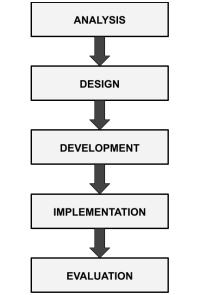
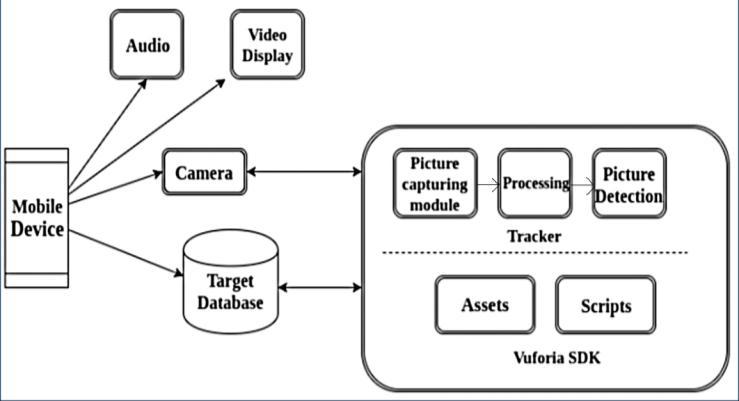
Figure 2: Block Diagram
2022, IRJET | Impact Factor value: 7.529 | ISO 9001:2008 Certified
International Research Journal of Engineering and Technology (IRJET) e ISSN: 2395 0056
Volume: 09 Issue: 07 | July 2022 www.irjet.net p-ISSN: 2395-0072
This application is developed by using Unity3d and Vuforia Augmented Reality Software Development Key (ARSDK). Here Unity3D is used to create the application andVuforiaARSDKisusedtolinktheAugmentedReality camera and the image tracker. Tracker is used to detect the image target which is stored in the database. Assets and Scripts working along with access to the Target Database is explained in detail in the same section after describingthemodel.AsshowninFigure2,thefirststepis to open the application camera and scan the targeted imageusingamobiledevice.Oncetheimageisscanned,it is sent to the picture capturing model for recognition. If theimageisrecognizeditissenttotheprocessingmodel. Processing model then detects the marker position and sends it to the tracker model. Tracker model then identifiesthemarkerandsendsittotherenderingmodel. Rendering a model using picture detection will mark a virtual object to the marker and hence the augmented videowillbeplayed.
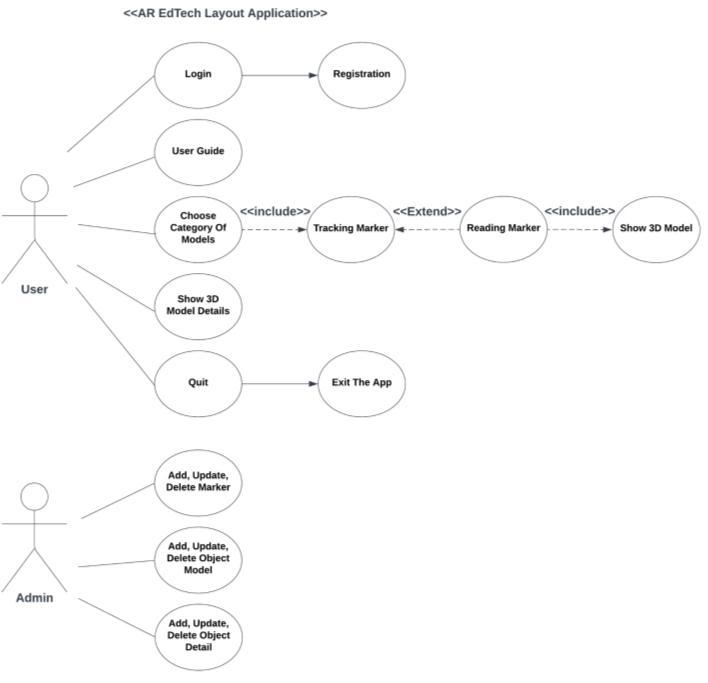
Figure3,describestheusecasediagramoftheapplication where the user interacts with the application using an Android device that supports AR camera. Initially we selectthemodelinwhichweareinterested,thenscanthe surroundingsusingadevicecameraandplacethemodel.
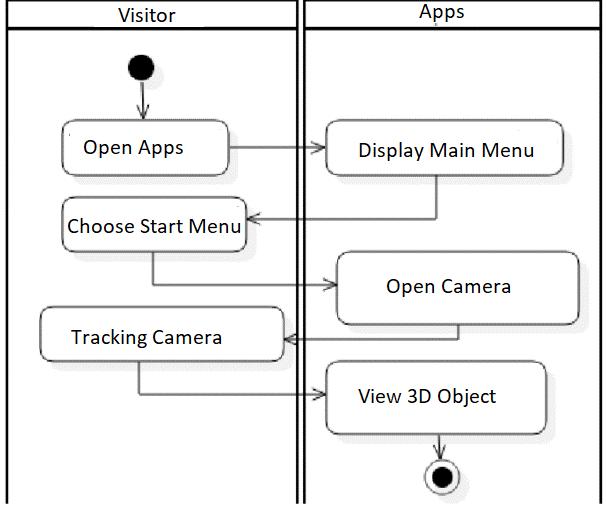
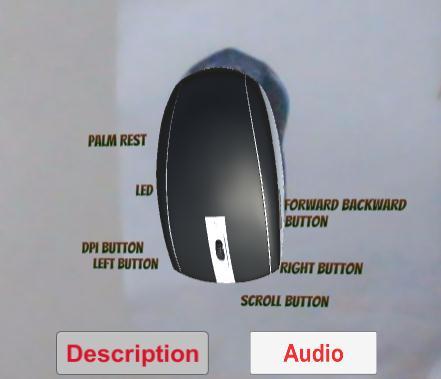
The user opens the app, chooses the module option from thestartmenu,pointsthecameratotheimagetargetthen a virtual 3D model is overlaid on the image target in the realworld.
A. Motherboard
Figure 5: 3D model of a motherboard
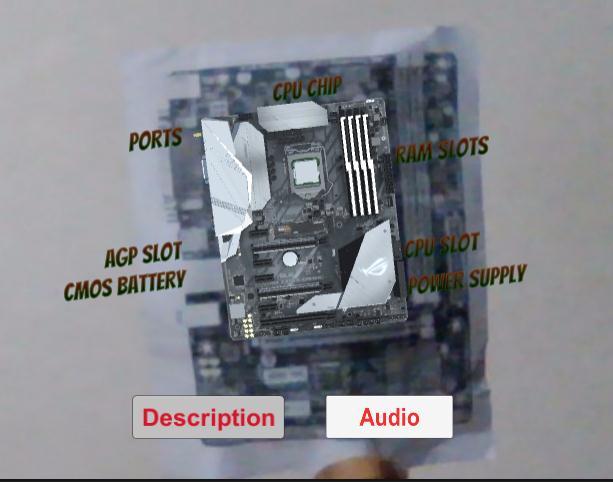
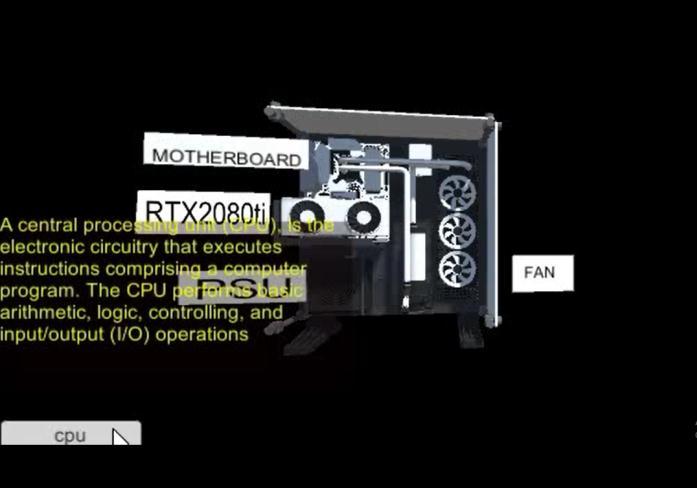
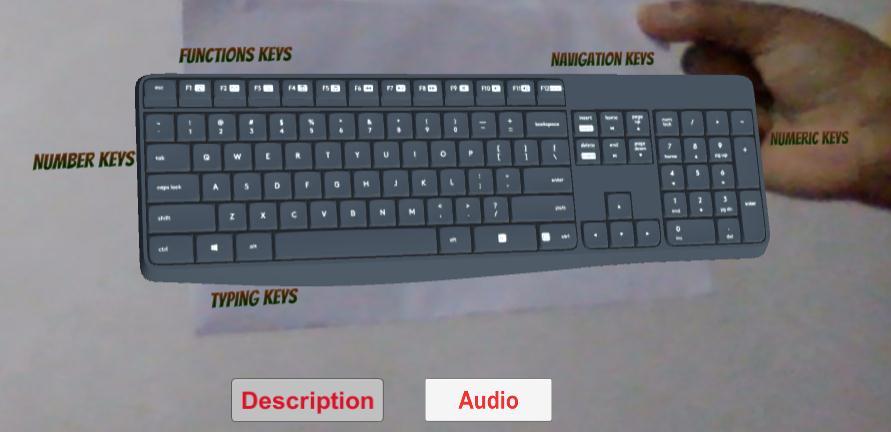
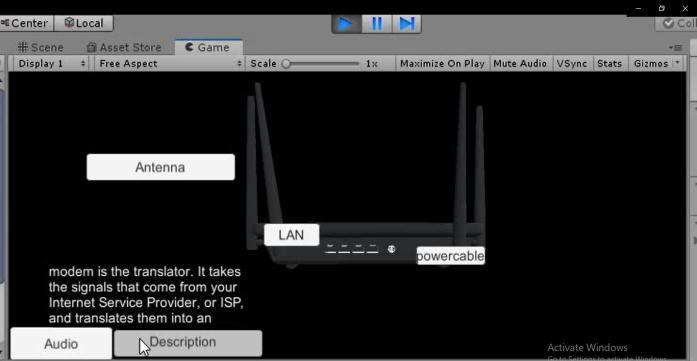
Figure 9: 3D model of a modem
The module includes visualization of various searching/pathfinding algorithms. Each of the algorithms is explained with a high level of visualization including interactiveness using AR which will help intelligence development. The algorithms will help build the user’s core foundation and logic of different searching algorithms.
TheAIproblem solvingmodulealsodealswithvariousAI ProblemSolvingmethodswhichareexplainedwithahigh level of interactiveness using AR which will help intelligence development. The included AI problem solving methods are Dijkstra’s algorithm, water jug problem, missionaries and cannibals’ problem, 8 puzzle problem,TowerofHanoiproblem,andtravelingsalesman.
The Dijkstra algorithm is also referred to as a single source shortest path algorithm. The single source means thatonlyonesource(start node) isgiven,and wehave to find the path with lowest distance from the start node to allthenodes.(javatpoint,2017)[11] Fig 10: Unity interface with 3D game objects
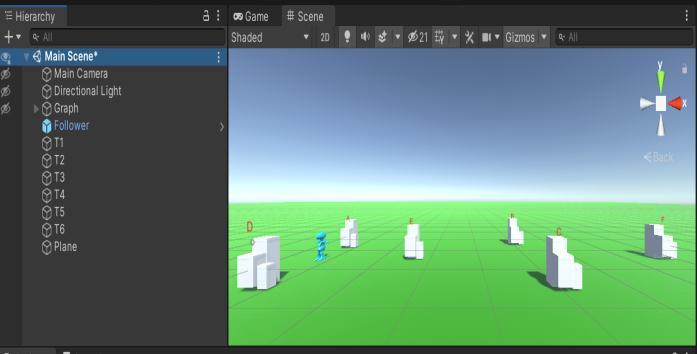
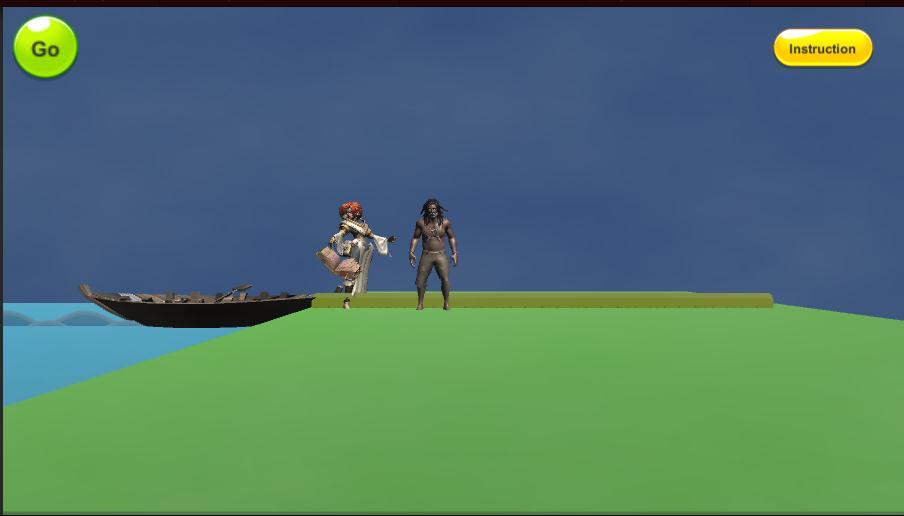
The game module focuses on testing the knowledge learned by the user in the other modules using various engagingandinteractivegames.Gamesincludeidentifying hardwareparts,reassemblingofparts,waterjugproblem, missionaries and cannibals’ problem, Tower of Hanoi problem,andapplicationsofnetworkingdevices.
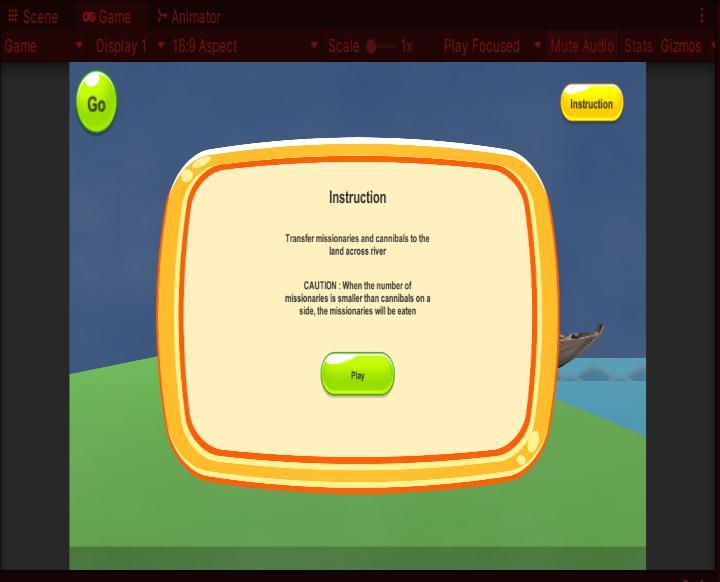
Missionaries and Cannibals problem can be defined as a situationin which3 missionaries and 3cannibalswant to cross fromtheleft bank of a rivertothe right bank ofthe river. There’s a boat on the bank, which at most carries only two people at a time and can never cross with zero people on the boat. If cannibals ever outnumber missionariesoneitherbank,thenthecannibalswilleatthe missionaries. This problem can be solved using Breadth firstsearch.
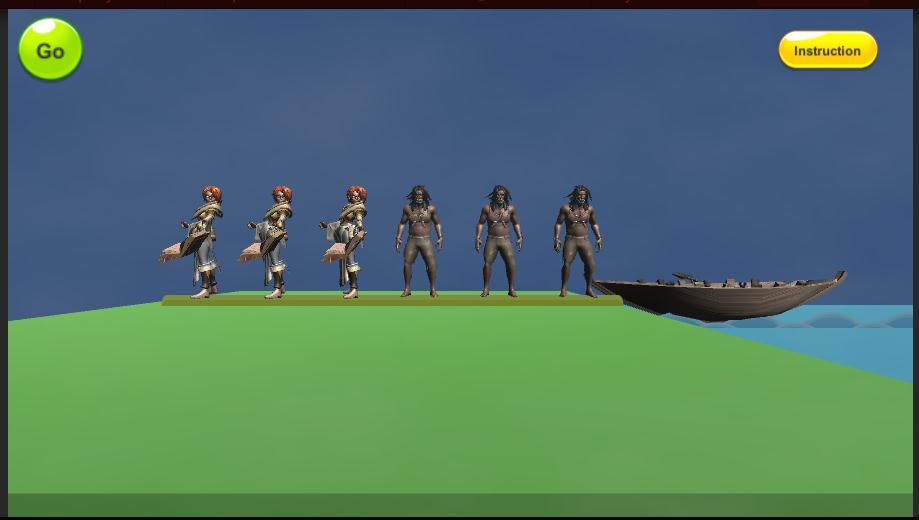
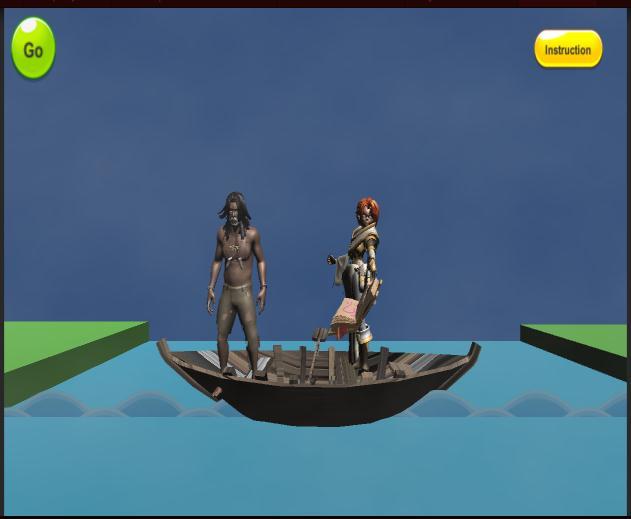
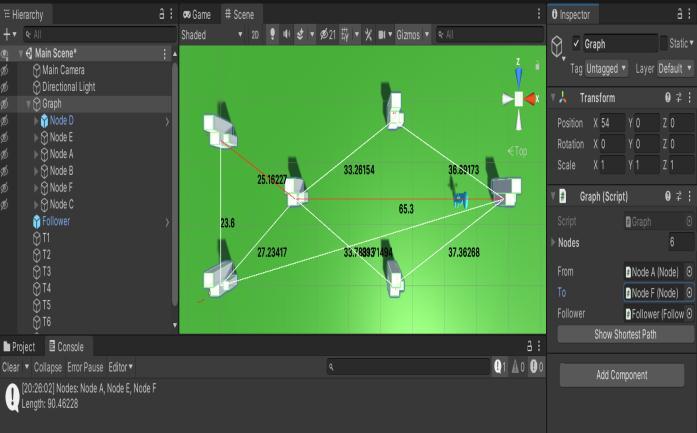
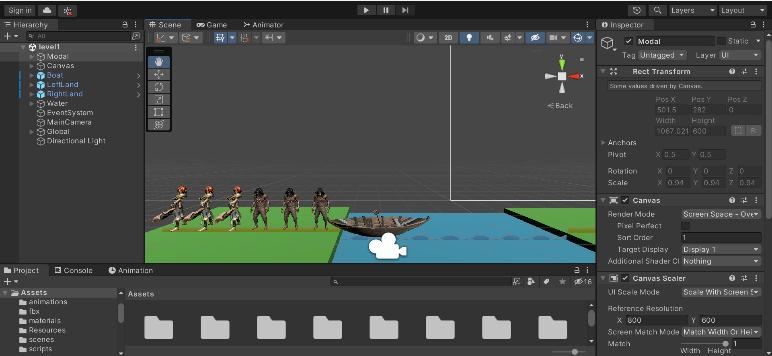
Figure 12: Unity interface with 3D game objects
International Research Journal of Engineering and Technology (IRJET) e ISSN: 2395 0056
Volume: 09 Issue: 07 | July 2022 www.irjet.net p-ISSN: 2395-0072
our colleagues for their constant support and encouragementrenderedthroughout.
1) Silva, R. (2019). Introduction to Augmented Reality NationalLaboratoryforScientificComputation,Av.Getulio Vargas, 333 Quitandinha Petropolis RJ Brazil. http://citeseerx.ist.psu.edu/viewdoc/download?doi=10.1. 1.63.4105&rep=rep1&type=pdf
2) ADDIE Model. (2010, August 1). Wikipedia. Retrieved June 30, 2022, from https://en.wikipedia.org/wiki/ADDIE_Model
The AR enabled E Learning applications help create a comfortable environment for learners of any age group. Oftenlearnersfacedifficultieswhenitcomestoperceiving theoretical information without any visuals or relatable examples, which results in incomprehensible outcomes. Augmented reality applications offer visual bliss by enabling learners to wander around 3D objects like CPU ontheirscreensofsmartphones/tabletsandinteractwith it.
Research has shown that AR in near future will provide personalized, accessible and well designed experiences. AR technology in education enhances and brings in benefits for learners, educators, institutions and content publishers. Following the Modern trends in educational technology and development, the application will add valueinthenearfuture.
WearegreatlyindebtedtoourPrincipal,Dr.V.Mariappan, Prof. Snehal Bhogan, Head of Computer Engineering Department,ourGuideProf.KedarSawant,AgnelInstitute of Technology and Design, Assagao Goa, who gave us the opportunity to do the project on the topic “BUILDING EDTECH SOLUTIONS WITH AR” and also for their valuable guidance throughout the dissertation, without which the study undertaken would not have been accomplished.
Our sincere thanks to our Co guide, Prof. Sagar Naik Faculty and Staff, Department of Computer Engineering, AgnelInstituteofTechnologyandDesign,AssagaoGoaand
3) Softtek. (2021, September 1). What are the different types of Augmented Reality? Softtek. Retrieved June 30, 2022,from https://softtek.eu/en/tech magazine en/user experience en/what are the different types of augmented reality/
4) assemblr edu. (2019, January). Assemblr EDU Augmented Reality (AR) for Classrooms. Retrieved June 30,2022,fromhttps://edu.assemblrworld.com/
5) Billinghurst, M., Kato, H., & Poupyrev, I. (2001). The MagicBook: A Transitional AR Interface. Washington Publishing Company. http://www.hitl.washington.edu/people/tfurness/course s/inde543/READINGS 03/BILLINGHURST/MagicBook.pdf
6) Antonioli, M., Blake, C., & Sparks, K. (2014). Augmented Reality Applications in Education. The Journal of Technology Studies. https://www.semanticscholar.org/paper/JOTS v40n2 Augmented Reality Applications in Antonioli Blake/861d51b1f24a343a9acaf651b67139ca3dc57441
7) Raghaw,M.,&Paulose,J.(2018). Augmented reality for history education.Internationaljournalofengineeringand technology. https://www.academia.edu/36333632/Augmented_Realit y_for_History_Education
8) Kassim, M., & Zubir, M. (2019). Design of Augmented Reality for Engineering Equipment in Education International Journal of Advanced Trends in Computer Science and Engineering. https://www.warse.org/IJATCSE/static/pdf/file/ijatcse15 862019.pdf
9) Kesim,M.,&Ozarslan,Y.(2012).Augmentedrealityin education: current technologies and the potential for education. Procedia Social and Behavioral Sciences 47 ( 2012 ) 297 302. https://pdf.sciencedirectassets.com/277811/1 s2.0 S1877042812X00181/1 s2.0
International Research Journal of Engineering and Technology (IRJET) e ISSN: 2395 0056
Volume: 09 Issue: 07 | July 2022 www.irjet.net p-ISSN: 2395-0072
S1877042812023907/main.pdf?X Amz Security
Token=IQoJb3JpZ2luX2VjEAUaCXVzLWVhc3QtMSJHMEUC IQDSKfScdO7XVyLaTij5XpBDi97cUzEqa2EojMlvWKXe4gI gKk8W%2BjlEzaPCtHEQYCESAmIHflJ8LassygzF%2FbQq m
10) Lintern, G. (2017, June 25). Augmented reality. Wikipedia. Retrieved June 30, 2022, from https://en.wikipedia.org/wiki/Augmented_reality
11) javatpoint. (2017, January 1). Dijkstra's Algorithm javatpoint. Javatpoint. Retrieved June 30, 2022, from https://www.javatpoint.com/dijkstras algorithm
Final year Computer Engineering (BE) student at Agnel Institute of TechnologyandDesign,Goa
Lizanne Fernandes
Final year Computer Engineering (BE) student at Agnel Institute of TechnologyandDesign,Goa
Savita Jamdarkhani
Final year Computer Engineering (BE) student at Agnel Institute of TechnologyandDesign,Goa
Merlyn Joseph
Final year Computer Engineering (BE) student at Agnel Institute of TechnologyandDesign,Goa
Saniya Mulla
Final year Computer Engineering (BE) student at Agnel Institute of TechnologyandDesign,Goa







Ruchita Suranagi Assistant Professor at Agnel Institute of Technology and Design,Goa
Kedar Sawant Assistant Professor at Agnel Institute of Technology and Design,Goa
Sagar Naik