International Research Journal of Engineering and Technology (IRJET)
e-ISSN: 2395-0056
Volume: 09 Issue: 07 | July 2022
p-ISSN: 2395-0072
www.irjet.net
FLEXURAL BEHAVIOUR OF HYBRID FIBRE REINFPRCED GEOPOLYMER CONCRETE BEAM USING STEEL FIBRE AND POLYPROPYLENE FIBRE MANJUNATH M KATTI1, ISHITHA K P2, ABHISHEK N3, CHANDAN H S4, NITHESH KUMAR S5 Asst. professor and Students, Department Civil of Engineering, Channabasaveshwara Institute of Technology, Gubbi, Tumkur, India. -------------------------------------------------------------------------***------------------------------------------------------------------ABSTRACT –
coarse and fine aggregate, alkali solution and discontinuous discrete fibres are called Fibre Reinforced geopolymer Concrete. The fibres added in concrete are not a substitute for control reinforcement. The basic difference between steel reinforcement and discrete steel fibres is that the continual steel bars are used to increase the tensile and shear capacities of concrete whereas addition of discontinuous fibres improves the post cracking response by dominant the crack opening and propagation.
Geopolymer concrete is one of the emerging building materials in the world. Numerous studies are conducted on the Geopolymer concrete and the engineering properties of the material have been improved drastically. A mixture of sodium hydroxide solution and sodium silicate solution of 5M is used. Geopolymer concrete is found to be relatively brittle than the normal standard concrete. To counteract this effect fibres are incorporated in to the Geopolymer concrete. During this investigation, an attempt is made to analyses behaviour of fibre reinforced geopolymer concrete by hybridization of fibres. In this investigation polypropylene and steel fibre are used in hybridization form to find the flexural performance of fibre reinforced geopolymer concrete beams. In this project work, steel fibres and polypropylene fibres are added to the Geopolymer concrete, and its influence was studied over the hardened properties of concrete such as flexural strength.
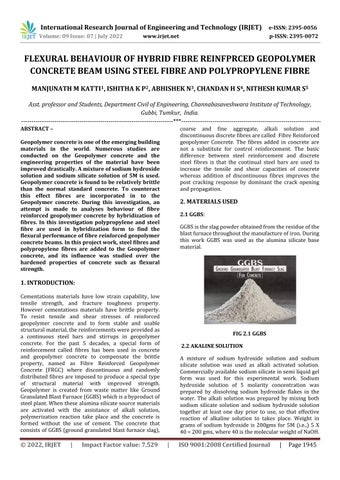
2. MATERIALS USED 2.1 GGBS: GGBS is the slag powder obtained from the residue of the blast furnace throughout the manufacture of iron. During this work GGBS was used as the alumina silicate base material.
1. INTRODUCTION: Cementations materials have low strain capability, low tensile strength, and fracture toughness property. However cementations materials have brittle property. To resist tensile and shear stresses of reinforced geopolymer concrete and to form stable and usable structural material, the reinforcements were provided as a continuous steel bars and stirrups in geopolymer concrete. For the past 5 decades, a special form of reinforcement called fibres has been used in concrete and geopolymer concrete to compensate the brittle property, named as Fibre Reinforced Geopolymer Concrete (FRGC) where discontinuous and randomly distributed fibres are imposed to produce a special type of structural material with improved strength. Geopolymer is created from waste matter like Ground Granulated Blast Furnace (GGBS) which is a byproduct of steel plant. When these alumina silicate source materials are activated with the assistance of alkali solution, polymerization reaction take place and the concrete is formed without the use of cement. The concrete that consists of GGBS (ground granulated blast furnace slag),
© 2022, IRJET
|
Impact Factor value: 7.529
FIG 2.1 GGBS 2.2 AKALINE SOLUTION A mixture of sodium hydroxide solution and sodium silicate solution was used as alkali activated solution. Commercially available sodium silicate in semi liquid gel form was used for this experimental work. Sodium hydroxide solution of 5 molarity concentration was prepared by dissolving sodium hydroxide flakes in the water. The alkali solution was prepared by mixing both sodium silicate solution and sodium hydroxide solution together at least one day prior to use, so that effective reaction of alkaline solution to takes place. Weight in grams of sodium hydroxide is 200gms for 5M (i.e.,) 5 X 40 = 200 gms, where 40 is the molecular weight of NaOH.
|
ISO 9001:2008 Certified Journal
|
Page 1945