International Research Journal of Engineering and Technology (IRJET)
e-ISSN: 2395-0056
Volume: 09 Issue: 07 | July 2022
p-ISSN: 2395-0072
“Experimental
www.irjet.net
Investigation on EDM of EN-8 Using Copper Tools”
Shivardhan Goswami1, Dr. Mohd. Shadab Khan2, Dr. Mohd. Anas3 1M.techStudent,
Mechanical Engineering Dept, Integral University, Lucknow, UP India Professor, Mechanical engineering Dept, Integral University, Lucknow, UP, India 3Associate Professor, Mechanical engineering Dept, Integral University, Lucknow, UP, India ---------------------------------------------------------------------***--------------------------------------------------------------------which is fed verticaaly downwards and erodes the Abstract - EDM machine is a non-conventional machine 2Associate
which is used to cut alloy materials with high hardness, impact resistance and toughness. It can cut complex contours which are difficult to be machined by conventional cutting methods. The present investigation is conducted on EDM is performed on EN-8 with copper as electrode to establish the relationship between process parameters of EDM on material removal rate, tool wear rate and white layer thickness. The investigation concluded that material removal rate, tool wear rate and white layer thickness were majorly influenced by the peak current and pulse on time. Pulse off time was found to be the least dominating parameter for all the performance measures.
1.INTRODUCTION Electrical Discharge Machining (EDM) is a controlled material removal technique used to remove metal by means of spark erosion. This process utilizes an electric spark as the cutting tool to machine the workpiece to produce the finished product to the desired size and shape. The material removal process is performed in dielectric medium to enhance the efficiency of the process and applies a pulsating (ON/OFF) electrical charge of high-frequency current by the electrode on to the workpiece. This removes a very tiny layer of metal from the workpiece at a controlled rate.
workpiece into finished desired product.
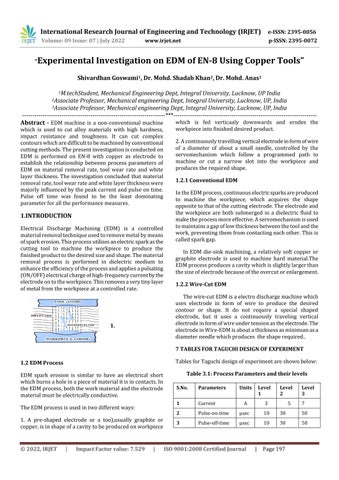
2. A continuously travelling vertical electrode in form of wire of a diameter of about a small needle, controlled by the servomechanism which follow a programmed path to machine or cut a narrow slot into the workpiece and produces the required shape. 1.2.1 Conventional EDM In the EDM process, continuous electric sparks are produced to machine the workpiece, which acquires the shape opposite to that of the cutting electrode. The electrode and the workpiece are both submerged in a dielectric fluid to make the process more effective. A servomechanism is used to maintains a gap of low thickness between the tool and the work, preventing them from contacting each other. This is called spark gap. In EDM die-sink machining, a relatively soft copper or graphite electrode is used to machine hard material.The EDM process produces a cavity which is slightly larger than the size of electrode because of the overcut or enlargement. 1.2.2 Wire-Cut EDM The wire-cut EDM is a electro discharge machine which uses electrode in form of wire to produce the desired contour or shape. It do not require a special shaped electrode, but it uses a continuously traveling vertical electrode in form of wire under tension as the electrode. The electrode in Wire-EDM is about a thickness as minimum as a diameter needle which produces the shape required..
1.
7 TABLES FOR TAGUCHI DESIGN OF EXPERIMENT Tables for Taguchi design of experiment are shown below:
1.2 EDM Process EDM spark erosion is similar to have an electrical short which burns a hole in a piece of material it is in contacts. In the EDM process, both the work material and the electrode material must be electrically conductive. The EDM process is used in two different ways: 1. A pre-shaped electrode or a too),usually graphite or copper, is in shape of a cavity to be produced on workpiece
© 2022, IRJET
|
Impact Factor value: 7.529
|
Table 3.1: Process Parameters and their levels S.No.
Parameters
1
Current
2 3
Units
Level 1
Level 2
A
3
Pulse-on-time
µsec
10
30
50
Pulse-off-time
µsec
10
30
50
ISO 9001:2008 Certified Journal
|
5
Level 3
Page 197
7