Grid Integration and Application of Solar Energy; A Technological Review

Page 1

International Research Journal of Engineering and Technology (IRJET)

e-ISSN: 2395-0056

Volume: 09 Issue: 07 | July 2022

p-ISSN: 2395-0072

www.irjet.net

Grid Integration and Application of Solar Energy; A Technological Review Anjali Patel, Ranjana Singh Department of Electrical Engineering Department of Electrical Engineering Jabalpur Engineering College, Jabalpur Madhya Pradesh, India ---------------------------------------------------------------------***---------------------------------------------------------------------

Abstract – The author in this paper attempts to present a

Though the efficiency of electricity production from SECS is lower than conventional resources, it is the need of time to move to a green form of power since conventional resources have high carbon emission which leads to global warming [4]. The adverse effects of climate change are much more discernible than ever before, with a better understanding of the relationship between energy use and poor environmental outcomes. While the global agenda is of common concern, there is a heightened consciousness of the need to fix poor air quality standards in Indian cities, which is being reflected in tough administrative actions and court mandated orders [6].

comprehensive review in the development of technologies to integrate Solar Energy Conversion System (SECS) into the main grid. The applicable solution to overcome intermittent nature of the solar energy has been discussed. Various government and private entities have charted energy policy in a way forward to beat the challenges of grid integrated operation of SECS. The innovation in technologies such as process bus technology, digitizing sub-station, geographicalinformation system, advanced metering infrastructure has been briefed to mitigate synchronization issues with SECS. The key component of integrated operation of the solar system is inverters. Inverters are the solid technical backbone of smart grid capable of performing multiple functions such as static compensator mitigating harmonics and voltage stability assessment. Key Words: Solar Energy, Renewable energy Sources (RES), Single Stage (SS), Dual Stage (DS), Power quality (PQ), Smart Grid (SG).

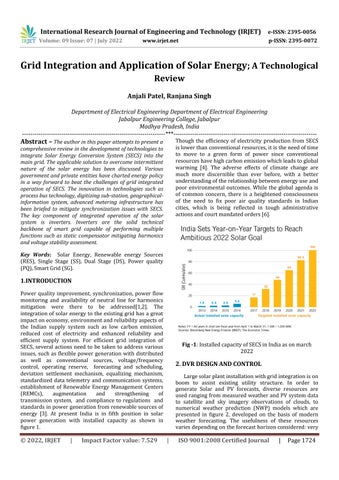
1.INTRODUCTION Power quality improvement, synchronization, power flow monitoring and availability of neutral line for harmonics mitigation were there to be addressed[1,2]. The integration of solar energy to the existing grid has a great impact on economy, environment and reliability aspects of the Indian supply system such as low carbon emission, reduced cost of electricity and enhanced reliability and efficient supply system. For efficient grid integration of SECS, several actions need to be taken to address various issues, such as flexible power generation with distributed as well as conventional sources, voltage/frequency control, operating reserve, forecasting and scheduling, deviation settlement mechanism, equalizing mechanism, standardized data telemetry and communication systems, establishment of Renewable Energy Management Centers (REMCs), augmentation and strengthening of transmission system, and compliance to regulations and standards in power generation from renewable sources of energy [3]. At present India is in fifth position in solar power generation with installed capacity as shown in figure 1.

© 2022, IRJET

|

Impact Factor value: 7.529

Fig -1: Installed capacity of SECS in India as on march 2022

2. DVR DESIGN AND CONTROL Large solar plant installation with grid integration is on boom to assist existing utility structure. In order to generate Solar and PV forecasts, diverse resources are used ranging from measured weather and PV system data to satellite and sky imagery observations of clouds, to numerical weather prediction (NWP) models which are presented in figure 2, developed on the basis of modern weather forecasting. The usefulness of these resources varies depending on the forecast horizon considered: very

|

ISO 9001:2008 Certified Journal

|

Page 1724


Turn static files into dynamic content formats.
Create a flipbook