Numerical Analysis of Liquid Storage Tank Subjected to Dynamic Loading

Page 1

International Research Journal of Engineering and Technology (IRJET)

e-ISSN: 2395-0056

Volume: 09 Issue: 07 | July 2022

p-ISSN: 2395-0072

www.irjet.net

Numerical Analysis of Liquid Storage Tank Subjected to Dynamic Loading Shamna N.1, Liji A.2 1M.TECH.

(Structural Engineering) Student, Dept. of Civil Engineering, Younus College of Engineering and Technology, Kollam, Kerala, India 2Associate Professor, Dept. of Civil Engineering, Younus College of Engineering and Technology, Kollam, Kerala, India ---------------------------------------------------------------------***---------------------------------------------------------------------

Abstract – Liquid storage tanks are used to store water,

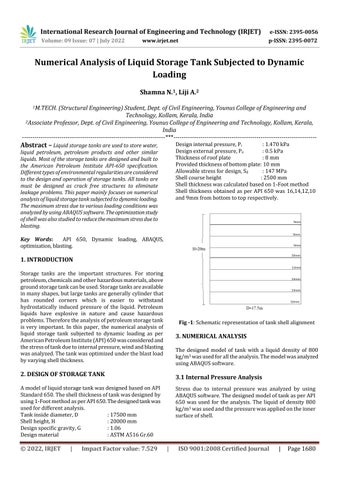
Design internal pressure, Pi : 1.470 kPa Design external pressure, Pe : 0.5 kPa Thickness of roof plate : 8 mm Provided thickness of bottom plate: 10 mm Allowable stress for design, Sd : 147 MPa Shell course height : 2500 mm Shell thickness was calculated based on 1-Foot method Shell thickness obtained as per API 650 was 16,14,12,10 and 9mm from bottom to top respectively.

liquid petroleum, petroleum products and other similar liquids. Most of the storage tanks are designed and built to the American Petroleum Institute API-650 specification. Different types of environmental regularities are considered to the design and operation of storage tanks. All tanks are must be designed as crack free structures to eliminate leakage problems. This paper mainly focuses on numerical analysis of liquid storage tank subjected to dynamic loading. The maximum stress due to various loading conditions was analyzed by using ABAQUS software. The optimization study of shell was also studied to reduce the maximum stress due to blasting. Key Words: API 650, Dynamic loading, ABAQUS, optimization, blasting.

1. INTRODUCTION Storage tanks are the important structures. For storing petroleum, chemicals and other hazardous materials, above ground storage tank can be used. Storage tanks are available in many shapes, but large tanks are generally cylinder that has rounded corners which is easier to withstand hydrostatically induced pressure of the liquid. Petroleum liquids have explosive in nature and cause hazardous problems. Therefore the analysis of petroleum storage tank is very important. In this paper, the numerical analysis of liquid storage tank subjected to dynamic loading as per American Petroleum Institute (API) 650 was considered and the stress of tank due to internal pressure, wind and blasting was analyzed. The tank was optimized under the blast load by varying shell thickness.

Fig -1: Schematic representation of tank shell alignment

3. NUMERICAL ANALYSIS The designed model of tank with a liquid density of 800 kg/m3 was used for all the analysis. The model was analyzed using ABAQUS software.

2. DESIGN OF STORAGE TANK

3.1 Internal Pressure Analysis

A model of liquid storage tank was designed based on API Standard 650. The shell thickness of tank was designed by using 1-Foot method as per API 650. The designed tank was used for different analysis. Tank inside diameter, D : 17500 mm Shell height, H : 20000 mm Design specific gravity, G : 1.06 Design material : ASTM A516 Gr.60

© 2022, IRJET

|

Impact Factor value: 7.529

Stress due to internal pressure was analyzed by using ABAQUS software. The designed model of tank as per API 650 was used for the analysis. The liquid of density 800 kg/m3 was used and the pressure was applied on the inner surface of shell.

|

ISO 9001:2008 Certified Journal

|

Page 1680


Turn static files into dynamic content formats.
Create a flipbook