EXPERIMENTAL INVESTIGATION ON PERFORMANCE OF WHITE TOPPING OVER FLEXIBLE PAVEMENTS
Abstract - The main focus of the present era is to construct a long lasting and better Performing pavement. Usually, with respect to the rehabilitation of the pavement, the construction agencies go with the bituminous overlays as their first priority without considering the condition of the existing pavement structure. But Cement Concrete (CC) pavements have proved that they perform better and are long lasting as new pavement as well as when used for rehabilitation of the existing pavement.
Hence it is the era, White Topping methods are gaining their popularity White topping is rehabilitation treatment on asphalt concrete. It is defined as Plain Cement Concrete overlay on asphalt concrete. It provides a new innovative method of rehabilitation at a very low cost with very good results and low maintenance cost.This method of rehabilitation/strengthening can be adopted for rural road network and district roads as theseroads have low to moderate traffic. Even on the State Highways and some recently declared National Highways, where traffic is moderate, the above method of strengthening has a lot of promise. By adopting proper construction methods, we can rehabilitate large network of roads at reasonable cost and we get additional long life.
This study presents a methodology to adopt white topping as rehabilitation treatment and cost effective rehabilitation alternative for preserving bituminous pavements on long term basis and to compare & conclude which type of road is feasible and is good to have on a particular situation. The comparison of the study shows that the white topping of both types of roads improves the life span of the road & its withstanding capability.
Keywords: White Topping, Potholes, Compressive Strength,SplitTensileStrength,FlexuralStrength.
1. INTRODUCTION
Indiahasthesecondlargestroadnetworkinthe world spanning about 4.69 million km comprising different categories of roads. Only half of the total road network is paved and of the paved roads, 90% of them are bituminous pavements. Pavement design is the
process of developing the most economical combination of pavement layers to suit the soil foundation and the cumulative traffic to be carried during the design life. Highway pavement is deteriorating fast due to lack of timely maintenance Thus, timely maintenance of the highway pavement is essential. Road maintenance is one of the important components of the entire road system. Right maintenance treatment is to be given to the right place at the right time. Highway engineering is an engineering discipline branching from civil engineering that involves the planning, design, construction, operation, and maintenance of roads, bridges, and tunnels to ensure safe and effective transportationofpeopleandgoods.Someconsiderations aretheadverseeffectsontheenvironment,suchasnoise pollution, air pollution, water pollution, and other ecological impacts. A flexible pavement failure is defined by formation of potholes, ruts, cracks, localized depressions,settlements,etc.
The Portland Cement Concrete (PCC) overlay on an existing bituminous pavement is termed as White topping.Themaingoalofconcreteoverlayistomaximize thestrengthoftheexistingasphaltstructurebyrebuilding it. While achieving this aim, the overlay also brings back the riding quality of the existing structure which had undergone deformations like rutting. At present, the concrete technology and its applications have developed in a rapid rate and hence the concrete overlay has becomeanon renewableoption.
2. OBJECTIVES OF THE STUDY
[1] To evaluate the design and methodologies for repairingpotholesbywhitetoppinglayers.
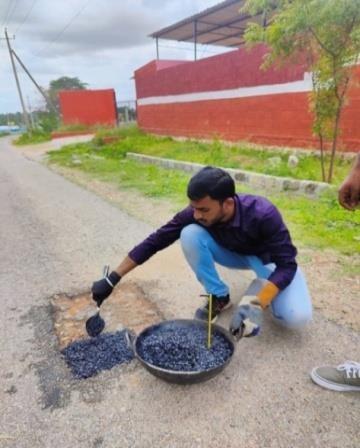
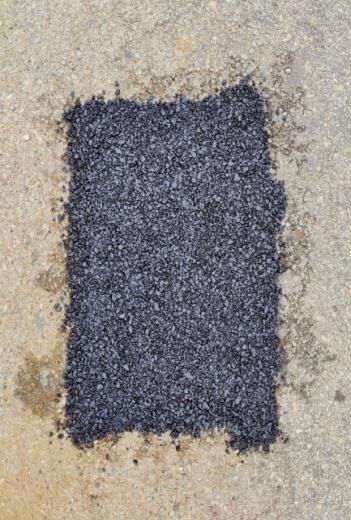
[2] To compare the Performance of potholes repaired using white topping layers and bituminous concrete mix.
3. METHODOLOGY
To achieve the objectives stated above, an efficient working procedure has to be followed. Initially

International Research Journal of Engineering and Technology (IRJET) e ISSN: 2395 0056
therequiredmaterialsforwhitetoppingareselectedand basic tests are conducted, then mix proportion of M40 grade is designed as per IS: 10262 and IS: 456 codal specifications. By the obtained mix proportion moulds are prepared to test the properties of concrete such as compressive strength test, split tensile strength test and flexural strength test. When after reach the target strength the same proportion of mix is prepared to fill the potholes of known stretch of 50 meter road. Simultaneously bitumen mix is also prepared and filled inthesamestretchofotherpotholes.Comparisonis to
be madeaftercertaintimeandtheconclusionsareobtained.
4. MATERIALS USED
The materials used in experimental investigation are Cement,Fineaggregates,coarseaggregatesandWater.
4.1 Cement
The Portland Pozzolana Cement (PPC) is a kind of Blended Cement which is produced by either inter grinding of Ordinary Portland Cement (OPC) clinker along with gypsum and pozzolanic materials in certain proportions or grinding the OPC clinker, gypsum and Pozzolanic materialsseparatelyandthoroughlyblending them in certain proportions and tests results are tabulatedasshowninTable1.
Table: 1 BasicLaboratoryTestsonCement
SL No Tests on Cement Test Results
Initialsettingtime Finalsettingtime 240min.. 300min.. NormalConsistency 34% Finenessofcement 2.83% specificgravityof cement 3.0
4.2 Coarse Aggregate
20 mm and down size angular aggregates are used for experimental investigation and tests results aretabulatedasshowninTable2.
Table: 2 BasicLaboratoryTestsonCoarseAggregates
SL No Tests on Coarse Aggregates Test Results 1 Impacttest 22.17% 2 Crushingtest 27.45% 3 Abrasiontest 32% 4 Soundnesstest 2.04% 5 Specificgravityand waterabsorption 2.50and0.5%
4.3 Fine Aggregate / Sand Zone 2 aggregates are used for experimental investigation and tests results are tabulated as below Table3andtheparticlesizedistributionisasshownin Fig 1.
Table: 3 BasicLaboratoryTestsonFineAggregates
SL No Tests on Fine Aggregates Test Results 1 Specificgravity 2.60 2 Sieveanalysis WellGraded
120 100 80 60 40 20 SIEVE SIZE (mm)

% PAS S I NG 0 0.01 0.1 1 10


Fig: 1 ParticleSizeDistribution
4.4 Water
Locallyavailablepotablewaterusedformixing and curing was clean and free from injurious amounts ofoils,acids, alkalis, salts and sugar, organic materials or othersubstancesthatmaybedeleterious toconcrete.
Volume: 09 Issue: 07 | July 2022 www.irjet.net p ISSN: 2395 0072 © 2022, IRJET | Impact Factor value: 7.529 | ISO 9001:2008 Certified Journal
5. MIX DESIGN

From the results of materials basic tests, Mix design were conducted for M40 grade concrete mix using IS10262 and IS 456:2000 codal provisions. The mix designratio among cement, fine aggregate, coarse aggregate and water were originated as shown in Table 4 and percentage of proportionswereshowninFig2.
6. CASTING AND CURING
Atotal 9cubes,9 cylindersand9beamswerecast for thecompressivestrengthtest,splittensilestrengthtest andflexuralstrengthtestrespectively.Theappropriate mix proportion was maintained during the construction. After 24 hours of casting, the specimens were de-moulded and submerged under the water for curingwhichisshowninFig3.
Fig-3: ConcreteSpecimensafterDe-moulding
7. RESULTS AND DISCUSSIONS
The casted specimens are subjected to check thetarget strength for 3 days, 14 days and 28 days respectively.
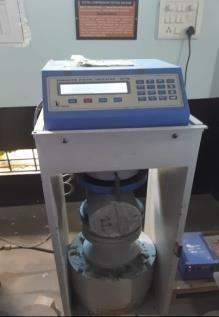
7.1 Compressive Strength Test: The cubes were testedforcompressivestrengthwithrespectiveagesof curing as 7, 14 and 28 days. A compressive strength test helps to determine concrete grading as shown in Fig-4.
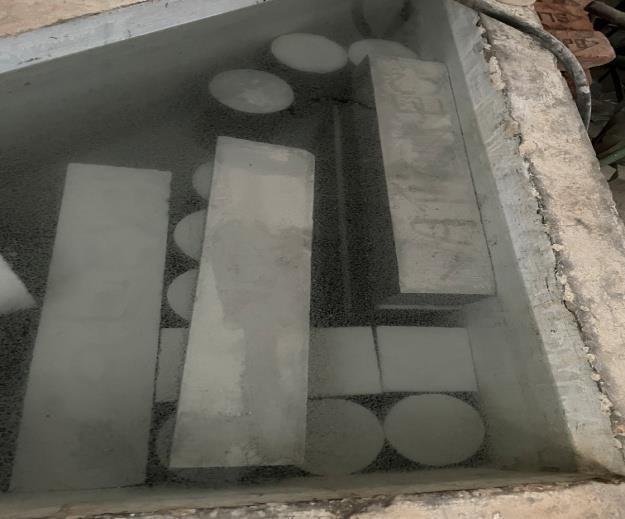


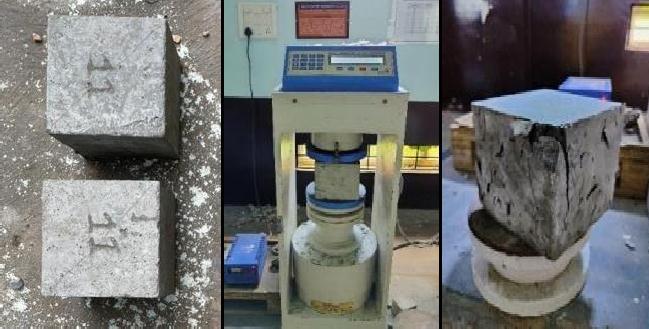
Fig-4: CompressiveStrengthTestofCubes
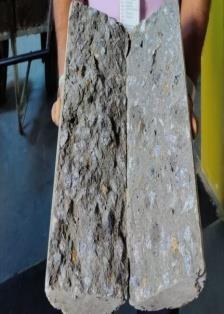
The compressive strength test results are tabulated as showninTable:5
Table: 5 ResultsofCompressiveStrengthTest
Factor value: 7.529
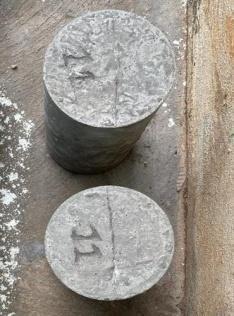
Fig-7: ResultofSplitTensileStrengthTest

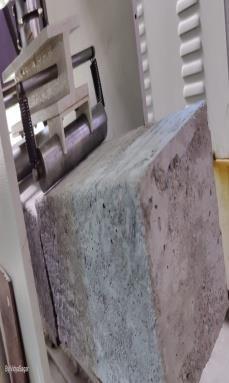
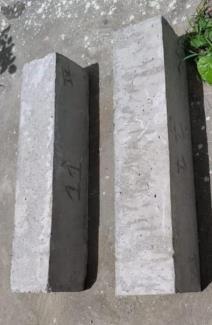
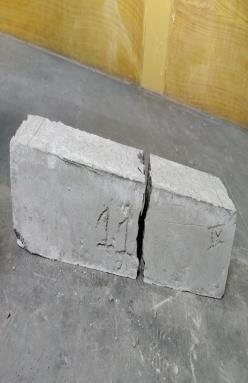
7.3 Flexural Strength Test: Thebeamsweretested for flexural strength with respective ages of curing as 7, 14 and 28 days. It tests the ability of unreinforced concrete beam or slab to withstand failure in bending asshowninFig-8.
9001:2008
8. CONCLUSIONS
The following conclusions were drawn from the experimentalinvestigation
[1]TheresultsobtainedfortheM40designconcrete mixin terms of compressive strength, split tensile strength and flexural strength are in permissible limits.
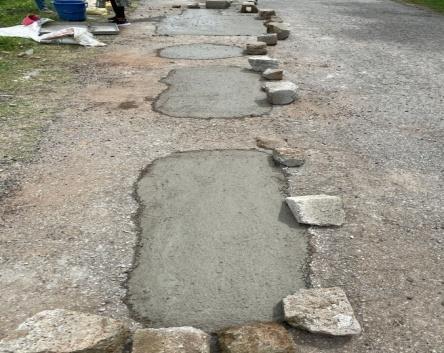
[2] Thewhitetoppingpotholeshavebettervisibility thanbituminousconcretemix.
[3] The performance of potholes patched with white topping is better than potholes patched with bituminous concrete mix in terms of durability, weatherresistanceandlongevity.
ACKNOWLEDGEMENT
AuthorswouldliketothanktheDepartment ofCivilEngineering,MITMysoreforprovidingthem laboratory facilities throughout the completion of theexperimentalinvestigation.
REFERENCES
[1] A.K.SehgalandS.N.SachdevaAReviewofUsing ThinWhiteToppingOverlaysforRehabilitation of J. BasicAppl.Eng.Res.,2,182 187,2015.
[2] Amaranatha Reddy, Muppireddy, Venkata Jogaro Bulusu et al, Elsevier:Transportation Research Procedia “A critical review of the PCA and IRC methods of thin white topping pavement design”,483764-3769,2020.
[3] Balbo, J. T.―Applications of high performance concrete for ultra-thin pavement overlays (white topping) ACI special publication, vol. 186, 1991, pp.731-744.
[4] CH. N. Satishkumar & U. Siva Rama Krishna, "Ultra- thin white topping concrete mix with sustainableconcretematerials aliteraturereview” International Journal of Pavement Engineering, Vol. 7,No.4,251 260,December2006.
[5] ConcreteOverlays Whitetoppingofroads,Cement ManufacturersAssociation,2010.
[6] D. Abijith.C.C Studies on the Performance of UltraThin Cement Concrete Overlays on Flexible Pavements VTUBelagavi2013.
[7] Dave Amos ―Pavement rehabilitation through ultra- thin white topping overlays‖ Missouri department of transportation research report ri 97 043,ri99 012,Missouri,may,2004.
International Research Journal of Engineering and Technology (IRJET) e ISSN: 2395 0056
Volume: 09 Issue: 07 | July 2022 www.irjet.net p ISSN: 2395 0072
[8] Deividi Da S. Pereira, José T. Balbo & Lev Khazanovich, "Theoretical and field evaluation of interaction between ultra thin white topping and existing asphalt pavement" International Journal of Pavement Engineering, Vol. 7, No. 4, 251 260, December2006.
[9] Guide to Concrete Overlays Sustainable solutions for resurfacing and rehabilitating existing pavements, National Concrete Pavement Technology Centre, USA, Sept.2008.
[10] IRC:SP:76 “Tentative guidelines for conventional, thin and ultra thin white topping”, Indian Roads Congress,NewDelhi,2008.
[11] IRC58 Guidelinesforthe designof plainjointed rigidpavementsforhighway,2011.
[12] IRC:SP:76 “Guidelinesforconventional,thinwhite topping”, First Revision, Indian Roads Congress, New Delhi,2015.
[13] IS: 516."Indian standard methods of tests for strength of concrete." Bureau of Indian Standards, 1959.
[14] Jundhare D.R, Khare K.C, Jain R.K (2012), Ultra ThinWhite toppinginIndia:StateofPractice,ACEEInt. J. on Transportation and Urban Development, Vol. 2, No.I,April2012.
[15] Michael E. Ayers&DaleHarrington,Selectionand use of concrete overlays, The Indian Concrete Journal, May2010.
[16] MiteshD.Patel,Prof.P.S.Ramanuj,BhavinParmar, Akash Parmar "White topping as a rehabilitation method: a case study of budhel ghogha road" International Journal of Advanced Engineering ResearchandStudiesVol.I/IssueIV/July Sept,2012.

[17] M S Nagakumar et al, "An Analytical Approach to Analysis of Concrete Overlay (White Topping) Over Flexible Pavement (Hot Mix Asphalt) using ANSYS Software" Civil Engineering TrendsandChallengesfor Sustainability(CTCS 2020)
[19] Rashmi S M, K Rajesh Kumar, Basavaraj Akki and I Rajasri Reddy, "Performance Studies on white topping layers over flexible pavement" IOP Conf. Series: Materials Science and Engineering 981032076,2020.
[20] Raval Purvesh, Belani Darsh, Pitroda Jayeshkumar,AliteraturereviewonUTWpavements in Indian context,journal of international academic research for multidisciplinary, volume 1, issue 9, pp 256-268,October2013.
[21]SINHA, Whitetopping-a Cost-Effective RehabilitationIRC,no.538,2007.
[22] S. Sultana Extending asphalt pavement life with thinwhitetopping2015.
BIOGRAPHIES
Name:AnushaHR USN:4MH19CV402 E-mail:anushahr31@gmail.com

Name:DarshanGowda HUSN:4MH18CV019 E-mail:darshanhgowda47@gmail.com

Name:NachikethC NUSN: 4MH18CV060 E-mail:nachikethcn93@gmail.com


Name:SindhuM USN:4MH18CV100 E-mail:msindhu0007@gmail.com
Name:Shankaregowda E-mail:sgowda1991@gmail.com
[18] Purvesh A. Raval, Prof. Jayeshkumar Pitroda, "ACost Effective Solution for Repair and Resurfacing of Distressed Asphalt Pavement by Coating of Ultra-Thin Whitetopping" International Journal of Advance Engineering and Research Development (IJAERD)Volume1,Issue5,May2014. © 2022, IRJET | Impact Factor value: 7.529 | ISO 9001:2008 Certified Journal