International Research Journal of Engineering and Technology (IRJET) e ISSN: 2395 0056

Volume: 09 Issue: 07 | July 2022 www.irjet.net p ISSN: 2395 0072
International Research Journal of Engineering and Technology (IRJET) e ISSN: 2395 0056
Volume: 09 Issue: 07 | July 2022 www.irjet.net p ISSN: 2395 0072
Veenu Sharma1 , Meena Siwach2
1Former Assistant Professor, Kurukshetra Institute of Technology & Management, Kurukshetra, Haryana, India.
2Assistant Professor, Maharaja Surajmal Institute of Technology, Delhi, India. ***
Abstract - The depletion of energy resources with the increases in demand of power pushes the world towards the smart power management system to balance it This paper briefly discusses about the Auto Healing System popularly known as Smart Grid. This emerging technology leads to better utilization of energy with great efficiency. The system integration of Renewable Energy Resources (RER) with traditional plants brings better reliability and security to the system.Thebidirectionalflowofenergyandinformationhelps to provide the real time consumption detail to the consumers will make it more adaptable. Big Data collection through Advanced Metering Infrastructure and processed in a meaningful manner is a challenge to the system. Security management is also key concern in this area.
Key Words: Smart Grid, Self healing, Advanced Metering infrastructure, Smart Meters, Phasor Measurement Unit, Big Data.
In present era, the deficit in power generation due to increaseindemandofpowertomeettheneedofelectricity itisrequiredtoswitchonasystemwhichismorereliable, energyefficient,managethepowerdemandandhavingself healingproperty.Allthesefeaturesindicatetowards“Smart Grid”. Smart Grid(SG) is digital automated network which canstorethedata,analyzeandmakedecisionbasedonit. This helps to monitor, measure, and control the flow of powerinrealtimethathelpstominimizethelossesalong with it contribute to develop a system or actions that reduces the losses [1]. To maximize the reliability and stabilityofthesystem,SGmakecoordinationbetweenthe requirementandcapabilitiesofallthegenerators,gridusers andendusers.Theinfrastructureofexistingfossilfuelbased powersystemcanbeconvertedintosmartGridtooptimize theassets[3].
By Comparing SG with traditional one, SG concept can be betterunderstand.Conventionalpowersystemisavertical unidirectionalnetworkhavingpowerflowfromgeneration toendusersthroughhighvoltagetransmissionlinehaving centralized source of power supply. The difference in conventionalandsmartGridare:
1. Centralized source of power.
2. Unidirectional flow of energyfromgeneratingend touserend.
3. Passive participation of customer.
4. Real time monitoring is limited to generation & transmissiononly.
5. Difficult to integrate it with other alternative sources.
6.Atthetimeoffailureand blackout, customer receive noenergy.
1. Centralized as well as distributedpowerplants.
2. Bidirectional flow of energyfromgeneratingend touserend.
3. Active participation of customer.
4. Real time monitoring is possiblefromgenerationto customer.
5.Possibletointegratewith renewableenergysources.
6.Itcanbereroutedforthe continuityofsupply.Incase offailureislandingmodeis activatedmakethesystem morereliable.
7. Peak shaving is not possibleastheflowofpower isunidirectional.
7.PeakShavingispossible i.e.electricitycansendback whendemandishigh.
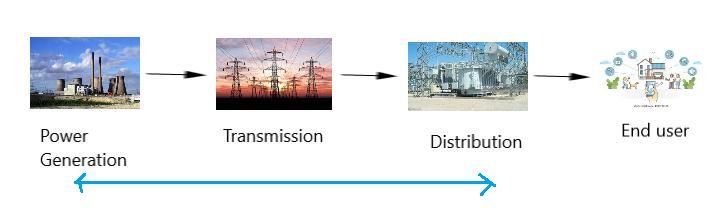
The information flow from generating end to distribution end in traditional plants while in SG the information is sharedfromgeneratingtoconsumerend.
International Research Journal of Engineering and Technology (IRJET) e ISSN: 2395 0056
Volume: 09 Issue: 07 | July 2022 www.irjet.net p ISSN: 2395 0072
Fig.2:

Hereinformationflowisrepresentedbybluecolor.
1.2. Features:
1.Flexibility:Itisflexibletointerconnectwiththefossilas wellasdistributedpowerplants.
2.Efficient: Withoutadding extrainfrastructurethefossil fuelpowerplantcanbemodernizedintosmartgrid.
3. Poweranddataflow:Two waycommunicationofpower anddatabetweenconsumerandutilityispossiblethatgives control to the consumers to reduce the wastage of power and precise & timely information of consumption of electricity.
4. Integrationwithadvancedelectricalstoragedevices.
5.Resilient:Itismoreresilienti.e.hasabilitytorecoverfrom adverseandabnormalconditionandrestorethenormalone.
6.Reliability:Reliabilityiscontinuityofsupply.Itprovides secure,consistentqualityofsupplytotheconsumers.
7.CostEffectiveness: itprovidescosteffectivepowersupply totheconsumerbyprovidingchoiceofbothcentralizedand distributedpowersources.
8. Environmental impact: It minimize the Environmental impactbyreducingtheemissionofCO2 intheatmosphere.
1.3.
Faultanddisturbancesinpowersystemareunavoidable.It’s severenessdependsonthefaulttypeandthefaultarea.Here the unique attribute i.e. self healing (SH) property of SG makeitpopular.SHmeansatthetimeoffault,theSGsystem can repair itself [1 2]. It provides the detection and segregationoffaultynetwork fromheathier network.It is done through distributed generator (DG), smart switches andprotectiondevices.Duringthisaction,nomanpoweris required.Itisrealtimecomputationalsystemtosupervise, analyzeandtakecorrectiveactionquickly[2].
Theself healing(SH)primarilyobjectiveistotacklethefault inbetterwayandsecurethewholesystem.Tounderstand this characteristic deeply, the self healing property is studied under generation, transmission, and distribution system.AtGenerationside,DG&reconfiguration ofsmart switchespresentforSH[4].Intransmissionsystem,forSH
the parameters studies are related to transmission line, transformer,circuitbreakerandsmartsensor.Smartsensors observe the temperature of transmission line, current carrying capacity of conductors, thermal ability, fault location, sag, ice loading and isolator failure [5 6]. In distribution system, fault diagnosis is very important and crucialfactortoimprovethepowerquality,reliability.The challengeinthissectionistheincreaseinmagnitudeoffault currentwhichmakeitdifficulttomaintainthestabilityand synchronism. To limit the fault current magnitude, fault current limiter (FCL) is used in between main grid and microgrid[8].
TheFCLcanbeusedasenergystoringdeviceconnectedto power grid to maintain the stability of the system. In distribution network even after the clearance of fault, the powerquality,reliability,efficiencyaffected.Voltagesupply andfrequencyshouldbeinprescribedlimitforbetterpower quality.ReliabilitymeanscontinuityofsupplysoQuickand high quality research needed in distribution system to restorethesystemafterclearanceoffault.
One of the SH method in distribution system is based on speed of travelling wave. At the time of fault the speed of travelling wave increases that indicate the occurrence of fault[8 9].OthermethodsareMarkovanalyticalmethodand adaptive over current method[9]. When load varies relay automatically restore the setting but in case of any disturbance the islanding mode is activated in adaptive overcurrent method. When thereisdecreaseinfrequency loadsheddingAlgorithmisused[9].
The architecture of SH control divided in direct and conditionalcontrolsystem[10].Directcontrolisbasedon theclosedloopanalysisforfaultrecoveryandprevention, maintaining the optimal control while the conditional control depends on logical control on several parameters frombusandtakeactionimmediatelyonfaultysection[5].It actsasprotectivecontrolbetweencustomerandutility.
Normal and faulty condition are the two condition in SH. DuringnormalconditionSHenhancesthestabilitymargin andperformancewhileduringthefaultyconditionitcontrol theloadvariationautomatically[1].
AccordingtoElectricPowerResearchInstitutethe“Smart Grid” is one that incorporates information and communication technologyinto every aspect of electricity generation,delivery,andconsumptioninordertominimize environmentalimpact,enhancemarket,improvereliability andservicesandreducecostandimproveefficiency[12].
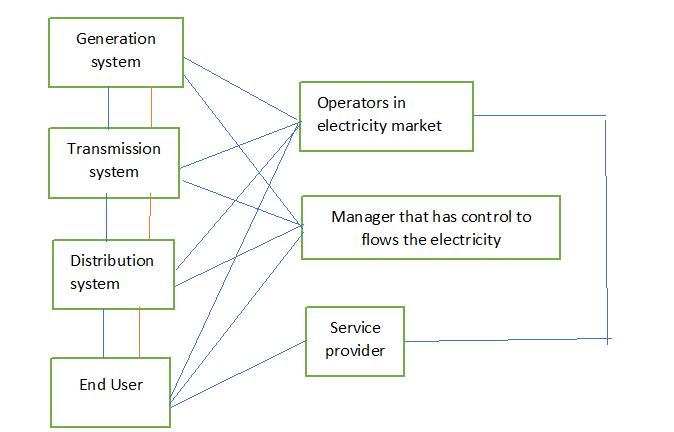
NIST(NationalInstituteofStandardandTechnology)givesa conceptual model of Smart Grid where power and informationflowsinbidirectionalmode[12].Flowofpower
International Research Journal of Engineering and Technology (IRJET) e ISSN: 2395 0056
Volume: 09 Issue: 07 | July 2022 www.irjet.net p ISSN: 2395 0072
isrepresentedbyredlinewhereasbluecolorrepresentthe flowofinformation.
iii.DistributionSystem:Oneofthechallengeamongthisis howtodistributetheenergyeffectivelysothatthelossesare minimum[14]. Many research work has been proposed to connectmanyDGwithSmartDistributionGridtoincrease thesystemflexibilitywiththegenerationsystem.
The Smart grid consists of digitally automated systems to sense, communicate, analyze, and control the functions of grid.TounderstandcompletelySmartGrid(SG)dividesin threesystem[12]:
1.Infrastructuresystem
2.Communicationsystem
3.Protectionsystem
1.InfrastructureSystem: thesystem isfurthersubdivided intoenergysystem,data,orinformationcollectionsystem. The energy system generates, transmit and distribute energy.
a.EnergySystem:
i. Generation of Power: Power is generated through Generatorinthepowerplants.Intraditionallypowerplants, theenergyisgeneratedcentrally.Theseplantsarelargein size and located at center of load. Use of Distributed generators(DG)inSGgivesanadvantagetoit.TheseDGcan beconnectedtoDistributedenergyResources(DER)power plantaswellasfossilfuelpowerplantbutconnectionofDG toexistingsystemisabigchallenge.ThewideFluctuationin power generated by DER, there is always a wide gap betweengenerationanddemand.Also,theoperatingcostfor generationofoneunitofelectricitybyDGiscomparatively high to the generator connected centrally producing electricity at large scale in tradition power plant[12]. AlthoughwehavelimitationsbutinfutureSGwilladoptDG atalargescaletogeneratepower.
ii.TransmissionSystem:Itincludetheexistingtransmission networkwithadditionofnewtechnologypowerelectronics devices and a smart substation. Here the self healing propertyofsubstationmakingthesystemmorereliable[13].
b. Data or information collection system: To collect information from end user, meters and measurement equipmentisrequired. Smartmeters,smartsensors,Phasor Measurement unit(PMU) is connected for this. AMI(AutomaticallyMeteringinfrastructure)makethetwo waycommunicationwithconsumerwhileAMR(Automatic meter Reading) collect the reading i.e. consumption of electricity of consumer and send it to centrally data base systemtogeneratetariff.SmartSensorsaremicroprocessor based device used for monitoring and measuring. PMU measures voltage and frequency at any point of time and providetimestampeddatatosystemoperatortocompare theshapesofACwavegeneratedbyno.ofPMU’sconnected torespondquicklyandmakingthesystemmoresecureand reliable[17].
2.CommunicationSystem: thesystemisresponsibleforthe flow of information among various devices and systems.it canbewiredorwireless.ForthisSCADAwithotheroutage systemwhichcollectivelyknownasoperationaltechnology (OT)isused[15].ThefunctionsofOTare:
i. Monitoringandcontrollingofallthedevicesconnectedto grid.
ii. monitoring and controlling of grid devices i.e. circuit breaker,fieldswitchesandpowerelectronicsdevices. InparallelwithOT,ITsystemmanagethebilling,revenue collectionanddepreciationcost.
3. Protection system: it comprises of fault prediction and prevention, diagnosis, fault clearance along with end user errors,devicefailure[16].
3. Role of big data in Smart Grid:
The advanced metering infrastructure (AMI) and Measurement Technologies that make up the power grid contains Smart meters, PMU’s. Through these measuring devicestherealtimedatawithhighresolutioniscollected thatmakethesmartgridtwowaycommunicatorwithend user.Therealtimestoredinformationisutilizedtoenhance the observability of power grid, reliability and economic operation of grid & consumer’s behavior[big data]. Smart meter collect the energy consumption in every 15 min. whereasPMU’srecorditwithhighresolutioninevery30 60 sec. The data generated by smart meters and PMU’s is 3TB/yr and40TB/yrrespectively[18].Thisbigdatacanbe utilizedfortheadvancementofsmartgrids.Applicationof bigdatainsmartgridare[18]:
International Research Journal of Engineering and Technology (IRJET) e ISSN: 2395 0056
Volume: 09 Issue: 07 | July 2022 www.irjet.net p ISSN: 2395 0072
3.LiLiu,andXuanZhao2012Studyonself healingcontrol strategyofsmartdistributionnetworkIninnovativesmart gridtechnologies asia(ISGTAsia)pp.1 3.
4. Ghosh D, Sharman R, Rao H R, Upadhyaya S 2007 Self healing systems survey and synthesis Decision Support Systems American journal of electrical power and energy systems42(4)2164 85.
Thedatavolume,datauncertaintyanddatasecurityarethe keychallenges.Astheutilitiesincreasinginexponentialrate sothedatavolumeisveryhigh.Toconvertthebigrawdata into actionable information, quality data is required that musthaveaccuracy,completeness,andconsistency but in realworldduetoagingofsensors,noiseetc.erroroccurred. We all know the data security is an important issue nowadays.Datasecuritymeansprivacyanddataintegrity. Cyber security is another challenge [23]. Though wehave thesechallengesbutthepossibilitiesofemergenceofnew technologies to clear these issues are also there. Lot of research work been proposed regarding the data security [17].
ThevisionofSGleadstoenvironmentallyfriendlysolution with better reliability of supply. However, the challenges includedintegrationwithconsumers,serviceproviders,new technologiesdevelopersarestill toovercomeandprovide safe,secure,selfhealedandresilientoperationofSG.
Inthispaper,thereview of autohealingcharacteristics of SmartGridhasbeendiscussed.AsSmartGridisemerging technologysolotofresearchworkisstillgoingontodevelop the new technologies to enhance the better utilization of electricity. ApilotprojecthasbeeninitiatedbyPOWERGRID withopencollaborationofElectricityDepartment,Govt.of PuducherrytodevelopSmartGridatPuducherry[20].Thus, Smart Grid provides efficiency, reliability, safety, security, andstabilitytothepowersector.Also,itbringsanadvantage totheconsumerbymakingtheirparticipationactive.
1.DSarathkumar,MSrinivasan, AlbertAlexander Stonier, RaviSamikannu,NarasimhaRaoDasariandRaymonAntony Raj, “ATechnicalReviewonSelf HealingControlStrategyfor SmartGridPowerSystems”, 2021 IOP Conf. Ser.: Mater. Sci. Eng. 1055012153.
2.DongLiJia,XiaoLiMeng,andXiaoHuiSong2011Studyon technology system of self healing control in smart distribution grid International conference on advanced power system automation and protection (APAP) vol.1 pp.26 30.
5. Bose A 2010 Smart transmission grid applications and theirsupportinginfrastructureIEEETransactionsonSmart Grid1(1)pp.11 19.
6.LiF,QiaoW,SunH,WanH,WangJ,XiaY,XuZ,ZhangP 2010 Smart transmission grid: visionandframeworkIEEETransactionsonSmartGrid1(2) pp.168 77.
7. Arefifar S A, Mohamed YAR, EL Fouly I T M 2013 Comprehensive operational planning framework for self healing control actions in smart distribution grids, IEEE transactions on powersystems28(4)pp.4192 200.
8. Arefifar S A, Mohamed Y A I, EL Fouly T H M 2013 Comprehensive operational planning framework for self healing control actions in smart distribution grids IEEE Transactions on PowerSystems28(4)pp.4192 200.
9. Ahadi A, Ghadimi N, Mirabbasi D 2015 An analytical methodologyforassessmentofsmartmonitoringimpacton future electric power distribution system reliability Complexity IEEE Transactions on Power Systems vol.21 pp.99 113.
10.AlbertAlexanderSandBradLehman2018Anintelligent basedfaulttolerantsystemforsolarfedcascadedmultilevel inverters IEEE transactions on energy conversion vol.33 issueno.3pp.1047 57.
11. Xi Fang; Satyajayant Misra; Guoliang Xue; Dejun Yang “Smart Grid The new and improved power Grid Survey, IEEEExplore,vol.14.
12.InternationalEnergyAgency.Distributedgenerationin liberalizedelectricitymarkets2002.
13. F. Li, W. Qiao, H. Sun, H. Wan, J. Wang, Y. Xia, Z. Xu, andP.Zhang.Smarttransmissiongrid:Visionandframework. IEEETranscationsonSmartGrid,1(2):168 177,2010.
14.T.Takuno,M.Koyama,andT.Hikihara.In homepower distributionsystemsbycircuitswitchingandpowerpacket dispatching.IEEESmartGridComm’10,pages427 430,2010.
International Research Journal of Engineering and Technology (IRJET) e ISSN: 2395 0056
Volume: 09 Issue: 07 | July 2022 www.irjet.net p ISSN: 2395 0072
15. United State Department of Energy 2018 Washington, DC. Report to congress “Smart Grid system Report”, November2018.
16. J. Tate and T. Overbye. Line outage detection using phasor angle measurements. IEEE Transactions on Power Systems,23(4):1644 1652,2008.
17. Anderson Roger, Reza Ghafurian and Hamid Gharavi, "SmartGridTheFutureoftheElectricEnergySystem", IEEE Explore,June2018.
18.ShadyRefaatS,AmiraMohamed,HaithamAbu Rub“Big dataimpactonstabilityandreliabilityimprovementofsmart grid”2017,IEEEbigdatavol.1pp.1 8.
19. Shambhavi Tripathi; Pradeep Kumar Verma; Garima Goswami,“AreviewonPowerGridpowersystemnetwork”, IEEEExplore,2020.
20.I.S.Jha,Y.K.Sehgal,SubirSen,RajeshKumar,“SmartGrid DevelopmentinIndia AcaseStudy”,NPSE 2014.
21. integration with smart grid IT systems,IT/OT convergence, and global market analysis and forecasts, Navigant Research 2014 Outage management systems: pp.59.
22.T,FarjahE2013Unidirectionalfaultcurrentlimiter:an efficientinterfacebetweenthemicrogridandmainnetwork IEEETransactionsonPowerSystems28(2)pp.1591 98.
23.MichaelI.Henderson,DamirNovosel,MariesaL.Crow, “ElectricPowerGridModernizationTrends,Challenges,and Opportunity”,November2017.
24. Akhil Nigam, Inderpreet Kaun, Kamal Kant Sharma, “SmartGridTechnology:AReview”InternationalJournalof recent Technology and Engineering ISSN: 2277 3878, Volume 7,Issue 6S4,April2019.
25. QiangSun, XuboGe, LinLiu, XinXu, YibinZhang, RuixinNiu,YuanZeng, “ReviewofSmartGridComprehensive Assessment Systems”,Elsevier, energy Procedia, vol. 12,2011,Pg.219 229.