International Research Journal of Engineering and Technology (IRJET) e ISSN:2395 0056

International Research Journal of Engineering and Technology (IRJET) e ISSN:2395 0056
Shah1, Er.Sonia2, Er. Danish Ahmad Lone3
1Student M.tech Civil (T.E) at Desh Bhagat University punjab, India
2proffesor ,Dept .of Civil Engineering , Desh Bhagat University
3Student M.tech Civil (T.E) at Desh Bhagat University ,punjab ,India ***
Abstract India boastsofthethirdlargest roadnetwork in the world. To keep up with the continuous infrastructure development, new roads are being constructed. The ever increasing population has further raised the vehicular density due to increased passenger traffic and freight transport over the last few decades. India and many other countries have more than 90 percent of roads which are constructed with flexible pavements or bituminous courses. So, to achieve the requirements, properties of asphalt binder and bituminous mixes are to be improved by using various additives. For a pavement section different types of additives are used such as Polymers, Crumb Rubber and other waste materials like waste plastic, discarded tyre tubes etc which increases the life of the pavement depending upon the degree of modification and type of additivesused.
Duetoincreaseinpopulation,thevehiculartrafficdensity is also increasing. Due to this, thewear and tear of tyres from these vehicles is undoubted due to which large number of scrap tyres are being generated. A large number of waste and worn out tyres are already in existence and with an annual generation rate of 15 20% each year. These tyres are discarded indiscriminately or stockpiled. The used tyres had a great threat to human health and environment, since it is non biodegradable so itishavingdisposalproblemsalso.Similarly,consumption ofwasteplasticisincreasingdaybyday.Morethan50%of the plastic is used as a packaging material. As plastic is a non biodegradable waste so it does not under goes decomposition.Inthis,weprojectedtostudytheuseofthe wastetyrerubberandwasteplasticasablendingmaterial inbitumen, whichisfurther usedforroadconstruction. If waste plastic and used tyre rubber can be added in bitumen for improving the properties of bituminous mixes.
The present research focuses at developing modified bituminous mixes for Bituminous Concrete Grade 1 by partiallyreplacingthebitumencontent withwasteplastic and waste tyre tube. Also the study focuses on the different blends of Bituminous Concrete Grade 1 by using Polymer Modified Bitumen (PMB) and Crumb rubber ModifiedBitumen(CRMB)andStability Flowanalysiswas done with modified binders and with the replacement of
waste plastic and wastetyre tubes were done. It is found thatoutoftwomaterials,replacementofoptimum binder content (OBC) by 8% of waste plastic and 12% of waste tyre tube was observed. The optimum binder content for Polymer Modified Bitumen (PMB) for Bituminous ConcreteGrade1is5.2%andforCrumbRubberModified Bitumen(CRMB)is5%.
Key Words: Bitumen,Aggregate,Polymers,Bindersetc
For developing country like India an efficient road networkispre requisitefornationalintegration,country’s development and for socio economic development. From lastfewyears,theuseofvehicleshasincreased,whichhas further increased the vehicular density on roads. Due to increase in vehicular traffic, there is a huge demand for improved pavement sections which can resist the increasing vehicular loads. A highway pavement is a structure consisting of different layers of prepared materials above the natural soil subgrade. The primary function of these layers is to disperse the applied vehicle load to the subgrade. The pavement surface should provide the acceptable riding quality, competent skid resistance i.e. adequately smooth. The main aim is to ensure that stresses conveyed due to wheel loads are adequately reduced, so that they will not go beyond the bearing capacity of the soil subgrade. There are mostly twotypesofpavementswhichareprimarilyrecognizedas, FlexiblepavementsandRigidpavements.
Flexible Pavement is constructed with the bituminous treated top surface course and its pavement structure is composed of several layers. Flexible pavements are those which have low or almost negligible flexural strength. Flexible pavements conveys wheel load stresses to the lower layers of the pavement by grain to grain particles by the contact of the aggregate through the granular particlesofthestructure.
Bitumen.
The bitumen used for Bituminous Concrete layer is a paving bitumen of different viscosity grade (VG10, VG20,
International Research Journal of Engineering and Technology (IRJET) e ISSN:2395 0056
Volume: 09 Issue: 07 | July 2022 www.irjet.net p ISSN:2395 0072
VG30, VG40) following the IS specifications for “Paving Bitumen” IS73:2013 and the penetration is specified by MORTH Specifications for Road & Bridge work (Fourth Revision,ReprintMarch2007)forBituminousConcrete
DifferentViscositygradesofbitumenareasfollows:
1 .VG 10 Bitumen: VG 10 is widely used in spraying applications such as surface dressing and paving in very cold climate. It is also used to manufacture Bitumen Emulsion.
2 .VG 20 BITUMEN: VG 20 is used for paving in cold climate&highaltituderegions.
3 .VG 30 BITUMEN: VG 30 is primarily used to construct extra heavy duty bitumen pavements that need to endure substantialtrafficloads.Itisalsocalled60/70Penetration grade.
4.VG 40BITUMEN:VG 40isusedinhighlystressedareas such as intersections, near toll booths and truck parking lots. Due to its higher viscosity, stiffer bitumen mixes can be produced to improve resistance to shoving and other problems associated with higher temperature and heavy trafficloads.
The coarse aggregates for Bituminous Concrete (BC) mix consist of crushed rock, gravel and other stiff or hard material which is retained on 2.36 mm sieve.The aggregates should be classified according the standard limitswhichareindicated
Fine aggregates for BC layer consists of naturally occurringmaterial orcrushedaggregatespassingthrough 2.36mm sieve and retaining on 75 micron sieve and shouldbefreefromdustandshouldbestiffanddurable.
The binder content shall be optimised to achieve the requirements of the mix set out in Table as per traffic conditions. The Marshall method is used for determining the optimumbinder content. The optimum binder content canbecalculatedasfollows:
Whenvariousadditivesareusedinthebituminousmixes, these are known as bitumen modifiers. The additives like polymers, rubber or the blend of the two or more should be selected in such a way that they should have the followingproperties(IS15462 2004):
● Additivesshouldbecompatiblewiththebitumen.
● Can resist degradation at various mixing temperatures.
● Shouldcapableofbeingprocessedbyordinaryor conventionalmixing&layingmachinery.
● Should maintain properties like penetration, ductility, viscosity etc during application, in serviceandstorage.
● Produce required coating viscosity at application temperature.
●
Polymers are the substances having large molecule size andhighmolarmassesandarecomposedoflargenumber of repeating structural units. There are both naturally occurring as well as synthetic polymers with a large varietyofproperties.
●
Plastic is a very common material used in day to day life. In present day, every vital industry uses plastic like PVC pipes, furniture industry, food, packaging and automobile because it is a very cheap and effective raw material. As plastic is a non biodegradable material, it remains unchanged for thousands of years; so its disposal is a major problem in present time as it is a threat to human bodyandenvironment
Use of polythene in bituminous pavements is not new. These days it is mandatory to use waste polythene in the construction of bituminous pavements. Waste plastic or polythene is added to hot mix asphalt mixture and the processoflayingmixtureonthesurfaceofroadissimilar toanormaltarroad.Plasticroadsconsistsmainlyofwaste plastic carry bags, water bottles, soft drink bottles, and disposalcups
● Dhara et al (2016) calculated the strength of different mixes of bituminous concrete using Marshall test method. Asphalt binder used in this case was VG 30 & VG 10 and their properties were compared. The optimum bitumen content for VG 10 and VG 30 are 6.0%, and 5.05% respectively. Stability of VG 30 at optimum bitumen content 5.05% of 2 % EpoxyResin was higherthanVG 10atBitumencontent6.0%of3% Epoxy Resin and Flow was decreased. In case of VG 30 bitumen, maximum stability value i.e. 1490.55 kg was attainedat 5% of bitumen, where
© 2022, IRJET | Impact Factor value: 7.529 | ISO 9001:2008 Certified Journal | Page 1336
International Research Journal of Engineering and Technology (IRJET) e ISSN:2395 0056
Volume: 09 Issue: 07 | July 2022 www.irjet.net p ISSN:2395 0072
as in case of VG 10 bitumen, Maximum stability i.e. 1650.6 kg wasattained at 6% of bitumen. In this,itisalsoobservedthatEpoxyResinwasused asModifierandshowsimprovedresults.
● Singh and Gupta (2015), evaluated the mix properties of bituminous mixes made by the use ofdifferentgradingofbitumenbinderslikeVG10, VG30 and VG40 and different grading of aggregates. Bituminous mix testing was done on these materials and their stability values, flow values were compared with each other and their optimum asphalt binder content was compared i.e.forVG10(6%),VG30(5.8%)andVG40(5.6%) OBC was calculated and their stability value comes out to be i.e. for VG10 1650.6 kg, VG30 1867.6kgandVG401993.5kg.
● Bhargav and Gautam (2013), tried to find the optimum temperature by which the bituminous mix temperature was reduced by the warm mix asphalt technology. Rediset organic additive was used as an adhesive with the bitumen binder VG 30. There was significant difference in properties of mix with addition of additive with VG 30 asphalt binder. With addition of 2%, Rediset stability at 120˚C was calculated to be 1656 kg and at 2.5% Rediset at 120˚C, it reduces to 1272 kg. Results shows that there was a (30 40) °C reductioninmixing&compactiontemperatureof bituminous mixes by adding 2% of additive which satisfies all the volumetric requirement for both the asphalt binders resulting in better performance of the bituminous mixes at the lower temperature.
● Kazmi and Rao (2015) investigated the use of wasteplasticmaterial(PolyethyleneBags)[LDPE] in the shredded form which is used as a binding agent in the construction of Flexible Pavements. In this study, polyethylene was used as a binding agentwithbitumenVG 30gradeasareplacement of bitumen with different proportions 5, 7, 9 and 11% and properties of mix is carried out. There wassubstantiallyincreaseinthestabilityvalueof blended material in comparison to normal VG 30 asphaltbinder.Theresultsshowedthatthewaste plasticmaterialscanbeincorporatedasabinding agent for the construction of flexible pavements. Addition of 9% LDPE was found to be the optimum binder proportion. Marshal stability with addition of 9% of LDPE comes out to be 1590.2 kg and it was 32.5% greater than the standard value of a minimum 1200 kg. The flow range of 2.9 3.0 was also well within the requiredrange.
● Akinpelu et al (2013) used Polyethylene as a binder modifier. In this six different proportions of waste plastic by weight of optimum binder content was selected i.e. 2.5, 5.0, 7.5, 10.0, 12.5 and 15%. The waste plastic was incorporated using wet process as a replacement and various propertiesweretestedlikeBulkDensity,Stability and Flow. The results showed the increased stability value, reduced density and slightly reduced flow value for all percentages. The optimum proportion of modifier was obtained at 12.5% by the weightof optimum binder content (OBC). The improvement in stability value of the modified asphalt binder using polyethylene is mainly due to an increase in adhesion and cohesion properties of the asphalt binder which will enhance the higher fatigue resistance value andreducethermalcrackingandrutting.
MarshallTestforBituminousConcreteGrade 1
Marshall Mix design method is a design methodology which is adopted worldwide for determining the strength andflowcharacteristicsofthebituminouspavingmixes.It isgenerallyusedfordesignofbituminousmixeswhichcan withstand with heavy traffic loads even under adverse climatic conditions by fulfilling the requirements of the pavement surface characteristics. It is a very popular method in India for characterization of bituminous mixes andalsousedtocalculateOptimumBinderContent(OBC) for different mixes and for studying the various Marshall Characteristics such as Marshall Stability value, Flow value, VMA, VFB, Unit Weight in a mixture etc The resultingmixshouldsatisfythefollowingconditions:
● Sufficient binder should be used to ensure a strong and tough pavement by providing a water proofing coating on the surface of aggregate particles & binding them together under the suitablecompaction.
● Provide sufficient stability for resistance to deformationunderrepeatedloads.Thisresistance in the mixture is obtained from aggregate interlocking and cohesion which generally developsduetobinderinthemix.
● Sufficient flexibility should be provided to withstand deflection and the bending without cracking. So, to obtain desired flexibility, it is necessarytohavepropergradeofbitumen
● TestProcedureandSetupisasperASTMD6927 06StandardTest:
International Research Journal of Engineering and Technology (IRJET) e ISSN:2395 0056
Volume: 09 Issue: 07 | July 2022 www.irjet.net p ISSN:2395 0072
● An oven for heating the bituminous mixture & specimen mould assembly at certain required temperature.
● Hotplatesforheatingcompactionhammerhaving circularplateatbottom,spoonandspatula.
● A flat steel spatula is required with blade having size25mmwideandshouldbeoflength150mm and stiff enough to penetrate the entire bituminousmixture.
● Thermometer is essentially required to for determining the temperature of the hot bituminous mixtures. It should preferably be a dialtypehavingtemperaturerangeof10to200˚C.
● Abalanceorweighingmachineformeasuringthe weight of the mix. The sensitivity of the balance shouldbeatleastonegram.
● Trowels for making the bituminous mix and for placing the bituminous mix in the mould assembly.
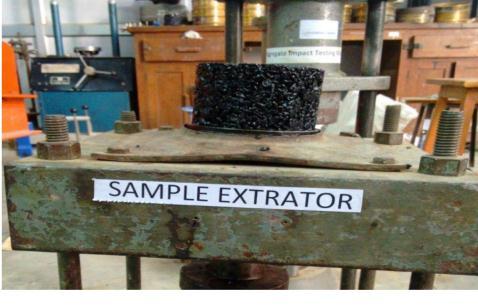
● Aspecimenextractorsuitablyfittedwithajackor compression machine, for extruding the compacted specimen from the mould. Testing head consists of upper & lower cylindrical segments of test head with an inside radius of 51 mm. The lower segment is mounted on the base having two vertical guide rods which facilitates insertionintheholesofuppertestead.
There are various of tests to calculate the properties of asphalt binders. The following tests were conducted to evaluate the different properties of asphalt binder which aretobeused.
● PenetrationTest[IS:1203 1978]
Penetration test measures the hardness or softness of bitumen or asphalt binder by measuring the depth in tenths of a mille meter (mm) to which a standard loaded needle penetrates vertically in 5 seconds. The test was performed as per recommendations of Indian Standards (IS).Thepenetrometerconsistsofaneedleassemblywith a total weight of 100g of bitumen and a device for releasing and locking in any position. The bitumen is softenedsothatitcanbepouredeasily,stirredthoroughly andpouredinto containers. The testshould beconducted at a particular temperature of 25˚C. It may be noted that penetration value is largely influenced by any inaccuracy with regards to pouring temperature, size of the needle, weight placed on the needle and the test temperature. A gradeof40/50bitumenmeansthepenetrationvalueisin the range 40 to 50 at standard test conditions. In hot climates,alowerpenetrationgradeispreferred.
● SpecificGravityTest[IS:1202 1978]
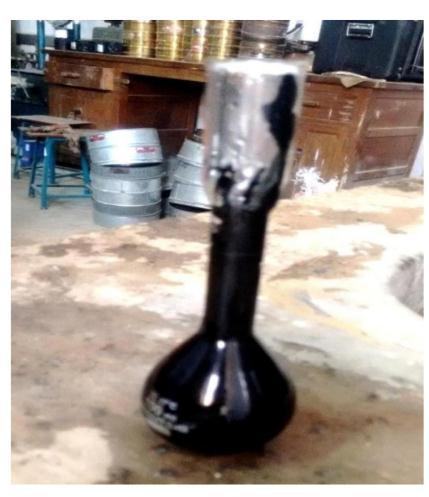
Inpavingjobs,densitypropertyisofgreatusetoclassifya binder. In most cases bitumen is weighed, but when used withaggregates,thebitumenisconvertedtovolumeusing density values. The density of bitumen is greatly influenced by its chemical composition. Increase in aromatic type mineral impurities cause an increase in specific gravity .The specific gravity of bitumen is defined astheratio ofmassof given volumeofbitumen ofknown contenttothemassofequalvolumeofwaterat27˚C.The specific gravity can be measured using Pycnometer as shown in the Plate 3.5. The specific gravity of bitumen variesfrom0.97to1.02.
Marshall Stability testing machineconsists of a motorized loading unit provided with a gear system to lift the base plateupwardatthespecifiedrate.Itconsistsofcalibrated proving ring of 10 tons capacity fitted with a dial gauge. The strain controlled loading machine produces a movementofthebase plateattherateof50.8mm/min. at60˚CTheAwaterbathofsufficientdepthisrequiredfor the complete immersion of samples. The samples are thermostatically controlled so as to maintain the water bathat60±1°C.
International Research Journal of Engineering and Technology (IRJET) e ISSN:2395 0056
Volume: 09 Issue: 07 | July 2022 www.irjet.net p ISSN:2395 0072
● ViscosityTest[IS:1206 1978]
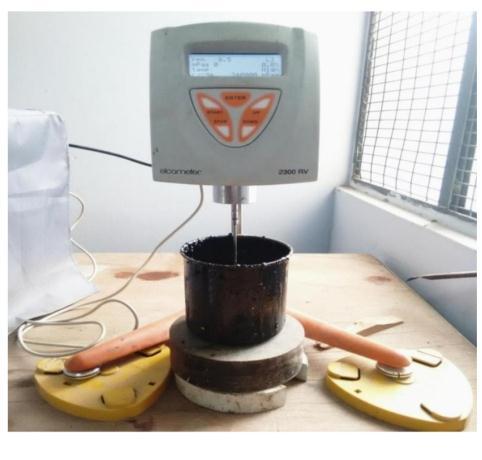
Viscosity denotes the fluid property of bituminous material and it is a measure of resistance to flow. At the application temperature, this characteristic greatly influences the strength of resulting paving mixes. Low or high viscosity during compaction or mixing has been observed to result in lower stability values. At high viscosity, Bitumen resists the compactive effort; thereby resultingmixisheterogeneous,hencelowstabilityvalues. At low viscosityinstead of providing a uniform bending film over aggregates, bitumen will lubricate the aggregate particles, thereby reducing the stability values. A rotational viscometer gathers data on a material’s viscosity behaviour under different conditions. The rotational viscometer basically consists of two parts a headunitwithamotorandaspindlethatisdrivenbythe motor. The viscosity is determined by measuring the resistance of a spindle rotating in the sample. Rotational viscometers can be used for the accurate measurement of viscosity for both Newtonian and non Newtonian fluids. Newtonian fluids are those that are affected by temperature, such as water, kerosene, mineral oils etc. Non Newtonian fluids are those that change viscosity whenstirred,shakenorotherwiseagitated.Theseinclude paint,gels,inks,milk,ketchupetc.
Sieve analysis test was carried out for determining the gradation of aggregates preparation of the Marshall specimen. Through this sieve analysis test, the proportioning of aggregates such as coarse aggregates, fine aggregate and stone dust is determined by ensuring the proper blending of aggregates to satisfy the gradation limit as specified in MORTH for BC Grade 1. The sieve analysis test results on aggregates are presented in the Table
Sieve Size % Passing 20mm
% Passing 10mm % Passing 4.75mm % Passing Stone Dust
26.5 100 100 100 100 19 93.8 100 100 100 9.5 15 55.13 100 100 4.75 10 23.23 89.33 100 2.36 0.54 5.19 70.66 100 0.300 0.54 1.06 30 96 0.075 0.54 1.06 10 35.5
MORTH Specified Gradation For Bituminous Concrete Grading 1 2
Nominal AggregateSize 19mm 13.2mm LayerThickness 50mm 30 40mm
The results obtained from the laboratory testing of the Bituminous Concrete (BC) mixes designed using Marshall Mix method with and without the addition of various additivesincertainproportionsasthe replacement of the asphalt binder. All the prepared Marshall mix specimens weresubjectedtocompactionof75blowsoneachfaceto obtaintherequireddensity.Theresultswerecalibratedto determine the Optimum Binder Content (OBC) by performing the Stability Flow analysis and Volumetric analysis for the prepared specimens. In addition to Marshall Mix method, other test was also conducted such as Indirect Tensile Strength Test on various asphalt binderstocalculatetheResilientModulusvalues.
ISSieve,mm Cumulative%byweightoftotal aggregatepassing 26.5 100 19 90 100 100 13.2 59 79 90 100 9.5 52 72 70 88 4.75 35 55 53 71 2.36 28 44 42 58 1.18 20 34 34 48 0.6 15 27 26 38 0.3 10 20 18 28 0.15 5 13 12 20 0.075 b2 8 4 10
Bitumencontent%by massoftotal mix
bMin5.2* Min5.4**
International Research Journal of Engineering and Technology (IRJET) e ISSN:2395 0056
Volume: 09 Issue: 07 | July 2022 www.irjet.net p ISSN:2395 0072
● ResultsofBCMixDesignGrade 1withoutusing anyAdditive
To decide the optimum binder content (OBC), Marshall Mix samples were prepared by varying the percentage of 60/70 asphalt binder without using any additive or modifier. Stability Flow laboratory analysis and Volumetric analysis were performed for the Marshall mix sampleswithbitumencontentvaryingfrom4.5%to5.5%. Thetestvalueswereobtainedandplottedgraphically.The output results of stability and flow values are shown in Tableno.
Test
1 4.5 2.49 4.244 14.863 71.44 8.6 2 5.0 2.530 4.899 16.474 70.26 13.6 3 5.5 2.435 4.966 17.537 71.679 10.8
The above table signifies that the maximum Marshall Stability comes out to be 13.6 kN at bitumen content 5 percent and with addition of more, the stability value startsgettingdecreasing.
● ResultsofBCMixDesignGrade 1usingPolymer ModifiedBitumen(PMB40)
To calculate the optimum binder content (OBC) of Polymer Modified mix, Marshall Mix samples were prepared by varying the percentages of PMB 40 asphalt binder. Stability Flow laboratory analysis and Volumetric analysis were carried out for the Marshall Mix samples prepared with bitumen content varying from 4.5% to 5.5%. The test values were obtained and are plotted graphically.
Test
1 4.52.466 5.15 15.65 67.09 16.112 2.20 2 5.02.50 4.69 16.28 71.19 18.40 3.48 3 5.52.463 4.16 16.87 75.34 15.13 3.63
The Result shows that the maximum Stability value of 18.40 kN is attained at 5% of Polymer Modified Bitumen (PMB)andwithadditionofmore,thestabilityvaluestarts getting decreasing and maximum Bulk Density is 2.50 at 5%bitumencontent.
The Result shows that the maximum Stability value of 18.40 kN is attained at 5% of Polymer Modified Bitumen (PMB)andwithadditionofmore,thestabilityvaluestarts getting decreasing and maximum Bulk Density is 2.50 at 5%bitumencontent.
Replacement of OBC with Plastic% (by weight of OBC)
Flow (mm) 2 19.9 3.88 4 23.12 3.56 6 25.67 3.47 8 26.50 3.36 10 24.79 2.86 12 21.97

Corrected Stability (kN)
The major conclusions drawn from the study carried out on stability flow analysis of BC mix (Grade 1) by using differentadditivesareasfollows:
● Initially, normal asphalt binder VG 30 is tested at differentpercentagesfortheBCmixgrade 1and optimum binder content (OBC) is calculated .The OBCoccursat5%andflowvaluesareinthelimits specifiedasperMORTH.
● The stability values for the BC grade 1 mix increasewiththereplacementofOBCupto8%of waste plastic but it decreases further with the addition of waste plastic. This waste plastic only indicates that this percentage is the only suited levelofreplacement.
● For the addition of discarded tyre tubes, the stability values for the BC grade 1 mix increase with the replacement of OBC (5%) upto 12% of discarded tyre tubes with optimum binder content of 5% but decreases with the addition of tyre tube. However, the stability and flow values liewithinthelimitsspecifiedbyMORTHforall% replacementsoftyretubes.
International Research Journal of Engineering and Technology (IRJET) e ISSN:2395 0056
1. TheOBCof PMBusedinBCGrade 1is5.2%.
2. Out of the various materials used, replacement of OBC by 12% discarded tyre tube has the higheststabilityvalue.
[1] AASTHO: T 315 10: Standard method of test for “Determining the Rheological Properties of Asphalt BinderusingaDynamicShearRheometer(DSR)”.
[2] Adedimi1a A., Kennedy T.(1975) “Fatigue and Resilient characteristics of asphalt mixtures by repeated loadIndirectTensiletest”.
[3] Akinpelu M., Dahunsi B., Olafusi O., Awogboro O. and Quadri A. (2013) “Effect of Polythene Modified Bitumen on Properties of Hot Mix Asphalt”. ARPN Journal of Engineering and Applied Sciences, 8(4), pp. 290 295.
[4] Anwar S. (2014) “Studies On Marshall And Modified Marshall Specimens By Using CRMB” (International Journal of Structural and Civil Engineering Research IJSCERISSN2319 6009,3(4)
[5] Archana M.R, Sathish H.S., Ashwin M, Hanamant Hunashikatti (2014) “ Effect of waste plastic utilisation on Indirect Tensile Strength properties of Semi Dense Bituminous Concrete Mixes” Indian Highways.pp.64 72.
[6] ASTM D6931 12: Standard test method for Indirect Tensile(IDT)StrengthofBituminousmixtures.
[7] Bhargav N.Gautam (2013) “Warm mix Design of Bituminous Concrete using Rediset WMX” Global ResearchAnalysis,2(6),ISSnNo2277 8160.pp.70 72
[8] Kalasariya D., Patel K., Raol H. (2016) “Study of Bituminous Concrete under Different Mix Conditions byUsingEpoxyResinasModifier”IJSRSET,2(3),ISSN :2395 1990,OnlineISSN:2394 4099
[9] Four Laning of National Highway from Rajkot to Somnath.
[10] Gawande A., Zamre G.S, Renge V.C., Bharsakale G. and Tayde S. (2012) “Utilisation of waste plastic in asphalting of roads” Scientific reviews and Chemical communications, SRCC: 2(2), 2012, ISSN 2277 2669, pp.147 157.
[11] IRC:37 2012 “Guidelines for the Design of Flexible Pavements”(3rd Revision)
Volume: 09 Issue: 07 | July 2022 www.irjet.net p ISSN:2395 0072 © 2022, IRJET | Impact Factor value: 7.529 | ISO 9001:2008 Certified Journal |
[12] IRC SP:98 2013 “Guidelines for the use of Waste Plasticinhotbituminousmixes”.
[13] IRC SP:53 “Guidelines on use of Polymer and Rubber Modified Bitumen in Road Construction” IRC, New Delhi
[14] IS 15462:2004 “Polymer and Rubber Modified Bitumen”.BIS,NewDelhi.