International Research Journal of Engineering and Technology (IRJET) e ISSN: 2395 0056

Volume: 09 Issue: 07 | July 2022 www.irjet.net p ISSN: 2395 0072
International Research Journal of Engineering and Technology (IRJET) e ISSN: 2395 0056
Volume: 09 Issue: 07 | July 2022 www.irjet.net p ISSN: 2395 0072
Prof. Berlin Sabu1 , Amrutha Johnson2, Jain P Antony2 , Nahla Fathima2, Suhail Shameer2
1Professor, Department of Civil Engineering, Mar Athanasius College of Engineering, Kothamangalam 2Student, B.Tech Civil Engineering, Mar Athanasius College of Engineering, Kothamangalam ***
Abstract - The main objective of earthquake engineering is to analyse, design and build a structure in such a way that the damage to the structure and its structural component during an earthquake is minimized. A large number of papers have focused to study the effect of irregular structures. In this project, the variations in the behaviour of structure with different shape configuration subjected to seismic motion is studied. Building with irregular geometry responds differently against seismic action. Plan geometry is the parameter which decides its performance under different loading conditions. To workout the performance of the structure, equivalent static analysis has been adopted. ETABS 20 software is used for achieving this objective. Estimation of responses such as lateral displacement, storey drift and base shear has been carried out. Based on these parameters the response of each model has been compared. Results are expressed in the form of graphs. From the comparisons made with these parameters, it is observed that to minimize the effect of earthquake simple plan and configuration like regular shape must be adopted at the planning stage.
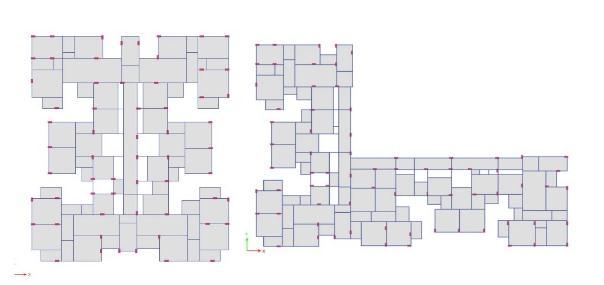
Seismic Analysis of structure is to find out the seismic forces of structure and also find the effect of structure of various shape of building. Earthquakes are unpredictable natural disaster and earthquake are not prevented. So that we are consideredalltypesofseismicparameteranddesignedthestructuretoresistingearthquake(seismic)forces. Wehaveconsideredtwotypesofbuildingshapeitmeansrectangleshape&Lshape AreaofbothrectangleandLplanis samethatis6900SQ.M.
Generally we have designed structure by considering factors like load distribution, moment and forces, but we should design structure for earthquake resistant because earthquake are unpredictable and not prevented disaster. We have to calculate Seismic Forces of both shape of structure and after that we can predict that which shape of structure are performancewellduringearthquake.
In structural design, we are putting structural element that is beam & column in their proper place, we couldn’t place in obstructed position. We have Design G+7 residential building in zone III so we have to consider safety parameter and safetyfactorduringdesignofstructure,structureshouldbesafeistheaimwhiledesigning.
In modern and new technique of structural designing, it will be a challenge for structural designer to design irregular shape of building and is to become safe during earthquake. The main aim is to resist the earthquake forces and other seismicforcesduringearthquake.
Theresponseofthebuildingsisassumedinalinearlyelasticmannerasthismethodfollowlinearstaticprocedure.Itisone oftheprocesstoestimatetheseismicload.Asitdoesnotconsideralltheparameterthataresignificanceofthefoundation conditionthushigh risestructurearenotconsideredforthedesignbystatic method.Thismethodisonlysuitableforthe designandanalysisofsmallstructure.Thismethodconsidersonlyonemodeforeachdirection.Tallstructuresarerequired morethantwomodesandmassweightofeverystorydesignearthquakeresistantloads.Staticmethodhasadrawbackasit usesonlyonemodeofvibrationofbuilding.AspertheIS1893:2002(part1),analysisiscarriedout.Thetotalbaseshearor design lateral force along X and Y direction is provided in terms of seismic weight of the structure and design horizontal seismic coefficient. There are several factors on which design horizontal coefficient depends namely, importance of the structure,fundamentalnaturaltimeperiod,Responsereductionfactor,zonefactoretc.
Factor value:
International Research Journal of Engineering and Technology (IRJET) e ISSN: 2395 0056
Inthisstudy,theanalysisoftwodifferentG+7buildingsofdifferentplansiscarriedoutwith staticanalysistofindout the stability among the cases. The Analysis is carried out through ETABS 2020 software as it is more user friendly and versatileprogram.Thedetailsoftheseismicandothervariousparametersarementionedinthetablesbelow.
A. Seismic parameter
A. Load details
Table I: Seismicparameter
SoilType II
ImportanceFactor 1 SeismicZone III ZoneFactor 0.16
Responsereductionfactor 5
Table II: Loaddetails
Property Intensityofload(kN/m)
LiveLoad@Floor 3
LiveLoad@Roof 1 MainwallLoad 9.12 PartitionwallLoad 4.8
Table III: Plandetails
NumberofStories 7
Supportcondition Fixed
Storeyheight 3m
ConcreteGrade 30MPa
SteelGrade Fe500
Sizeofcolumns 300x600
Sizeofbeam 250x600
HeightofParapetwall 1.2m
ParapetwallThickness 100mm
MainWallThickness 200mm
PartitionWallThickness 100mm Slabthickness 150mm
Volume: 09 Issue: 06 | Jun 2022 www.irjet.net p ISSN: 2395 0072 © 2022, IRJET | Impact Factor value: 7.529 | ISO 9001:2008 Certified
International Research Journal of Engineering and Technology (IRJET) e ISSN: 2395 0056
Volume: 09 Issue: 06 | Jun 2022 www.irjet.net p ISSN: 2395 0072
Fig. a)Rectangular Shape
b)L Shape
Storey displacement is the deflection of a single story relative to the base or ground level of the structure. Displacement increases as the storey height increases. In the figure below shows the storey displacements of the regular rectangular shapedbuildingandL shapedbuilding.
0 100 200 300 400 500 600 700 1 2 3 4 5 6 7
Storey drift is the lateral displacement of a floor relative to the floor below, and the storey drift ratio is the storey drift divided by storey height. In the figures below shows the storey drifts of the regular rectangular shaped building and L shapedbuildingbothinXandYdirections.
Rectangular shape EQX direction Rectangular shape EQY direction L shape EQX direction
Rectangular shaped (mm) L shaped 0 5 10 15 20 25 30 35 40 Base pstorey Storey 1 Storey 2 Storey 3 Storey 4 Storey 5 Storey 6 Storey 7
Fig. 2: Storeydrift
2022, IRJET | Impact Factor value: 7.529 | ISO 9001:2008 Certified
International Research Journal of Engineering and Technology (IRJET) e ISSN: 2395 0056
Volume: 09 Issue: 06 | Jun 2022 www.irjet.net p ISSN: 2395 0072
Storeyshearisthegraphshowinghowmuchlateralload,beitwindorseismic,isactingperstorey.Theloweryougo,the greatertheshearbecomes.Storydriftontheotherhandistheplotofresultingshearperfloor.
7000
6000
5000
4000
3000
2000
1000
0
Rectangular shape Y direction
0.003
0.0025
0.002
0.0015
0.001
0.0005
Base pstorey Storey 1 Storey 2 Storey 3 Storey 4 Storey 5 Storey 6 Storey 7
Fig. 3: StoreyshearofRectangularshape
L shape X direction L shape Y direction
Rectangular shape X direction 0
Base pstorey Storey 1 Storey 2 Storey 3 Storey 4 Storey 5 Storey 6 Storey 7
Fig. 4: StoreyshearofLshape
•The lateral displacement of L shaped building is more than rectangular buildings. In general we can say that regular shaped buildings shows lesser displacement than irregular buildings and hence they are safe against seismic loads. This maybeduetoslendergeometryofL shapedbuildingascomparedtorectangular.
•From linear static analysis it is observed that there is an increase of storey drift for L shaped building as compared to rectangular model. The increase in the response demand may be due to the increase in the eccentricity due to plan configurationirregularity.
•ThereisanincreaseofbaseshearofrectangularmodelascomparedtoL shapedmodel
•Consideringalltheseaboveconclusionsmadeonanalysisofirregularstructures,wemayfinallysaythatsimplegeometry attractslessforceandperformwellduringtheeffectofearthquake.
•Itisinevitabletoomitcomplexgeometries butthesecanbesortedintosimpleronebyprovidingseismicjointtoreduce earthquakeeffect
2022, IRJET | Impact Factor value: 7.529 | ISO 9001:2008 Certified
[1]. Mohd Abdul Aqib Farhan and Jagadeesh Bommosetty (November 2019), “Seismic Analysis of Multistoried RCC BuildingsRegularandIrregularinPlan”,InternationalJournalofEngineeringResearchandTechnology(IJERT)Vol.8Issue 11
[2].ATitiksh(2017),“EffectsofIrregularitiesontheSeismicResponseofAMediumRiseStructure”,AsianJournalOfCivil Engineering(BHRC)Vol.18
[3]. V.Rajendra Kumar and Ranga Rao. V (January 2017), “Comparative Study of Regular and Irregular Structures Using EquivalentStaticandResponseSpectrumMethods”,InternationalJournalofCivilEngineeringandTechnology(IJCET)Vol 8,Issue1
[4]. Pardeshi Sameer and N. G. Gore (2016), “Study of Seismic Analysis and Design of Multi Storey Symmetrical and AsymmetricalBuilding”,InternationalResearchJournalofEngineeringandTechnology(IRJET)Vol.3,Issues1
[5] S Monish and S Karuna (2015), “A Study of Seismic Performance of High Rise Irregular RC Framed Buildings”, InternationalJournalofResearchinEngineeringandTechnology(IJRET)Vol.4,Issue5
[6] Mahesh N. Patil and Yogesh N. Sonawane (2015), “Seismic Analysis of Multistoried Building”, International Journal of EngineeringandInnovativeTechnology(IJEIT),Vol4,Issue9
[7] B. Rajesh, Mr. Sadat Ali Khan, Mr. Mani Kandan, Dr. S. Suresh Babu (2015), “Comparison of both Linear Static and Dynamic Analysis of Multistoried Buildings with Plan Irregularities”, International Journal of Scientific Engineering and AppliedScience(IJSEA),Vol.1,Issue7
[8] Neha P. Modakwar, Sangita S. Meshram and Dinesh W. Gawatre (2014), “Seismic Analysis of Structures with Irregularities”
[9] Ravikumar C M, Babu Narayan K S, Sujith B Y, and Venkat Reddy D (2012), “Effect of Irregular Configurations on SeismicVulnerabilityofRCBuildings”,ArcgitectureResearch
[10] Gottala A, Shaik Yajdhani D (July 2015), “Comparative Study of Static and Dynamic seismic Analysis of Multistoried Building”,InternationalJournalOfScienceTechnologyandEngineering(IJSTE)
International Research Journal of Engineering and Technology (IRJET) e ISSN: 2395 0056 Volume: 09 Issue: 06 | Jun 2022 www.irjet.net p ISSN: 2395 0072 © 2022, IRJET | Impact Factor value: 7.529 | ISO 9001:2008 Certified Journal | Page