International Research Journal of Engineering and Technology (IRJET)
e-ISSN: 2395-0056
Volume: 09 Issue: 07 | July 2022
p-ISSN: 2395-0072
www.irjet.net
FEA OF DIFFERENT CONFIGURATIONS OF RECTANGULAR HOLLOW FLANGE CHANNEL BEAM (RHFCB) WITH AND WITHOUT WEB OPENING Shinsy P. Sanson1, Ms. Anna M. Thomas2, Ms. Manju George3 M. Tech Student, Department of Civil Engineering, Mar Baselios Institute of Technology & Science (MBITS), Kothamangalam, Kerala, India 2 Assistant Professor, Department of Civil Engineering, Mar Baselios Institute of Technology & Science (MBITS), Kothamangalam, Kerala, India 3Assistant Professor, Department of Civil Engineering, Mar Baselios Institute of Technology & Science (MBITS), Kothamangalam, Kerala, India ---------------------------------------------------------------------***--------------------------------------------------------------------Abstract - The use of members of steel made from the cold 1
process in building structures is increased. 70 percent of steel buildings will be built using cold-shaped steel. The main advantages are ease of transportation, low construction costs, lightweight weight, and so on. Rivet-fastened RHFCB can be easily manufactured using a cooling-forming and rivet binding process. The independent method of adding flange plate elements of the web and section allows for further optimization by selecting the appropriate combinations of web and flange plate thickness. RHFCB also has extra lips, which probably contribute to tightness and an increase in strength. For this purpose, we will achieve the optimal design capability of a sample with a better height. Opening the web with proper diameter found a better stress value. In this study, both the lipped channel beam and the rectangular hollow flange were made and validated. A better stress value was obtained from a rectangular hollow flange. This study discusses the various parameters affecting web crippling. Here we consider both the bending radius and the bearing length. The use of web openings in cold-formed steel beams such as lipped channel beams significantly reduces their shear capabilities due to the low web area. Several parameters affect the shear capacity of the cold-formed steel beam containing the web opening. They are also the size, shape, and location of the web opening and the thinness of the web element.
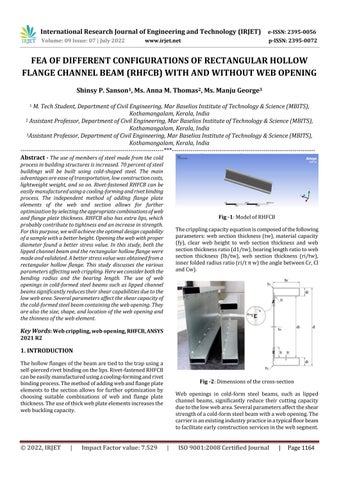
Fig -1: Model of RHFCB The crippling capacity equation is composed of the following parameters: web section thickness (tw), material capacity (fy), clear web height to web section thickness and web section thickness ratio (d1/tw), bearing length ratio to web section thickness (lb/tw), web section thickness (ri/tw), inner folded radius ratio (ri/t π w) the angle between Cr, Cl and Cw).
Key Words: Web crippling, web opening, RHFCB, ANSYS 2021 R2
1. INTRODUCTION The hollow flanges of the beam are tied to the trap using a self-pierced rivet binding on the lips. Rivet-fastened RHFCB can be easily manufactured using a cooling-forming and rivet binding process. The method of adding web and flange plate elements to the section allows for further optimization by choosing suitable combinations of web and flange plate thickness. The use of thick web plate elements increases the web buckling capacity.
© 2022, IRJET
|
Impact Factor value: 7.529
Fig -2: Dimensions of the cross-section Web openings in cold-form steel beams, such as lipped channel beams, significantly reduce their cutting capacity due to the low web area. Several parameters affect the shear strength of a cold-form steel beam with a web opening. The carrier is an existing industry practice in a typical floor beam to facilitate early construction services in the web segment.
|
ISO 9001:2008 Certified Journal
|
Page 1164