INVESTIGATION ON EFFECT OF WATER HYACINTH IN CONCRETE

Page 1

International Research Journal of Engineering and Technology (IRJET) Volume: 09 Issue: 07 | July 2022

www.irjet.net

e-ISSN: 2395-0056 p-ISSN: 2395-0072

INVESTIGATION ON EFFECT OF WATER HYACINTH IN CONCRETE Akhilakumari.P1, Akash Hari2, Devika.S3, Shijina Shaji4, Chaithra.S5 1-4Student, Civil

Engineering Department, Sree Narayana Institute of Technology, Adoor, India. professor, Civil Engineering Department, Sree Narayana Institute of Technology, Adoor, India. ---------------------------------------------------------------------***--------------------------------------------------------------------Large amount of carbon dioxide is released in the Abstract – Water Hyacinth is an aquatic plant that grow 5Assistant

manufacture of cement which causes many environmental problems including global warming. Many locally available materials are being tested for substitute of building materials in part or full replacement which would result in cost reduction in construction works and preferably preserving the natural resources and make it environmentally friendly. This includes the locally available material like paper pulp, rice husk, silica fume, eggshell, ground nutshell, etc. the tests conducted with these materials have proven successful in all ways this supplementary material will come largely in use when the shortage of materials occurs and does not meet the needs of the construction industries.

vigorously in water bodies and spread all over the area in a short period. It is found in most of the countries in the world and known to be killer of aquatic life. It is found in many rivers and lakes of Kerala, which obstruct the water way itself. Water Hyacinth are usually found in two types one with long stem and broad leaves and other with short stem and small leaves. Many researches have been conducted to make use of these plants in an innovative way. Experiments were conducted to make use of these weeds as partial replacement of fine aggregate, ash of water Hyacinth as partial replacement of cement etc. Concrete one of the important construction materials use world wide composing of cement, water, fine aggregate and coarse aggregate. There is lot of environmental problems in manufacturing process of cement, the main problem being the release of greenhouse gases in large amount of CO2. In this study Water Hyacinth were prepared in different forms and concrete mixes were prepared by adding these forms in various proportions as partial replacement of Binary cement.

Key Words: Water Hyacinth, Compressive strength, Split tensile Strength, Flexural strength.

1. INTRODUCTION Kerala, the God's own country is blessed with lots of water bodies like lakes, rivers channel irrigation channels paddy fields, and ponds the majority of them reinvested in one or the other. The most common among them is E. crapssips, commonly known as water hyacinth. It is an aquatic plant that floats freely on slow-moving water bodies or grows in soil with stagnated water. It doubles in the area and covers the entire area within two weeks. Some of them are such as loss in biodiversity, affecting the quality of water, loss of water, agricultural imperfections, and infrastructure damage and also affecting the human health and safety as well as some aquatic species.

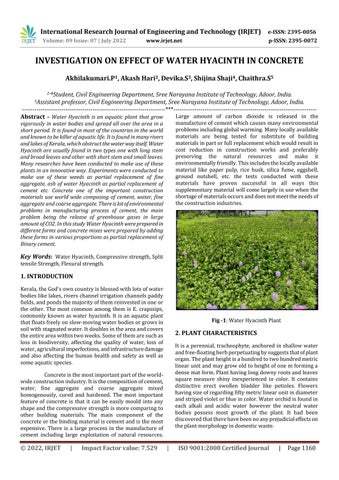
Fig -1: Water Hyacinth Plant

2. PLANT CHARACTERISTICS It is a perennial, tracheophyte, anchored in shallow water and free-floating herb perpetuating by suggests that of plant organ. The plant height is a hundred to two hundred metric linear unit and may grow old to height of one m forming a dense mat form. Plant having long downy roots and leaves square measure shiny inexperienced in color. It contains distinctive erect swollen bladder like petioles. Flowers having size of regarding fifty metric linear unit in diameter and striped violet or blue in color. Water orchid is found in each alkali and acidic water however the neutral water bodies possess most growth of the plant. It had been discovered that there have been no any prejudicial effects on the plant morphology in domestic waste.

Concrete is the most important part of the worldwide construction industry. It is the composition of cement, water, fine aggregate and coarse aggregate mixed homogenously, cured and hardened. The most important feature of concrete is that it can be easily mould into any shape and the compressive strength is more comparing to other building materials. The main component of the concrete or the binding material is cement and is the most expensive. There is a large process in the manufacture of cement including large exploitation of natural resources.

© 2022, IRJET

|

Impact Factor value: 7.529

|

ISO 9001:2008 Certified Journal

|

Page 1160


Turn static files into dynamic content formats.
Create a flipbook