NUMERICAL EVALUATION OF BEAM COLUMN JOINT REINFORCED WITH GFRP BARS AND STIRRUPS

Page 1

International Research Journal of Engineering and Technology (IRJET)

e-ISSN: 2395-0056

Volume: 09 Issue: 07 | July 2022

p-ISSN: 2395-0072

www.irjet.net

NUMERICAL EVALUATION OF BEAM COLUMN JOINT REINFORCED WITH GFRP BARS AND STIRRUPS Ali Usman1, Dr. Ajmal Muhammad 2, Asha Jose3 1Mtech

student, Structural and construction management, IIPE, Nellikuzhi P.O, Kothamangalam, Kerala, India 2Head of Department, Civil Department, IIPE, Nellikuzhi P.O, Kothamangalam, Kerala, India 3Assistant professor, Civil Department, IIPE, Nellikuzhi P.O, Kothamangalam, Kerala, India ---------------------------------------------------------------------***--------------------------------------------------------------------glass GFRP bars and stirrups. In this paper GFRP and steel Abstract - Reinforced concrete beam column joins are often used in buildings such as parking areas and viaducts which may be visible to extreme weather conditions. The objective of this project is to assess the seismic behavior of concrete beam column joints reinforced by glass GFRP and stirrups. In this paper GFRP and steel are mainly used. The main objectives of the projects are, to analyse the effect of corner beam- column joints using steel and GFRP rebar under cyclic loading, to analyse the effect of interior beam- column joints using steel and GFRP rebar under cyclic loading. From the analysis, the beam column joint with GFRP main bars and steel stirrups have the extreme energy absorption capacity and have great yield strength as compared to other models. This indicates the feasibility of using GFRP and stirrups as reinforcement on the beam column joints subjected to seismic type loading.

are mainly used. The material properties of different ingredients are shown Table 1 and Table 2.

Keywords: Beam column joint, GFRP, Energy absorption

Table -2: Material Property of GFRP

Table -1: Material Property. Mix/Grade Density Young’s modulus (GPa) Poisson’s ratio (ν) Bulk modulus Shear modulus

capacity, Reinforcement.

Concrete M20 2500 kg/m3 22360.679 N/mm2

Steel Fe 415 7850 kg/m3 2x10⁵

0.2 12422.56 N/mm2

0.3 1.6667x10⁵ N/mm2 7.6923x10⁴ N/mm2

9316.95 N/mm2

Material properties

1. INTRODUCTION

Young’s modulus

Fiber reinforced polymer (FRP) reinforcement was currently being used as a viable temporary to steel in new concrete structures especially those in harsh environments. The main driving force behind this effort is the greater performance of FRP in destructive environments attributable to its non-corrodible nature. The beam column joint in the critical zone in a reinforced concrete (RC) frame exposed to large forces during several ground pulsating events, and its behavior has a significant influence on the response of the structure. Beam column joints are the bond between horizontal and vertical structural elements, and therefore, the joints are directly involved in the transfer of seismic forces.

Tensile strength Poisson’s ratio Density Bulk modulus Shear modulus

Diameter of bar 8mm 12mm 16mm 42000 45400 46400 N/mm2 N/mm2 N/mm2 489.30 7465.54 715 N/mm2 0.26 0.26 0.26 2500 2500 2500 kg/m3 kg/m3 kg/m3 29166.67 31527.78 32222.22 N/mm2 N/mm2 N/mm2 16666.67 181015.87 18412.69 N/mm2 N/mm2 N/mm2

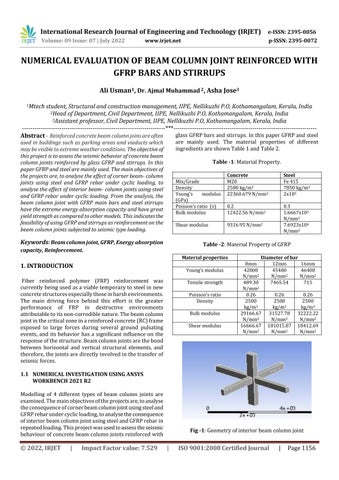
1.1 NUMERICAL INVESTIGATION USING ANSYS WORKBENCH 2021 R2 Modelling of 4 different types of beam column joints are examined. The main objectives of the projects are, to analyse the consequence of corner beam column joint using steel and GFRP rebar under cyclic loading, to analyse the consequence of interior beam column joint using steel and GFRP rebar in repeated loading. This project was used to assess the seismic behaviour of concrete beam column joints reinforced with

© 2022, IRJET

|

Impact Factor value: 7.529

Fig -1: Geometry of interior beam column joint

|

ISO 9001:2008 Certified Journal

|

Page 1156


Turn static files into dynamic content formats.
Create a flipbook