Volume: 09 Issue: 07 | July 2022 www.irjet.net p ISSN: 2395 0072
AUTOMATIC DETECTION OF TRAFFIC ACCIDENTS FROM VIDEO
USING DEEP LEARNING
Hemanth Kumar K1 , Shravanthi R2 , Rachitha E3 , Panchami B V4 , Namratha N Joshi5
1Hemanth Kumar K : Assistant Professor, Dept of ISE, EWIT, Karnataka, India
2Shravanthi R Student, Dept of ISE, EWIT, Karnataka, India
3Rachitha E Student, Dept of ISE, EWIT, Karnataka, India
4Panchami B V Student, Dept of ISE, EWIT, Karnataka, India
5Namratha N Joshi Student, Dept of ISE, EWIT, Karnataka, India ***

Abstract As per overall insights, car crashes are the reason for a high level of fierce passings. The time taken to send the clinical reaction to the mishap site is to a great extent impacted by the human variable and connects with endurance likelihood. Because of the wide utilization of observation of video and shrewd traffic frameworks, a robotized auto collision location approach becomes attractive for PC vision specialists. These days, Deep Learning (DL) based approaches have shown elite execution in PC vision errands that include a perplexing elements relationship. Along these lines, this work fosters a computerized DL based technique equipped for identifying car crashes on record. The proposed strategy expects that auto collision occasions are depicted by visual highlights happening through a transient way. Subsequently, a visual elements extraction stage, trailed by a transitory example distinguishing proof, make the model engineering. The visual and transient elements are learned in the preparation stage through convolution and repetitive layers utilizing worked without any preparation also, public datasets. A precision of 98% is accomplished in the recognition of mishaps in broad daylight traffic mishap datasets, showing a high limit in recognition free of the street structure.
Key Words: metropolitan auto collision; profound learning; mishap identification; intermittent brain organizations; CNN
1.INTRODUCTION
Thevarious elements that justifythe auto collisions.In association with the well known components that increment a likelihood of the event they are the calculation of the street, the environment of the area, tanked drivers, and speeding. Those mishaps can hurtto individualsincluded and,albeitthevastmajorityof these present just material harm, each one influences individuals' personal satisfaction regarding both traffic versatility and individual. Because of mechanical advances, camcorders have turned into an asset for controlling and managing traffic in metropolitan regions. Theymake it conceivable tobreak down and screen
the traffic streaming inside the city. In any case, the quantity ofcameras expected to perform these assignments has been expanding fundamentally overithe long haul. Which control troubles mechanization components are not carried out in light of the fact that the quantity of experts required to agree with everyone of the focuses additionallyincrements.
A few methodologies have been proposed to robotize assignments inside the control and follow-upprocess. An illustration of this is a frameworkin light of camcorder reconnaissance in rush hour gridlock. Through these, it is feasible to assess the velocities and directions of the objects ofiinterest, with the goal of anticipating and controlling the event of auto collisions nearby. Established researchers have introduced various ways to deal with identify auto collisions. These incorporate insightsbased strategies, informal communit information examination, sensor information, AI, and profound learning. These most recent procedures have introducedenhancements indifferent areas ofscience, including video based critical thinking (video handling). Hence, it means quite a bit to concentrate on this technique to move toward an answer for the identification and grouping of car crashes inview of video. With the appearance ofconvolutional layers in the area of brain organizations, better executioni has been accomplished in the arrangement of issues including advanced picture handling. Profound learning methods have shown superiori execution in an enormous number of issues, particularly for picture understanding andinvestigation. It is beyond the realm of possibilities to expect to accomplish with thickbrain organization. input formation with countless highlights makes it conceivable, in addition to other things, to keep away from the issueof the scourge of dimensionality. This is an extremely regular issue whileworking with information withhighintricacy, like pictures. Similarly, it means alotto feature thatthe utilizationof a fewConvolutional layers helps the extraction of pertinentvisual elements inside the equivalent dataset,which characterizes the presentationofthe organization.
The utilization of convolutions on
International Research Journal of Engineering and Technology (IRJET) e ISSN: 2395 0056
© 2022, IRJET | Impact Factor value: 7.529 | ISO 9001:2008 Certified Journal | Page964
Volume: 09 Issue: 07 | July 2022 www.irjet.net p ISSN: 2395 0072
In certain issues, the fleeting connection that the information might have been of more prominent significance. That is on the grounds that there are occasions that rely upon past as well as future occasions, that is to say, on a setting ofthe occasion in time to comprehend the genuine occasion. To this end another profound learning model has arisen: intermittent brain networks.
These organizations have a comparative design to thick fake brain organizations in any case, varyin that no less than one neuron has anassociation with fundamentally. It permits them to be capable to recollect what has been recently handled, i.e., it empowers them to store data over timeframes They represent considerable authority in seeing as the transient connections thata bunch of informationmighthave.Suchorganizations are utilized to take care of issues, forexample,paceof progress forecast, text interpretation, and normal language handling, among others. The information handling in these neurons has a higher intricacy than the handling performed from a conventional neuron. What's more, thesehave been moved along throughoutthe long term. One of the most pertinent changes was the likelihood that the cell wouldbe able store short and long haul memory, called long momentary memory neurons (LSTM).
These networks have given enhancements in a few issues regard to past models. Among these are travel time forecast issues, language understanding, and regular language handling. Nonetheless, the examination of video scenes isn'tan issue that can settled use one of the two models referenced previously. This is on thegrounds that a video presents both a spatial what's more, a transient relationship in itssubstance. In this way, established researchers has introduced a few designs that utilization both profound learning layers: convolutional layers and intermittent layers. A portion of theadvances they have accomplished utilizing these kinds of structures are feeling acknowledgment, assessment of an individual's stance, examination of ball recordings for the computerizationofundertakingslike the score of each group, and activity acknowledgment. Along these lines, a strategy fit for taking care of the car crash recognition issue is proposed. Nonetheless, themost common way of recognizing car crashes is an errand that includes a ton of handling and, therefore, these assignments present numerous troubles. The event of a street mishap is an occasion equipped for happeningin variousspatial fleeting mixes.
This leaves an enormous space of different circulations of information to be named a mishap, which makes it hard to tackle the issue.
Likewise, the grouping of a mishap is a complex issue because of the fleeting ramifications it might introduce. Accordingly, we try to work on the presentation of current methodologies with the plan of a technique able to do identifying car crashes through video investigation utilizing profound learning strategies.
1.1 STRATEGY FOR AUTOMATIC DETECTION OF TRAFFIC ACCIDENTS
The proposed strategy depends on methods utilized in video examination. Specifically, profound learning brain networks designs prepared to recognize the event of a traffic mishap are utilized. Prior to portraying the design, characterizing the network was vital input. Since a video should be handled, it is isolated into sections. Consequently, the worldly division of the video expected an essential investigation to figureout which was the most proper plan to produce the fragments, taking into account a trade off between the computational expense of handling the fragment and the age of enough visualattributes to separate examples that the organization learned. When the information wascharacterized, the mishap occasion was worked asthe event in season of a bunch of visualexamples. The first concentrates a vector of visual qualities utilizing a changed Inception V4 design; this arrangement of qualities is handledby an intermittent part to separate the worldly part connected with the event of the occasion. Then, we depict the two phases: fleeting videodivision and programmed discovery of car crashes.
1.2 AUTOMATIC DETECTION OF TRAFFIC
ACCIDENTS
To decipher a videofragment to recognize whether an occasion happens, the information must be taken advantage
of in two Primary ways: outwardly and transiently.
The convolutional based designs arethe main methods for visual examination of pictures. These are a huge improvement over conventional fake brain networks in the presentation of picture arrangement arrangements.Be that as it
may, convolutional layersdon't take care of all issues. One of the shortcomings of convolutional layers is that they are bad at extricating worldly elements from information. Despite the fact that convolutional layers are strong in taking advantage of the spatial qualities of the information, repetitive brain networkswereintended to take advantage of the transient qualities of the information. Convolutional layerscanhandletheinformationsothat the spatial data changes to a more dynamic portrayal
savingcomputational expense.
International Research Journal of Engineering and Technology (IRJET) e ISSN: 2395 0056
© 2022, IRJET | Impact Factor value: 7.529 | ISO 9001:2008 Certified Journal | Page965
International Research Journal of Engineering and Technology (IRJET) e ISSN: 2395 0056
Volume: 09 Issue: 07 | July 2022 www.irjet.net p ISSN: 2395 0072
At present,the redesigns are utilized as programmedi extractors ofi picture highlights because ofi their exhibition decreasing the dimensionality of theinformation. In any case, spatial information isn't everything in a video. Successive information isof significanceiniunderstanding anoccasion that occurs throughout a period length. Repetitive brain network perform better while handlingia succession over the haulcontrastedwithcounterfeitbrainorganizations.
There are arrangements that utilizationiboth architectures to further develop execution ini taking care ofi video cognizance issues. Notwithstanding, established researchers has introduced a plan fit for taking advantage of the two kinds of information: the Convolutional LSTM (Conv LSTM) layers.
These are a unique sort of architecture wherethe cells follow similar tasks as a LongShortTerm Memory neuron yet vary in that the information activities are convolutions rather than fundamental number jugglingtasks.
This design has shown elite execution in issueswith videopressure.Totackletheautocollisionrecognition issue, the initial segment of the engineering is planned as a programmed picture include extractor to handle each casing of thevideo portion. Then, this new portrayal of theinformation is utilized as information in an observationally planned intermittent brain organizationto separate worldly data from the information.At long last, a thick counterfeit brain networkblock is utilized to play out the double characterization of recognizing a mishap.
2. IMPLEMENTATION
Implementation is the stage of the project where theoretical design is turned into a working system There are mainly five modules used in this project they are
User login module
Load and generate CNN model module
Start accident detection module
Loss and accuracy graph module
Exit module
1. User login module User can login by giving correct user name and password using this module
2. Load and generate CNN model module
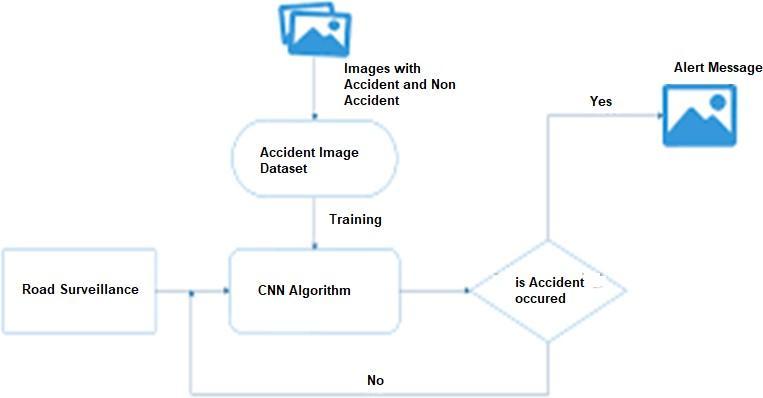
Training data set can be loaded and CNN model is generated using this module
3. Start accident detection module By giving input video user can start this module to detect accident
4. Loss and accuracy graph module Overall loss and accuracy in finding accident isdone by this module
5. Exit moduleUser can come out of from home pageofproposed system.
2.1 ALGORITHM USED
We have used CNN algorithm to implement, the step involved are as follows:
STEP1: The pixels from the image are fed to the convolutional layer that performs the convolution operation.
STEP2: It results in a convolved map.
STEP 3: The convolved map is applied to a ReLU function to generate a rectified feature map.
STEP 4: The image is processed with multiple convolutions and ReLU layers for locating the features.
STEP 5: Different pooling layers with various filters are used to identify specific parts of the image.
STEP 6: The pooled feature map is flattened and fed to a fully connected layer to get the final output.
STEP 7: The output will have the value ranging from (0 to 1) showing probability of match.
2.2 ARCHITECTURE
Figure 1: System Architecture
© 2022, IRJET | Impact Factor value: 7.529 | ISO 9001:2008 Certified Journal | Page966
Volume: 09 Issue: 07 | July 2022 www.irjet.net p ISSN: 2395 0072
2.3 SOFTWARE ENVIRONMENT
Python
Python is a general cause interpreted, interactive, object oriented, and high degree programming language. It became created with the aid ofusing Guido van Rossum at some point of1985 1990. Like Perl, Python supply code is likewise to be had beneath Neath the GNU General Public License (GPL).
MySQL
MySQLi is presently the maximum famous database control gadget software program used for handling the relational database. It is opensupply database software program, thatis supported with the aid
of using Oracle Company. It is typically used along with PHP scripts for developing effective and dynamic server-aspect or internet-primarily based totally employer applications.
Setting route at windows to upload the Python listing to the route for a specific consultation in windows
At the command prompt kind route %route%; Python and press enter. Django is a high-degree Python internet framework that encourages speedy improvement and clean, pragmatic design. Django makes it simpler to construct higher internet apps fast and with much less code.
3. RESULT
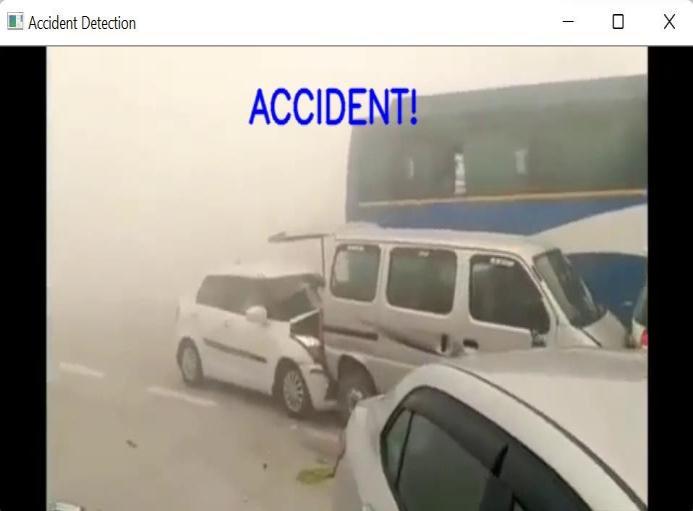
The implementation of automatic road accident detection systems to provide timely aid is crucial road accident analysis and automatic detection model is built using the visual and temporal features of Deep Learning.
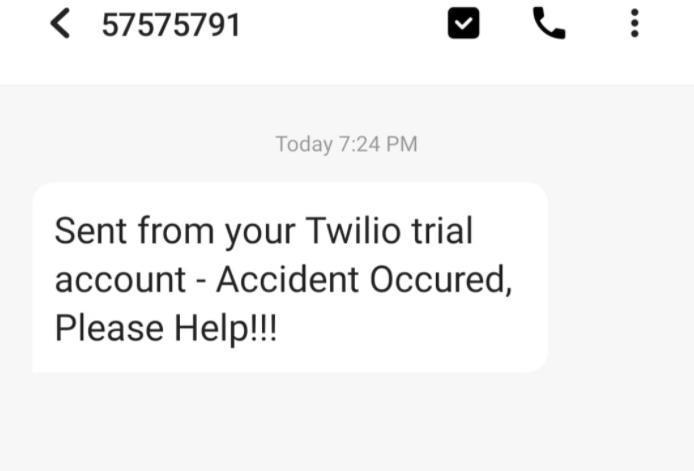
Figure 3: Send alert message
Once accident is detected by the system it automatically sends alert message
4. CONCLUSIONS
Today the road traffic accidents being a major reason of losing lives each day. The driver's mistake and late response time from the emergency services are the main cause of it. In order to save wounded people, a reliable road accident detection and information transfer system is needed. The proposed method is based on techniques used in video analytics. In particular, deep learning neural networks architectures trained to detect the occurrence of a traffic accident are used.
Figure 2: Accident image
International Research Journal of Engineering and Technology (IRJET) e ISSN: 2395 0056
REFERENCES 1. Car crash detection using ensemble deep learning and multimodal data from dashboard camera spanel Jae GyeongChoia1Chan WooKonga2GyeonghoKima3SunghoonLim Volume 183,30November2021,115400 2. A New Video-Based Crash Detection Method: Balancing Speed and Accuracy Using a Feature Fusion Deep Learning Framework Zhenbo Lu,1 Wei Zhou,1 Shixiang Zhang,2 and Chen WangVolume2020|ArticleID8848874 3. Parsa,A.B.;Movahedi,A.;Taghipour,H.;Derrible,S.; Mohammadian, A. (Kouros) Toward Safer Highways, Application of XGBoost and SHAP for Real-Time Accident Detection and Feature Analysis. Accid.Anal.Prev.2020,136,105405. © 2022, IRJET | Impact Factor value: 7.529 | ISO 9001:2008 Certified Journal | Page967
International Research Journal of Engineering and Technology (IRJET) e ISSN: 2395 0056
Volume: 09 Issue: 07 | July 2022 www.irjet.net p ISSN: 2395 0072
4. Yao, Y., Xu, M., Wang, Y., Crandall, D.J.and Atkins, E.M., 2019. Unsupervised traffic accident detection in first person videos. arXiv preprintarXiv:1903.00618.
5. Tian, D., Zhang, C., Duan, X. and Wang, X., 2019. An automatic car accident detection methodbasedoncooperativevehicleinfrastructure systems. IEEE Access,7,pp.127453 127463.
6. Md.FarhanLabib,AhmedSady Rifat,Md.Mosabbir Hossain,AmitKumarDas,FariaNawrine, "Road Accident Analysisand Prediction of Accident Severity by Using Machine Learning in Bangladesh", IEEE2019.
7. Nikhil Sharma, Rajat Rathi, Chinkit Manchanda,"Traffic Density Investigation & Road Accident Analysis in India usingDeepLearning" IEEE2019
8. Elijah Blessing Rajsingh, Salaja Silas , P.Joyce Beryl Princess,"Performance Analysis of Edge Detection Algorithms for Object Detection in AccidentImages",IEEE2019.
9. Kyu Beom Lee, Hyu Soungi Shin,"A application of a deep learning algorithm forautomaticdetection ofunexpectedaccidentsunderbadCCTVmonitoring conditionsintunnels"IEEE2019.
10. Murugan.V,VijaykumarV.R and Nidhila.A,"ADeep Learning RCNN Approach for Vehicle Recognition in TrafficSurveillanceSystem"IEEE2019.
11. Vipul Gaurav, Sanyam Kumar Singh, Avikant Srivastava,"Accident Detection, Severity Prediction, Identification ofAccident Prone Areas in India an Feasibility Study using Improved Image Segmentation, Machine Learning and Sensors", IJERT2019.
12. Bulbula Kumeda, Zhang Fengli, Ariyo Oluwasanmi, Forster Owusu, Maregu Assefa, "Temesgen Amenu,Vehicle accident and traffic classification using Deep Convolutional NeuralNetwork",IEEE2019.
13. Miao Chong, Ajith Abraham and Marcin Paprzycki1,"Traffic Accident Analysis UsingMachine LearningParadigms",IEEE2017.
14. Nejdet Dogru, Abdulhamit Subasi,"Traffic Accident Detection Using Random Forest Classifier", IEEE 2018.
15. Helen Rose Mampilayil, Rahamathullah K,"Deep learningbasedDetection of OneWayTraffic Rule Violation of ThreeWheelerVehicles",IEEE2018.
© 2022, IRJET | Impact Factor value: 7.529 | ISO 9001:2008 Certified Journal | Page968