International Research Journal of Engineering and Technology (IRJET)
e-ISSN: 2395-0056
Volume: 09 Issue: 07 | July 2022
p-ISSN: 2395-0072
www.irjet.net
WELDLINE STRENGTH ANALYSIS THEORETICAL PREDICTIVE MODEL WITH THE USE OF MOLDLFLOW Mahesh S. Tetambe1, Shailesh A. Agrawal2, Basavaraj Naikmani3 1DGM at Engineering Tooling Solution at Schneider electric India Pvt Ltd. Senior Manager at Engineering Tooling Solution at Schneider electric India Pvt Ltd. 3Senior Engineer at Engineering Tooling Solution at Schneider electric India Pvt Ltd. ---------------------------------------------------------------------***-------------------------------------------------------------------2
Abstract - Molding process can introduce different
variation in different sections of mould cavity create a nonuniform flow front.
moulding defects into the final moulded part.
It is observed that amorphous resins generally provide better weld-line strength than semi-crystalline resins. Adding glass fibres can also contribute to reduction in weld-line strength. The flow pattern of the plastic when it enters the mould cavity through gate is most important to weld-line strength. Minimizing flow interruptions, and care to place them such that the flow fronts are allowed to meet and flow some distance together to merge properly.
Here we are looking at most common part defect that can come from injection molding called weld line. Weld line additionally called as knit line, is a defect that occurs when the injected plastic meets within a mold. When the polymer resin is injected into a mold, it flows through all portions of the mold cavity. When the two such melt flows collide in a mold cavity, they are supposed to merge back together. The pressure & temperature with which they merge together decide strong or weak weld line.
Weld lines can be weaker than the surrounding area hence, it is important to understand how weld lines form, and how to optimize their appearance and strength. The flow of molten plastic in a mold does not progress in a turbulent manner as would a fast-moving Newtonian fluid such as water. Also, it does not slide along the walls of the mold cavity. Instead, it moves forward by way of fountain flow. Portions of the long chain polymer molecules become lodged in the stationary and slow-moving layers near the mold surface. This pulls plastic from the center, core region of the advancing flow front. Fresh melt exits the core and rolls out to the mold surface. The flow gets split due to product designs and tool designs aspects leading to weldline formation.
Based on flow front meeting angle melt line & weld line are identified. Weld line is usually weaker than melt line & subsequently it reduces strength of moulded part. The parameters like gate location, part geometry, melt temperature and fill pressure near weld line plays vital role in weld line formation. There is no process to objectify the plastic part strength at weldline area. The structural simulation done on CAD model does not account for the weldline and stresses generated during moulding process in part. Hence a predictive weldline strength model considering in mould stresses is established. Key Words: Weld line, injection pressure, Simulation
1. INTRODUCTION Weld line is generally a most common defect, but it is difficult task to eliminate. They usually occur when melt flow fronts collide with each other in a mold cavity. A weak weld line can cause aesthetic issues, or it can significantly weaken the structural integrity of a plastic part.
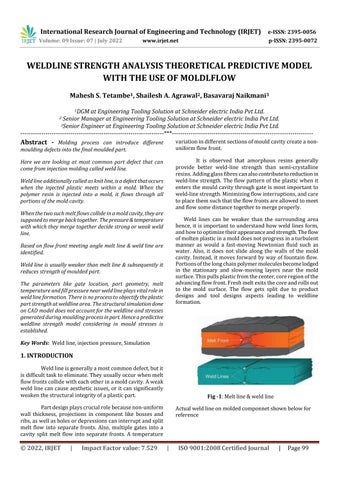
Fig -1: Melt line & weld line
Part design plays crucial role because non-uniform wall thickness, projections in component like bosses and ribs, as well as holes or depressions can interrupt and split melt flow into separate fronts. Also, multiple gates into a cavity split melt flow into separate fronts. A temperature
© 2022, IRJET
|
Impact Factor value: 7.529
Actual weld line on molded componnet shown below for reference
|
ISO 9001:2008 Certified Journal
|
Page 99