International Research Journal of Engineering and Technology (IRJET)
e-ISSN: 2395-0056
Volume: 09 Issue: 07 | July 2022
p-ISSN: 2395-0072
www.irjet.net
DIGITAL TWIN FRAMEWORK FOR SUPPLYCHAIN PROCESS Ajeesh K Raj1, Dr. Haris Naduthodi2 1PG
Scholar manufacturing systems management, GEC Thrissur,Kerala,India,680009
2Professor, Department of production engineering, GEC Thrissur, kerala, India 680009
---------------------------------------------------------------------***--------------------------------------------------------------------Abstract - A successful supply chain management is an 2. LITERATURE SURVEY important factor to improve the performance in an organization. The major problem identified is the uncertainties in stock management in the supply chain process. It causes due to the lack of information flow in real time. For that we need an effective integration and collaboration of various processes. Digital twin is an emerging technology that consists of creating virtual replicas of the object or processes. It achieves deep synchronization and dynamic interaction between the physical and virtual world. So, a real time information system is developed. It includes the data flow from sales point to the manufacturing organization in real time. The data’s are stored in cloud system. This will provide accurate and intuitive information for decisionmakers, to speed up the decision-making process and improve the veracity of decision
Digital Twins was introduced by Michael Grieves in early 2000’s in a course presentation for product life-cycle management [1]. Implementing DT was considered a complex procedure, which required many developments in different technologies in early 2011 [2]. The first description to use of Digital Twin was years by NASA in Technology Roadmaps [3], where a twin was used to mirror conditions in space and to perform tests for flight preparation. Dawned with the aerospace industry, the other manufacturing industry started to use digital twin in 2012. With the advancements in technologies like cloud computing, IoT and big data, many domains have seen major developments occurred , such as Industry 4.0 [4], Physical Internet [5,6], Cyber-manufacturing [7], Made in China 2025[8], Cloud Manufacturing [9] etc. Industry 4.0 has seen a revolution mainly because of digital advancements, IoT and Big Data [10, 11]. It was because of the Industry 4.0, the storage of all data in digital format, and sensors being inbuilt into the industrial spaces, that the implementation of digital twin was possible, rejuvenating the concept. With the emerging extensive simulation capabilities, it became feasible to perform realistic tests in a virtual environment. Owing to these technical advancements, the idea of implementing a functional digital twin was soon adopted by companies like IBM, Siemens and GE, as a utility for themselves and for their clients. Currently industries depend commercial software solutions for managing supply chain but in this packages the application of real time integration of data across systems with IoT and cloud computing seems to be limited. Hence a framework for managing supply chain with digital twin capabilities enables development of more intelligent integrated systems.
Keywords: Digital twin ,Supplychain process, Information system, IOT, Digital Monitoring, Industry 4.0, Cloud Infrastructure
1. INTRODUCTION In the beginning of the development of technological solutions in the world, it mentioned that a Digital twins are software representations of assets and processes that are used to understand, predict, and optimize performance in order to achieve improved business outcomes. Digital twins consist of mainly three components: a set of data model, a set of analytics or algorithms, and knowledge to create the system. Considering the classic concept of digital twin and the lack of comprehensive and robust solutions along a supply chain, it is possible to naturally conceive the concept of digital twin in supply chains. The design of a digital twin with the organizations that are part of a supply chain facilitates the activities of monitoring and digital control of operations happening there.Here the major problem identified is the uncertainties in stock management in the supply chain process. It causes due to the lack of information flow in real time. For that we need an effective integration and collaboration of various processes. So created an information system which includes the data flow from sales point to the manufacturing organization in real time with the help of cloud and IoT platforms.
3. RESEARCH METHODOLOGY
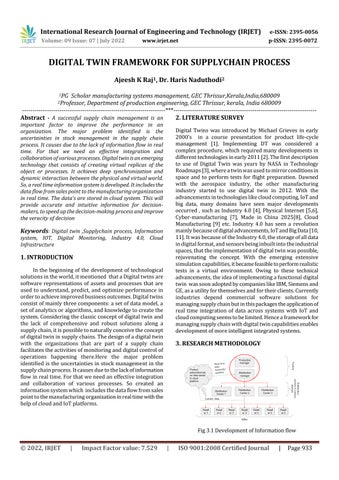
Fig 3.1 Development of Information flow
© 2022, IRJET
|
Impact Factor value: 7.529
|
ISO 9001:2008 Certified Journal
|
Page 933
International Research Journal of Engineering and Technology (IRJET)
e-ISSN: 2395-0056
Volume: 09 Issue: 07 | July 2022
p-ISSN: 2395-0072
www.irjet.net
4.RESULT AND DISCUSSION
AKR-IS application is used for keeping track of stock. In this application the sections are mainly focused the information data flows from the sales ,the distribution center and the manufacturing organization. The development of the information flow is shown in the fig 3.1 The major features of this application is adding stock to the inventory, selling items from the inventory / sales, lay out/email/SMS shows that the items that need to be restocked. All these data’s are stored in cloud system ,then the distribution manager can access the data in the manufacturing organization when they log in to their page. Distribution manager can only visible the data from various distribution centers. Distribution manager couldn’t edit or change the data , they can only visible. As it is a Prototype application ,i used the excel sheet as the backend. Instead of that we can use any other applications which support the cloud system or internet ,as the backend. It depend on store manager choice. Store managers can connect the other software’s or platforms to the Appsheet as its backend.
The user interface of the application is given in the images. Fig 4.1 shows the application name, logo etc… This section will appear after login. Add description about the application in the preliminary page. The inventory section is shown in the Fig 4.2 .Here the product category, the product image, the current stock ,and other details regards to the product are added. We can add product details through the backend page or by the front end in the application. When we clicked on the Sales section a tab is open and we can add the sales details occurred during the period of time. When the sales added ,it automatically reduce the quantity number from the current stock and shows the exact quantity at that time in the developed system. So when the sales occurred and it reaches below or equal to the restock level quantity at any time ,so it automatically shows in the restock page. We can identify the restock needed products easily in the section as shown in the fig 4.5 Using the filter option we can easily check the other details of the products too. In the sales report section we can see the history of sales data. It can be visible in different option using the filter criteria as shown in the fig 4.4 All these views can be set according to the users choice. Once the products are visible in the restock needed section as shown in the fig 4.5 the stock manager can order the product. So it can restore in minimum time.
Appsheet is used to develop the front end of the application. Create an account in the Appsheet platform using email id. Then select the prototype application creation page and start the application making process. This is one of the easy platform to create prototype applications .There we can upload the data’s in the given section .I used the excel sheet so I can upload and share the data to the platform. Create the login pages. For connecting the back ends give necessary commands needed. All these data’s are stored in the cloud platform. Data used for this application are; product code, name of the product, category of products, links for the images of the product ,initial stock for each product ,restock level needed for each product in the organization.
When we added these stock in the system the current stock is automatically updated in the application. So the system automatically delete the product from the restock needed list. Restock the products quickly is possible because of two things, the order given by the stock manager at right time and the distribution manager who send the previous sales quantity data to the production team in the organization to manufacture and keep stock . We know that all these sales data’s are stored in the cloud platform. So the distribution manager can login and check the sales data on each day as shown in the fig 4.6 Here distribution manager in the factory can visible all the sales data of various distribution centers. This information can send to the production manager in the organization, to speed up the decision-making process related to the manufacturing and inventory process. This is possible because of the fastest information flow in the system.
Update the sales data to the information system on each day. These data automatically stored in the cloud platform. The distribution manager can visible the actual number of products remaining in the store through this application while he login. The sales data also visible on each distribution centers. The representation of these data’s are available in various formats like table view or chart views. During these period ,in some days the restock level is crossed by some of the products. So the restock is needed for those products, and it is shown the specific page in the application. We can also attached the mobile number or email id to get the information personally from the system (Depend on the users choice).According to the information shown by the system the distribution center ordered the products which are needed to keep the stock. Here the distribution center added the products by giving the right information at right time and product details to the distribution manager in the manufacturing organization.
© 2022, IRJET
|
Impact Factor value: 7.529
|
ISO 9001:2008 Certified Journal
|
Page 934
International Research Journal of Engineering and Technology (IRJET)
e-ISSN: 2395-0056
Volume: 09 Issue: 07 | July 2022
p-ISSN: 2395-0072
www.irjet.net
Fig.4.5 Restock needed section
Fig.4.1 Application details
Fig.4.6 Data access by the distribution manager
5.CONCLUSION This thesis describes a cloud based stock management system for decision making process. The objective is to develop a real-time information system in dynamic nature for managing supply chain with digital twin capabilities. This system will provide an accurate and intuitive information’s to decision-makers, and it helps to speed up the decisionmaking process. Any organization can customize this application and use accordingly . Considering the evolution of technologies and IoT, more companies will host a digital twin process in future.
Fig.4.2 Inventory section
6.REFERENCES [1]
Grieves, M (2015). Digital Twin : Manufacturing Excellence through Virtual Factory Replication This paper introduces the concept of a A Whitepaper by Dr . MichaelGrieves.WhitePaperURL:http://www.apriso.com /library/Whitepaper{_}Dr{_}Grieves{_}DigitalTwin{_}Ma nufacturingExcellence.php.
[2]
Tuegel, E.J., Ingra_ea, A.R., Eason, T.G., Spottswood, S.M., (2011). Reengineering Aircraft Structural Life Prediction Using a Digital Twin. International Journal of Aerospace Engineering 2011,14.doi:10.1155/2011/154798
[3]
Shafto, M., Rich, M.C., Glaessgen, D.E., Kemp, C., Lemoigne, J., Wang, L., (2010). DRAFT Modeling, Simulation, Information Technology & Processing Roadmap Technology Area 11. Technical Report.
Fig.4.3 Sales and Add Stock section
Fig.4.4 Sales Report view
© 2022, IRJET
|
Impact Factor value: 7.529
|
ISO 9001:2008 Certified Journal
|
Page 935
International Research Journal of Engineering and Technology (IRJET)
e-ISSN: 2395-0056
Volume: 09 Issue: 07 | July 2022
p-ISSN: 2395-0072
www.irjet.net
[4]
Lu, Y., (2017). Industry 4.0: A survey on technologies, applications and open research issues. doi: 10.1016/j.jii.2017.04.005.
[5]
Ballot, E., Montreuil, B., Meller, R., (2014). The Physical Internet URL: https://hal-mines-paristech.archivesouvertes.fr/hal-01113648.
[6]
Sternberg, H., Norrman, A.,(2017) The Physical Internet – review, analysis and future research agenda. doi:10.1108/IJPDLM-12-2016-0353.
[7]
Jeschke, S., Brecher, C., Meisen, T., O¨ zdemir, D., Eschert, T., (2017). Industrial Internet of Things and Cyber Manufacturing Systems, Springer, Cham, pp. 3–19. URL: https://link.springer.com/chapter/10.1007/978-3-31942559-7{_}1, doi:10.1007/978-3-319-42559-7_1.
[8]
Li, L., (2018). China’s manufacturing locus in 2025: With a comparison of “Made-in-China 2025” and “Industry 4.0”. Technological Forecasting and Social Change 135, 66–74. doi:10.1016/j.techfore.2017.05.028.
[9]
Xu, X., (2012). From cloud computing to cloud manufacturing. Robotics and Computer-Integrated Manufacturing 28, 75–86. doi:10.1016/j.rcim.2011.07.002.
[10] Negri, E., Fumagalli, L., Macchi, M., (2017). A Review of
the Roles of Digital Twin in CPS-based Production Systems. Procedia Manufacturing 11, 939–948. doi:10.1016/j.promfg.2017.07.198.R. Nicole, “Title of paper with only first word capitalized,” J. Name Stand. Abbrev., in press. [11] Jazdi, N., (2014). Cyber physical systems in the context
of Industry 4.0, in: Proceedings of 2014 IEEE International Conference on Automation, Quality and Testing, Robotics, AQTR 2014, IEEE Computer Society. doi: 10.1109/AQTR.2014.6857843.
© 2022, IRJET
|
Impact Factor value: 7.529
|
ISO 9001:2008 Certified Journal
|
Page 936