AGGRESSION DETECTION USING MACHINE LEARNING MODEL

Page 1

International Research Journal of Engineering and Technology (IRJET)

e-ISSN: 2395-0056

Volume: 09 Issue: 07 | July 2022

p-ISSN: 2395-0072

www.irjet.net

AGGRESSION DETECTION USING MACHINE LEARNING MODEL Sreesanth1 , Aleena Ibrahim2, Hasheem M.N3, Shanavas K.A4 B. Tech students, CSE, Ilahia College of Engineering and Technology, Muvattupuzha, Kerala. Assistant Professor, CSE, Ilahia College of Engineering and Technology, Muvattupuzha, Kerala. ---------------------------------------------------------------------***--------------------------------------------------------------------2.2 Flair Model Abstract -On social media, aggression has become a big 1,2,3

4

area of tension. However, due to the rapid and increasing rate of content generation as well as the evolution of violent behavior over time, recently proposed machine learning (ML) algorithms to detect various types of violent behavior suffer from a lack. Based on the ML paradigm, this paper describes a real-time system for monitoring aggression on Twitter. Here, we are implementing the system with the Flair Model. This method updates its Machine Learning models gradually when fresh labeled samples are received, and it achieves similar accuracy, precision, and recall in ML models with 93% accuracy, precision, and recall.

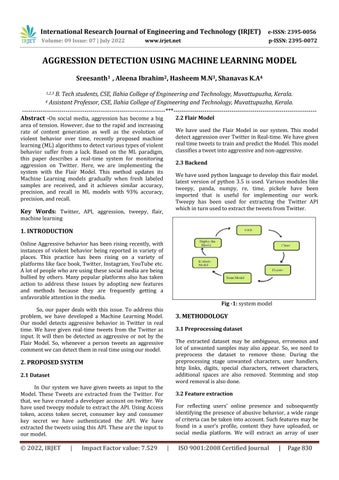
We have used the Flair Model in our system. This model detect aggression over Twitter in Real-time. We have given real time tweets to train and predict the Model. This model classifies a tweet into aggressive and non-aggressive. 2.3 Backend We have used python language to develop this flair model. latest version of python 3.5 is used. Various modules like tweepy, panda, numpy, re, time, pickele have been imported that is useful for implementing our work. Tweepy has been used for extracting the Twitter API which in turn used to extract the tweets from Twitter.

Key Words: Twitter, API, aggression, tweepy, flair, machine learning

1. INTRODUCTION Online Aggressive behavior has been rising recently, with instances of violent behavior being reported in variety of places. This practice has been rising on a variety of platforms like face book, Twitter, Instagram, YouTube etc. A lot of people who are using these social media are being bullied by others. Many popular platforms also has taken action to address these issues by adopting new features and methods because they are frequently getting a unfavorable attention in the media.

Fig -1: system model

So, our paper deals with this issue. To address this problem, we have developed a Machine Learning Model. Our model detects aggressive behavior in Twitter in real time. We have given real-time tweets from the Twitter as input. It will then be detected as aggressive or not by the Flair Model. So, whenever a person tweets an aggressive comment we can detect them in real time using our model.

3. METHODOLOGY 3.1 Preprocessing dataset The extracted dataset may be ambiguous, erroneous and lot of unwanted samples may also appear. So, we need to preprocess the dataset to remove those. During the preprocessing stage unwanted characters, user handlers, http links, digits, special characters, retweet characters, additional spaces are also removed. Stemming and stop word removal is also done.

2. PROPOSED SYSTEM 2.1 Dataset In Our system we have given tweets as input to the Model. These Tweets are extracted from the Twitter. For that, we have created a developer account on twitter. We have used tweepy module to extract the API. Using Access token, access token secret, consumer key and consumer key secret we have authenticated the API. We have extracted the tweets using this API. These are the input to our model.

© 2022, IRJET

|

Impact Factor value: 7.529

3.2 Feature extraction For reflecting users' online presence and subsequently identifying the presence of abusive behavior, a wide range of criteria can be taken into account. Such features may be found in a user's profile, content they have uploaded, or social media platform. We will extract an array of user

|

ISO 9001:2008 Certified Journal

|

Page 830


Turn static files into dynamic content formats.
Create a flipbook