Computational fluid dynamic analysis of solar chimney design

Page 1

International Research Journal of Engineering and Technology (IRJET)

e-ISSN: 2395-0056

Volume: 09 Issue: 07 | July 2022

p-ISSN: 2395-0072

www.irjet.net

Computational fluid dynamic analysis of solar chimney design Bhushan Verma1, Chandrakant Mengoliya 2, Purushottam Sahu3 1Research

Scholar, BM College of Technology, Indore RGPV, Bhopal Chandrakant Mengoliya BM College of Technology, Indore RGPV, Bhopal 3 Professor and HEAD, Dept. of Mechanical Engineering, BM College of Technology, Indore RGPV, Bhopal ---------------------------------------------------------------------***--------------------------------------------------------------------pressure is positive on the windward side and negative on Abstract - For both configurations with and without the 2

the leeward side. Air flow is caused by the pressure difference between these two areas.

geothermal mechanisms, the CFD analysis of such a solar chimney is performed using ANSYS CFX. Investigations are conducted into the typical room temperature, air flow rate, and radiation level. Moving away from the left glass, where solar radiation is incident, reduces the average radiation intensity in the room. Radiation levels are lowest at the room's centre. Geothermal design 3 has the lowest observed average room temperature, which is roughly 299K. With a magnitude of roughly 309.69K, the generic design (without a geothermal mechanism) produces the greatest average room temperature. The rate of mass flow decreases with the inclusion of a geothermal process.

2. In ventilation systems driven by temperature, a high temperature creates a stacking effect. The building's interior air temperature rises as cooler exterior air enters at a faster rate. As a result, cool air is brought in from the outside, causing airflow. 1.3 Mechanical ventilation (1.1.2) Mechanical fans are used throughout the mechanical ventilation process. These mechanical fans are installed on ducts, walls, ceilings, or both. These mechanical fans' main function is to make it easier for air to enter and leave the area. When the weather is warm and muggy, infiltration is used. A constructive pressure system places the room under positive pressure, and the room air escapes through envelope leaks or other openings. A negative pressure system places the room under negative pressure, and the room air is made up by sucking air in from the outside. [6]. The mechanical ventilation system should be balanced "where air supply and exhausts have been evaluated and changed to satisfy design standards." [6].

Key Words: CFD, Comfort thermal, naturally ventilated, solar chimney

1. INTRODUCTION 1.1 VENTILATION In any closed environmental system, ventilation involves the input and outflow of air. There may or may not be an air purification component. To control interior humidity, remove impurities, and maintain a reasonable temperature, a structure must have proper ventilation. Inhaled air quality has a big impact on how comfortable people are and how productive they are.

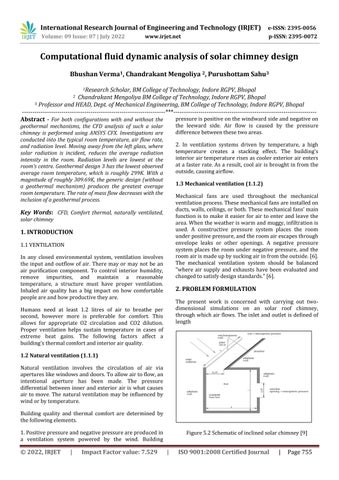
2. PROBLEM FORMULATION The present work is concerned with carrying out twodimensional simulations on an solar roof chimney, through which air flows. The inlet and outlet is defined of length

Humans need at least 1.2 litres of air to breathe per second, however more is preferable for comfort. This allows for appropriate O2 circulation and CO2 dilution. Proper ventilation helps sustain temperature in cases of extreme heat gains. The following factors affect a building's thermal comfort and interior air quality. 1.2 Natural ventilation (1.1.1) Natural ventilation involves the circulation of air via apertures like windows and doors. To allow air to flow, an intentional aperture has been made. The pressure differential between inner and exterior air is what causes air to move. The natural ventilation may be influenced by wind or by temperature. Building quality and thermal comfort are determined by the following elements. 1. Positive pressure and negative pressure are produced in a ventilation system powered by the wind. Building

© 2022, IRJET

|

Impact Factor value: 7.529

Figure 5.2 Schematic of inclined solar chimney [9]

|

ISO 9001:2008 Certified Journal

|

Page 755


Turn static files into dynamic content formats.
Create a flipbook