International Research Journal of Engineering and Technology (IRJET)
e-ISSN: 2395-0056
Volume: 09 Issue: 07 | July 2022
p-ISSN: 2395-0072
www.irjet.net
A CASE STUDY ON CONCRETE PAVEMENT AND EFFECTS OF WASTE CERAMICS Ch. DurgaRao1, A. Hari Krishna Prasad2, K. Siva Kumar3, G. Sai Manoj4, M. Mounika5, A. Madhusudhan Rao6, P. Phanindra Kumar7 1Guide,
Assistant Professor & HOD of Department of civil Engineering, Velaga Nageswara Rao (VNR)College of Engineering, (Approved by AICTE and affiliated to JNTUK, Kakinada), G.B.C. Road, Ponnur–522124, GUNTUR, A.PINDIA. 2,3,4,5,6,7 UG, Student, Department of civil Engineering, Velaga Nageswara Rao (VNR) College of Engineering, (Approved by AICTE and affiliated to JNTUK, Kakinada), G.B.C. Road, Ponnur–522124, GUNTUR, A.P-(INDIA). ---------------------------------------------------------------------***--------------------------------------------------------------------2. MATERIALS AND METHODS Abstract - Concrete is widely used in the construction of important projects in India. This leads to faster depletion of natural resources and increases the cost of construction of structures. It becomes necessary to search for suitable alternative waste materials which could be used either as an additive or as a partial replacement for the conventional ingredients of concrete. These waste materials contribute to environmental problems by causing disposal crises. So, the use of waste in concrete has been done for the safe and economic disposal of waste materials. The use of waste materials not only saves natural resources and dumping spaces but also maintains a clean environment. Partial replacement of waste material in concrete is done to achieve the desired properties of concrete such as compressive strength, splitting tensile strength, durability, and workability. In this research, waste ceramic is used as a substitute ingredient in concrete with a view to finding the combined effects of these wastes in pavement concrete. Along with having these properties, several cubes and cylinders were cast with various percentages of both these wastes to determine the compressive strength and splitting tensile strength of Waste Ceramic Concrete (WCC).
The comprehensive research work had been done to found out the suitable Waste Ceramic for its partial replacement and to characterize its suitability in pavement concrete. Both of these wastes were tested for its physical as well as its chemical properties before it was being used in the concrete. In this Investigation we had taken waste ceramic and its effects. Experimental tests in laboratory conditions had been done on fresh and hardened concrete to found out its acceptance and its comparison with normal concrete.
Key Words: Compressive strength, Splitting tensile strength, Durability, Workability
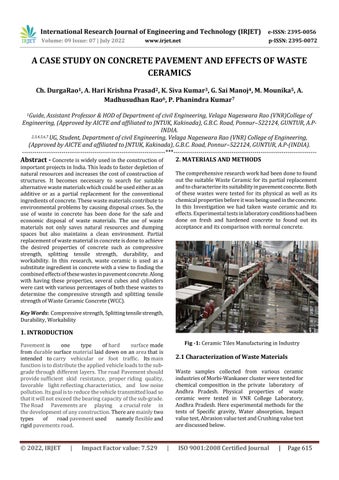
1. INTRODUCTION Fig -1: Ceramic Tiles Manufacturing in Industry
Pavement is one type of hard surface made from durable surface material laid down on an area that is intended to carry vehicular or foot traffic. Its main function is to distribute the applied vehicle loads to the subgrade through different layers. The road Pavement should provide sufficient skid resistance, proper riding quality, favorable light reflecting characteristics, and low noise pollution. Its goal is to reduce the vehicle transmitted load so that it will not exceed the bearing capacity of the sub-grade. The Road Pavements are playing a crucial role in the development of any construction. There are mainly two types of road pavement used namely flexible and rigid pavements road.
© 2022, IRJET
|
Impact Factor value: 7.529
2.1 Characterization of Waste Materials Waste samples collected from various ceramic industries of Morbi-Wankaner cluster were tested for chemical composition in the private laboratory of Andhra Pradesh. Physical properties of waste ceramic were tested in VNR College Laboratory, Andhra Pradesh. Here experimental methods for the tests of Specific gravity, Water absorption, Impact value test, Abrasion value test and Crushing value test are discussed below.
|
ISO 9001:2008 Certified Journal
|
Page 615