International Research Journal of Engineering and Technology (IRJET) e-ISSN: 2395-0056

Volume: 09 Issue: 07 | July 2022 www.irjet.net p-ISSN: 2395-0072
International Research Journal of Engineering and Technology (IRJET) e-ISSN: 2395-0056
Volume: 09 Issue: 07 | July 2022 www.irjet.net p-ISSN: 2395-0072
Amal Joseph K A, Rohan H S, Surya V P, Yathin N P, Dr C M Patil
Amal Joseph K A, Department of Electronics and Communication Engineering, Vidyavardhaka College of Engineering Mysuru, India
Rohan H S, Department of Electronics and Communication Engineering, Vidyavardhaka College of Engineering Mysuru, India
Surya V P, Department of Electronics and Communication Engineering, Vidyavardhaka College of Engineering Mysuru, India
Yathin N P, Department of Electronics and Communication Engineering, Vidyavardhaka College of Engineering Mysuru, India
Dr C M Patil, Department of Electronics and Communication Engineering, Vidyavardhaka College of Engineering Mysuru, India ***
Abstract: In the past, people used speech as a mode of communication, or the way a listener is conveyed through voice and emotion. However, for speech recognition in the context of machine interaction, the idea of machine learning and several approaches are necessary. Speech has become an important part of speech development, with the voice serving as a bio metric via usage and importance. In this post, we attempt to explore a variety of speech and emotion recognition approaches. We discussed and separated speaking technologies in this study by focusing on needs, databases, classifications, feature extraction, augmentation, segmentation, and the method of Speech Emotion detection. Human intellect, on the other hand, has constructed a concealed mystery in the form of speech. It eliminates any uncertainty in speaking and comprehending other persons. Furthermore, comprehending what the voice decodes has been the most important element of the communication process. Wemay address one other and communicate deeper feelingswiththeuseofwords.
Key Words: Speech Emotion Recognition, Speech Processing, Biometric, Machine Learning, MLP
Speech cues can be used to discern emotions. Emotional differences are influenced by speech characteristics. This domain has a number of datasets available. Apart from feature extraction, emotion categorization in speech is becoming increasingly significant. Various classifiers are used to categorize emotions such as sadness, neutral, happiness, surprise, fury, and so on. Emotion identification systems can been hanced by using a deep neural network basedautonomousemotiondetectionsystem.
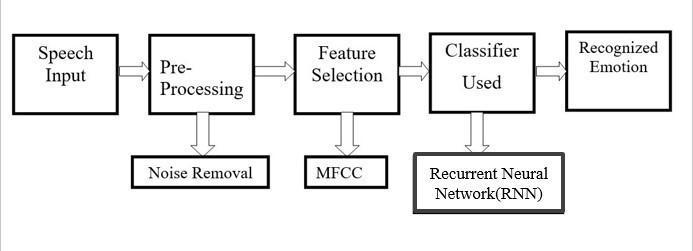
Multiple ML methods wereappliedtoimprove the accuracy of identifying speech emotions in English. Some of
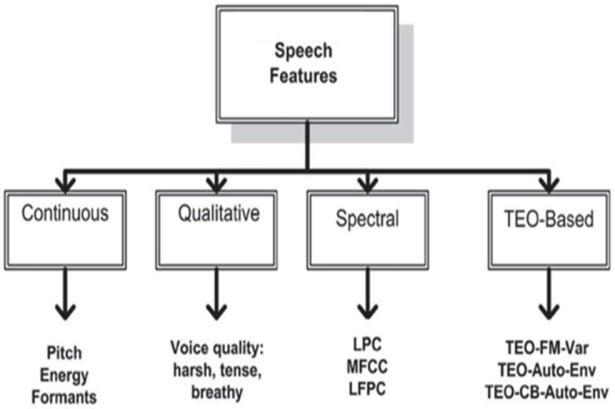
the researched speech characteristics are linear prediction cepstral coefficients (LPCC), fundamental frequencies, and Mel frequencycepstralcoefficients(MFCC).
The use of voice signals for human machine interaction is the quickest and most efficient way. Emotional detection is a challenging assignment for machines, but it is intuitive for people.Speechemotionrecognitionmaybeusedtodistinguish betweenmaleandfemalespeakers.
There is what is known as accosting variability, which alters the characteristics of speech due to the existence of varied speaking rates, styles, phrases, and speakers. The same speech can indicate several emotions, and different sections of the same utterance can reflect multiple emotions. This further complicatesmatters.Therearealsoculturalandenvironmental variances. There are two kinds of emotions: fleeting and persistent. Recognized emotions may be speaker independent or speaker dependent. For classification, we have some alternatives in the form of K nearest neighbours (KNN), Support vector machine (SVM),Convolution neural network (CNN),Deepneuralnetwork(DNN)etc.
Thewholeprogramwouldbebuiltinthebelowgiven classification,
© 2022, IRJET | Impact Factor value: 7.529 | ISO 9001:2008 Certified Journal | Page567
e-ISSN: 2395-0056
Volume: 09 Issue: 07 | July 2022 www.irjet.net p-ISSN: 2395-0072
Variousvoicedatabasesareusedinthisstudytovalidate theofferedmethodologiesinspeechemotionrecognition phrases.Anger,fear,neutrality,contempt,happiness,and sorrowarealldocumentedemotions.
This helps us and the program to understand the difference between most the speech patterns of human voice and the underlying emotions in them. This is done byrecording the voice of the human and feeding it to the system, this in turn willbe further analysed be the program for further classification of its deferred notes and pitch format.
In recent years, a variety of parameters have been proposed to enhance human emotional screening findings, including Mel frequency cepstral coefficients (MFCC), linear predictive cepstral coefficients (LPCC), and perceptual linear predictive coefficients (PLP). Recently, there has been considerable interest in separating speech using the filter bank and the auditory filter in order to extract variables from the long term spectro temporal inspired signal. Although these features gave acceptable results, certain limits necessitated researchers developing their own set of features because most conventional features are focused onshort termanalysisofnon stationaryaudiosignals.
Some of the classification algorithms used to build successful classifiers for collecting emotional states include support vector machine (SVM), Hidden Markov models
(HMM), Deep Neural Network, K-nearest neighbour, and Gaussian mixed model(GMM). A basic level classifier, on the other hand, may strugglewith highly emotional situations. In comparison to a combination of SVM and radial basis function, a ranking SVM technique can resultin significant improvements in emotion identification (RBF). Several hybrid/fusion-based systems outperform solostrategiesinterms of identification rate.
Based on this classification, the input voice will be completely desynchronized to a limit where the increase inany pitch or note would develop an understanding of theconclusion.Andfinally,thisevidentconclusionwould be grouped together to gather a single pre dominant conclusion. Which also changes and updates based on the furtherexperimentationsandtrails.
In answer to the binary split issue, Cao et al suggested a typical SVM strategy for integrating information linked to emotional perception. This strategy teaches SVM algorithms for certain emotions, takes each input as a distinctquery,then combinesallresultsfrompartnersto employmultipleclasspredictions.SVMmeasurementhas two advantages. It starts with gathering speaker-specific data for the training and evaluation phases. Second, it acknowledges thatmultiple emotions mightbe produced by each speaker in order to decide the dominating emotion. The measuring techniques outperform the conventionalSVMin thetwo public datasets ofheart-toheartspeech, Berlin and LDC. When both performance and default data are incorporated, standard-based SVM algorithms recognize emotional expression substantially better than standard SVM algorithms. The average accuracy, also known as the weighted average (UA), was44.4percent.
Chen et al. used a three-level emotion identification approach to improve speaker-independent speech emotion detection. After sorting emotional reactions from coarse to fine, the Fisher rate is utilized to choose the appropriate feature. The Fisher rate output is usedas aninputparameter
© 2022, IRJET | Impact Factor value: 7.529 | ISO 9001:2008 Certified Journal | Page568
(IRJET) e-ISSN: 2395-0056
Volume: 09 Issue: 07 | July 2022 www.irjet.net p-ISSN: 2395-0072
inamulti levelSVM basedclassifier.Fourcomparabletrials are also identified using principal component analysis (PCA) and artificial neural networks (ANN). Fisher Plus SVM,PCAPlusSVM,Fisher+ANN,andPCA+ANNarethe four comparative experiments. As a result, Fisher outperforms PCA in dimension reduction, although SVM outperforms ANN in emotion classification for speaker independence. In BHUDES, the recognition rate for three levels is 86.5 percent, 68.5 percent, and 50.2 percent.
Nwe and her colleagues suggested a novel method for detecting emotions in audio data. The system employs accurate HMM and short term log energy coefficients to define speech and separation signals (LFPC). Before training and assessing the system with secret information,divide emotions into six stages. The suggested approach is compared to Mel frequency Cepstral coefficients (MFCC) and direct prediction of Cepstral coefficients (LPCC) to assess its efficacy (LPCC). Statistically, the best category's accuracy was 78 and 96 percent, respectively. Furthermore, the findings demonstrate that LFPC is a far superior alternative to traditionalemotionalisolation.
Wu et al. developed a unique set of modulation spectral indicators for detecting emotions in human speech (MSFs). Tocomplete the speech, a suitable feature is discovered in the long-term spectro-temporal-inspired databasebymergingamodifiedfilterbankandahearing filterbank.Thesemethodsrecordacousticfrequencyand momentarily changed frequency components in order to offer sensitive data with typical short- term properties that cannot be transferred. In the separation approach, SVM with radial base function (RBF) is applied. In Berlin and Vera am Mittag, MSFs are being probed (VAM). According to the findings, MSFs outperform the MFCC and perceptual linear prediction coefficients (PLPC). Recognition performance increases dramatically when MSFsareemployedtoaddprosodicaspects.Furthermore, theclassacquisitionaccuracyis91.6percent.
Rongetal.proposedusinganensemblerandomforestto trees (ERFTrees) technique with a high number of emotional identification variables without using any language or grammar, however the grammar issue remains unresolved.Thesuggestedapproachwasevaluatedonthe Chinese emotional expression database and shown to enhance the degree of emotional recognition. ERFTrees goes beyond classic size reduction algorithms like PCA and multi dimensional scaling (MDS), as well as the recently published ISO Map. The predictability of the 16 item women's data set was 82.54 percent, whereas the 84 factorperformancewasjust16percent.
Wu et al. created a mix based technique for detecting speech emotions by combining several class separators,
acoustic- prosodic (AP) characteristics, andsemantic labels (SLs).FollowingtheextractionofAPfeatures,threetypesof basic level separators are used: GMMs, SVMs, MLPs, and Meta decision trees (MDT). A high-end entropy model (MaxEnt) was applied in a semantic labelling
approach. MaxEnt modelled the interaction between the rules of emotional organization (EARs) and emotional states in the identification of emotions. In the latter situation, combined data from SL and AS are utilized to create emotional awareness outcomes. According to secret data test findings, replies based on MDT archives are 80%, SL-based diagnostic archives are 80%, and a mix of AP andSLarchivesis83.55percent.
Narayanan has recommended using the contact center app's voice support suggestions to identify domainspecific emotions. The primary purpose of this research was to differentiate between negative and positive emotions. Emotional perception is employed in many situations, including auditory, lexical, and spoken data. Emotional theoryelements are also supplied in order to collect sensorydata at the language level. Both k-NN and direct separator separators are used to work with distinct sorts of features. According toresearch findings, integrating acoustic and oral data yields the greatest outcomes. According to the study, using three sources instead of one boost the accuracy of the sections by 40.7 percent for men and 36.4 percent for women. Male accuracy varied from 1.4 percent to 6.75 percent in a priorstudy,whilefemaleaccuracyrangedfrom
0.75percent to3.96percent.
Yang and Lugger presented a new set of harmonic notes torepresent emotion in speech. These characteristics are based on music theory's psychoacoustic awareness. To begin, combine the spherical autocorrelation of the pitch histogram with the specified voice input pipeline. It determines whether two tone durations produce harmonic or inharmonic perception. The Bayesian class with the conditional condition of the Gaussian class is significant in the separation process. The recognition function has improved, according to test findings employing consensus characteristics from Berlin neuroscience.Theaveragevisibilitylevelincreasedby2%.
Albornoz and colleagues investigate a distinct regionof the spectrum that may be utilized to identify emotions and separategroups. This function employs sensory features aswell as a distinct program area to categorize emotions. A few classdividers, including as HMM, GMM, and MLP, have experimented with different configurations and input data to develop a hierarchical approach for a unique emotional separation. The recommended approach differs in two ways: first, it selects the most efficient features; second, it exploits the best performance of the category editor in all areas, including the separator. According to the results, the text editing approach outperforms the standard separator in
International Research Journal of Engineering and Technology (IRJET) e-ISSN: 2395-0056
Volume: 09 Issue: 07 | July 2022 www.irjet.net p-ISSN: 2395-0072
the Berlin database utilizing decuple validation. The normal HMM technique, for example, earned 68.57 percent, but whereas in the position model received 71.75
percent.
For visualizing emotions, Lee et al. propose a hierarchical calculating approach. This approach translates input audio signals into associated emotion categories by using many layers of binary categories. The primary idea behind the tree'snumerous levels is to performthesortingoperation
as quickly as feasible while limiting mistake spread. AIBO and USC IEMOCAP data sets are used to evaluate the partition algorithm. The real result improves accuracy by 72.44 percent- 89.58 percent when compared to the SVM basis. The results demonstrate that the suggested textual sequencing technique is successfulin categorizing emotional expression into various databases.
Speech Emotion Recognition (SER) is the endeavor to detect human emotions and affective responses from speech. This takes use of the fact that tone and pitch of thevoicefrequentlyreflectunderlyingemotion. This actsas tool for the machine tounderstand human interaction and respond to user based on the emotion towards next generation machine learning model for user interaction withmachines.
The results obtained would be useful in understanding theunderlying idea about the human speech and computeddigital signals. Due to which the program canbe upgraded to higher versions and other development criteria.
Basedontheclassificationtobeused,theinputvoicewill be completely desynchronized to a limit where the increase in any pitch or note would develop an understanding of the conclusion. And finally this evident conclusion would be grouped together to gather a single pre-dominant conclusion. Which also changes and updates
basedonthefurtherexperimentationsandtrails.
The use of MFCC as the feature extraction, has given us certain ideas of how a SER works in its under-coverings. Therefore, we use an MFCC as an feature extraction system. This is due the higher extent of usage in major industries and the possibility of higher accuracies in MachineLearninganddatascience.
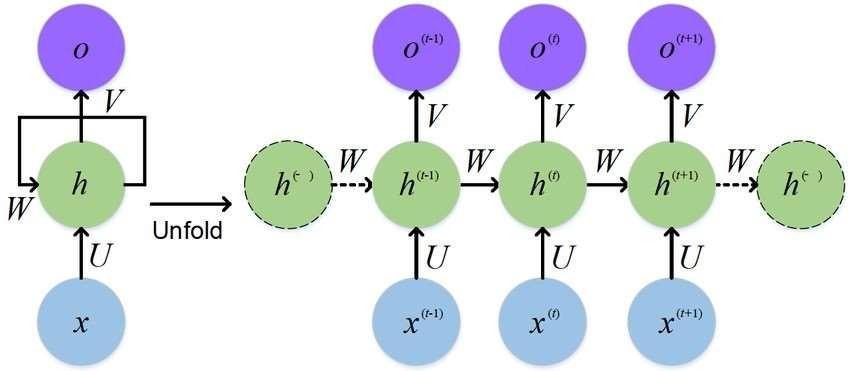
As the classifiers, the RNN system brings upon a coupled reaction towardstheparalleluse oftheMFCC.Therefore,we ought to use an RNN classifier. The RNN has the capacity to link nodes in a directed or undirected network in response to atemporal sequence of data inputs.
We would like to convey our wholehearted thanks of gratitudeto our guide and HOD, Dr. C M Patil, and our esteemed principal Dr. B Sadashive Gowda, under whose inspiration and the opportunity they had provided us to conduct this project ‘SPEECH EMOTION RECOGNITION SYSTEM USING RNN’ .Through this opportunity to perform this project, we are thankful and embed our
gratitude in Prof. Audrey Arlene A, who had also helped us tocompletethisproject.
[1] H. Cao, R. Verma, and A. Nenkova, “Speakersensitive emotion recognition via ranking: Studieson acted and spontaneous speech,” Comput. Speech Lang., vol. 28, no. 1, pp. 186 202, Jan. 2015.
[2] L. Chen, X. Mao, Y. Xue, and L. L. Cheng, “Speech emotion recognition: Features and classification models,” Digit. Signal Process., vol. 22, no. 6, pp. 1154 1160,Dec. 2012.
[3] T. L. Nwe, S. W. Foo, and L. C. De Silva, “Speech emotion recognition using hidden Markov models,” Speech Commun., vol. 41, no. 4, pp. 603 623,Nov.2003.
[4] S. Wu, T. H. Falk, and W. Y. Chan, “Automatic speech emotion recognition using modulation spectralfeatures,”SpeechCommun.,vol.53, no. 5,pp. 768 785,May 2011.
[5] J. Rong, G. Li, and Y.-P. P. Chen, “Acoustic feature selection for automatic emotion recognition from speech,” Inf. Process. Manag., vol. 45, no. 3, pp. 315
328,May 2009. 328,May 2009.
[6] J. Rong, G. Li, and Y.-P. P. Chen, “Acoustic feature selection for automatic emotion recognition from speech,” Inf. Process. Manag., vol. 45, no. 3, pp. 315
[7] S. S. Narayanan, “Toward detecting emotions in spoken dialogs,” IEEE Trans. Speech Audio Process.,
vol.13,no. 2,pp. 293 303,Mar.2005.
International Research Journal of Engineering and Technology (IRJET) e-ISSN: 2395-0056
Volume: 09 Issue: 07 | July 2022 www.irjet.net p-ISSN: 2395-0072
[8] B.YangandM.Lugger,“Emotion recognition from speech signals using new harmony features,” Signal Processing, vol. 90, no. 5, pp. 1415 1423, May2010


[9] E. M. Albornoz, D. H. Milone, and H. L. Rufiner, “Spoken emotion recognition using hierarchical classifiers,” Comput. Speech Lang., vol. 25, no. 3, pp.556 570,Jul.2011.
[10] C. C. Lee, E. Mower, C. Busso, S. Lee, and S. Narayanan, “Emotion recognition using a hierarchical binary decision tree approach,” Speech Commun., vol. 53, no. 9 10, pp. 1162 1171,Nov.2011.
AmalJosephKA
DepartmentofElectronicsand CommunicationEngineering


VidyavardhakaCollegeof Engineering,Mysuru,India
RohanHS
DepartmentofElectronicsand CommunicationEngineering
VidyavardhakaCollegeof Engineering,Mysuru,India
SuryaVP
DepartmentofElectronicsand CommunicationEngineering
VidyavardhakaCollegeof Engineering,Mysuru,India
YathinNP
DepartmentofElectronicsand CommunicationEngineering
VidyavardhakaCollegeof Engineering,Mysuru,India

DrCMPatil
DepartmentofElectronicsand CommunicationEngineering
VidyavardhakaCollegeof Engineering,Mysuru,India