TO DETERMINE RELATION AMONG LABORATORY AND IN- SITUSTRENGTH OF CONCRETE

Page 1

International Research Journal of Engineering and Technology (IRJET)

e-ISSN: 2395-0056

Volume: 09 Issue: 07 | July 2022

p-ISSN: 2395-0072

www.irjet.net

TO DETERMINE RELATION AMONG LABORATORY AND INSITUSTRENGTH OF CONCRETE Pramod Chandra 1, Smita Sen 2 1PG

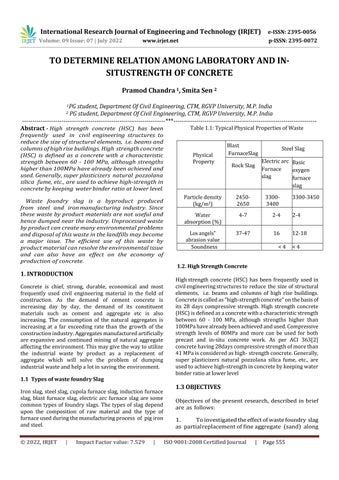
student, Department Of Civil Engineering, CTM, RGVP University, M.P. India PG student, Department Of Civil Engineering, CTM, RGVP University, M.P. India ---------------------------------------------------------------------***--------------------------------------------------------------------Table 1.1: Typical Physical Properties of Waste Abstract - High strength concrete (HSC) has been 2

frequently used in civil engineering structures to reduce the size of structural elements, i.e. beams and columns of high rise buildings. High strength concrete (HSC) is defined as a concrete with a characteristic strength between 60 - 100 MPa, although strengths higher than 100MPa have already been achieved and used. Generally, super plasticizers natural pozzolana silica fume, etc., are used to achieve high-strength in concrete by keeping water binder ratio at lower level.

Waste foundry slag is a byproduct produced from steel and iron manufacturing industry. Since these waste by product materials are not useful and hence dumped near the industry. Unprocessed waste by product can create many environmental problems and disposal of this waste in the landfills may become a major issue. The efficient use of this waste by product material can resolve the environmental issue and can also have an effect on the economy of production of concrete.

1. INTRODUCTION Concrete is chief, strong, durable, economical and most frequently used civil engineering material in the field of construction. As the demand of cement concrete is increasing day by day, the demand of its constituent materials such as cement and aggregate etc is also increasing. The consumption of the natural aggregates is increasing at a far exceeding rate than the growth of the construction industry. Aggregates manufactured artificially are expansive and continued mining of natural aggregate affecting the environment. This may give the way to utilize the industrial waste by product as a replacement of aggregate which will solve the problem of dumping industrial waste and help a lot in saving the environment. 1.1 Types of waste foundry Slag Iron slag, steel slag, cupola furnace slag, induction furnace slag, blast furnace slag, electric arc furnace slag are some common types of foundry slags. The types of slag depend upon the composition of raw material and the type of furnace used during the manufacturing process of pig iron and steel. © 2022, IRJET

|

Impact Factor value: 7.529

|

Physical Property

Blast FurnaceSlag

Steel Slag Electric arc Basic Furnace oxygen slag furnace slag

Rock Slag

Particle density (kg/m3)

24502650

33003400

Water absorption (%)

4-7

2-4

2-4

Los angels‟ abrasion value Soundness

37-47

16

12-18

<4

3300-3450

<4

1.2. High Strength Concrete High strength concrete (HSC) has been frequently used in civil engineering structures to reduce the size of structural elements, i.e. beams and columns of high rise buildings. Concrete is called as “high-strength concrete” on the basis of its 28 days compressive strength. High strength concrete (HSC) is defined as a concrete with a characteristic strength between 60 - 100 MPa, although strengths higher than 100MPa have already been achieved and used. Compressive strength levels of 80MPa and more can be used for both precast and in-situ concrete work. As per ACI 363[2] concrete having 28days compressive strength of more than 41 MPa is considered as high- strength concrete. Generally, super plasticizers natural pozzolana silica fume, etc., are used to achieve high-strength in concrete by keeping water binder ratio at lower level

1.3 OBJECTIVES Objectives of the present research, described in brief are as follows: 1. To investigated the effect of waste foundry slag as partial replacement of fine aggregate (sand) along ISO 9001:2008 Certified Journal

|

Page 555


Turn static files into dynamic content formats.
Create a flipbook