International Research Journal of Engineering and Technology (IRJET)
e-ISSN: 2395-0056
Volume: 09 Issue: 06 | June 2022
p-ISSN: 2395-0072
www.irjet.net
A REVIEW ON THE PREDICTION OF CONGENITAL HEART DISEASE USING DEEP LEARNING AND MACHINE LEARNING TECHNIQUES. Nimi S Das1, Dr. Deepambika V. A.2 PG Student, Dept. of Electronics & Communication Engineering, LBSITW, Kerala, India Assistant Professor, Dept. of Electronics & Communication Engineering, LBSITW, Kerala, India ---------------------------------------------------------------------***--------------------------------------------------------------------with enhanced pulmonary vascularity (pulmonary plethora) Abstract - Congenital heart disease(CHD) is a leading cause 1
2
and those with normal vascularity.
of newborn mortality and morbidity around the world. Early detection and management can dramatically minimize the risk of negative result. Chest X-Ray(CXR) is a useful examination for medical practitioners to diagnose CHD. The CXR is a simple, rapid and inexpensive examination that provides useful diagnostic information clearly displays heart shapes and sizes with low doses of radiation. The system is built on deep learning and machine learning techniques and proposes an efficient and accurate assistance system for medical practitioners to diagnose CHD. As a result, the deep learning assisted Convolutional Neural Network(CNN) has been devised and applied for decision support systems that assist doctors in diagnosing CHD successfully. Another aspect of the problem that has been studied in this study is the prediction of CHD using machine learning techniques. As a result of the established prediction models and deep learning categorization, very precise and reliable CHD diagnosis may be made, reducing the frequency of misdiagnosis that might cause patients to panic.
A chest x-ray (CXR) can detect a ventricular septal defect or cardiomegaly. CXR is easy to use, takes less time, is inexpensive, and emits minimal quantities of radiation. The information gathered from diseased children's chest x-rays can be utilized to predict CHD and treat it as soon as possible. Changes in the heart can be caused by a variety of heart diseases. Changes in the structure of the heart can be caused by a variety of disorders.
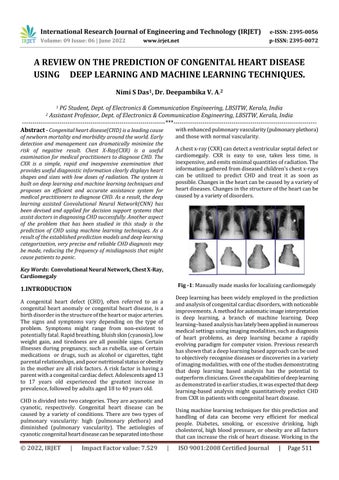
Key Words: Convolutional Neural Network, Chest X-Ray, Cardiomegaly Fig -1: Manually made masks for localizing cardiomegaly
1.INTRODUCTION
Deep learning has been widely employed in the prediction and analysis of congenital cardiac disorders, with noticeable improvements. A method for automatic image interpretation is deep learning, a branch of machine learning. Deep learning–based analysis has lately been applied in numerous medical settings using imaging modalities, such as diagnosis of heart problems, as deep learning became a rapidly evolving paradigm for computer vision. Previous research has shown that a deep learning based approach can be used to objectively recognise diseases or discoveries in a variety of imaging modalities, with one of the studies demonstrating that deep learning based analysis has the potential to outperform clinicians. Given the capabilities of deep learning as demonstrated in earlier studies, it was expected that deep learning-based analysis might quantitatively predict CHD from CXR in patients with congenital heart disease.
A congenital heart defect (CHD), often referred to as a congenital heart anomaly or congenital heart disease, is a birth disorder in the structure of the heart or major arteries. The signs and symptoms vary depending on the type of problem. Symptoms might range from non-existent to potentially fatal. Rapid breathing, bluish skin (cyanosis), low weight gain, and tiredness are all possible signs. Certain illnesses during pregnancy, such as rubella, use of certain medications or drugs, such as alcohol or cigarettes, tight parental relationships, and poor nutritional status or obesity in the mother are all risk factors. A risk factor is having a parent with a congenital cardiac defect. Adolescents aged 13 to 17 years old experienced the greatest increase in prevalence, followed by adults aged 18 to 40 years old. CHD is divided into two categories. They are acyanotic and cyanotic, respectively. Congenital heart disease can be caused by a variety of conditions. There are two types of pulmonary vascularity: high (pulmonary plethora) and diminished (pulmonary vascularity). The aetiologies of cyanotic congenital heart disease can be separated into those
© 2022, IRJET
|
Impact Factor value: 7.529
Using machine learning techniques for this prediction and handling of data can become very efficient for medical people. Diabetes, smoking, or excessive drinking, high cholesterol, high blood pressure, or obesity are all factors that can increase the risk of heart disease. Working in the
|
ISO 9001:2008 Certified Journal
|
Page 511