International Research Journal of Engineering and Technology (IRJET) e ISSN: 2395 0056

Volume: 09 Issue: 06 | Jun 2022 www.irjet.net p ISSN: 2395 0072

International Research Journal of Engineering and Technology (IRJET) e ISSN: 2395 0056
Volume: 09 Issue: 06 | Jun 2022 www.irjet.net p ISSN: 2395 0072
1M. Tech Student, Dept of Computer Engineering, and IT, VJTI College, Mumbai, Maharashtra, India
2Associate Professor, Dept of Computer Engineering, and IT, VJTI College, Mumbai, Maharashtra, India ***
Abstract The work of recommendation system is to guess the thought process of user and to predict the interests of the users. This system can provide suitable information to the user based on the needs of the user while taking care of the interests of the user. For giving better recommendation the data need tobe analyzed more effectively. There are various recommendation systems that hadbeenbuilt using differentapproaches. Andtilltodaythe research in such system is popular as now days there are many OTT platforms increasing day by day, many shopping, travel etc. websites are increasing who want to improve their recommendations to the users rapidly. So, the main goal of this paper is to provide the overview of various approaches related to the recommendations system as well as to do the comparative study of them based on certain features. After reviewingvarious papers we observed there are many recommendation systems were built which were majorly based on traditional methods. However, nowadays recommendation system based on knowledge graph have catches the attention of researchers and the industries as they are capable of solving various performance and information sparsity related problems and gives better recommendations as compared to previous approaches.Machine learning is used along with knowledge graph to increase the performance of the system. Also, we will study various proposed algorithms in the papers which have used knowledge graph for better recommendation.We have also given brief idea about our proposed system.Finally, we will suggest different future paths of research in the domainof recommendation system.
Key Words: Knowledge graph, Machine Learning, Recommendation system, Technologies, Approaches
Recommendation system are used to recommend various services to the user based on the activity and the needs oftheuser.Recommendationsystemis widely used in e commerce[4], entertainment, e learning, search enginesetcdo mainstoprovidebetterresultstotheuser. There are certain approaches which are used for building recommendation system like content based filtering, collaborative filtering[22],hybrid filtering, context filtering methods. So, in this paper we aregoing to discuss about those methods in details. Also, due to fast development of internet, the size of data in each of the application
have increased drastically. Hence, it becomes difficult for theusertochoosetheirinterestsrelateditemsor services from huge amount of data.
The recommendation algorithm is the main part of rec ommendation system. Collaboration filtering recom mendation gives recommendations based on the preferencesofothersimilarusersfortheproductfeatures whereas in content based recommendation, this model uses the item’s content features. Collaborative filtering is widely used as compared to content based filtering because they are efficient in capturing the preference of user and can be easily applied inmultiple scenarios.But in content based filtering lot of effort is required for extracting the features. Also, there is context based recommendation in which as per the contextual in formationoftheuserlikelocation,timeetc,werecommend services to him/her. In this model, we retrieve patterns from thewebsite or application based on the user’s past interaction with the system and then we provide recommendations to the user. Collaborative filtering suffers from problems like data sparsity and cold start problems.Tosolvetheseissues,hybridrecommendationis proposed which merges the content level similarity and interaction level similarity. In this model other extra information is also explored like item reviews, item attributes etc. In recent years, introduction of knowledge graphinrecommendationsystemhavegainedtheattention ofresearchersandindustries.Aknowledgegraphisakind of heterogeneous graph in which nodes indicate entities and edges indicate the relationship between the entities. For better under standing the mutual relationship between the items we can map items and their attributes in the knowledge graph. Also,we can map user information into the knowledge graph, this creates the relationship between users and items and can we can capture user preference more accurately. In this survey paper we’re also going to do survey of graph based recommendation system using knowledge graph. The paper proposed by C.Liu[16] discussed that how one can include the knowledge graph embedding in the recommendation system. And the paper proposed by Z. Sun[17] explains that how knowledge graph can work as additionalinformationforrecommendationsystem,butthe categorizationofrecommendationapproachesare not fine grained in this paper.
International Research Journal of Engineering and Technology (IRJET) e ISSN: 2395 0056
In heading 2, we discuss about various concepts used and foundations of knowledge graph required in the recommendationsystem.
Inheading3,wediscussthebasicbackgroundrequiredfor mostof the recommendation system.
Inheading4,wediscussvariousstandardrecommendation approachesusedin the recommendation system.
In heading 5, we discuss about various knowledge graph based recommendation systems and understand the differentapproaches used in it.
In heading 6, we discuss about comparative study of literaturereview.
Inheading7,wediscussaboutourproposedsystem.
In heading 8, wediscussabout potential research paths in therecommendation system.
In heading 9, we conclude our survey paper and also mentionthe references used for this paper
The work of recommendation system is to predict and recommendtheunobserveditemsorservicestotheuser.It can be done in the following manner like first the system learns the representation of target user ui and candidate itemvj.Second,formodellingthepreferenceofuiandvjit learns from the scoring function which is defined asf(ui xvjgivesycapi,j).Third,Wesortthepreferencescoresfor itemstogeneraterecommendationsfortheuser.Thereare many surveys available related to the recommendation system with different emphasis. This system is majorly classified into three categories like content based, collaborative filtering based and hybrid recommendation system. Amongst these categories collaborative filtering recommendationisthemostpopularone.However,due to development of various deep learning methods the architecture of recommendation system have changed drastically. The paper proposed by S.Zhang,[18] explored how various deep learning techniques are adopted in the current recommendation systems.
Nowadays knowledge graph is emerging as a abstraction toolfororganizingworld’sstructuredknowledgepresentin the internet. It is also used for integrating information gathered from multiple data sources. It also plays a major role in machine learning as a method for incorporating world knowledge and also as a target knowledge
representation for the extracted knowledge. It also explains what it has learned. It’s definitionis like : Given entities(E),relations(R) and knowledge graph is a directed multi relational graph(G) that comprises of triples (S(Subject),P(property),O(Object)).Each edge in the knowledge graph is of the form(head entity, relation, tail entity).ItislikeaninstanceofaHeterogeneousInformation network. Knowledgegraphiscreatedandapplied in many domainslikequestionansweringsystem,recommendation system, search engines etc. There are two types of knowledge graph like : First, Item Knowledge graph In this,itemanditsrelatedentities(likeitemattributes)acta nodes. And edges can represent item’s attribute relations(like category, brand etc.) or user related relations(like co buy, co view etc.).Second, User item knowledge graph In this, items users and their related entities acts as nodes. Inspite of items related rela tions present in the item knowledge graph, relationships between user and item are also included in user item knowledge graph(like mention,buy,click etc.).
Itis definedas pathP=A0(R1)A1(R2). (Rk)Ak definedon the graph of network G=(A,R),it defines a new composite relationasR1R2.....Rkbetweenentities A0 andAk,whereAi A and Ri R for i=0,. . . ,k.It is used toextract connectivity featuresbetweentwonodesinthegraph.
Itissomewhatsimilartometapath,it’slikeanothermetas tructurewhichconnectstwoentitiesinagraph.Themajor difference between metapath and metagraph is that meta path defines only one relation sequence whereas meta graph is a combination of various metapaths. Metagraph can express more structural information between the entities as compared to metapath.
Knowledge graph is embedded into low dimensional vectorspace[19]usingknowledgegraphembedding. After applying embedding on the knowledge graph each com ponent of graph(like entity and relation) is represented by a dimensional vector. This dimensional vector still preserves the properties of graph and we can quantify thesepropertiessemanticallyorbyhigherorderproximity in the graph. For understanding various knowledge graph embedding algorithms we can refer to [20][21].
Forthepurposeofrecommendingappropriateitemstothe users as per needsof the user, this systemcollectsas well asprocess the useful information about the users and the items.
Volume: 09 Issue: 06 | Jun 2022 www.irjet.net p ISSN: 2395 0072 © 2022, IRJET | Impact Factor value: 7.529 | ISO 9001:2008 Certified Journal | Page428
International Research Journal of Engineering and Technology (IRJET) e ISSN: 2395 0056
Volume: 09 Issue: 06 | Jun 2022 www.irjet.net p ISSN: 2395 0072
The details about the items need to be considered for better recommendation. So, these details about the items can beobtained from the dataset from standard websites like kaggle etc. or we can extract the information about the items from the web using web crawler etc. and then do preprocessing of the data. The data extracted about the items from web can be in structured, semi structuredorunstructuredform.So,preprocessingwillbe required for the semi structured or unstructured data. Once the data about the items is ready then we can then useitforbuildingrecommendationsystem.Ifweareusing knowledgegraphbasedapproachthenweusethis data to create item based entities in the knowledge graph.
The recommendation system fully the utilizes the interac tions of the user withthe systemortheservicelikeuser’s past purchase history ,user’s activity etc. in order to give better recommendations to him or her. There are various ways by which we collect information about the users like:
(i) Explicit way Feedback In this method , user is involved to getinformationabouthim/her. Theusercan asked to fill certain forms or asked about their preferences related to the different services. The informationabouttheusercanbeaskedinvariousforms likenumericalscale(likerateitemorserviceinscaleof1 to 5),binary scale(like product good or bad),ordinal scale(like userchooses fromthelist offeeling which ex plains its inclination towards a particular service),descriptive way(like reviews in the form of text aboutparticularservice).Ifthe reviews in the descriptive way are utilized properly then it can help us to understand the preferences of the user related to various items. There are certain aspects of reviews like considering the contextual information, multi view of a particular review,comparison based reviews etc. The methods of extracting useful information from the user review is usedin various papers.
(ii) ImplicitwayFeedback Inthiskindofmethoduseris not involved in the process of gathering data about him/her. Such methods does the proper analysis of the user purchasing history like how many times user bought a particular product, his rating for the product, how much time the user spent on the website while seeingtheproductetc.Wecanalsousealreadyavailable datasets for such methods.
(iii) Hybrid way Feedback In this method, both the abovemethodscanbeusedtogatherproperinformation abouttheuser.Inthisapproachboththeabovemethods can fulfill the drawbacks of one another. For better understandingoftheuser’sbehaviorwiththesystemwe
can try to use implicit data as validation for the explicit data provided by the user.
This kind of recommendation system uses the data provided by the user in implicit way(like clicking on a product etc.) or explicit way(like ratings or reviews etc.).Based on these details user profile is generated and used to give certain recommendations to the user. This system also recommenditems similar to the items which werepositivelyreviewedorrated/likedbytheuserinthe past.Theuseranditemprofilesconsistofvariousfeatures of items and users respectively. For example The user profile can have attributes like userid, user review, user rating, user purchase etc. The item profile can have attributes like movieid, movie actors, moved I rectors etc. If the user likes the comedy movies, so those comedy movieswhicharenotlikedpreviouslybytheuserwillalso be recommended to user. There are main steps of content based filtering like: (i)first, the item attributes are extracted to create item profile for all the items.(ii) Then user profiles for each active users are generated.(iii)Thenuserprofileiscomparedwiththeitem profile.(iv) Then items are recommended to the user which are new to the user and which matches the user profilemore.
There are certain approaches in this method like:
(a) Preferencebasedonproductranking: Thisapproachis usedwhenitemsaredescribedusingdifferentattributes. Inthismethod,user’s preference is denoted by(v1,. ,vn, w1,. ,wn), where vi is the value function which a user specifies for a particular attribute ai and wi is the relative importance(i.e.weight)of the attribute ai .Then the utility ofeach product is calculated by multiplying each vi with each wi and then doing the sum of all. So, the product with high utility value are classified and thenrecommendedtotheuser.
(b) Exploiting terms on reviews for recommendation purpose: It’s like a index based approach in which each user is classified by the textual content of the reviews. The term based user profiles are created by fetching keywords from the user reviews and then weights are assignedtotheeachextractedkeywordsbyusingTF IDF technique. The weight indicates how important is each keyword for the user.
(c) Exploiting context from reviews for recommendation purpose: In this approach context is extracted from the textual information of user’s current scenarioand the features which are important to him. The utility score for an item i of a user u is calculated as below:
International Research Journal of Engineering and Technology (IRJET) e ISSN: 2395 0056
Volume: 09 Issue: 06 | Jun 2022 www.irjet.net p ISSN: 2395 0072
Utility(u,i)=a*predicted Rating (u,i)+(1 a)*context score (u,i)Hereaisaconstantvaluewhichindicatestheweight of predicted rating. In above formula predicting rating is calculated using standard item based collaborative approach and context score indicates the importance of itemitothetargetuser’s context.
In this kind of recommendation system, wetry to find the similaruserswhichmatchesthecurrentusersinterestand recommendthoseitemstocurrentuserwhichsimilarkind of users had liked. In this approach, we never use the attributes of items for the recommendation purpose. Instead of that we try to classify the users into various clusters of similar types and then recommend to each of the user as per the preference of the cluster. There are varioustypeofcollaborativefilteringapproaches :
(i) User Based: In this approach, those items are recom mended to the target user which he/she may like, according to the ratings or reviews given by the other users whohavesimilarkindofinterestasthatof a target user. The major steps of the user based collaborative filtering can be mentioned as below: (a)First of all we need to have user item rating data (b)Then we need to createuser usersimilaritymatrixusingpearsoncorrelation as it is most famous andwidely used method for finding similarity in collaborativefiltering. Similaritybetweentwo usersisfoundoutbypearson’scorrelationwithvaluesof 1,0,1. 1 means two users are havinginterests completely opposite, 0 means there is no relation between the interests of the users and 1 means two usersare having exactly same kind of interests. (c)Then find the similar users to target user with the help of similarity matrix. (d)Then we need to generate candidate items for recommend ing purpose. (e)Then we should rank the candidate items as pertheirprediction. (f)Finally we need tofilterpossiblecandidatesitemsandshowittothetarget user. Drawbacks: It might be possible that there can be morenumberofusersthanitems which can lead to much larger user similarity matrices which canresultinvarious performanceand memoryissueson the larger dataset. So, to deal with such issues we need to use parallelisation techniques.
(ii) Item Based: In this approach, we try to find out the relationship between the items(like user who bought P, also bought Q).Also, in this approach we predict the new rating with the help of other items ratings given by the user. Let us understand this approach with simple example,letssaytherearethreeusers(A,BandC)andfour fruits(like grapes, strawberry, water melon, orange).User Alikesgrapes,watermelonandorange.UserBlikesgrapes and watermelon and User C likes watermelon. So, here grapes are watermelon are similar to each other as they
had been liked by the user A and B. So, if I want to recommend more fruits to the user C and as I know already know that helikes watermelon then it is mostly likelythatC mightlike grapes also as grape is similar to watermelon. User based collaborative filtering have certain drawbacks so to deal with it item based collaborativetechniquesanalyzetheuser itemmatrixand findsouttherelationshipsbetweenvariousitems.Sobased on the identified linear relationships between items it gives the recommendation.
(iii) Matrix Factorization: In the matrix factorization, we multiply two different entities to get the latent features. Withthe help of user rating on the shop items(i.e. input), we wantto know how will the user rate the items so that user can get the recommendation on the basis of prediction. For example, we’ve customer rank table of 6 users and 6 movies, rating are the values from 1 to 5.As every user will not rate every movie so there can be missing values in the matrix and this resultsin a sparse matrix. So, in place of missing entries we put zero and filled values are given for the multiplication. Using this method, lets say we have scenario like user 3 didn’t give rating to the movie 3.So,we’d like to know whether user 3 liked the movie 3 or not.So, using this method we can discover other similar kin d of users with similar kind of preferencesofuser3bytaking theratings from the users of similar preferences to the movie 3 and predict that whether user 3 willlike movie or not. In this we get the prediction rating of item by doing the dot product of matrix p and q where p indicate the relationshipbetweenuserandfeaturesandqindicatethe relationship between an item and the features. R=PxQT. There are various matrix factorization techniques like SVD(Singular value decomposition),NMF(Non Negative Matrix factorization),PCA(Principal Component Analysis) which are used for finding latent factors from explicit usersfeedback.Matrixfactorization models are becoming more efficient these daysas in this we can consider the text, time and social links which helps us to understand the user behaviour in a better way. There are certain problems which occurs in the collaborative filtering approachlike: a)Earlierrateproblem thishappenswhen new user is using the system and has not rated that much items that we can recommend items to them. b)Sparsity problem it happens when there is much little information available to make appropriate prediction. c)Cold start problem it is situation when doing prediction becomes difficult due users or items addedinthesystemarenew.
The recommendation using context based recommendation have mainly three approaches like pre filtering,postfilteringandcontextualmodelling.Inthepre filteringapproach,wetrytoreducetheinformationofuser
International Research Journal of Engineering and Technology (IRJET) e ISSN: 2395 0056
Volume: 09 Issue: 06 | Jun 2022 www.irjet.net p ISSN: 2395 0072
item matrix using context before applying any recommendation algorithm. In the postfiltering approach, we try to reduce the information which is obtain after applying recommendation algorithm using the context. And in the contextual modelling approach, context is included in the recommendation system. In the pre and post filtering method, we generally use the existing recommendation algorithms. But in case of context modelling we can modify the existing recommendation methods.
Inthisapproachworkontheideathatusershavingsimilar demographic attributes(like gender, age, city, job etc.) can havesimilarkindsoftrendsinthefuture.Forexampleyou might have noticed that when we go to different state youtube based on your current location starts recommending whatever popular videos are trending in the state thinking that you might alsolike. This approach focuses more on the demographic location of the user rather than its evaluation history. As this approach does nottakesintoconsiderationtheuser’spreferencesoitmay not always be the case that it will recommend items or services to the user in the accurate manner.
In this approach, we combine collaborative and content based methods to overcome the drawbacks of both the approaches. There are various ways in which we can implement hybrid filtering like: (i)After implementing both content and collaborative filtering approach separately then we can combine the prediction logic of bothmethods.(ii)Usingcollaborativepropertiesincontent based approach or vice versa (iii)By modelling two or more approaches together like content and collaborative approach together.
This method suggest the items to the user as per how the itemsatisfytheuserpreferencesusingdomainknowledge. The recommendation system using knowledge graph should use majorly three kinds of knowledge like knowledge about items, knowledge about users and knowledgebasedonrelationshipbetweentheitemandthe user needs. knowledge graph provides extra information which can be used to solve problems where were present in content and collaborative filtering based approaches. It usesdomainknowledgeforgivingrecommendationstothe user. However, there are also drawbacks of knowledge based recommendation is that for creating such systems we need to have skills related to knowledge engineering. Semantic relationships present in the knowledge graph canbeutilizedtoimprovetheaccuracyofrecommendation systemandcanincreasetherecommendeditemsdiversity.
value:
The paper proposed by Zhang[22] suggest a method in which collaborative filtering with implicit comments are used and theinteraction between the users and items are learned by using knowledge graph embedding method. knowledge graph based approaches have advantage over traditional approaches. In this survey, we’ll analyze and focus on various applications developed using knowledge graphandvariousknowledge based technologies used for recommendation system.
WhenGoogleintroducedknowledgegraphitspurposewas to improve the search engine’ s searching capability and to improve the user experience. Knowledge graph actually provides machine readable data organized in the formofgraph.Thisgraphdatainterconnectsanddescribes the entities. As we know that the data in a knowledge graph can be accessed via web and can be consumed automatically so because of these characteristics many applicationshavebeencreatedusingknowledgegraphlike question answering system, recommendation systems etc. Knowledge graph based recommendation system fully utilizes the connections betweenthe entities representing theitems,usersandtheinteractions betweenthem. These connections can be direct or indirect. The relationships present in the knowledge graph acts as a additional information and this information can help us to deduce inference between the entities to explore new relationships. According to the paper proposed byLiu[23] and Zou[24],the recent knowledge graph based recommendation approaches can be divided majorly into four types like linked open data based, knowledge graph embedddingbased,ontologiesbasedrecommendation and the path based recommendation.
a) Ontology based recommendation: In this method, ontology is used for modelling the knowledge using the information like users and their context, items information and the information about domain. While defining ontology we create various semantics and structures which help us to create some rules for generating recommendations to the user. So, the items which fulfills the rules as per the user’s preference will shown as recommendation tothe user. The drawback of this method is that it is time consuming process and it also requires little bit of expertise.
b) Linked open data based recommendation: As rich semantic information can be extracted from linked open datasoitcanhelpustofindthesimilarattributesamong the items to be recommended. This method helps us to overcome the problem of data sparsity. However ,there are some recommendation systems which depends on outside data so this kind of data can affect the recommendation results.
International Research Journal of Engineering and Technology (IRJET) e ISSN: 2395 0056
Volume: 09 Issue: 06 | Jun 2022 www.irjet.net p ISSN: 2395 0072
c) Path based recommendation: This method is very normal way of using knowledge graph in the recommendation system. In this method we try to explore different patterns of relationships between entities in a knowledge graph and in thisway it helps to give better recommendation to the user. This method actually depends on hardcoded metapaths and they are difficulttooptimize.Thedrawbackofthismethodis that whenentities and relationships are not from the same domain then in that case it becomes difficulttodesignmetapathsforit[24].
d) Embedding based recommendation: This method is more popular because it provides an easy and efficient wayforgeneratingrecommendations[16].Inthismethod, wecanconverttheknowledgegraphbyusing knowledge graph based embeddings then the recommendation model can fully utilize the learned entities and relationships embedding to produce better results[24].The main goal of this method is to make the processing of knowledge graph easier while preserving its structure. Knowledge graph embedding is used to enhance the information of users and items and thenit is used for calculating the similarity between users and items[16].Some of the examples of such embedding models are TransE, TransD, TransH, TransR etc.Introductionof knowledgegraphembedding in recommendation system includes using of traditional recommendationalgorithm.Inthepa per[16],asperthe relationship between recommendation algorithm and knowledgegraphembeddingtherearemajorlytwoways fordoingthesetasks: independentlylearningand jointly learning.
Haithem Mezni[1] Abletogive multi relational representati onof contextual datarelated tousersand services, whichthe previous approaches likematrix andtensor basedfailed togive.
1)Their modeldoes notworkfor the uncertain factorslike incomplete context information, missing reviewsor feedback
2)Their system’s average accuracyis almosthalf i.e50.52
1)Forfinding similarity betweenthe contextoftwo ormoreusers andservices usedconceptof subgraph aware proximity.
2)Contentand collaborative filtering
SihangHu [2] Their recommend ation algorithm performs betterthan SPrank algorithm whichis novelhybrid recommend ation algorithmto computetop N recommend ation.
Tiantian He[3] Their method combines graph clustering and multiview learningso asto performthe taskof clusteringin the multiview featured graph
Cairong Yan[4]
percent
Theirmodel mainly focuseson pointof interest whichare obtained fromuser review.But other contextual information canalso improve recommend ation
Contentbased filteringand directedgraph
1)Their method provides different recommend ationsfor activeand inactive users respectively.
2)Their paperclaims tosolvethe coldstart problemand sparsity problem whichwas problemin previous recommend ation systems.
Theirmodel isbasedon unsupervise dlearning soitdoes nothave supportfor vertex embedding for attributed graphasitis usedin supervised learning model
1)More parameters needtobe considered for recommend ationother than userid,itemi d,itemtags, season,st yle,gender and customer scorefor improving recommend ation.
2)Approach isbasedon knowledge graphbut doesnotgo indetail betweenthe entities
Attributed graphsand contextual correlation whichpreserves multiview featuresbased graphclustering
Collaborative filtering,data augmentation forimproving qualityof data,factorizatio nmachine modelforhigh accuracyof recommendatio n,knowledge graph
Xiaoliang Fan[5]
International Research Journal of Engineering and Technology (IRJET)
e ISSN: 2395 0056
Volume: 09 Issue: 06 | Jun 2022 www.irjet.net p ISSN: 2395 0072
1)Their approach fullyutilizes theconcept ofspatial and temporal correlation which previous methods failedtodo.
2)Theyhave used weighted ratingfactor toimprove the effectiveness of recommend ation
HaoWang [6] Their proposed clustering algorithm converges fast.
1)Other contextual information likesocial contextetc. ofuserisnot considered.
2) Performan ceofthe systemcan beimproved byusing knowledge graph
Temporaland spatial correlation, weightedrating effectfor similarity computation.
LanZhang [9] Considered user event interactions, event event interactions forbetter recommend ation
Zhixue Jiang[14] Created efficient question answering systemusing conceptlike information extraction and knowledge fusion
different users.
Forcomplex eventstheir modelmay work slower.
Userbehavior analysisand knowledge graph
WeizhiMa [7] Theirmodel performs goodincase ofnoisyitem knowledge graphthatis createdby linkingitem namesto related entities
Zhiheng Wu[8] Usedthe conceptof user reputations for validating the reputationof itemor service
1)Time complexity oftheir algorithmis square.
2)Forlarge amountof datatheir clustering algorithm works slower
Creating rulesfor large numberof itemscan makethe system complexand canaffect recommen dation
Their method givesmore reputation valuetoreal userand lessvalueto malicious user.So,if thisvalueis samefor bothtypes ofusersthen theirsystem failsto distinguish
Multiview clustering
7.1
1) Construction andretrieval speedof knowledge graphisnot efficient.2) Multiround dialogueand complex knowledge reasoning needtobe improved.
Natural language processing, knowledge graph,Rule basedmatching techniquesand stringmatching algorithmsare usedfor classifyingand queryingthe questions
Jointlylearning rules,random walk, collaborative filteringand knowledge graph
Userreputation calculation, collaborative filteringand context
“Toimplementthe recommendationsystemusingcontext aware services, Dilated RNN based on the knowledge graphusingmachinelearning”
Nowadays recommendation systems are used in many domains and the challenge is to provide better recommendation to the user when we have large amount of data. So, We will be building recommendation system using knowledge graph as it have many advantages over traditional approaches. Also,we will be using machine learning for improving the performance of knowledge graphbasedrecommendationsystem.
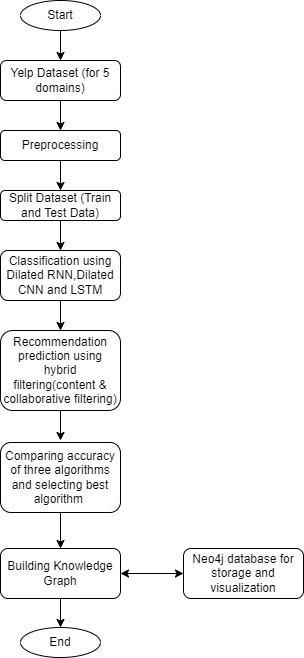
Dilated RNN(Recurrent Neural Networks) is the latest embedding algorithm that can be used in the knowledge graph for improving the performance of the system. We will be comparing performance of three algorithms Dilated RNN(Recurrent Neural Networks),Dilated CNN(Convolutional Neural Networks) and LSTM(Long ShortTermMemory).OutofthesealgorithmsDilatedRNN gives better accuracy as compared to others. So, Machine learning algorithms play an important role in improving theperformanceofthesystem.WehaveusedYelpdataset for five domains (Movie, Travel, Health, Shopping and Restaurant) for creating recommendation systems. We
International Research Journal of Engineering and Technology (IRJET) e ISSN: 2395 0056
will do pre processing of the dataset. Then training and testing of model is done by using three algorithm. And then classification of dataset is done by each of three algorithm. After that recommendation prediction part is implemented and then we are comparing the accuracy of threealgorithmsand thebestalgorithmisselectedoutof three algorithm and then we will be creating knowledge graphforeachoftheabovementioneddomains.
then split the dataset into training set and testing set. We willbeusingDilatedRNN, DilatedCNNandLSTM. Dilated RNNisalsousedheretoconverttheknowledgegraphinto low dimensional vector space and also for reducing the processingcomplexityofknowledgegraph.
Wewillbetestingourmodelontestingdata andthenwe will be evaluating the performance of the system using certain metrics like accuracy, MRR(Mean Reciprocal Rank),Recall,Precision,F1measureetc.
Inthissectionwewilldiscusssomeofthefamousresearch approaches related to the recommendation system.
a) Dynamic Recommendation: We have seen that some knowledge graph based recommendation system with GNN or GCN architecture shows good performance but the training process is quite time consuming. The recommendationsystemusingsuchmodelsarecalledas static preference recommendation. However, nowadays recommendation system should also be deal with real time interests because nowadays user’s preference can get affected by social media or friends also. So, in that scenario static preference model would not be sufficient. However for the purpose of capturing frequently changing user preference dynamic graph network can be used. The paper proposed by W.song [26]usedthisdynamicgraphnetworkforincludinglong and short term interests from friends. Along with this, other side information can be used and knowledge graphfordynamicrecommendationcanbeprepared.
Fig7.3WorkflowDiagram
We will collect data from Yelp dataset for five domains (Movie, Travel, Health, Shopping and Restaurant) for building recommendation systems. Each domain dataset willhaverelevantparametersrequiredforit.
Before starting the training of model we will first do pre processing of the dataset. For training the model we will
b) Multi task Learning: One of the most important task in creation of knowledge graph for recommendation purposeis the link prediction in the graph. So, there is a scope to improve the performance of graph based recommendation system. Some of the indirect links may get ignored because of user preference fact is missing which can ultimately impact the recommendation results. However, paper proposed by W.Cao [27] showed that it is effective to train the knowledge graph completion and recommendation module together for giving better recommendation. Therearesomeotherpaperswhich have used multitask learning by training together task of recommendation modulewithknowledgegraphembedding and item relation regulation task
c) Cross domain recommendation: For dealing with the problem of long standing data sparsity in the recommendation system this cross domain recommendation is used. In this approach, we fully utilize the richer information from a richer domain for improvingrecommendationperformanceinaless richer
Volume: 09 Issue: 06 | Jun 2022 www.irjet.net p ISSN: 2395 0072 © 2022, IRJET | Impact Factor value: 7.529 | ISO 9001:2008 Certified Journal | Page434
International Research Journal of Engineering and Technology (IRJET) e ISSN: 2395 0056
Volume: 09 Issue: 06 | Jun 2022 www.irjet.net p ISSN: 2395 0072
domain. The paper proposed by Zhang[28],created a matrixbasedmethodforcrossdomainrecommendation. Alsoinsomeoftheapproachesuseritemgraphcontains only interaction relation and it does not consider any other relationships between users and items. For improving the cross domain recommendation we can includedifferenttypesofusersand items information in the graph.
d) Knowledgebasedenhancedlanguagerepresentation:
For the purpose of improving the performance of various natural language processing tasks, nowadays external knowledge is merged into the language representation model. So, language and text representation can be improved mutually. The paper proposed by Chen[29] created a model for short text classification and it utilizes previous knowledge from knowledge graphs for enhancing the semantic representationoftheshorttexts.
In this survey paper, we have studied various methods used for filtering in recommendation system and also studied various traditional and recent knowledge graph based recommendation approaches. We have also seen approachesinwhichknowledgegraphisusedasadditional informationforgivingbetterrecommendationstotheuser. We observed that knowledge graph based recommendation are good for better and explainable recommendation.
In this paper, We have also introduced a method using knowledge and machine learning which we are going to experiment on existing knowledge graph based recommendationsystems.Afterthat,wewillgetthemodel having more average accuracy as compared to earlier model which will be able to give better recommended itemsorservicestotheuser.Withthehelpofthisproposed system ,we will try to create more efficient and accurate modelfortherecommendationsystems.
We hope that through this survey paper we have helped the readers to understand various works done in the recommendation field.
[1] Haithem Mezni,Djamal Benslimane, and Ladjel Bellatreche,“Context aware Service Recommendation based on Knowledge Graph Embedding”,2021 IEEE Transactions on Knowledge and Data Engineering, DOI: 10.1109/TKDE.2021.3059506
[2] Sihang Hu, Zhiying Tu, Zhongjie Wang,“A POI Sensitive Knowledge Graph based Service Recommendation Method”,2019 IEEE International
Conference on Services Computing (SCC), DOI: 10.1109/SCC.2019.00041
[3] Tiantian He ,Yang Liu,Tobey H. Ko,Keith C. C. Chan and YewSoon Ong,“Contextual Correlation Preserving Multiview Featured Graph Clustering”,2019 IEEE Transaction on Cybernetics, DOI: 10.1109/ TCYB.2019.2926431
[4] Cairong Yan,Yizhou Chen,“Differentiated Fashion Recommendation Using Knowledge Graph and Data Augmentation”,2017 IEEE Access, DOI: 10.1109/ACCESS.2019.2928848
[5] Xiaoliang Fan, Yakun Hu, Zibin Zheng,Yujie Wang, Wenbo Chen and Patrick Brezillon,“CASR TSE: Context aware Web Services Recommendation for Modeling Weighted Temporal Spatial Effectiveness”,2017 IEEE Transactions on Services Computing,DOI: 10.1109/TSC.2017.2782793
[6] Hao Wang, Yan Yang, Bing Liu,“GMC: Graph based Multi view Clustering”,2018 IEEE Transactions on knowledge and data engineering , DOI: 10.1109/TKDE.2019.2903810
[7] Min Zhang,Weizhi Ma, Yue Cao , Woojeong Jin , Chenyang Wang , Xiang Ren,Yiqun Liu , Shaoping Ma,“Jointly Learning Explainable Rules for Recommendation with Knowledge Graph”,2019 ACM(Association for Computing Machinery) , DOI: 10.1145/3308558.3313607
[8] Zhiheng Wu,Jinglin Li,Qibo Sun,Ao Zhou,“Service recommendation with context aware user reputation evaluation”,2017IEEE7th InternationalSymposiumon Cloud and Service Computing(SC2) , DOI: 10.1109/SC2.2017.47
[9] Lan Zhang,a Xiang Li,b Weihua Li,a Huali Zhou,a Quan Baib,“Context Aware Recommendation System usingGraphbased Behaviours Analysis”,2021Journal of Systems Science and Systems Engineering, DOI: 10.1007/s11518 021 5499 z
[10] Hoang Long Nguyen1 , Dang Thinh Vu1 , Jason J. Jung,“Knowledgegraphfusionforsmartsystems:A Survey”,2020ScienceDirect, DOI:10.1016/j.inffus. 2020.03.014
[11] Chongyan Chen, Islam Akef Ebeid, Yi Bu, and Ying Ding,“Coronavirus Knowledge Graph: A Case Study”,2020arXiv,DOI:2007.10287
[12] Shuai Qianjun,Cheng Zhang, “Question Answering System based on Knowledge Graph of Film Culture”,2020 ICCST(International Conference on Culture Oriented Science and Technology), DOI: 10.1109/ICCST50977.2020.00035
© 2022, IRJET | Impact Factor value: 7.529 | ISO 9001:2008 Certified Journal | Page435
International Research Journal of Engineering and Technology (IRJET) e ISSN: 2395 0056
[13] Yan Jia, Yulu Qi, Huaijun Shang, Rong Jiang, Aiping Li,“A PracticalApproach to Constructing a Knowledge Graph for Cybersecurity”,2018 ScienceDirect, DOI: 10.1016/j.eng.2018.01.004
[14] Zhixuejiang,Chengying chi,Yunyun zhan,“Researchon Medical Question Answering System Based on Knowledge Graph”,2021 IEEE Access, DOI: 10.1109/ACCESS.2021.3055371
[15] Addi AitMlouk , Lili Jiang,“KBot: a Knowledge graph based chatBot for natural language understanding over linked data”,2020 IEEE Access ,DOI: 10.1109/ACCESS.2020.3016142
[16] C. Liu, L. Li, X. Yao, and L. Tang,“A survey of recommendation algorithms based on knowledge graph embedding”, 2019 MDPI, DOI: 10.3390/info12060232
[17] Z.Sun, Q.Guo, J. Yang, H.Fang,G.Guo, J.Zhang,andR. Burke, “Research commentary on recommendations with side information: A survey and research directions,”,2019 ACM(Association for Computing Machinery),DOI:10.1016/j.elerap.2019.100879
[18] S. Zhang, L. Yao, A. Sun, and Y. Tay, “Deep learning based recommender system: A survey and new perspectives”,2019 ACM Computing Surveys, DOI: 10.48550/arXiv.1707.07435
[19] H. Cai, V. W. Zheng,K. C. C. Chang, “A comprehensive surveyofgraphembedding:Problems,techniques,and applications”,”2018 IEEE Transactions paper on Knowledge and Data Engineering, DOI: 10.48550/arXiv.1709.07604
[20] Q.Wang,Z.Mao,B.Wang,andL.Guo,“Knowledge graphembedding:Asurveyofapproachesand applications”,2017IEEETransactionsonKnowledge andDataEngineering,DOI :10.1109/TKDE.2017.2754499
[21] S. Ji, S. Pan, E. Cambria, P. Marttinen, and P. S. Yu,“A survey on knowledge graphs: Representation, acquisition and applications”, 2020 arXiv, DOI :10.48550/arXiv.2002.00388
[22] Zhang, Y.; Wang, J.; Luo, J.,”Knowledge Graph Embedding Based Collaborative Filtering”,2020 IEEE Access,DOI:10.1109/ACCESS.2020.3011105
[23] Chan Liu,Lun Li,Xiaolu Yao,Lin Tang, “A Survey of Recommendation Algorithms Based on Knowledge Graph Embedding”,2019 IEEEInternationConference onComputerScienceandEducationalInformatization, DOI:10.1109/CSEI47661.2019.8938875
[24] Xiaohan Zou,”A Survey on Application of Knowledge Graph”,2020 4th International Conference on Control Engineering and Artificial Intelligence, DOI: 10.1088/1742 6596/1487/1/012016
[25] Ayesha Ameen,”Knowledge based Recommendation System in Semantic Web A Survey”,2019 International Journal of Computer Applications, DOI: 10.5120/ijca2019918538
[26] Weiping Song, Zhiping Xiao, Yifan Wang,”Session based social recommendation via dynamic graph attention Networks,2019 12th ACM International Conference,DOI:10.1145/3289600.3290989
[27] Yixin Cao,Xiang Wang,Xiangnan He,” Unifying Knowledge graph learning and recommendation:Towards a better understanding of user preferences”,2019 ACM, DOI : 10.1145/ 3308558.3313705
[28] Qian Zhang,Jie Lu,Guangquan Zhang,”A cross domain recommendersystemwithkernel inducedknowledge transfer for overlapping entities”,2018 IEEE transactions on neural networks and learning systems,DOI:10.1109/TNNLS.2018.2875144
[29] Jindong Chen,Yizhou Hu,Jingping Liu,Yanghua Xiao,”Deep Short text classification with knowledge powered attention”,2019 Proceedings of the AAAI Conference on Artificial Intelligence , DOI: 10.1609/aaai.v33i01.33016252
[30] Qingyu Guo,Fuzhen Zhuang,Chuan Qin,Hengshu Zhu,Xing Xie,Hui Xiong,Qing He,”A survey on KnowledgegraphbasedRecommenderSystems”,2020 arXiv,DOI:10.48550/arXiv.2003.00911
[31] Khalid Haruna,Maizatul Akmar Ismail, Suhendroyono Suhendroyono,Damiasih Damiasih,Adi Cilik Pierewan,Haruna Chiroma,Tutut Herawan, “”Context Aware Recommender System: A Reviewof Recent Developmental Process and Future Research Direction”,2017,DOI:10.3390/app7121211
Volume: 09 Issue: 06 | Jun 2022 www.irjet.net p ISSN: 2395 0072 © 2022, IRJET | Impact Factor value: 7.529 | ISO 9001:2008 Certified Journal | Page436
International Research Journal of Engineering and Technology (IRJET) e ISSN: 2395 0056
Volume: 09 Issue: 06 | Jun 2022 www.irjet.net p ISSN: 2395 0072

Shailesh D.Kalkar
MTechComputerEngineering, VJTIMumbai

Prof. Pramila M. Chawan is working as an Associate Professor in the Computer EngineeringDepartmentofVJTI, Mumbai. She has done her B.E.(ComputerEngineering)and M.E.(Computer Engineering) fromVJTICollegeofEngineering, Mumbai
University. She has 28 years of teaching experience and has guided 80+ M Tech. projects and 100+ B Tech. projects She has published 134 papers in International Journals, 20 papers in National /International Conferences/Symposiums She has worked as an Organizing Committee member for 21 International Conferences and 5 AICTE/MHRD sponsored Workshops/STTPs/FDPs She has participated in 14 National/International Conferences She has worked as NBA Coordinator of the Computer Engineering Department of VJTI for 5 years She had written a proposal under TEQIP I in June 2004 for ‘Creating Central Computing Facility at VJTI’.Rs. Eight CroreweresanctionedbytheWorldBankunderTEQIP Ionthisproposal.CentralComputingFacilitywassetupat VJTI through this fund which has played a key role in improvingtheteachinglearningprocessatVJTI.