International Research Journal of Engineering and Technology (IRJET)

e ISSN: 2395 0056
Volume: 09 Issue: 06 | June 2022 www.irjet.net p ISSN: 2395 0072
International Research Journal of Engineering and Technology (IRJET)
e ISSN: 2395 0056
Volume: 09 Issue: 06 | June 2022 www.irjet.net p ISSN: 2395 0072
UG Scholar, St.Joseph’s College of Engineering and Technology, Palai, Kerala UG Scholar, St.Joseph’s College of Engineering and Technology, Palai, Kerala UG Scholar, St.Joseph’s College of Engineering and Technology, Palai, Kerala UG Scholar, St.Joseph’s College of Engineering and Technology, Palai, Kerala Assistant Professor, Department of Civil Engineering, St. Joseph’s College of Engineering and Technology, Palai, Kerala ***
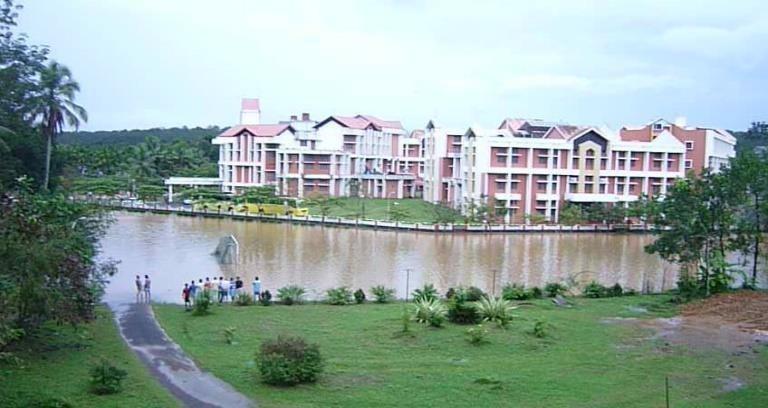
Abstract Waterlogging is the achromatism of soil with water. Soil may be regarded as doused when it's nearly impregnated with water important of the time similar that its air phase is confined and anaerobic conditions prevails. This design deals with the analysis of water logging at SJCET campus. Which include data collection from SJCET campus, infiltration dimension of the soil, study of the being drainage system at SJCET campus, study of drainage outside SJCET campus, study of the living rain water harvesting system at SJCET campus, and eventually grounded on the studies, remedial measure for reducing water logging at SJCET campus is set up out.
Waterlogging refers to the achromatism of soil with water. Soil may be regarded as doused when it's nearly impregnated with water important of the timesimilar that its air phase is confined and anaerobic conditions prevail. In extreme cases of prolonged waterlogging, an aerobiosis occurs, the roots of mesophytes suffer, and the subsurface reducing atmosphere leads to similar processes as denitrification, methanogenesis and the reduction of iron and manganese oxides. Water logging maybedividedintotwo as
Due to the geological reasons, some areas are located into low lying regions and water from highland moved towardthatareaandit'ssubmersedforperiodoftimeor fairlyendless.Ontheotherhand,some spatial development and masonry construction help water infiltration to the soil orblock thewatertodrain out from the affected area and that’sarea Came water logged. The depth and duration ofalluvion vary from place to place, similar areas are freed from alluvion by process of evaporation and infiltration. The reason for waterloggingare
Specialized,socialandinstitutional. thuswaterloggingis takingplaceasdifferentcorridorofthemegacityremains submersed for several days. shy drainage sections, conventional drainage system with low gravity and capacity, natural siltation, absence of coves and outlets, indefinitedrainageoutlets,lackofproperconservationof being drainage system, and over and over disposal of solid waste into the rainspoutsand drainage paths are reckoned for the high causes of blockage in drainage systemandwaterlogging.
Su qin Han et al (1) Analyzed the risk of urban rainstorm waterlogging facing the city of Tianjin by using methods of probability, investigation and numerical simulation. A mathematical model for the urban rainstorm Water logging was established and the precipitation over heavy rain was divided into seven grades. The mathematical model was used to simulate various rain process according to the features ofthe rainstorm and thedraining rule.
e ISSN: 2395 0056
Volume: 09 Issue: 06 | June 2022 www.irjet.net p-ISSN: 2395-0072
R.P. Silbestein et al (2) Predicted the risk of water loggingbyusingasteadystatehydrologicalmodel and a hydrogeomorphic classification. The patterns of water logging occurrence were compared well with simulationsusingadynamiccatchmentmodel.
Wen ChiTangetal(3)Theabilitiesforwaterlogging tolerance of four herbaceous flowers (Angelonia, narrow leafzinnia,celosia,andmedallionflower)are investigatedtoscreensuitableornamentalplantsfor bioretention basins, and the influence of RW on the plantsisalso evaluated. All plants were treated with 10 days of waterloggingfollowedby7 dayrecovery.
Ziren Ambaliya et al (4) Waterlogging is a serious burden for the inhabitants of the city of surat as it creates adverse social, physical, economic, and environmental impacts. A solution for this problem proposedwasthelocationofrechargewellanddesign concept.Thestudyisdesignedasafeasibilityshowing foremostoptionsandpotentialscreatedandtoapply suchanalysisandtoevaluatetheavailabilityusability ofexisting dataavailableforthis.
Otti. V. I et al (5) This paper takes a look at the environmental effects of drainage system and flood control in Awka, the capital city of Anambra state. They proposed that the rain water be directed by crossslopesintheoverstresseddrains.Runoffandoff shootsmustbeconsideredfordrainagesystem.
Zoran Vojinovic et al (6) Proposed that grey flood mitigation measures are no longer achieving desirable results. Nature based solutions have the potential to be more effective and sustainable than traditional measures.Analysisandobservationoflargeandsmall scale nature based solutions and their hybrid combinations withgreymeasures.
JingwenZhangetal(7)Proposalofahuman machine interactive method for the real time reservoir flood control operation. Modelling, operation, and human experiencesareintegratedformoreeffectivedecision support. Forensic engineering analysis applied to flood control was also proposed. Development of a novel forensic engineering approach to improve reservoir operationonfloodcontrol.
Mohammad Delpasand et al(8)Proposed the development of a novel forensic engineering approach to improve reservoir operation on flood control. A criteria to guide assessment of reservoirs was also proposed. Developing forecast based prereleases of water reservoir to reduce flooding. Two key performance criteria( PDR and FVR) was developed.
In our campus water logging is a problem of great
concern. Main objective of our project is to solve this problemofwaterlogging.Weresearchedaboutitandfind various methods to solve the problem of waterlogging in SJCET.Thestepstakenincludeimplementationofdrainage schemes, provision of deep drains, and excavation of new channels and improvement of existing ones. Most of the time during the monsoon, the water level remains higher inside SJCET campus. It has been identified that improvement of the drainage system is one of the highest priority to solve it. Inadequate drainage of over-land runoffincreasestherateofpercolation.Welookatthelocation of the waterlogging, to build a proper modern drainage systemsothatitcanbereduced.
4.1DATACOLLECTION
DataaboutannualrainfallinSJCETiscollected.Mainly focused on data include amount of rainfall during rainy season. Collected data also shows the whole area of the campus and rainfall storage capacity of eacharea
4.2MEASURE OF INFILTRATION
Infiltration of the campus is measured. Infiltration is the process by which water on the ground surface enters the soil. The infiltration capacity is defined as the maximum rate of infiltration. Infiltration capacity of several part of thecampusisveryless.The infiltrationcapacity decreases as the soil moisture content of soils surface layers increases.
4.3STUDY OF DRAINAGE INSIDESJCET CAMPUS
The size of the drainage area, topography and soil of drainage is analysed. . The larger the area, the greater the volumeofrunoff.Bystudyingaboutthedrainagesystemof campus, we came to the conclusion that the drainage systemisnotappropriateenoughtotransporttheamount ofrainwaterfallsin.
4.4 STUDY OFEXISTINGRAINWATERHARVESTING SYSTEM
Campusalreadyconsistsofrainwaterharvestingsystem,a study about its capacity , its materials , location , overall drainage scheme are conducted and new system can be constructedbasedontheseinformation
e ISSN: 2395 0056
Volume: 09 Issue: 06 | June 2022 www.irjet.net p ISSN: 2395 0072
By using the data’s in above steps, various remedial measurescanbefoundtoreducethewaterlogginginSJCET campus. Measures should be in such a way that it should reducethewaterloggingproblemtoagreat extent.
RainfalldataofSJCETcampusiscollectedfrommechanical department. This includes the rainfall data from the year 2008to2021.Thetotal rainfall ofeachmonthisspecified inthis data.Thisdata is collected toknow theintensity of rainfall in SJCET campus during a period of time. By knowingintensityofrainfallduringaperiodoftimewecan calculatethestormwaterflow
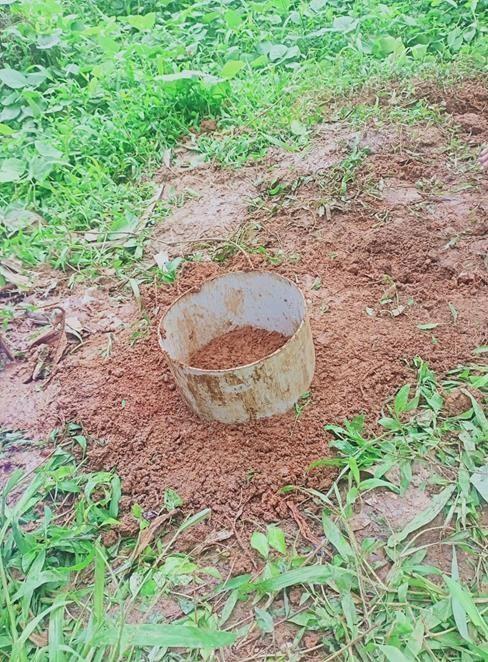
Single tube infiltrometer test is conducted to measure infiltration of soil.It consistsofa hollow metal cylinder of 30cmdiameterand60cmlengthwithbothendsopen.The cylinder is driven in ground such that 10cm of it projects above the ground. The cylinder is filled with water, such thataheadof7cmwithintheinfiltrationofwater,thewater level in the cylinder will go on decreasing. Water is added tothecylinder,soastomaintainconstantlevel.Thevolume of water added over a predetermined time interval gives theinfiltrationrateforthattimeinterval.Theobservations are continued till almost uniform infiltration rate is obtained, which may take about 3 to 6 hours, depending uponthetypeofsoil.
It was observed that the average infiltration rate of our campus is 4 litres in 3 hours. The infiltration rate is very lowaccordingtoourexperiment.Soitisconcludedthatitis oneofthemainreasonforthewaterloggingofSJCET.
Stormwaterisrainwaterplusanythingtheraincarriesalong with it. As rainwater runs across different surfaces, it can pick upvarious types of pollutantsincluding: sedimentsfrom exposedsoil, oil andgrease fromdrivewaysandroads. Storm water flow is found out using rational method. This method is used for design of sewers when the area draining waterintosewerissmall.
Stormwaterquantity,Q=2.8CIAl/sec Where, Q=Quantityofstormwater C= impermeability factor or coefficient or coefficient of runoff I= intensity of rainfall, mm/hr A=catchmentareainhectares. C=.75 I=12.5mm/hr(fromdatacollected) A=23ha Q=2.8*.75*12.5*23 Q=603.75l/sec 8.1ACTUALAREAOFDRAINAGE Q=A*V
International Research Journal of Engineering and Technology (IRJET)
e ISSN: 2395 0056
Volume: 09 Issue: 06 | June 2022 www.irjet.net p ISSN: 2395 0072
A=Areaofdrainage
V=Velocity of flow
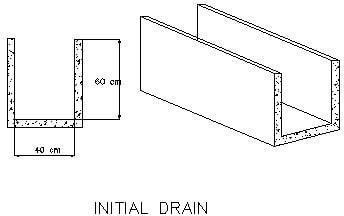
A=.6*.4=.24
V=1.2m/s
Q =.24*1.2 =288 l/sec
Theactualstormwaterflowis 603.75l/secbut,thedrainage capacityisonly288l/secwhichisnotenoughtocarrythe upcomingwater.
Itisanartificialflowcontrolstructurethatisusedto contain storm water and waste water. The system worksbyallowingalargecollectionarea,orbasin,for the water from different drainage systems. So this watercanbeusedtorecharge groundwater.
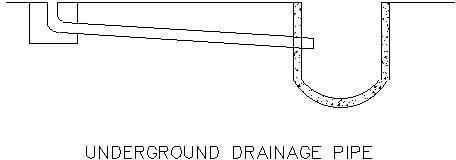
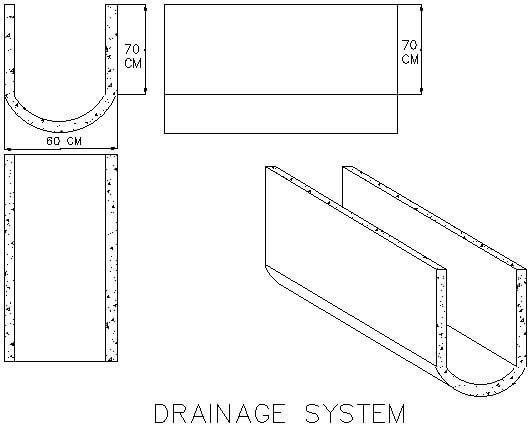
It is constructed in front of Einstein hall so that the rainwater collected in front of it can be taken away to another drainage which is situated near the solar power plant,whichreducesthewaterinfrontoftheEinsteinhall. Underdrainagesystemisprovidedwithatopgrillsoasto avoidlittering.
The existing drainage system in SJCET campus is not having enough capacity to hold water during the time of heavy rain. The existing drainage system is in the shape of a rectangle, this shape may help in sedimentation. So redesignofthedrainageisnecessary.
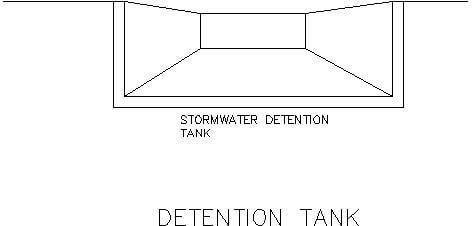
From our investigation, waterlogging in SJCET campus is a serious issue during the time of heavy rainfall. The main reason for this is the inadequate drainage capacity, sedimentation and less infiltration of the soil. So to eradicate this problem, the existing drainage system has to be redesigned, so that the capacity of drainage system can be increased and the sedimentation can be avoided by self-cleaning. A detention tank is constructed to collect some amount of drainage water and rain water such that groundwater recharging and rainwater storage can be achieved. An under drainage system is constructed in front of the Einstein hall so that the waterlogging infront of it can be taken away to another drainage located near solar power plant. By applying all these measures, waterlogging in SJCET campus can be reducedtoamuchlowerrate.
e ISSN: 2395 0056
Volume: 09 Issue: 06 | June 2022 www.irjet.net p-ISSN: 2395-0072
1. Su qin HAN; Yi yang Xie (2020) “Risk analysis and management of urban rainstorm waterlogging in Tianjin”.
2. .PSilberstein ,G.ABartle ,R.BSalama (2012). “Mechanisms and control of water logging and groundwater flow in the ‘Ucarro’ sub catchment”.
3. OttiV. I., Ejikeme, I. R., Nwafor, A.U. (2013). “The environmental effects of the drainage system and flood controllinginAwkaurbancity.
4. Shawn LPlatt,GihanRanasinghe,H.A.D.G.S.Jayathilaka(2021 ). “Retrofitting and rehabilitation of vernacular housinginfloodproneareasinSriLanka”.
5. HafizSulimanMunawar,AhmedW.A.Hammad .S. TravisWaller(2020). “A review on flood management technologies related to image processingandmachinelearning”.
6. Wen Chi Yang, Kuan Hung Lin, Chun Wei Wu(2020). “Effects of waterlogging with different water resources on plant growth and tolerance capacity of four herbaceous flowers in a bioretentionbasin”.
7. Ziren Ambaliya, Pratik Gajera, Shivam Patel(2019). “Water logging and ground water recharge”.
8. Zoran Vojinovic,AlidaAlves ,Jose PatiñoGómezetal(2021).“Effectivenessofsmalland large scale nature based solution for flood mitigation:thecaseofAyutthaya,Thailand”.
9. JingwenZhang,XimingCai,XiaohuiLei,PanLiu, HaoWang(2020).“Realtimereservoirfloodcontrol operationenhancedbydataassimilation”.
10. ElaheFallah Mehdipour,MohammadDelpasand(2021). “Forensic engineeringanalysisappliedtofloodcontrol”