International Research Journal of Engineering and Technology (IRJET) e ISSN: 2395 0056

Volume: 09 Issue: 06 | June 2022 www.irjet.net p ISSN: 2395 0072
International Research Journal of Engineering and Technology (IRJET) e ISSN: 2395 0056
Volume: 09 Issue: 06 | June 2022 www.irjet.net p ISSN: 2395 0072
1 Assistant Professor, Dept. of Computer Science and Engineering, Maharaja Institute of Technology Thandavapura, Mysore, Karnataka, India 2,3,4,5 Students, Dept of Computer Science and Engineering, Maharaja Institute of Technology Thandavapura, Mysore, Karnataka, India ***
Abstract Mental health is an essential issue in the world today. Nowadays, stress has increased a lot in the post covid world. People are finding it hard to find ways to channel their stress or frustration. We come across many teenagers and youth succumbing to the mere stress faced in this competitive world. This is for several reasons. Chief among them is that people are not finding the right platforms and psychological guidance to overcome stress. In this project, we have planned to make an effort to reduce the stress level of people by utilizing technical advances in the field of computer science. We create an app that contains a closed set of questionnaires from SF 36, which have some weight associated with each question. Using clustering algorithms like k means, we classify the new user into one of the three stress levels (positive, tolerable, and toxic). We modify the dataset, add the respective clusters in each row, and use the new data set to train classification algorithms like Naïve Bayes and Decision tree. We get the range limits from this and use that in our App to give results. Based on the obtained results, we recommend a few stress relieving techniques and direct the user towards professional help, if necessary.
Key Words: Mental health, Machine learning, Android application, Human Psychology, SF-36
Mental well being is the state of mind of that individual andgivesanoverviewofhis/hergeneralnature.Assessing mental wellness is critical to understanding and suggestingtreatmentsforpatientswithdeviatedcognitive behavior. This project aims to determine the mentally distressed individuals in the target population. The basic form of getting to know about individuals in a population is to get responses to benchmarked questions and rate them depending on their responses. The Short Form 36 Health Survey Questionnaire (SF 36) is employed to provide information about the state of a population's health, aid in planning services, and assess the effectiveness of clinical and social treatments. In addition, the SF 36 evaluates the individual patient's health status and monitors and compares the disease burden. Our App
includes a user login page, user profile, notifications, and dashboard whichcontainsasetofquestionnairesforthe users and track the result of the user according to their answers. Activities like meditation and deep breathing exercises, some relaxing music, and some fun games for thosewhoenjoyplayinggamesaresuggestedbasedonthe user's stress level. One resource where we can find de stressinggamesisthe'Stressreliefpig'website.
Our social, emotional, and mental health are all interconnected parts of our mental health. With a large population now, people are working from home and staying away from their loved ones; their mental health situation has deteriorated. It influences how we act, feel, and think. Moreover, it determines how we handle stress, relate to others, and make healthy choices. Mental health issues include thinking and emotional difficulties. Minor disruptions in various areas of life are typical, but when they cause the person great anguish, they are regarded as mentalillnesses.
About one in four persons suffer from mental health issues, from ordinary people, such as depression and anxiety, to rare problems, such as schizophrenia and bipolardisorders.Experiencingamentalhealthproblemis often upsetting, confusing, and frightening. The fears are often reinforced by the negative way people experience mental health problems shown by the media. The covid patients also experience many mental health issues such as anxiety, stress, insecurity, suicidal thoughts, and hopelessness. Peoples are interested in improving their mentalhealth,especiallyinstressfultimes.However,they struggle with being unsure where to begin when learning how to improve their mental health and that it is challengingtoaffordexpertcare.Weaimtoaidinmaking a safe space for people in need of a secure and understanding community and provide mental health guidance.
International Research Journal of Engineering and Technology (IRJET) e ISSN: 2395 0056
Volume: 09 Issue: 06 | June 2022 www.irjet.net p ISSN: 2395 0072
2.1 Machine learning techniques: This section discusses various machine learning techniques used for classification and has been used for this system. The resultsofallthesemodelshavebeencomparedtofindthe bestmodelforthesystem.
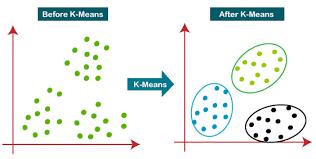
K Means Algorithm: The K Means algorithm handles clustering issues in machine learning or data science. K Means Clustering is an unsupervised learning approach. We shall discover in this article what the K means clusteringmethodis,howitfunctions,andhowtoapplyit in Python to divide the unlabeled dataset into various clusters. Here, K specifies how many pre defined clusters must be produced during the operation. Here, K=3, there will be three clusters because there are three levels of classification in our project: positive, tolerable, and toxic. It enables us to split up the data into various groups. It provides a practical method for automatically identifying thegroupsintheunlabeleddatasetwithouttraining.
occurred. However, the centroid will reflect the outcome afteritstopsmoving(asignthattheclusteringprocesshas converged).
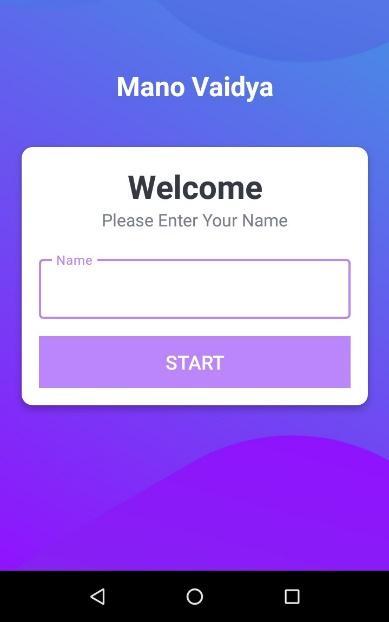
3.1 Start building screens: First, we will create the App'sskeleton.Useyourimaginationtocreateanintuitive app with elements that appeal to people of all backgrounds. Make sure the workflow is simple to understand and follow. Avoid any design choice that requires the user to take a complicated path to achieve a goalthatcanbeaccomplishedmorestraightforwardly.
Inourproject,wereceiveddataonmentalhealthfromall over the world, which gives information on the mental healthstatusgivenbytheusersandthefeedbacktakenby them in the last few months. Using this knowledge, we must categorize the data into three clusters: positive, tolerable,andtoxic.ToascertainK'svalue,anotheroption istoapplytheElbowtechnique.Thesystemwillrandomly assign a large number of centroids and measure the separation between each data point and these centroids after we have the K value. As a result, it designates the sites from where the distance is shortest as the appropriatecentroid.Eachdatapointwillthenbegivenits closest centroid as a result. As a result, there are K initial clusters.Next,it determines thenewcentroid positionfor newly generated clusters. Compared to the one chosen at random, the centroid's location changes. Finally, each point's distance from the new centroid location is once morecalculated.Ifnecessary,thedatapointsaremovedto the new centroids, and a new calculation of the mean positionofthenewcentroidismade.Iterationcontinuesif the centroid shifts, indicating that convergence has not
Fig 2: HomePage
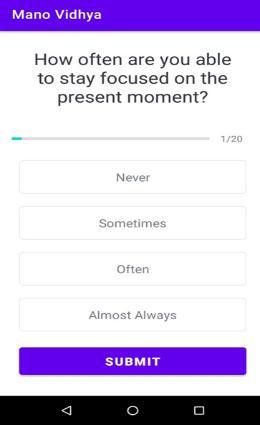
3.2 Questions Screen and UI refinement: Give the QuestionsUIafull screenexperience.Inordertokeepthe user's attention only on the question displayed on the screen, all distractions are eliminated. Then we find out whatwidgetscanbeusedtogetanswersfromtheuserin a fun way. Using the K means algorithm, we have used a data set and successfully clustered them into three clusters,i.e.,positive,tolerable,andtoxic.Afterclustering, we used a classification algorithm to classify a user into one of these classes. We have also implemented various algorithms for classifications and compared their accuracy.
International Research Journal of Engineering and Technology (IRJET) e ISSN: 2395 0056
Volume: 09 Issue: 06 | June 2022 www.irjet.net p ISSN: 2395 0072
Fig - 3: Questiondisplayed
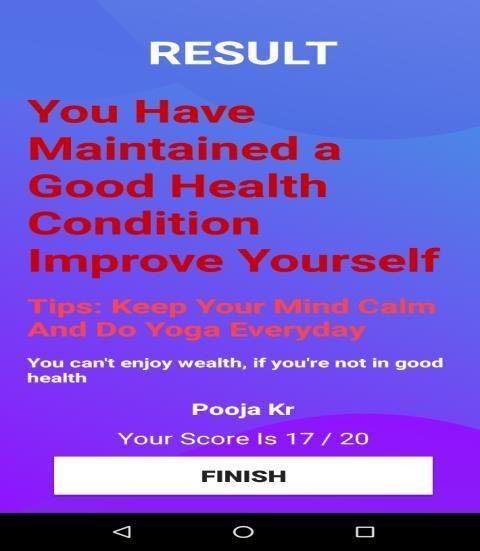
3.3 By machine Learning Algorithms, the App was predicting the future results: Out of Logistic Regression, Naive Bayes, SVM (Support Vector Machine), and k Means have the highest accuracy in our case. It includesasequenceofinquiriescommonlyusedtopredict a person's mental health. A user friendly interface is created where the user can answer a series of questions. Each correct answer is worth some points. After the user enters answers to all questions, the average points are calculated,andhismentalhealthispredicted.Asuggestion willbemadetotheuserbasedontheirresponses.
With the help of the Android platform's self analyzing treatment, the concept of inevitable improvements in mental health for human services is seen as one possible treatment option. A promising innovation stage through which to make it a reality is recognized as cell phones. Furthermore,whenself evaluationsurveysaredistributed through completely designed mobile phone interfaces instead of the best in classpaper based versions, the quantity,consistency,andcharacteroftheinformationare improved. A particular application is crucial to choosing the best strategy. Focusing on differentiating mentalhealth difficulties like discouragement or bipolar disorder, we present the positives and cons of the most inspiring technological breakthroughs. Business social insurance providers are becoming increasingly interested in modifying research into products and bringing them to market because of the positive results cell phones can provide for treating mental illness. Finally, we look at the advantages that patients, parents, doctors, and providers of medical services protection can receive from using the application.
We want to extend our deepest gratitude to our Project Guide, Prof. Akhilesh Sathyanarayan, who guided us and provided us with his valuable knowledge and suggestions onthisprojectandhelpedusimproveourprojectbeyond our limits. Secondly, we would like to thank our Project Coordinator, Dr. Ranjit K N, who helped us finalize this project within the limited time frame by constantly supportingus.Wewouldalsoliketoexpressourheartfelt thanks to our Head of Department, Prof. Navile Nageshwara Naveen, for providing us with a platform where we can try to work on developing projects and demonstrate the practical applications of our academic curriculum. Finally, we want to express our gratitude to our Principal, Dr. Y T Krishne Gowda, who gave us a golden opportunity to do this wonderful project on the topicof'ManoVaidya:GatewaytoRelaxationViaMachine Learning’, which has helped us in doing much research andlearningtheimplementation.
Fig - 4: Resultpage
1. Agrawal,A.,Rastogi,R.,Chaturvedi,D.K.,Sharma,S.,& Bansal, A. (2018g). Audio Visual EMG & GSR BiofeedbackAnalysisforEffectofSpiritualTechniques on Human Behavior and Psychic Challenges. Proceedingsofthe12thINDIACom.
2. Chaturvedi, D. K. (2004). Science, Religion and Spiritual Quest. In Linkages between Social Service, Agriculture and Theology for the Future of Mankind. DEIPress.
International Research Journal of Engineering and Technology (IRJET) e ISSN: 2395 0056
Volume: 09 Issue: 06 | June 2022 www.irjet.net p ISSN: 2395 0072
3. Chaturvedi, D. K. (2012). Human Rights and Consciousness. International Seminar on Prominence ofHumanRightsintheCriminalJusticeSystem(ISPUR 2012). Proceedings of Organized Ambedkar Chair, Dept. of Contemporary Social Studies & Law. Dr. B.R. AmbedkarUniversity.
4. Chaturvedi, D. K. Manish Arya (2013). Correlation between Human Performance and Consciousness, IEEE International Conference on Human Computer Interaction. Proceedings of Saveetha School of Engineering.
5. Chaturvedi, D. K. (2013). The Correlation between Student Performance and Consciousness Level. ProceedingsofInternational Conference onAdvanced Computing and Communication Technologies (ICACCT™ 2013).
6. Chaturvedi, D. K. (2013). A Study of Correlation between Consciousness Level and Performance of Worker, Industrial. Engineering Journal (New York), 6(8),40 43.
7. Chaturvedi, D. K. (2014). The correlation between Student Performance and Consciousness Level. International Journal of Computing Science and CommunicationTechnologies,6(2),936 939.
8. Chaturvedi, D. K. (2014). Correlation between Energy Distribution profile and Level of Consciousness. Shiakshk Parisamvad, International Journal of Education,4(1),1 9.
9. Chaturvedi, D.K. (2015). Dayalbagh Way of Life for Better Worldliness. Quest Journals, Journal of Research in Humanities and Social Science, 3(5), 16 23.
10. Chaturvedi,D.K.(2019).RelationshipbetweenChakra Energy and Consciousness. Biomedical Journal of Scientific and Technical Research, 15(3), 1 3. Doi:10.26717/BJSTR.2019.15.002705
11. Chaturvedi, D. K., Kumar, J., & Bhardwaj, R. (2015, September). Effect of meditation on Chakra Energy and Hemodynamic parameters. International Journal of Computers and Applications, 126(12), 52 59. doi:10.5120/ijca2015906304
12. Chauhan, S., Rastogi, R., Chaturvedi, D. K., Arora, N., & Trivedi, P. (2017a). Framework for Use of Machine IntelligenceonClinicalPsychologytostudytheeffects of Spiritual tools on Human Behavior and Psychic Challenges.ProceedingsofNSC 2017(Nationalsystem conference),DEI.
13. Glombiewski, J. A. (2013). Efficacy of EMG and EEG Biofeedback in Fibromyalgia Syndrome: A Meta Analysis and a Systematic Review of Randomized Controlled Trials. Vid Based Complement Alternat Med.,2013,962741.PMID:24082911
14. Gulati, M., Rastogi, R., Chaturvedi, D. K., Satya, S., Arora, N., & Singhal, P. (2018f). Statistical Resultant Analysis of Spiritual & Psychosomatic Stress Survey on Various Human Personality Indicators. The InternationalConferenceproceedingsofICCI2018.
15. Gulati, M., Rastogi, R., Chaturvedi, D. K., Sharma, P., Yadav,V.,Chauhan,S.,Gupta,M.,&Singhal,P.(2019e). StatisticalResultantAnalysisofPsychosomaticSurvey on Various Human Personality Indicators: Statistical SurveytoMapStressandMentalHealth.InHandbook ofResearchonLearningintheAgeofTranshumanism. Hershey, PA: IGI Global. doi:10.4018/978 1 5225 8431 5.ch022
16. Medknow, P. (2019). Article. Annals of Indian PsychiatrySoitey WesternZonalBranch,3(1).
17. Rubin, A. (1992). Biofeedback and binocular vision. Journal of Behavioral Optometry, 3(4), 9598. MathSciNet.
18. Sahoo, B. M., Gupta, A. D., & Shivahare, B. D. (2018). Audio Visual EMG & GSR Biofeedback Analysis and Spiritual Methods for Understanding Human Behaviour and Psychosomatic Disorders. Amity Journal of Computational Sciences, 2(1). www.amity.edu/ajcs
19. Rastogi,R.,Chaturvedi,D.K.,Satya,S.,Arora,N.,Yadav, V., Chauhan, S., & Sharma, P. (2018c). SF 36 scores Analysis for EMG and GSR Therapy on Audio, Visual andAudio VisualModesforChronicTTH.Proceedings oftheICCIDA 2018.
20. Nagai, Y., Jones, C.I., & Sen, A. (2019). Galvanic Skin Response (GSR)/Electrodermal/Skin Conductance Biofeedback on Epilepsy: A Systematic Review and Meta Analysis. Frontier Neurology. doi:10.3389/ fneur.2019.00377
21. Rastogi, R., Chaturvedi, D. K., Arora, N., Trivedi, P., & Mishra, V. (2017b). Swarm Intelligent Optimized Method of Development of Noble Life in the perspective of Indian Scientific Philosophy and Psychology’, Proceedings of NSC 2017(National systemconference),DEI
International Research Journal of Engineering and Technology (IRJET) e ISSN: 2395 0056
Volume: 09 Issue: 06 | June 2022 www.irjet.net p ISSN: 2395 0072
Prof. Akhilesh Sathyanarayan, MSE (USA), Assistant Professor, Dept. of CS&E, MIT Thandavapura.
Passionate about VLSI Design &MachineLearning.
Always open to network & connect.

Chandana B R, Student of Maharaja Institute of Technology Thandavapura, Mysore. Pursuing Bachelor of Engineering Degree in Computer Science and Engineering
Harshitha M B, Student of Maharaja Institute of Technology Thandavapura, Mysore. Pursuing Bachelor of Engineering Degree in ComputerScienceand Engineering.
PoojaKR,StudentofMaharaja Institute of Technology Thandavapura, Mysore Pursuing Bachelor of Engineering Degree in Computer Science and Engineering
Supriya T S, Student of Maharaja Institute of Technology Thandavapura, Mysore. Pursuing Bachelor of Engineering Degree in Computer Science and Engineering.