International Research Journal of Engineering and Technology (IRJET) e ISSN: 2395 0056

Volume: 09 Issue: 06 | June 2022 www.irjet.net p ISSN: 2395 0072
International Research Journal of Engineering and Technology (IRJET) e ISSN: 2395 0056
Volume: 09 Issue: 06 | June 2022 www.irjet.net p ISSN: 2395 0072
Sunil Kumar1, Dr. K.L. Bansal2
1 Research Scholar, Department of Computer Science, Himachal Pradesh University, Shimla, Himachal Pradesh, India
2 Professor, Department of Computer Science, Himachal Pradesh University, Shimla, Himachal Pradesh, India ***
Abstract This paper aims to analyze some of the different areaswhere humongous(Big Data)amount of datawhich is being generated on daily basis from various sources across the globe can be processed and exploited in order to effectively and efficiently use the information hidden in that data. This big data when combined with artificial intelligence, machine learning, deep learning, and data science concepts and algorithms, helps decision makers in efficient decision making. We have enlisted various application areas where data is being getting used for designing efficient system which can give more accurate results,thus moreaccuratepredictionscanbemade.
Keywords: Big-data, artificial intelligence, machine learning, deep learning, data science, algorithms, decision making.
Every part of a business generates some data which may notseemuseful tothose whogeneratesitbutfordecision makers that data plays a very crucial part in decision making especially decisions related to various operations of the business. Surge in data creation is mainly due to advancement in technology, growth of www and smartphone over the past decade. Data is being collected from various sources viz. primary and secondary. Data nowincludestext,audioandvideoinformationthatisdata canbestructured,unstructured,andsemi structured
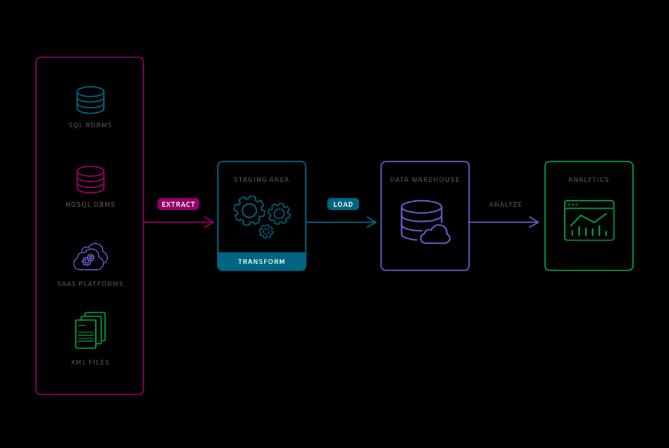
Data thus collected needs to undergo ETL (Extraction, Transformation and Loading) process so that only such data can be extracted from the bunch of data which is useful totheorganization,data thusextractedneedsto be transformed to a common structure and then loaded to a staging area or data warehouse where various analytical tools can be applied on the data thus extracted, transformedandloaded.
Artificial Intelligence (AI), Machine Learning (ML), Deep Learning (DL), and Data Science (DS) all these fields combines the power of statistics, mathematical modeling, automation and programming for creating an efficient
system which can solve real world problems within fraction ofseconds,thesystemthuscreatedpossessesthe capabilityoflearningonitself.
The way a human sees various things, observe various features of that thing, extract important features [9] and considering the importance of selected features take necessary action Similarly, machines or computer programs are required to extract important features from the data fed to the program and then take or suggest required decision or action. The data fed to the program for observation and processing can be either of the followingtypes:
Structured data: This data is basically an organized data. It generally refers to data that has defined the length and formatofdata.
Semi Structured data: This data is basically a semi organized data. It is generally a form of data that do not conform to the formal structure of data. Log files are the examplesofthistypeofdata.
Unstructured data: This data basically refers to unorganized data. The data which doesn’t follows traditional row and column structure falls in the category of unstructured data. Texts, pictures, videos etc. are the examplesofunstructureddata.
Data nowadays is increasing at a rapid scale. It has been projected that by 2025, the global data creation will be more than 180 zettabytes. One can imagine how valuable that huge data (Big Data) can be. Big Data has following characteristics:
Volume:
To determine the value of data, size of data plays a very crucial role. If the volume of data is very large then it is
International Research Journal of Engineering and Technology (IRJET) e ISSN: 2395 0056
Volume: 09 Issue: 06 | June 2022 www.irjet.net p ISSN: 2395 0072
actually considered as a ‘Big Data’. This means whether a particulardatacanactuallybeconsideredasaBigDataor not,isdependentuponthevolumeofdata.
The velocity aspect of Big Data demands analytic algorithms that can operate data in motion, ie, algorithms thatdonotassumethatallthedataisavailableallthetime fordecisionmaking,anddecisionsneedtobemade“onthe go,”probablywithsummariesofpastdata.
Variety:
Datacomingfromvariousdatasourcesisexpectedtobeof different types like structured, semi structured and unstructured data. Such data may come from inside or outsideoftheorganization.
Veracity:
Veracityreferstothetruthfulnessorqualityoraccuracyof dataandtrustworthinessofdatasourcefromwhichdatais beingcollected.
Value:
Datanomatterhowbig,isofnousetoorganizationuntilit is processed and useful information is collected from it. Such useful information helps decision makers to take necessary decision which helps in the growth of organization.
Inorderto use data for decisionmaking,useful data must be first extracted from various data sources (primary and secondary). Thedata presentinthese data sourcescan be eitheroftheforms.
cleaningofnullvaluesorremovalofmissingvaluedatafor consideration, joining of multiple attributes into one or vice versa, etc. After transforming data, data is being loadedintothedatawarehousefromwhereitisfedtoOn LineAnalytical Processing(OLAP)systemwhichhelpsthe organization in retrieving useful and valuable insights fromthedata.
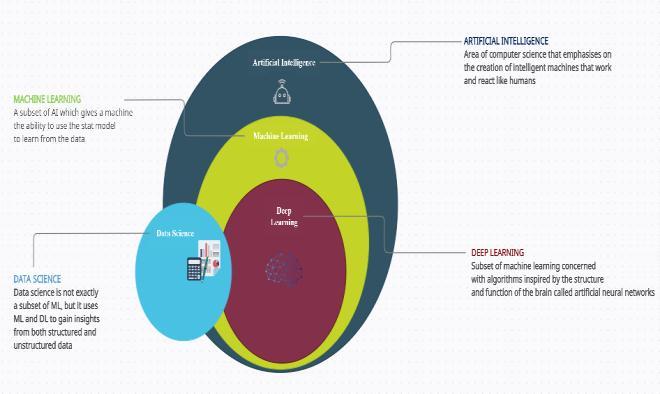
Artificial Intelligence (AI) is a branch of computer science in which we create intelligent machines or programs. The machine or program thus created behaves like a human, thinks like humans, and is able to make decisions on its own. The term “Artificial Intelligence” is a combination of two words “Artificial” and “Intelligence”. The word “Artificial” refers to the something which is created by human to mimic something natural and the word “Intelligence”referstotheabilityofthinkingonitsown,so itcanbeviewedas“thinkingpowercreatedbyhuman”[8]. Theprocessofcreatingintelligentmachinesandprograms goes through several stages of planning, reasoning, analyzing data, prediction of outcomes and acting accordingly. AI also involves the use of statistics and probability and various other mathematical tools (neural networksandmachinelearningismostlybasedonthese).
Unlike Artificial Intelligence which solves a problem mimicking human intelligence, Machine Learning solves a problem by learning from data and making predictions. MachinelearningissubsetofArtificialIntelligence. Soone can say that all machine learning is artificial intelligence butnotallartificialintelligenceismachinelearning.
Within artificial intelligence (AI), machine learning has emerged as the method of choice for developing practical software for computer vision, speech recognition, natural languageprocessing,robotcontrol,andotherapplications.
After extracting data from data sources, data needs to be transformedintostandardform.Intransformationprocess various operations are performed like feature selection,
Deeplearningisanewlearningparadigmwhichisasubset of machine learning (ML) which is a subset of artificial intelligence (AI). Advancement in image analysis and image processing using deep learning resulted into generatingmassiveinterestinthisfield duetoitslearning capabilities from the given data [1]. A deep learning algorithm and support vector machine (SVM) is used to categorize the image as healthy or COVID 19 infected by
International Research Journal of Engineering and Technology (IRJET) e ISSN: 2395 0056
Volume: 09 Issue: 06 | June 2022 www.irjet.net p ISSN: 2395 0072
the feature extraction process with chest X ray images. Various deep learning models like Inception v3, AlexNet, VGG16, Inception ResNet v2, VGG19, ResNet 18, ResNet 50, GoogLeNet, ResNet 101, DenseNet201, and XceptionNet were used and achieved a 95.38% accuracy with ResNet50 and SVM. Deep learning has been successfully applied to several application areas which include image recognition [3,4], speech recognition [5], natural language understanding [6] and computational biology[7]
Data science is the process of finding meaningful information or insights from the data in a particular domain where deep learning can play a vital role in data analyticsanddecisionmaking.Datascienceisanemerging discipline which came into limelight in the last few years. Data science is a collective discipline which combines variousconceptsofdifferentfields.Itmergestheconcepts of computer science (algorithms, programming, artificial intelligence, machine learning, and deep learning), mathematics (statistics and optimization), and domain knowledge (business, applications, and visualization) to extract insights from data and transform it into actions that have an impact in the particular domain of application. Implementing these concepts of computer science and mathematically tweaking the data with domain knowledge, results into accurate and effective insights from data. These previously hidden insights from data can be extremely important for the organization, as suchvaluableinformationmayhelpthedecisionmakersin takingmoreaccurateandefficientdecisionsforthebenefit of organization especially in the current era of extremely competitivemarket.
Oneofthemajorapplicationareaofdatascienceisfinance. Banks and companies dealing with finance were in huge loss due to various factors which includes bad debts, banking fraud etc. Even though these organizations had a lot of data about their customers including transactional databutwerelackingresourcestodrawinsightsformthis data. As data science started evolving, these financial organizations started using this data for drawing meaningful insights. They started listing their customers aspertheirexpendituresandprofilesandonvariousother factorswhichmighthelpindecidingwhetherthecustomer candefaultonhisloanornot. Thisalsohelpedthemtodo targetmarketingbasedoncustomer’spurchasingpower.
The healthcare sector, especially, receives great benefits from data science applications. Using data science in healthcare sector may help health experts in diagnosing the disease at an earlier stage and in taking important decision combining their own expertise at right time so that better treatment can be given to patients. Following aresomeofthehealthcareareaswheredatasciencecanbe usedmoreefficiently:
Procedures such as detecting tumors, artery stenosis, organdelineationemployvarious methodstofindoptimal parameters for tasks like lung texture classification. It applies machine learning methods for bio medical image analysiswhichhelpsintextureclassificationanddetection.
Integrating data science concepts for understanding the impact of DNA on our health and finding biological connection between genes, disease, and drug response of an individual. This provides us meaningful insights of genetic issues in reactions to particular drugs and diseases. This helps in personalization of treatment for individuals.
Drug development often includes testing, huge financial and time expenditure. Usually this process takes over a
International Research Journal of Engineering and Technology (IRJET) e ISSN: 2395 0056
Volume: 09 Issue: 06 | June 2022 www.irjet.net p ISSN: 2395 0072
decade for successful drug development. Data science in combination with machine learning algorithms simplifies this drug development cycle from the very beginning to end that is from selection of drug compounds to the prediction of the success rate based on the biological factors. Simulating lab experiments using machine learningalgorithmsandmodelingcanforecastthereaction ofdrugcompoundsinthebodywithhigheraccuracy
Artificial intelligence powered virtual assistants can providebasichealthcaresupportinmanycasesinwhichit is not required for the patients to visit the doctor in person. Such virtual assistants are trained using various machine learning algorithms and helps the patient by askinghimtodescribethesymptoms,pastmedicalhistory and then receive key information about his medical condition.
These virtual assistants encouraging patients to make healthy decisions, saves their time waiting in line for an appointment, and allows doctors to focus on more critical cases.
Datasciencehelpstheorganizationsinadvertisingtheiror theirclient’sproducttovisitorsoftheirwebsiteasperthe likings or search of the visitor. Different visitors may find different advertisement in the same place at the same place.Thisisthereasonwhyorganizationsarefocusingon digitallyadvertisingtheirproductsthanplacing hoardings neartothepublicplacesoronhighways.
Machine learning algorithms are being used for recognizing various objects in an image or video Such algorithms work bydetectingvariousobjectsintheimage orvideoandthenclassifyingthedetectedobjectaccording to their features. Machine learning algorithms are being used for training machine learning model with huge datasets which contains images or videos containing different objects. For instance, you upload an image containingfacesofyourfriendsonFacebookandyoustart gettingsuggestionstotagyourfriends.Thisautomatic tag suggestionfeatureusesfacerecognitionalgorithm.
Machine learning is widely used in speech recognition systems. Amazon Alexa, Google assistant, Siri, Cortana etc. are some of the most widely used voice assistant systems whichprocessesourvoice,analyzeitandthengivesusthe appropriate information or feedback as per our voice command.Therearesystemswhichconvertourspeechto text, so if you are not in a position to type a message, just speakitoutanditwillbeconvertedtotext.
In this research we have examined the ingenious topic of big data, artificial intelligence, machine learning, deep learning and data science. All these topics gained lots of interest due to their perceived unprecedented opportunities and benefits. Variety of humongous data is being collected at a rapid speed, within this data lies the hiddenknowledgewhichshouldbeextractedandutilized. The literature was reviewed in order to provide an overview of application areas of Artificial intelligence, machine learning, deep learning and data science which arebeingresearched.
Accordingly, this research enlisted various application areas viz. banking fraud detection and risk analysis, healthcare, targeted digital marketing, image recognition and speech recognition where with the help of AI, ML, DL and DS concepts, data is being used to design intelligent systems. Data acts as a base for designing intelligent decisionmakingsystemsaswithouthavingdataorenough datainhandwewon’tbeabletomakeanylearningmodel efficientandeffective.
It is believed that data when used in a more efficient mannerthatiswithappropriatetechnologyandalgorithm isofgreatsignificanceinalmostall areaswhichgenerates data.
[1] Emmert Streib, F., Yang, Z., Feng, H., Tripathi, S., & Dehmer, M. (2020). An Introductory Review of Deep Learningfor PredictionModelsWithBigData. Frontiers In ArtificialIntelligence, 3.doi:10.3389/frai.2020.00004
[2] Wan, L., Zeiler, M., Zhang, S., Cun, Y. L., and Fergus, R. (2013). “Regularization of neural networks using dropconnect,” in Proceedings of the 30th International ConferenceonMachineLearning(ICML 13),1058 1066.
International Research Journal of Engineering and Technology (IRJET) e ISSN: 2395 0056 Volume: 09 Issue: 06 | June 2022 www.irjet.net p ISSN: 2395 0072
[3] Krizhevsky, A., Sutskever, I., and Hinton, G. E. (2012a). ImageNet Classification with Deep Convolutional Neural Networks.CurranAssociates,Inc.
[4] LeCun, Y., Bengio, Y., and Hinton, G. (2015). Deep learning.Nature521:436.
[5] Graves, A., Mohamed, A., and Hinton, G. E. (2013). “Speechrecognitionwithdeeprecurrentneuralnetworks,” in 2013 IEEE International Conference on Acoustics, SpeechandSignalProcessing(ICASSP).
[6] Sarikaya, R., Hinton, G. E., and Deoras, A. (2014). Application of deep belief networks for natural language understanding. IEEE/ACM Trans. Audio Speech Lang. Process.22,778 784.doi:10.1109/TASLP.2014.2303296
[7] Leung, M. K. K., Xiong, H. Y., Lee, L. J., and Frey, B. J. (2014).Deeplearningofthetissue regulatedsplicingcode. Bioinformatics 30, 121 129. doi: 10.1093/bioinformatics/btu277
[8] Dhankar, M., & Walia, N. (2020). An Introduction to Artificial Intelligence. In Emerging Trends in Big Data, IoT and Cyber Security (pp. 105 108). EXCELLENT PUBLISHING HOUSE. Retrieved from https://msi ggsip.org/wp content/uploads/conference2020.pdf
[9]Guyon,I.,Gunn,S.,Nikravesh,M.,&A.Zadeh,L.(2006). FeatureExtraction:FoundationsandApplications(Studies inFuzzinessandSoftComputing,207).Springer.