International Research Journal of Engineering and Technology (IRJET) e ISSN: 2395 0056

Volume: 09 Issue: 06 | Jun 2022 www.irjet.net p ISSN: 2395 0072
International Research Journal of Engineering and Technology (IRJET) e ISSN: 2395 0056
Volume: 09 Issue: 06 | Jun 2022 www.irjet.net p ISSN: 2395 0072
Abstract - Social interactions have always been a quintessential part of Indian culture. Historically Indian cities were built around the essence of social interaction. The urban form of Indian cities has undergone multifold built form transformation owing to urbanization. The urban form of the cities progressively transitioned from compact to neo liberal. Along with the urban form so did transform the social nature of urban spaces. The built form of the cities has always been a key determinant in influencing the social nature of the urban spaces in the cities. The paper aims at analyzing the social nature of urban spaces in the gated communities in neo liberal Indian cities. The methodology adopted for the paper includes identifying parameters which influence the social nature of urban spaces through literature review, assessing the identified parameters on a primary case study (located in the city of Gurugram) through direct observations, and physical interviews. The study identifies the type, nature and degree of social interactions in gated communities in neo liberal Indian cities. The paper comments on the nature of urban spaces in neo liberal cities by outlining the privatization of public space and fortification of the public realm which has changed the dynamics of the social nature of urban spaces.
Key Words: neo liberal, privatization of space, social interaction, urban form, urban space
Urbanspacesincitiesarethephysicalmanifestationsofthe socio cultural structure of the society. “Space encourages anddiscouragescertainformsofinteractionandgivesform tosocial structuresandideologies”(Kumar,2017).Indian citieshavehistoricallybeensupportiveofsocialinteraction throughthecity’sphysicalstructure “Thespatialstructure of the Indian cities reveals an intense and compact arrangement of buildings and structures, containing and compressingtheopenwhitespacesthatconstitutethepublic realmofthecity“(Kumar,2017).ThehistoricalIndiancities are known for their streets and bazaars which depict the plethoraofIndiancultureeventoday.Theurbanspacesin Indiancitiesareconstitutedofopenspacesnearmonuments of religious importance in the form of bazaars and organicallydevelopedstreetsinresidentialneighborhoods. Thebazaarsandchowkshavebeenactiveurbanspacesin historical Indian city planning. These urban spaces have actedasavitalmeansoffacilitatingsocialinteractionwithin thecity Thesespacesaretemporalwherethecharacterof
thespacekeepsonchangingwithrespecttothetimeaswell as the season. Owing to the climatic and cultural considerationsthehistoricalIndiancitieshadcompacturban forms. Thecompacturban form wasdominatedbycoarse grain, narrow streets, built on edge housing typology and activepedestrianmovement.
Asperthehistoryofurbanizationgivenby(Ramachandran 1989),theIndiancitiescanbeclassifiedwithinthefollowed periods:
1. ThePrehistoricperiod(2300BCto1800BC)
2. TheearlyHistoricalperiod(600BCtoAD500)
3. Urbanizationinthemedievalperiod(AD600 1800)
4. UrbanizationintheBritishperiod(1800 1947)
5. ThePost independenceperiod
Indiancitieshaveundergoneahugetransformationinthe termsofurbanform.Therehavebeenmultiplepoliticaland economic factors that have contributed to this change. Startingfromthemonarchicalruletothecolonialruletothe independenteraofthecountry,withtheonsetofdifferent governancemodels,theurbanformofthecitieshaschanged dramatically.Whilethehistoricalcitiesandmedievalcities hadcompacturbanformsaftercomingunderthecolonial ruletheformofthecitiesstartedtoalterandgetdispersed. Forexample,“thetransformationinDelhibetweentheearly 19thandthemid 20thcenturieswereaprocesswhereby theBritishcolonialgovernmentinstalled,apparentlyatwill, particularspatialandphysicalarrangementsintheoldcity of Delhi and in the region immediately beyond it” (Raychaudhuri,2001).Thecolonialerasawtheevolutionof adifferentkindofurbanforminwhichthetypologyofcivil lines and bungalows came into existence. After the liberalizationoftheeconomyin1991,thecountrywitnessed achangeintheroleofthegovernmentfrombeingaprovider toafacilitatorintermsofhousing.Privatedevelopersturned outtobethemajorplayerinprovidingaccommodationto thepeople.Thisledtothedevelopmentofneo liberalurban form in the cities which was also the capitalistic model of housing development. “Important aspects of neo liberal housing policy are dealt with in ensuing sub sections, for example,gentrificationandprivatelygovernedandsecured neighbourhoods(gatedcommunities)”(Sager2011).
International Research Journal of Engineering and Technology (IRJET) e ISSN: 2395 0056
Volume: 09 Issue: 06 | Jun 2022 www.irjet.net p ISSN: 2395 0072
Withthetransformationintheurbanformofthecities,the nature of urban spaces in the cities also transformed. “Unbridled urbanization in the wake of globalization has drasticallyinflictedchangesonthesespacesandhaspaved thewayforhybridandnewlyevolvedvariants ”(Prosperi, 2012) The relationship between people and the physical environment in these hybrid and newly evolved variants formsthebaselineoftheexplorationforthisresearcharticle.
The research aims at enquiring the social nature of urban spacesinthegatedcommunityinneo liberalcities.
Inthelonghistoryofurbanization,Indiancitieshavealtered immensely. Post the liberalization of the economy, urbanization in Indian cities entered a new phase. In the Government of India’s seventh plan (1985 1990) major responsibilityforhousingconstructionwasassignedtothe private sector and it called for “radical reorientation of all policies to housing”. The great impact of this move was visible in the cities which were either established (urban centers) with a political/economic impact or small towns which were closer to these urban centers. Owing to the demands of the housing sector the birth of the gated community or enclave development model in Indian cities was observed. As (Rafael E. Pizarro 2003) states on the nature of the urban form generated in the third world countries post the globalization, “Enclaves are formed to maintainorcreatenewidentitiesofdiaspora,orethnicand religioussolidarities.”Onthenatureofthepublicrealm,they (Rafael E. Pizarro 2003) observed “There are signs of decreasingsocialcontactandincreasingisolationbetween peopleandneighborhoods.Adifferentversionofadualistic societyseeminglyis ontherise, where gatedcommunities and exclusive suburbs coexist with slums and squatter settlements”. “The rapid urbanization fueled by industrial mega projects and more recently liberalized markets has failedtoenablelocalgovernancetosupplyemergingurban agglomerations with sufficient infrastructure in all urban areas” (Sanjeev Vidyarthi 2017). “Gated communities are housing development that restricts public access, usually throughtheuseofgates,booms,wallsandfences”(Uduku, 2010). These residential areas have restricted access, and havepublicspaceswhichareprivatized Theyrepresenta class basedsegregationhousingmodel.
Residential neighbourhoods are defined as places where peoplelivetogether.AsperNorbergSchulzbesidesstreets andsquares,theyalsoformacategoryofurbanspace.The built form of the city has been a key determinant in
influencingthesocialnatureoftheurbanspacesinthecities. As (Krier 1979) states in his seminal text, urban spaces comprise two basic elements: streets and squares. Jane (Jacobs1960)discussesthatspacesneedtobeclassifiedas privateandpublic.
InIndiancities,thestreetshavebeenhistoricallysignificant. The streets in Indian cities have undergone an enormous transformationwithtime.Traditionallythestreetshadbeen designedforpedestrianmovement.Thestreetsinmedieval cities were narrow and active throughout the day.The Indian Street is a part of a ‘spatial complex’ which also comprises the bazaar and the fair and together they constitute an unclosed realm which provides a ‘meeting pointofseveralcommunities’(Fyfe,1998).Thestreetswere notonlyjustmeantforthemovementofthepedestrianand vehiclesbutwerealsothesiteofvariousactivitiessuchas vending, talking, eating, places of worship and also the accesstodwellingunitsetc.Themultifunctionalstructureof thestreetprovidesanadmixtureofoverlappingspacesthat merge public and private, work and leisure, and holy and profane activities (Fyfe, 1998). The built typology of the medievalcitieswassuchthatthehouseswerebuiltonedge havingseatingspacesasanembeddedarchitecturalelement whichhelpedinfacilitatingsocialinteractions.Themedieval citiesshowastarkcontrasttotheneoliberalcitiesinterms ofbuilttypologiesaswellasthestreetwidths(Table1).The dominanceofautomobileshastransformedthelayoutofthe cities. To accommodate the ever increasing demand for automobilesthestreetshavebecomewider.Thestreetsin the neoliberal urban form are mono functional and serve onlyasamovementcorridor.
Characteristics ofstreets Medievalcities Neo liberalcities
Function Multiplefunction Monofunction Width Narrow(designed forhumanscale) Wide(designedfor carscale) Edge relationship withbuilding
Direct Indirect Active Throughouttheday Partiallyactive Temporal nature Changeaspertime andspace Non temporalin nature
Table 1 :Comparisonofstreetsinmedievalandneo liberalcities,(source:author)
2.3 The social dimension of urban space:
“Space and society are clearly related: it is difficult to conceive of ‘space’ without social content and, equally to conceiveofsocietywithoutaspatialcomponent”(Carmona
International Research Journal of Engineering and Technology (IRJET) e ISSN: 2395 0056
Volume: 09 Issue: 06 | Jun 2022 www.irjet.net p ISSN: 2395 0072
2003). Public spaces play an integral role in generating a collectivefeelingintheneighborhood,astheyactasplaces where social interactions can freely occur. “A public open space in the neighborhood is an available opportunity for neighbors to have communication as a friendly chat in a fencedgardenorevenpublicmeetingsinlocalparkswhich can be common gathering places and social cultural interactions as results” (Farzad Soltanian, 2015) By definitionthepublicspacesshouldbeavailabletoallyetin gatedcommunitytheiraccessiscontrolledincertainform and manner. Forms of access to public spaces have been identified (Stephen Carr 1992) as: Visually accessible, symbolicallyaccessibleandphysicallyaccessible.
The importance of urban places as mediators of social interactionhasbeenestablishedbyseveralauthors. William (White1980)carriedoutastreetprojectinNewyork and used “demography of users, gender of the user, sittable space,theroleofnaturalelements,food,relationshipofthe space to the main pedestrian traffic flow, capacity and triangulation”asparametersforidentifyingthesocialuseof urban places such as city’s parks, playgrounds and city blocks.(Appleyard1981)identifiedstreetsasanimportant factor for sociability, neighbourliness, friendliness and community life. In this book the streets are identified as importantfactorforsociability,neighborliness,friendliness and community life. He conducted a study on three residential streets in San Francisco and compared their livability. He took the traffic movement as the main parameterandfoundthatasthetrafficvolumeincreasedthe interactions decreased as heavy traffic led to decrease in exchangespacesandnosidewalkactivity.Thefactorofsocial interaction can be measured by “determining the level of differentsocialgroups’presence,formationofsocialsocieties and living in different hours of day and night” . Four key attributes ofsuccessful places were identified by (Madden 2000) which are: “comfort and image, access and linkage, usesandactivityandsociability” Therearemoreparameters which influence the social interaction namely: “Relation which is related to the quality of circulation, space connections and access along with space visibility and accessibilitytothespacewhichTibbaldsreferstoasphysical andvisualaccessthataffectssecurityandperformanceofthe space ”(FarzadSoltanian,2015).
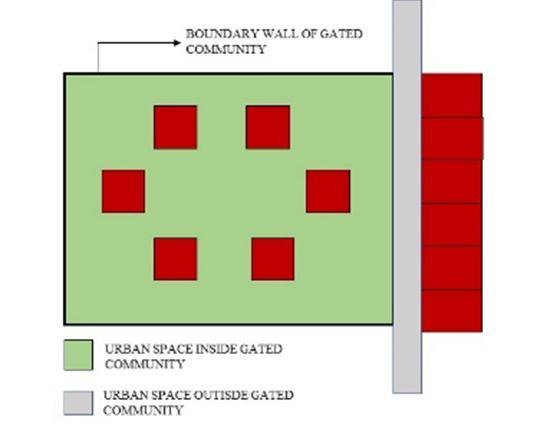
Inthecaseofneo liberalcitiestherearetwotypesofurban spaces in gated community that are formed: one which is inside the boundary wall and other on the outside of the boundarywall.Thestudylimitsitselftoassessmentofurban spaces surrounding the gated community. Two types of urbanspaceshavebeenidentifiedforanalysis(Fig1):
1. Inside the gated community (inclusive of the setback,internalroadandgreenarea)
2. Outsidethegatedcommunity(includestheaccess roadtothegatedcommunity)
Fig 1:Urbanspacesingatedcommunities(source:author)
Throughtheliteraturereviewthecriteriaforanalyzingthe urbanspacesingatedcommunitieswasformulated(Table 2):
Criteria Observation(inside thegated community)
Agegroup Genderofuser VisualAccess Symbolic Access Physical Access Natureof space (private/publi c) Traffic movement
Comfortand image
Accessand Linkage Usesand Activity
Sociability
Observation(outside thegated community)
Table 2: Criteria for analysis of urban spaces, (source: author)
International Research Journal of Engineering and Technology (IRJET) e ISSN: 2395 0056
Volume: 09 Issue: 06 | Jun 2022 www.irjet.net p ISSN: 2395 0072
The criteria does not follow any particular hierarchy. The method used for the analysis is direct observation and physicalinterviews.
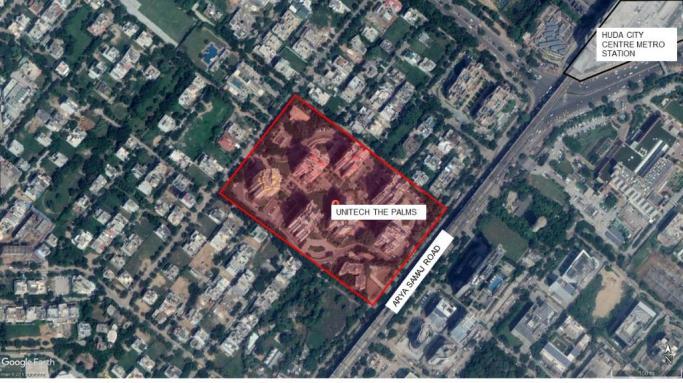
The site for primary exploration is located in Gurugram whichis a satellitecitylocated southwest of Delhi. Due to HDRUA (Haryana Development and regulation of Urban areasact)majorpartsofthecityhavebeendevelopedbythe private developers in forms of gated communities and plotteddevelopment.ThesitechosenislocatedinSector41 called The Palms which is a residential development developedbyaprivatedeveloper UnitechGroup(figure2).
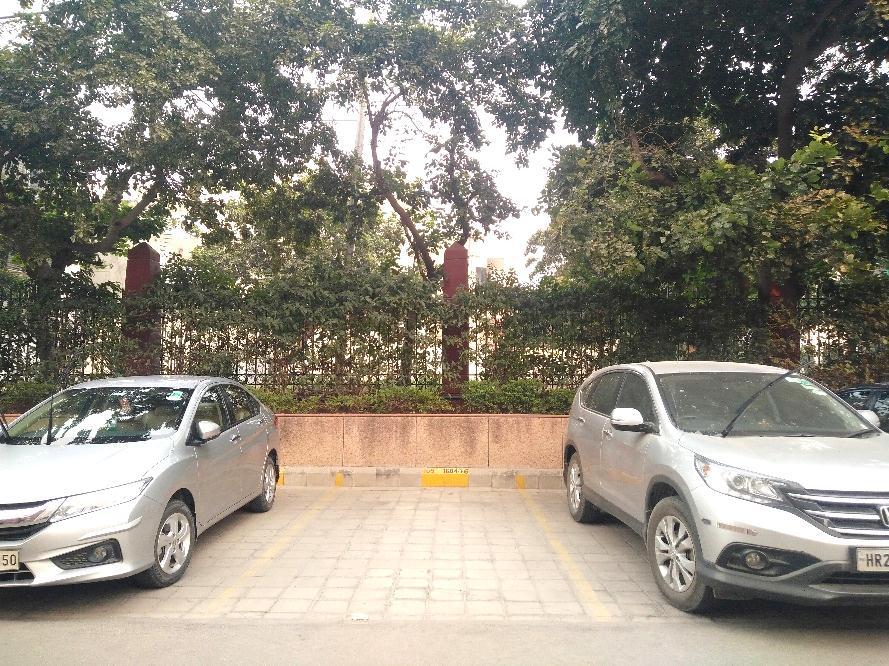
Surroundings: The gated community is surrounded by plotted residential development on three sides and by a majormovementcorridoronone.Theadjacentresidential developmentcomprisesofdoublestoreyhouseswhichare builtonlargeplotsizesvaryingfrom318to455sq.metres. The gated community is governed by the principle of exclusivityasattheentranceonefindsboombarrierandto enteroneeitherhastoberesidentofthecommunityorhas to be a friend/acquaintance of the resident. The gated communityisboundanddefinedbyhighboundarywallson the four sides which are visually permeable but not physicallyasshowninfigure4
Fig 2: LocationofThePalms,Gurugram(source;author)
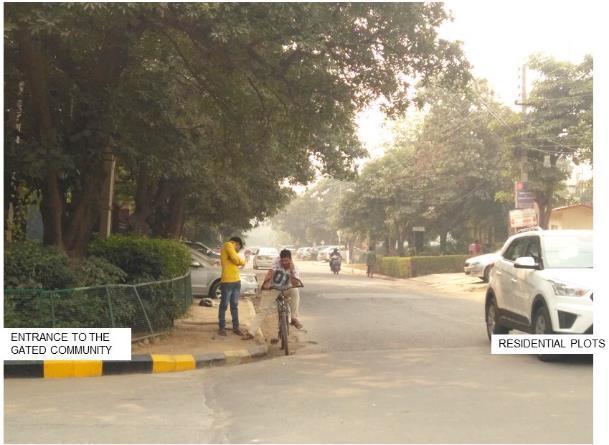
The residential development comprises of 2BHK ,3BHK, 3BHK+ Servant and duplex apartments. The height of the residential towers varies from 15 floors to 17 floors. The totalsiteareacoveredbythegatedcommunityis12.5acres having the plot dimension of 185 m x 275 m. Access: The gatedcommunityisaccessedby7.5mwideroadasshownin figure 3 which lacks footpath and presently acts only as movementcorridor.
Fig 4: Imageofboundarywallfrominsidethegated community(source:author)
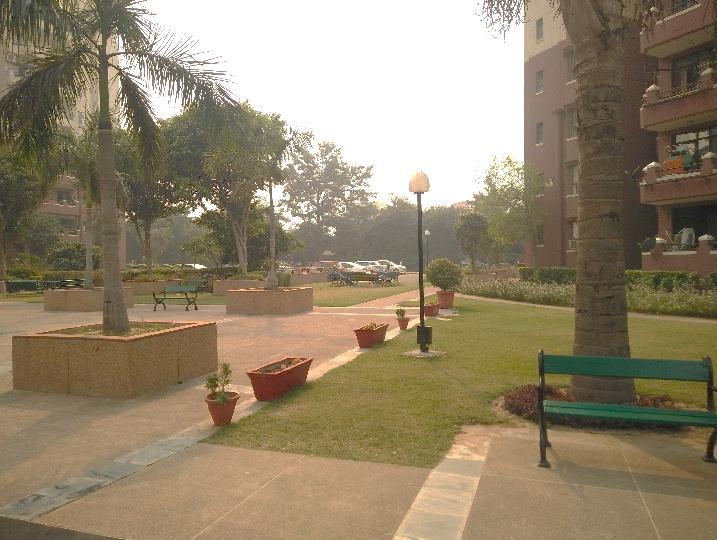
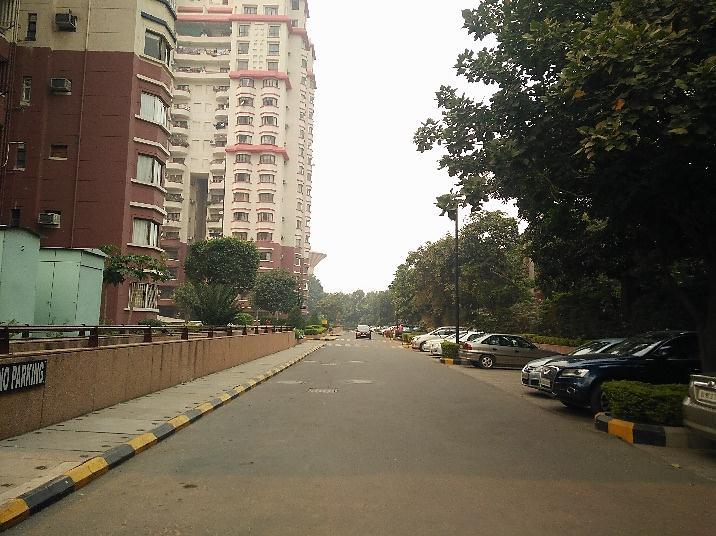
Insidethegatedcommunitytwotypesofurbanspacesare found: the central green space (figure 5) and the inside peripheral road (figure 6) surrounded by residential buildingononesideandboundarywallontheother.
Fig 3:Imageshowingtheroadabuttingthemainentrance (source:author)
Fig 5: Centralgreenspaceinsidethegatedcommunity (source:author)
International Research Journal of Engineering and Technology (IRJET) e ISSN: 2395 0056
Volume: 09 Issue: 06 | Jun 2022 www.irjet.net p ISSN: 2395 0072
5pm 7 pm Transporta tion All All
Fig 6: peripheralroadinsidethegatedcommunity (source:author)
After direct observation the urban space inside the gated communitywasdividedintotwopartsforsocialinteraction assessment:
1. Peripheralroad Theperipheralroadcomprisesof sidewalks,carriagewayandonstreetparking.Due tothepresenceofsidewalkspresenceofpeoplewas observed.Actsasaccesstoindividualbuildingsand commonamenitieswithinthegatedcommunity.
2. Centralgreenspace Thecentralgreenspacebeing majorlysoftscapeinnatureislocatedinbetweenall buildingtowersandisvisuallyaccessiblefrommost pointsinsidethegatedcommunity.Itcomprisesof tot lot,joggingtracks,amphitheaterandlandscaped area
The peripheral road is private in nature and is physically accessibleonlytotheresidentsofthegatedcommunity.The time based usage of the peripheral road in the gated communityisasfollows(Table3).
Time Activity type Agegroup Gender Levelof different social group’s presence
5am 8 am Physical activity Oldpeople, middleage group
Women andmen High
8am 10 am Transporta tion All All
10am 5 pm Inactive/ asmeans of pedestrian access
7pm 10 pm Physical activity Oldpeople, middleage group
Women andmen High 10pm 5 am Inactive/ asmeans of pedestrian access
Table 3:time basedusageoftheperipheralroadinthe gatedcommunity(source:author)
The central green is private in nature and is physically accessibleonlytotheresidentsofthegatedcommunity.The time based usage of the central green in the gated communityisasfollows(Table4)
Activitytype Time Age group Gender Levelof differentsocial group’s presence
Inactive/ partiallyactive (meansof seatingspace dependingon climate)
5am 4pm Old people Women andmen Physical activity 4pm 8pm Old people, kidsand youngste rs
Women, men High Inactive 8pm 5am
Table 4:time basedusageofthecentralgreeninthegated community(source:author)
Anothertypologyofurbanspaceisfound outsidethegated communitywhichistheaccessroadofthegatedcommunity. The access road is public in nature and is physically accessibletoall.Theusageoftheaccessroadisasfollows (Table5):
Activitytype Time Age group Gender Levelof differentsocial group’s presence
Transportation (Moderatevehicular movement) 6am 11am All All High Inactive/asmeans ofpedestrianand lowvehicular movement
5pm 11pm All All High
11am 5pm All All High Transportation (Moderatevehicular movement)
Table 5 :time basedusageoftheaccessroad(source: author)
International Research Journal of Engineering and Technology (IRJET) e ISSN: 2395 0056
Volume: 09 Issue: 06 | Jun 2022 www.irjet.net p ISSN: 2395 0072
Aftermappingthetime basedusageofthetwotypologiesof identified urban spaces, these spaces were assessed with respecttotheliteraturederivedparameters.
Criteria Observation (insidethegated community)
Observation(outside thegated community)
community. The boundary walls help in creating a safe environmentinsideasthepeoplearesavedfromthetraffic aswellasintruders.Thesocialinteractionshappenwithin theboundarywalls.TheseTrafficcongestionontheexterior roads has driven people inside the boundary walls of the gatedcommunity.
Thefindingsfromtheprimarycasestudyareasfollows:
AgeGroup All(governedby theprincipleof exclusivity)
All
All Genderofuser All(governedby theprincipleof exclusivity)
VisualAccess Partiallyvisually accessible Visuallyaccessible SymbolicAccess Symbolically inaccessibleto peoplewhoare non residents
Symbolically accessibletoall PhysicalAccess Notaccessibleto non residents Physicallyaccessible toall
Natureofspace (private/public) private public
Traffic movement Low High
Comfortand image Internallyhasa strongimageand providesvisual andthermal comforttothe residents
Lackscomfortand image Accessand Linkage Hasgoodaccess andlinkagewithin thegated community
Usesand Activity Barringthenight timeandafternoon timehasmultiple useandis thoroughlyactive
Doesnothavegood accessandlinkage
Onlyusedfor transportation Sociability Onlyforresidents Sociableinnature
Intheprimarystudy,asalltheamenitiesandfacilitieslike grocerystore,milkbooth,medicineshops,gym,swimming pool,Amphitheatre,badmintoncourt,andtinytotsplayarea areprovidedwithintheboundarywallthustheneedforthe residentstogooutsidebecomesless.Thisfurtherimpacts theinformalitythatcouldhavethrivedontheaccessroad giventheresidentialpopulationandtheirdemands.Theself sufficient model of gated community hampers the activity thatcanoccurontheroadabuttingthegatedcommunityand decreases the chances of social interaction of the gated community withthe outside city.The boundary wallsand surveillance provide a sense of security within the gated
1. Thesocialnatureofurbanspacesexistsintheneo liberalurbanformbutdiffersdrasticallyfromtheir traditionalcounterpartsintermsoftypology
2. Theurbanspacesinneo liberalcitiesdon’tdepict theplethoraofIndiancultureliketheirtraditional counterparts
3. Chancesofencounteringstrangershavereducedas people are confined within the boundary walls of thegatedcommunities
4. Largeblocksizesofgatedcommunitiesmakethem physicallyimpermeable
5. Visualpermeabilityingatedcommunitiesispresent
6. The access streets have transformed from multi functional to mono functional due to the indirect relationshipwiththebuildings
7. Successfulurbanspaceintermsofsocialnatureis theurbanspacewhichispresentinsidethegated communities as the interaction with the exterior urbanspacehasbecomeobsolete.
8. Thetemporalnatureoftheurbanspacesislost
9. Social interactions occur but within the confined boundariesofthegatedcommunities
Duetourbanisationandtheeaseofaffordability,thelifestyle ofthepeoplehaschanged.Theurbanspacesinneo liberal cities have become commodified and are governed by the principle of exclusivity. In the capitalistic model of developmenteconomicclass basedexclusionhappens.The urban spaceshave become introvertedand exclusive. The urban spaces inside the gated communities are not accessiblebythepublic.Theseurbanspaceshavebecomea productofmoderncapitalisticsociety.
The urban structure of the neo liberal cities is dis continuous and impermeable. Concerning gated communities, democratic urban spaces have become obsolete.Largeblocksizesofgatedcommunitiesareleading tothedevelopmentofisolatedparcelsoflandwhichfurther are leading to a discontinuity in the urban fabric. The proliferationofautomobileshasledtostreetsinneo liberal
2022, IRJET | Impact Factor value: 7.529 | ISO 9001:2008 Certified Journal
International Research Journal of Engineering and Technology (IRJET) e ISSN: 2395 0056
Volume: 09 Issue: 06 | Jun 2022 www.irjet.net p ISSN: 2395 0072
urbanformturningintomono functionalspaceswhichare drastically in contrast with their traditional counterparts. Privatization of urban space and commodification of the public land has occurred due to the commercial model of development. The urban spaces in the neo liberal urban form are socially interactive but their nature has turned inwards as the interactions are happening within the confinedboundarywallsofthegatedcommunity.Theyare governedprimarilybytheprincipleofexclusivity.Owingto the limitations of living in a gated environment the social interactions have also decreased in amount as the self sufficientboundedenvironmenthasdecreasedthechances of stepping outside the gated environment and fostering interactions.
[1] Appleyard,Donald.1981. Livebale Streets. Universityof CaliforniaPress.
[2] Carmona,Matthew.2003. Public Places, Urban Spaces: The Dimensions of Urban Design. Oxford:Architectural Press.
[3] FarzadSoltanian,AtefehMohammadi.2015."Studyof characteristics of urban public open spaces based on socialinteraction." European Online Journal of Natural and Social Sciences 2015;.
[4] Fyfe, Nicholas. 1998. Images of the Street: Planning, Identity and Control in Public Space.
[5] Jacobs,Jane.1960. The death and life of great American cities. NewYork:RandomHouse.
[6] Krier,Rob.1979. Urban Space. GreatBritian:Academy Editions.
[7] Kumar, Raj. 2017. "Overview: Social Spaces in Urban Areas." International Research Journal of Engineering and Technology (IRJET).
[8] Madden,Kathleen,andAndrewSchwartz.2000. How to turn a place around : a handbook for creating successful public spaces. ProjectforPublicSpaces,Inc.
[9] Meeta Tandonn, VandanaSehgal. 2017. "TraditionalIndianreligiousstreets." Frontiers ofArchitectural Research.
[10] Oliveira, V. 2016. "The Elements of Urban Form." In Urban Morphology, The Urban Book Series, 7 29. Switzerland:SpringerInternationalPublishing.
[11] Prosperi, Priya Sasidharan & Prof. David .C. 2012. "DichotomyofUrbanPublicSpaces."
[12] RafaelE.Pizarro,LiangWeiandTridibBanerjee.2003. "AgenciesofGlobalizationandThirdWorldUrbanForm: AReview." Journal of Planning Literature 111 130.
[13] Ramachandran, R. 1989. Urbanization and Urban Systems in India. OxfordUniversityPress
[14] Raychaudhuri,S.2001."Colonialism,IndigenousElites and the Transformation of Cities in the Non Western World:Ahmedabad(WesternIndia),1890 1947."677 726.
[15] Sager,Tore.2011."Neo liberalurbanplanningpolicies: Aliteraturesurvey1990 2010." Progress in Planning 76 147 199.
[16] SanjeevVidyarthi,ShishirMathur,andSandeepAgrawal. 2017. Understanding India's New Approach to Spatial Planning and Development. OxfordUniversityPress.
[17] spaces,Projectforpublic.n.d. Project for public spaces. https://www.pps.org/article/grplacefeat.
[18] StephenCarr,AndrewM.Stone,MarkFrancis,Leanne Rivlin.1992. Public Space. CambridgeUniversityPress.
[19] Tandon, Meeta. 2017. "Traditional Indian Religious streets: A spatial study of the study of Mathura." Frontiers of Architectural Reasearch.
[20] Uduku,SamerBagaeenandOla.2010."Gatedhistories." In Gated communities,bySamerBagaeenandOlaUduku.
[21] White, William. 1980. The Social life of small urban places. ProjectforPublicSpaces,Inc.
2022, IRJET | Impact Factor value: 7.529 | ISO 9001:2008 Certified