International Research Journal of Engineering and Technology (IRJET) Volume: 09 Issue: 06 | Jun 2022
www.irjet.net
e-ISSN: 2395-0056 p-ISSN: 2395-0072
Automated Defect Classifier for PCBs using Raspberry Pi G P V Kishore1, R L N N Sai Abhijeet2, B Likith3, Sushmitha4 1Associate
Professor, ECE Department, ACE Engineering College, Ghatkesar, Telangana, India. ECE Department, ACE Engineering College, Ghatkesar, Telangana, India. ---------------------------------------------------------------------***--------------------------------------------------------------------234Student,
Abstract - Printed circuit boards (PCBs) are an important
as many models out there need. This model is trained to detect the defects directly. We use YOLO – You only look once model to detect the defects.
component in the production of electronic products. A minor defect on the PCB can cause severe problems in the finished product, making PCB surface inspection one of the most crucial quality control tasks [1]. Because of the limits of manual examination, major efforts have been made to automate the process using high resolution CCD or CMOS sensors. Setting pass/fail criteria based on small failure samples has always been difficult in traditional machine vision systems, despite advanced sensor technology [2]. As a result, this paper proposes a deep learning method based on the youonly-look-once (YOLO) concept. A network of 24 convolutional layers and two fully linked layers make up the suggested approach. The model has been trained with 10,480 photos of diverse defects, including shorts, spurs, and mouse bites. In comparison to state-of-the-art works, the experimental results show that our approach detects defective PCBs with high accuracy (95%).
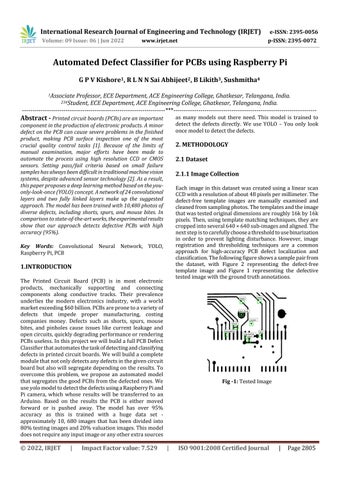
2. METHODOLOGY 2.1 Dataset 2.1.1 Image Collection Each image in this dataset was created using a linear scan CCD with a resolution of about 48 pixels per millimeter. The defect-free template images are manually examined and cleaned from sampling photos. The templates and the image that was tested original dimensions are roughly 16k by 16k pixels. Then, using template matching techniques, they are cropped into several 640 × 640 sub-images and aligned. The next step is to carefully choose a threshold to use binarization in order to prevent lighting disturbance. However, image registration and thresholding techniques are a common approach for high-accuracy PCB defect localization and classification. The following figure shows a sample pair from the dataset, with Figure 2 representing the defect-free template image and Figure 1 representing the defective tested image with the ground truth annotations.
Key Words: Convolutional Neural Network, YOLO, Raspberry Pi, PCB
1.INTRODUCTION The Printed Circuit Board (PCB) is in most electronic products, mechanically supporting and connecting components along conductive tracks. Their prevalence underlies the modern electronics industry, with a world market exceeding $60 billion. PCBs are prone to a variety of defects that impede proper manufacturing, costing companies money. Defects such as shorts, spurs, mouse bites, and pinholes cause issues like current leakage and open circuits, quickly degrading performance or rendering PCBs useless. In this project we will build a full PCB Defect Classifier that automates the task of detecting and classifying defects in printed circuit boards. We will build a complete module that not only detects any defects in the given circuit board but also will segregate depending on the results. To overcome this problem, we propose an automated model that segregates the good PCBs from the defected ones. We use yolo model to detect the defects using a Raspberry Pi and Pi camera, which whose results will be transferred to an Arduino. Based on the results the PCB is either moved forward or is pushed away. The model has over 95% accuracy as this is trained with a huge data set approximately 10, 680 images that has been divided into 80% testing images and 20% valuation images. This model does not require any input image or any other extra sources
© 2022, IRJET
|
Impact Factor value: 7.529
Fig -1: Tested Image
|
ISO 9001:2008 Certified Journal
|
Page 2805