International Research Journal of Engineering and Technology (IRJET) e-ISSN: 2395-0056
Volume: 09 Issue: 06 | Jun 2022 www.irjet.net p-ISSN: 2395-0072
International Research Journal of Engineering and Technology (IRJET) e-ISSN: 2395-0056
Volume: 09 Issue: 06 | Jun 2022 www.irjet.net p-ISSN: 2395-0072
1PG Student, Civil (Construction Management), Tatyasaheb Kore Institute of Engineering and Technology, Warananagar, Pin 416113, Maharashtra, India
2Assistant Professor, Dept. of Civil Engineering, Tatyasaheb Kore Institute of Engineering and Technology, Warananagar, Pin 416113, Maharashtra, India ***
Abstract Usage of natural things deriving from human activitiesisincreasingdaybydayactingagainstthestandard of the environment and sustainable use of natural resources. Human interference has caused an adverse effect on the environment. Construction activity has caused a serious impact on the environment. To reduce these problems people are moving to eco friendly practices. Today, there is a large levelofdemandforsustainablebuildings.Withtheincreasein demand for green buildings, the demand for Green Building Rating System (GBRS) is also increasing. Hence, it is considered an attempt to check the status of green building growth in India. This paper includes the Objective, Methodology, and Study process adopted for criteria of the Green Building Rating System (GBRS) to improve the performance of residential buildings in the Sangli and Kolhapur region, suggestions, and the expected conclusion. Theanalysisofresidentialbuildingsis doneasper thecriteria oftheSVAGRIHAratingsystem.Afterthatsuitablesuggestions are given to residential buildings and a cost comparison of greenbuildingsandresidentialbuildingsisdone.Thisresearch helpsthebuilderstoconsiderthecriteriaoftheGreenBuilding Rating System (GBRS) for residential buildings during the planning phase of the project. This will lead to the development of a sustainable world.
Key Words: Sustainable buildings, SVAGRIHA rating system, Analysis, Suggestions, Cost comparison
Due to increased population and rapid urbanization, there is a huge demand for commercial and residential buildings.Traditionalmethodsofconstructionandmaterials are harmful to our society and environment because they emitgreenhousegases(GHGs),anddust,andconsumemore water and energy. Natural resources like forests, ground cover, energy, and water are reducing to give way to buildings.Manyoccupantfunctionsandbuildingprocesses create a huge amount of waste. Therefore, buildings are majorpollutantsthataffecturbanairqualityandcontribute toclimatechange.Toresolvetheseissues,itisnecessaryto goforsustainableconstructionorgreenbuilding.AGreen building utilizes less energy, and less water creates less waste and gives more advantageous spaces to tenants as comparedtoaregularbuilding.
TheGreenBuildingfocusesmainlyontwoobjectives:
•Toreducebuilding’snegativeimpactontheenvironment and human health, by site selection, better design, construction,operation&maintenance.
•To increase the efficiency of buildings by using energy, materials,andwater.
As the demand for green buildings is increasing, the demandforGreenBuildingRatingSystemsandassessment tools is also increasing. For evaluating the environmental performance of buildings all over their life cycle, a Green BuildingRatingSystemisaratingtool.Thisratingtoolhelps to reduce the negative impact on the environment by promoting quality green buildings. It consists of a set of criteriathatincludesdifferentparametersrelatedtodesign, construction,andoperationofgreenbuildingperformances, benchmarks, and largely quantifiable goals which are mentionedineachcriterion.Eachcriterionhaspre assigned setsandpoints.Iftheprojectfulfillstheratingcriteria,then it is awarded by points and the final rating of a project is decided by adding points from start to end. For fair calculationofprojectratingsystemscallforanindependent thirdpartyanddifferentprocessesareputinplace.
Some of the successful international Green Building RatingSystemprogramswhichareusedinIndiaare:
GRIHA Green Rating For Integrated Habitat Assessment
LEED Leadership in Energy and Environmental Design.
IGBC-IndianGreenBuildingCouncil
To reduce the effect of human activities on our planet andimprovethelivingstandardsofall,onesolutionistogo forsustainablebuildingsinthecountry.Thesolutionsthat wemakenowwillshapeouropportunitiesinthefutureand thoseoffuturegenerations.Thus,itisconsideredanattempt to check the status of green building growth in India. Further,itwillhelpincreatingawarenessinthebuildersand the general public and motivate them to use this concept. Thiswillleadtotheprogressofagreenworld.
© 2022, IRJET | Impact Factor value: 7.529 | ISO 9001:2008 Certified Journal | Page2704

International Research Journal of Engineering and Technology (IRJET)
e ISSN: 2395 0056
Theprojectaimstostudyandanalyzethecurrentstatus oftheapplicationofGreenBuildingconceptsintheSangli andKolhapur region. Also,togivesuggestivemeasures to improve the performance of residential buildings and to createawarenessamongstthebuildersandgeneralpublic aboutthestandardsofapplicationofGreenBuildingRating SystemsinSangliandKolhapurregion.
Tostudythepresentstatusandmakealiterature review of the application of Green Building conceptsintheSangliandKolhapurregion.
Collection of required data according to the various criteria of the selected Green Building RatingSystemforresidentialbuildings located intheSangliandKolhapurregion.
different types of evaluation systems, particularly in categoriesofeachone,andperformanceoftheirimpactas applied to sustainability both from the viewpoint of General information, Applicability, Certification levels, Usability,Categoriesandpresenta casestudyaswell asa SampleofOn lineEvaluation.Bythiscomparison,itcanbe concluded that it is necessary to select the suitable rating system according to its categories which are generally considered the most significant measure in building sustainabilityassessment,likewisetoensurethesustainable design environmental performance goals are being met when desired ratings are achieved. Nangare Priyanka Pandharinath,PoundGauravChandrakant(2015)described that the comparison of green building with conventional buildingconcerningtheeconomyisstudied.Italsoincludes the study of existing green buildings, by surveying concerning energy saving, operating cost, saving in electricitywater,etc.
To perform analysis of ongoing and recently completedresidentialbuildingsasperselected GreenBuildingRatingSystemcriteria.
TosuggestsuitableGreenBuildingtechniquesto the residential buildings that have been analyzed, to improve the performance of residentialbuildings.
Tocomparethecostoftheresidentialbuilding before and after the application of selected GreenBuildingRatingSystemcriteria.
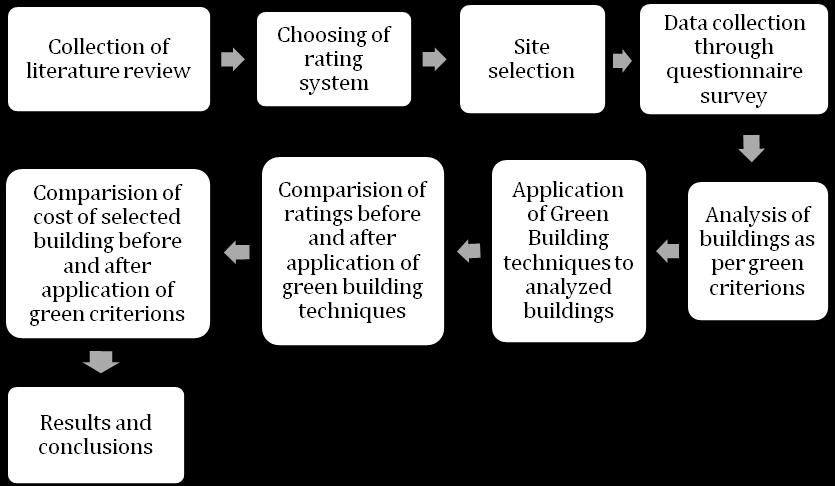
Thefollowingmethodologywasadoptedforanalysisof residential buildings and suggestions for improvement of performanceforresidentialbuildingsinSangliandKolhapur region,asshowninChartNo.1.
Flow Chart:
Dr. Dina Ahmed Elmeligy (May 2014) described comparativereviewtounderstandthedifferencesinusing
Rakesh Awasthi (2016) has explained that there are different rating systems available in India, the process of awardingthegreenbuildingsystem&finallyfindsoutwhich is the most critical part of the green building certification process.Hegivestheideatounderstandtheratingsystem& criticalpartsofthecertificationsprocesssothatwecanhave a detailed understanding of the selection process. Shaik Rehana Begum, B. Harish Naik (2017) described how to understand and find solutions to the significant impact of real estate activity in India on the environment and resources. They investigate the cost efficiency of green buildingsthroughacost benefitanalysisandastudyonthe paybackperiodoftheextrainvestmentindevelopinggreen buildings. Starting with the benefits that may be obtained during the design and construction phase, the discussion then shifts to the asset value and returns received by investorsanddevelopers.Thisisfollowedbytheoperational benefits such as cost savings, workplace health, and productivity,andfinallytheissueofriskmitigation,which playsaroleineverystageofabuilding’seconomiclife.
There are different rating systems, but for residential buildings, SVAGRIHA rating system has been selected. SVAGRIHA is a green building rating system that is being developed for small stand alone buildings like residences, commercial offices, dispensaries, schools, etc. and it is applicableforbuildingswithacumulativebuilt uparea of 2500sq.m.orless.
15 different residential building sites having a built up areaofabout2500sq.m.orlessintheSangliandKolhapur regionwereselected.
Volume: 09 Issue: 06 | Jun 2022 www.irjet.net p ISSN: 2395 0072 © 2022, IRJET | Impact Factor value: 7.529 | ISO 9001:2008 Certified Journal | Page2705
International Research Journal of Engineering and Technology (IRJET) e ISSN: 2395 0056
Volume: 09 Issue: 06 | Jun 2022 www.irjet.net p ISSN: 2395 0072
Analysisofselectedresidentialsitesisdoneasperthe SVAGRIHA rating system which has 14 criteria. These criteria are divided into 5 broad sub groups namely: architecture&energy,water&waste,materials,landscape, andlifestyle.Itwillbecompulsorytoattemptspecificpoints under each sub group. The total points the project can achieveare50Andtheratingoftheprojectwillbedoneona 1 5starratingscale.
Analysis of site No.1 is done per SVAGRIHA rating systemcriteria,shownbelowinTableNo.1.Inthistableas pertheSVAGRIHAratingsystem,14no.ofcriteriaaregiven. Thetotalpointsallottedforthiscriterionare52outofwhich pointsgainedbySiteNo.1are22.SoaspertheSVAGRIHA star rating shown in table no.2, none of the stars were achievedbysiteno.1.Analysisofall15sitesisdoneasper this criterion which is shown in table no.3. So from this analysis of all 15 sites, it is clear that there is a lack of knowledge of green ratings in the Sangli and Kolhapur regions. Criterion
TableNo.2:SVAGRIHAstarratingforSiteNo.1
Analysis of all 15 sites is done as per criterion of SVAGRIHA rating system which is shown in table no.3. So fromthisanalysisofall15sitesitisclearthatthereislackof knowledgeofgreenratingsinSangliandKolhapurregion.So itisrequiredtocreateawarenessamongstgeneralpublicand buildersrelatedtogreenratingsofresidentialbuildings.So somesuggestionsaccordingtothiscriterionaregiventoall 15sites.Siteno.1suggestionsareshownintableno.5.Dueto thissuggestionspointsgainedbysiteno.1areincreased.So all this 15 sites are got SVAGRIHA star rating; after giving thesesuggestionstositeasshownintableno.4
Crite rion S i t e N o 1
S i t e N o 2
S i t e N o 3
S i t e N o 4
S i t e N o 5
S i t e N o 6
S i t e N o 7
S i t e N o 8
S i t e N o 9
S i t e N o 1 0
S i t e N o 1 1
S i t e N o 1 2
S i t e N o 1 3
S i t e N o 1 4
S i t e N o 1 5 1 6 2 4 3 3 3 4 0 0 0 3 0 0 0 2 2 3 4 3 2 3 3 1 1 0 1 2 2 0 0 0 3 3 4 4 4 4 3 3 4 4 4 3 5 4 4 5 4 2 2 2 2 2 2 2 2 2 2 2 2 2 2 2 5 2 2 2 2 2 2 2 2 2 2 2 2 2 2 2 6 2 0 0 0 2 2 0 0 0 0 0 0 0 0 0 7 0 1 0 1 1 0 0 1 1 1 0 0 0 1 0 8 0 0 0 0 0 0 0 0 0 0 0 0 0 0 0 9 0 0 0 0 0 0 0 0 0 0 0 0 0 0 0 10 0 0 0 1 0 0 0 0 0 1 0 0 0 0 0 11 2 2 2 2 2 2 2 2 2 2 2 2 2 2 2 12 1 1 1 1 1 1 1 1 1 1 1 0 1 1 1 13 1 1 1 2 0 0 1 1 2 2 2 2 2 2 2 14 0 0 0 0 0 0 0 0 0 0 0 0 0 0 0 Tota l 2 2 1 9 1 9 2 0 2 0 1 8 1 6 1 4 1 4 1 6 1 7 1 5 1 3 1 4 1 6
TableNo.3:ComparingRatingSheetforallsites
1) Afteranalyzingallthebuildingswhichareselected forthesurvey,ithasbeenfoundthatnoresidential buildingisgettingastarfromtheSVAGRIHArating system,whilethereisascopeforimprovementin all the buildings. This is because people are not much aware of green building and their positive effectoneverything.Ithasbeenfoundthatpeople arenotreadyforextrainitialinvestmentotherthan building the structure. Spreading the word about green buildings is very much an important and necessarytasktomakeaware.
2) All thebuildingsstudiedare residential buildings (bungalows)havinganareaoflessthan2500sq.m. Forsuchbuildingstoachieveaminimumstarrating by SVAGRIHA i.e. to achieve a 1 star rating, suggestions are provided for improvement in residentialbuildings
3) Itisunabletoachievea5 starratingbyproviding suggestionsforexistingresidentialbuildingsonce theinfrastructureisreadyandcannotbechanged. Still,itispossibletogeta2 4starrating.
[1] Abhishek Rana, Dr. Rajiv Bhatt (Feb 2016), "MethodologyforDevelopingCriteria weightsfor Green Building Rating Tool for Gujarat State", InternationalResearchJournalofEngineeringand Technology,Volume:3,Issue:2
[2] Aishwarya Dhopate, Prof. Saurabh Joshi, Prof. ShrikantV.Kulkarni(April2018),"Assessmentof ResidentialBuildingasPerLEEDRatingSystem:A Review", International Journal of Research Publications,Volume:2,Issue:1 [3] Dr. Dina Ahmed Elmeligy (May 2014), "Rating Systems Awareness for Green Buildings Applications”, International Refereed Journal of Engineering and Science, Volume: 3, Issue:5., P.N.53 64 [4] Dr.M.N.Hedaoo,Mr.SharadR.Khese(June 2016), "AComparativeAnalysisofRatingSystemsinGreen Building”, International Research Journal of EngineeringandTechnology,Volume:3Issue:6
Dr. Supriya Vyas, Ar. Seemi Ahmed, Ar. Arshi Parashar (April 2014) “BEE (Bureau of energy efficiency) and Green Buildings”, International JournalofResearchVol:1,Issue:3
[6] Mr. Rohan V. Nalawade, Dr. S.G. Sonar (October 2016),"ComparativeReviewcriteriautilizationby LEEDandGRIHA:GreenbuildingRatingsystemsfor NewconstructioninIndia",InternationalJournalof Scientific and Research Publications, Volume: 6, Issue:10
[7] Nangare Priyanka Pandharinath, Pound Gaurav Chandrakant,WarudkarA.A,(2015),Evaluationof Green Building with Resources and Cost Aspects, International Journal on Recent and Innovation TrendsinComputingandCommunication,Volume 3,P.N.127 130
[8] Rakesh Awasthi, "Understand the different green building rating system in India &which criteria affect the most in green building certification system”, International Research Journal of Management Sociology & Humanity, Volume 7, Issue7,170 176
[9] Shaik Rehana Begum,B.Harish Naik (June2017), "Greenomics CostEfficiencyofGreenBuildingsin India",InternationalJournalofInnovativeResearch inScience,EngineeringandTechnology,Vol.6,Issue 6
International Research Journal of Engineering and Technology (IRJET) e ISSN: 2395 0056 Volume: 09 Issue: 06 | Jun 2022 www.irjet.net p ISSN: 2395 0072 © 2022, IRJET | Impact Factor value: 7.529 | ISO 9001:2008 Certified Journal | Page2708