International Research Journal of Engineering and Technology (IRJET) Volume: 09 Issue: 06 | Jun 2022
www.irjet.net
e-ISSN: 2395-0056 p-ISSN: 2395-0072
Analytical investigations of lightweight concrete infilled cold formed steel quadruple columns Shahina N.I1, Daniel Paul Thanaraj2 1PG
student, Dept. of Civil Engineering, KMEA College of Engineering, Kerala, India Dept. of Civil Engineering, KMEA College of Engineering, Kerala, India ---------------------------------------------------------------------***--------------------------------------------------------------------3. METHODOLOGY Abstract - Designing affordable structures is crucial in the 2Asst.Professor,
discipline of structural engineering. As a result, cold-formed steel structures were created (CFS). When more members are joined together, the load carrying capability rises. This project involves performing an axial parametric study on a quadruple column with various parametric adjustments. There are C sections and sigma sections. They are rearranged, and the behaviour is investigated. A useful model is discovered from that. It is planned to test the impact of eccentricity loading on light weight concrete fully filled quadruple column. The strength is increased when the tubes are filled with lightweight concrete, and they can also be utilised to build precast lightweight structures.
Different models are created and analysed in ANSYS. Channel sections and sigma sections are used for the quadruple columns. The effect of cross-sectional changes, configuration of sections, and arrangement of different sections is to be analysed. For this, six models are prepared and the results obtained are compared. The optimum model is fully filled with light-weight concrete and then analysed. Then it is subjected to two eccentric loading cases, and their results are to be evaluated.
4. MODELLING ANSYS WORKBENCH is used to perform the analysis. The model has a height of 2100 mm. the yield strength of the steel is 441 GPa and its elastic modulus is 210 GPa. At first, six different models are created using channel and sigma sections. The six models are;
Key Words: Cold formed steel, built up section, column, channel section, sigma section, optimum section, ANSYS, eccentricity, light weight concrete
1. INTRODUCTION
a) Channel section face to face (C F-F)
Cold-formed steel (CFS) built-up box sections are increasingly being used in structural engineering applications, which is growing gradually. Compound sections can be created by combining various sections. The strength of the column is influenced by the screw spacing. The strength of the column increases as the screw spacing decreases [1,2]. Due to its higher strength to weight ratio and simplicity of construction, cold-formed steel structures have also grown in popularity over the past few years in addition to hot-rolled steel sections. Cold formed built-up sections prove to be a stronger and more affordable alternative when hot rolled sections are uneconomical for lighter loads. Channel sections and sigma sections are used in this study.
b) Channel section back to back (C B-B) c) Sigma section face to face (S F-F) d) Sigma section back to back(S B-B) e) Sigma and channel sections face to face (S&C F-F) f)
Sigma and channel sections back to back (S&C B-B)
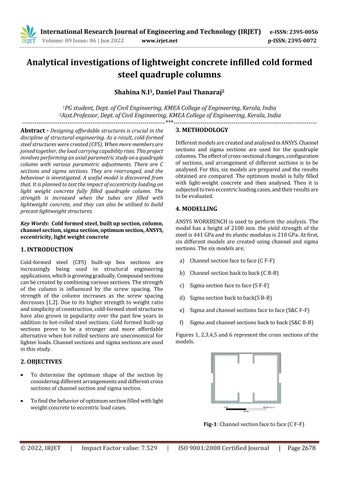
Figures 1, 2,3,4,5 and 6 represent the cross sections of the models.
2. OBJECTIVES
To determine the optimum shape of the section by considering different arrangements and different cross sections of channel section and sigma section.
To find the behavior of optimum section filled with light weight concrete to eccentric load cases. Fig-1: Channel section face to face (C F-F)
© 2022, IRJET
|
Impact Factor value: 7.529
|
ISO 9001:2008 Certified Journal
|
Page 2678