International Research Journal of Engineering and Technology (IRJET) Volume: 09 Issue: 06 | Jun 2022
e-ISSN: 2395-0056
www.irjet.net
p-ISSN: 2395-0072
Study on Gas Metal Arc Welding in S235 Steel T.Arunkumar1, B. Rajeswari2, T. Sekar 3 1PG
Scholar, Manufacturing Engineering, Government College of Technology, Coimbatore, India Assistant Professor, Mechanical Engineering, Government College of Technology, Coimbatore, India, 3Professor, Mechanical Engineering, Government College of Technology, Coimbatore, India, ---------------------------------------------------------------------***--------------------------------------------------------------------2
Abstract - For the assembly of vehicle body sections made of high-strength S235 steel, one of the most popular techniques in the automotive industry is Gas Metal Arc Welding (GMAW) with Cold Metal Transfer (CMT), which is lauded for its affordability, weld quality, and welding speed. High-strength steel retains flexibility and malleability despite having increased strength thanks to the mix of metal alloys it contains, including silicon, chromium, manganese, and molybdenum. The welding process parameters in the gas metal arc welding process can significantly affect the quality of the welded connection. In this investigation, gas metal arc welding was used to join samples of S235 high strength steel. Butt joints were created using plates that were 6 mm thick. Each joint sample was produced using a unique set of parameters, including input current, voltage, weld speed, and wire supply. The percentage of elongation, yield strength, ultimate strength, and Rockwell Hardness of the welded samples were all used to assess the weld quality. Gas metal arc welding was the subject of a micro structural analysis for a variety of welded joint qualities. Key Words: Gas metal arc welding, cold metal transfer, High strength steel, tensile strength, Yield strength, Hardness, Microstructure.
Aluminium, stainless steel, titanium, and tool steel are a few examples of other materials [2].
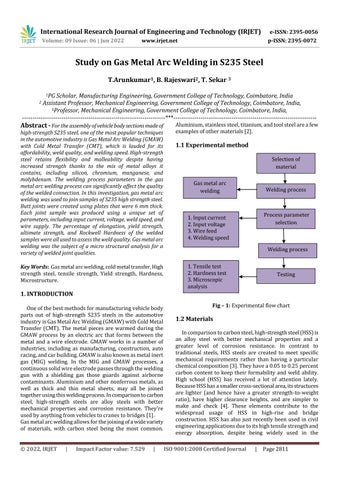
1.1 Experimental method Selection of material Gas metal arc welding
Welding process
Process parameter selection
1. Input current 2. Input voltage 3. Wire feed 4. Welding speed
Welding process 1. Tensile test 2. Hardness test 3. Microscopic analysis
Testing
1. INTRODUCTION One of the best methods for manufacturing vehicle body parts out of high-strength S235 steels in the automotive industry is Gas Metal Arc Welding (GMAW) with Cold Metal Transfer (CMT). The metal pieces are warmed during the GMAW process by an electric arc that forms between the metal and a wire electrode. GMAW works in a number of industries, including as manufacturing, construction, auto racing, and car building. GMAW is also known as metal inert gas (MIG) welding. In the MIG and GMAW processes, a continuous solid wire electrode passes through the welding gun with a shielding gas those guards against airborne contaminants. Aluminium and other nonferrous metals, as well as thick and thin metal sheets, may all be joined together using this welding process. In comparison to carbon steel, high-strength steels are alloy steels with better mechanical properties and corrosion resistance. They're used by anything from vehicles to cranes to bridges [1]. Gas metal arc welding allows for the joining of a wide variety of materials, with carbon steel being the most common. © 2022, IRJET
|
Impact Factor value: 7.529
|
Fig – 1: Experimental flow chart
1.2 Materials In comparison to carbon steel, high-strength steel (HSS) is an alloy steel with better mechanical properties and a greater level of corrosion resistance. In contrast to traditional steels, HSS steels are created to meet specific mechanical requirements rather than having a particular chemical composition [3]. They have a 0.05 to 0.25 percent carbon content to keep their formability and weld ability. High school (HSS) has received a lot of attention lately. Because HSS has a smaller cross-sectional area, its structures are lighter (and hence have a greater strength-to-weight ratio), have higher clearance heights, and are simpler to make and check [4]. These elements contribute to the widespread usage of HSS in high-rise and bridge construction. HSS has also just recently been used in civil engineering applications due to its high tensile strength and energy absorption, despite being widely used in the ISO 9001:2008 Certified Journal
|
Page 2811